The first bottle of burning oil struck the porch roof.
Flame climbed the dry wood almost instantly.
Samuel fired once toward the darkness—not to hunt anyone down, but to force the riders away from the house long enough to think.
Then another shot came from the ridge.
The window beside him shattered.
Samuel dropped behind the wall.
Below him, the cellar door opened.
“Samuel!”
Junia.
“I told you to stay down!”
“The house is burning!”
He smelled smoke.
She was right.
This was no longer about defending the ranch.
They needed to survive it.
Samuel reached the cellar and pulled the women into the yard through the rear entrance, keeping them behind the stone smokehouse where the flames could not reach as quickly.
Ruth clutched Francis.
Odelise stared toward the ridge.
Junia looked at Samuel.
“What now?”
Before he could answer, a voice called from the darkness.
“Give us the women, Mercer!”
Samuel recognized him.
The tall gunman from Cutter’s Notch.
The one with the scar across his chin.
“You walk away,” the man shouted, “and you can keep breathing!”
Samuel gave a tired laugh.
“You rode nine days to offer me mercy?”
Silence.
Then:
“This ain’t your fight!”
Samuel looked at the four women behind him.
Nine days ago, perhaps that had been true.
Not anymore.
“It is now.”
The next shot came without warning.
Samuel staggered.
Junia caught him before he fell.
“Samuel!”
“I’m fine.”
He wasn’t.
But there was no time to argue.
The attackers moved closer.
Then something unexpected happened.
Francis pointed toward the horse pasture.
“The gray mare.”
Samuel looked at her.
“What?”
“She’ll come when I call.”
For nine days, Francis had spent nearly every waking hour among his horses.
Samuel understood immediately what she meant.
“No.”
Francis looked terrified.
But steady.
“If they’re watching the house, they won’t watch the lower pasture.”
Junia shook her head.
“She’s eighteen.”
“So am I,” Francis said.
That silenced everyone.
Samuel looked toward the ridge.
Then at the girl.
“If you can get clear, ride for Sheriff Bell.”
Francis nodded.
Nobody celebrated the plan.
Nobody pretended it was brave or exciting.
It was simply the only chance they had.
A few minutes later, while the gunmen focused on the burning house, Francis slipped away through the darkness.
Samuel never saw her leave.
He only heard a faint whistle.
Then distant hoofbeats.
One of the attackers heard them too.
“Someone’s riding!”
The three men split.
And that was the moment everything changed.
Odelise grabbed Samuel’s arm.
“You’re hurt.”
“Later.”
“There might not be a later.”
Junia looked at him.
“Listen to her.”
He almost smiled.
Nine days ago, none of these women would have dared order him around.
Now apparently he had acquired four commanders.
Another section of roof collapsed behind them.
Ruth whispered:
“We cannot stay here.”
Samuel pointed toward the dry creek bed beyond the smokehouse.
“Go.”
Junia did not move.
“Junia.”
“No.”
“Please.”
That word stopped her.
Samuel had never said it to her before.
He lowered his voice.
“If they see you beside me, they’ll use you to make me surrender.”
Junia stared into his face.
Then finally nodded.
But before leaving, she grabbed his coat—the same coat he had given her at Cutter’s Notch—and pressed it back into his hands.
“You’re going to want this.”
He almost laughed.
“Bossy woman.”
“Stay alive and complain about it tomorrow.”
Then she disappeared into the dark with Ruth and Odelise.
Samuel turned back toward the ridge.
The confrontation did not last long.
It only felt that way.
The attackers had expected one exhausted cowboy and four frightened women.
They had not expected Francis to reach the road.
They had not expected Sheriff Bell’s deputy patrol to already be searching the region after finding the burned coach at Cutter’s Notch.
And they certainly had not expected riders to appear behind them before dawn.
One gunman fled.
Another surrendered.
The scarred man tried to escape through the lower wash.
He did not get far.
By sunrise, the ranch was half burned.
Two attackers were in custody.
The third was being searched for.
Samuel Mercer was lying in the dust beside what remained of his porch.
And Junia was kneeling over him.
Again.
Just as she had knelt at Cutter’s Notch.
Only this time her hands were free.
“Samuel.”
His eyes were closed.
She touched his face.
“Samuel, look at me.”
Nothing.
Her voice cracked.
“You changed your whole route for us.”
His eyelids moved.
“So?”
She almost laughed and cried at once.
“So you are not allowed to die before I repay you.”
He opened one eye.
“That sounds expensive.”
She let out a broken laugh.
Then Sheriff Bell knelt beside them.
“We need to move him.”
Junia refused to release Samuel’s hand.
Nobody asked her to.
Samuel survived.
Barely, according to the doctor in Red Creek.
He woke the following afternoon with Junia asleep in a chair beside him.
Her head rested against the wall.
His coat was folded across her knees.
Samuel watched her for a long moment.
Then said:
“You still have that?”
Her eyes opened immediately.
“You’re alive.”
“Apparently.”
She stood so quickly the chair nearly fell.
Then she stopped herself.
For one second, neither knew what to do.
Finally, Junia folded her arms.
“You frightened me.”
Samuel looked toward the window.
“I’m sorry.”
“You should be.”
That made him smile.
Then his expression became serious.
“Francis?”
“Fine.”
“Ruth?”
“Fine.”
“Odelise?”
“Also fine.”
He exhaled.
Only then did Junia understand.
Those had been his first questions.
Not the ranch.
Not the horses.
Them.
Sheriff Bell came that evening.
He brought news.
The captured men had talked.
And what they revealed explained Cutter’s Notch.
The four brides had not been attacked randomly.
Each had been promised to a homesteader north of Red Creek.
Four neighboring claims.
Four small ranches sharing access to the same creek.
For years, cattle investor Silas Vane had been trying to buy those claims because controlling them would give him practical control over the only reliable water route through that valley.
The ranchers refused.
But there was a problem.
Under the settlement agreements governing their claims, the men had limited time to establish permanent households.
The arrival of their brides would strengthen their right to remain.
If the women never arrived—
Vane expected the men to give up, sell cheaply, and leave.
Samuel stared at Bell.
“So he paid six men to make four women disappear?”
Bell’s jaw tightened.
“That’s what we believe.”
Junia went pale.
Samuel asked:
“Do the ranchers know?”
“They do now.”
“And Vane?”
Bell smiled without humor.
“On his way to jail if we find what I think we’ll find in his office.”
They did.
Payment records.
Letters.
Instructions connecting Vane’s foreman to the men at Cutter’s Notch.
Enough that the case no longer depended only on four frightened women’s testimony.
Silas Vane was arrested.
The surviving attackers were charged.
The land scheme collapsed.
And the four northern homesteaders finally learned why their brides had vanished.
Three of them rode south immediately.
That created another problem.
Because nine days had changed everything.
Ruth’s intended husband, Thomas Hale, arrived first.
He was awkward.
Kind.
Terrified that Ruth would hate him for what had happened.
She didn’t.
But she also refused to marry him immediately.
“I nearly died coming to marry a stranger,” she told him.
“I think I’ve earned the right to know you first.”
Thomas removed his hat.
“Yes, ma’am.”
Ruth married him eight months later.
By choice.
Odelise met her intended groom and discovered within three days that they could not stand each other.
She laughed when she told Samuel.
“He chews with his mouth open.”
Samuel blinked.
“That’s the reason?”
“It’s one of seventeen.”
She never married him.
Instead, she opened a boardinghouse in Red Creek with money she earned cooking for trail crews.
Within two years, it was the busiest kitchen in town.
Francis did something nobody expected.
Her intended groom released her from the arrangement immediately after learning what happened.
She thanked him.
Then accepted a job training horses at Samuel’s ranch.
“She’s better than you,” Junia told Samuel.
Samuel frowned.
“She’s faster.”
“Better.”
“Careful.”
Francis shouted from the corral:
“I can hear both of you!”
And Junia?
Her intended husband was named Walter Price.
He arrived wearing a clean coat and carrying flowers.
He was decent.
Respectful.
He apologized for everything she had suffered.
Then he said:
“If you still want the marriage, I’ll honor it.”
Junia looked at him.
“And if I don’t?”
Walter smiled sadly.
“Then I’ll honor that too.”
Samuel heard about the conversation afterward.
He said nothing.
That evening, Junia found him rebuilding the porch.
“You’re using that board crooked.”
“It’s fine.”
“It isn’t.”
Samuel sighed.
“You came all the way out here to criticize lumber?”
“No.”
She stood beside him.
“I told Walter no.”
Samuel’s hammer stopped.
“I see.”
“That’s all?”
“What do you want me to say?”
Junia studied him.
For a man who had faced six gunmen, Samuel Mercer could be astonishingly cowardly when a woman looked directly at him.
Finally she asked:
“Do you want me to leave?”
Samuel stared at the half-built porch.
“No.”
“Do you want me to stay because you feel responsible for me?”
“No.”
“Because I helped save the ranch?”
“No.”
“Then why?”
He looked at her.
And for the first time since his wife and son had died, Samuel allowed himself to say something that frightened him more than any rifle.
“Because when you’re here, this place feels like a home again.”
Junia’s expression softened.
Samuel continued:
“But if you stay, it has to be because you choose it.”
“No debts.”
“No gratitude.”
“No obligation.”
“You don’t owe me your life because I happened to be on that ridge.”
Junia smiled.
“You still don’t understand, do you?”
“What?”
“You didn’t happen to be there.”
“You chose to stop.”
Then she sat beside him.
“And now I’m choosing too.”
They did not marry the next week.
Or the next month.
Junia stayed in Red Creek and opened a small schoolroom in the back of Odelise’s boardinghouse.
She taught children.
Then adults.
Then three cowboys who insisted they could already read until she handed them a newspaper.
Samuel rebuilt the ranch.
Slowly.
The burned portion of the house went first.
Then the barn.
Then the porch.
The nine horses he had been supposed to sell?
He lost the buyer.
Lost most of the money.
Nearly lost the ranch.
When Junia apologized, Samuel shrugged.
“Worst business trip I ever made.”
She stared at him.
“You lost nearly everything.”
“No.”
Samuel looked toward the kitchen where Francis and Ruth were arguing about biscuits.
“I lost money.”
There was a difference.
A year after Cutter’s Notch, Samuel took Junia back there.
The burned coach was gone.
Rain had softened the wheel tracks.
Wild grass grew where she had once knelt waiting to die.
Junia stood quietly.
Samuel did not interrupt.
Finally she said:
“I thought that was where my life ended.”
Samuel looked at her.
“So did I.”
She frowned.
“You weren’t kneeling there.”
“No.”
He looked toward the ridge where he had first seen them.
“But before that day, I wasn’t doing much living.”
Junia understood.
She took his hand.
Samuel let her.
He proposed three months later.
Not with a grand speech.
Not with an expensive ring.
He was repairing a fence when Junia brought him lunch.
Samuel looked at her and said:
“I’ve been thinking.”
“That usually worries me.”
“Would you marry me?”
Junia stared.
“That was your proposal?”
“Yes.”
“No kneeling?”
“My knee hurts.”
“No flowers?”
“The goats ate them.”
“No speech?”
“I can try again.”
She made him wait long enough to regret everything.
Then smiled.
“Yes.”
Samuel blinked.
“Yes?”
“Yes.”
He looked so stunned she laughed.
The cowboy who once changed his route because he heard a stranger scream had finally found a destination he wanted to keep.
Their wedding was held at the ranch.
Ruth came with Thomas.
Odelise brought enough food for half the county.
Francis wore a blue dress and complained the entire time that dresses were useless around horses.
Sheriff Bell stood beside Samuel.
Walter Price even sent a wedding gift.
And when Junia walked toward Samuel, she wore no elaborate bridal gown.
Only a simple cream dress.
But sewn inside the sleeve was a small strip of Samuel’s old coat.
The one he had given her on the first night.
The one she had pressed back into his hands when the ranch burned.
Nobody else knew it was there.
They did.
That was enough.
Years later, people in Red Creek told the story differently.
Some said Samuel Mercer rescued four brides from six outlaws.
Others said four brides saved a broken rancher who had forgotten how to live.
Samuel always rejected both versions.
“We got lucky,” he would say.
Junia would immediately correct him.
“No.”
“We made choices.”
Samuel would smile.
He knew better than to argue.
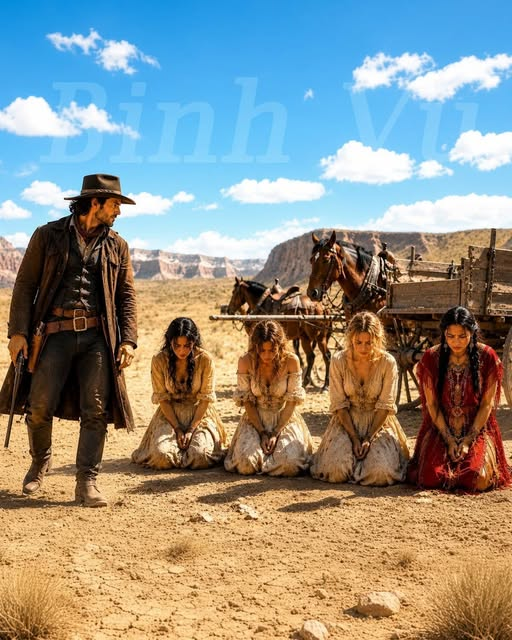
Because the truth was that Cutter’s Notch had begun with four women kneeling in the dust, certain their futures had been taken from them.
But one survived to run a boardinghouse.
One built a family only after choosing the man herself.
One became the best horse trainer in three counties.
And one returned to that same patch of earth holding Samuel Mercer’s hand.
Junia had once told him:
“I’m glad it was you on that ridge.”
Years later, Samuel finally told her why those words had stayed with him.
“Because I thought I saved you.”
Junia smiled.
“And?”
He looked toward their noisy house, the horses beyond it, Francis arguing with someone near the barn, and the life that had grown where silence once lived.
“I was wrong.”
She squeezed his hand.
At Cutter’s Notch, Junia had knelt because someone else had decided whether she would live.
At Samuel’s ranch, she knelt again because she refused to let him die.
But the day she married him, she stood.
No ropes.
No gunmen.
No arrangement made by strangers.
No debt to repay.
She walked toward Samuel freely.
And that was the part of the story Red Creek remembered longest.
The cowboy changed his route and saved four brides.
But he never chose their futures for them.
He simply gave them the chance to choose again.
