Nobody moved.
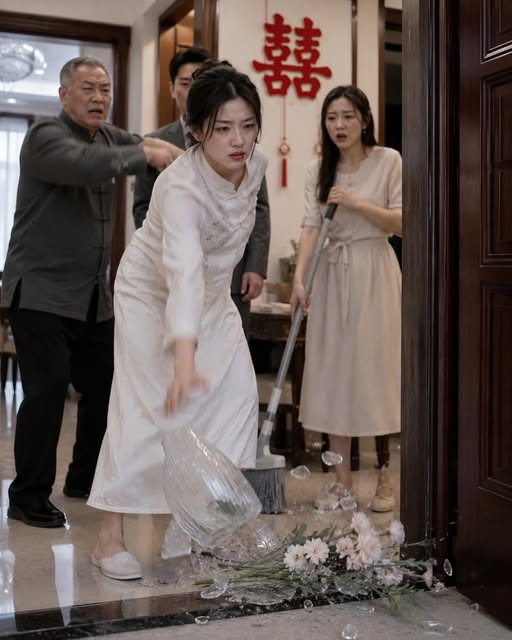
The broken glass lay across the doorway.
My father-in-law stared at me, his face turning purple with rage.
“What did you just say?”
I looked directly at him.
“I said nobody touches me again.”
My voice was quieter now.
The sentence about burning the house had come from shock and fury.
I had no intention of hurting anyone.
And as I stood there with my cheek burning, I realized something important:
If I wanted to leave this family with my dignity intact, I could not let their violence turn me into someone reckless too.
So I took out my phone.
“And if anyone hits me again, I call the police.”
That frightened them more than the broken vase.
My mother-in-law rushed forward.
“Van Cam, family matters should stay inside the family.”
I laughed.
“Your husband just slapped me.”
“That is no longer a family custom.”
“That is assault.”
My father-in-law slammed his hand against the table.
“You dare threaten me in my own house?”
I wiped the corner of my mouth again.
“Yes.”
Then I looked toward the stairs.
“Where is Canh Hanh?”
Silence.
My eldest sister-in-law, Tue Lan, looked away.
That was when I understood.
He knew something was happening.
Canh Hanh came downstairs two minutes later.
He had been on the fourth floor in a video meeting.
The moment he saw my face, he stopped.
“Van Cam?”
His eyes moved to the broken vase.
Then to his father.
“What happened?”
His father answered first.
“Your wife has no manners.”
I laughed once.
Canh Hanh looked at me.
“Who hit you?”
Nobody answered.
He asked again.
“Who hit my wife?”
His father stood.
“I did.”
Canh Hanh went completely still.
“You hit her?”
“She insulted your sister-in-law and disobeyed the household rules.”
Something changed in my husband’s face.
Not dramatically.
He simply removed his glasses and placed them on the table.
Then he said:
“Dad, apologize.”
The entire room froze.
His father almost seemed unable to understand the sentence.
“What?”
“Apologize to Van Cam.”
“You’ve been married three days and already dare teach your father?”
“I’m not teaching you.”
Canh Hanh looked at my swollen cheek.
“I’m telling you that you cannot hit my wife.”
His mother immediately pulled his sleeve.
“Canh Hanh, don’t make things worse.”
He moved her hand away gently.
“Mom, it is already worse.”
Then he turned toward me.
“Pack your things.”
My heart dropped.
For one ugly second, I thought he meant I should leave alone.
Then he continued:
“I’m packing mine too.”
His father exploded.
“You step out of this house today and don’t come back!”
Canh Hanh looked at him.
“Fine.”
The answer was so simple that nobody knew how to respond.
My eldest brother-in-law finally stood.
“Canh Hanh, think carefully. You’re going to break the family apart over a mop?”
I looked at him.
“No.”
“Your father broke it with a slap.”
Canh Hanh added:
“And all of you helped by pretending this is normal.”
Tue Lan’s face changed.
She looked at him bitterly.
“Easy for you to say.”
Everyone turned toward her.
She laughed, but her eyes were red.
“You think Van Cam is the first woman your father has treated like this?”
My mother-in-law whispered:
“Tue Lan.”
“Why should I shut up?”
She threw the mop onto the floor.
“For eight years I washed everyone’s clothes.”
“Cooked.”
“Cleaned.”
“Served tea.”
“When I complained, you told me I was the eldest daughter-in-law and had to set an example.”
Then she pointed at me.
“So when she came, yes, I wanted her to do it too.”
Her voice broke.
“Because if she could say no after three days, what did that make my eight years?”
The room went silent.
I looked at her.
For the first time, I stopped seeing an enemy.
She had tried to drag me into the same cage because admitting the door had always been unlocked would mean facing how long she had stayed inside it.
But understanding was not the same as excusing her.
I said:
“It means you were treated unfairly.”
She stared at me.
“It does not mean I have to be treated unfairly too.”
Tue Lan started crying.
That was when my second sister-in-law spoke.
She had barely said ten words since I married into the family.
Now she quietly put down her bowl.
“I’m not washing Father’s clothes anymore either.”
My father-in-law turned toward her.
“What did you say?”
She flinched.
Then looked at me.
And repeated:
“I said I won’t do it anymore.”
My mother-in-law looked horrified.
One refusal had become two.
Then three.
Because Tue Lan wiped her face and said:
“Neither will I.”
The old order did not collapse because I smashed a vase.
It collapsed because the women who had been maintaining it finally realized it required their cooperation.
My father-in-law pointed at me.
“You.”
“This is because of you.”
I shook my head.
“No.”
“This was already here before I arrived.”
“I just refused to inherit it.”
Canh Hanh went upstairs.
I followed.
We packed two suitcases in twenty minutes.
My hands shook while folding clothes.
He noticed.
“Are you afraid?”
I looked at him.
“I don’t know.”
Then I asked the question that mattered.
“If your father apologizes tomorrow, are we coming back?”
“No.”
He answered without hesitation.
I stared at him.
“This house was supposed to be temporary,” he said.
“I kept telling myself we could stay a few months, save money, and then move.”
“I knew my father was controlling.”
“But I thought if I stayed out of arguments, everyone would adjust.”
I laughed bitterly.
“You thought neutrality would protect us.”
He lowered his eyes.
“Yes.”
“It protected him.”
“I know.”
That was the first thing he said that made me believe leaving with him might not simply mean carrying the same problem to a different address.
We moved into a hotel that night.
The next morning, I went to a clinic and documented the injury.
Then I filed a police report.
Canh Hanh did not ask me to withdraw it.
That mattered.
His mother called seventeen times.
His father sent one message:
If she reports me, she is no longer part of this family.
Canh Hanh replied:
She is my family.
Then blocked him for the day.
I saw the message.
I didn’t praise him.
Defending your wife after your father hits her is not heroism.
It is the minimum.
But after three days in the Luc house, the minimum felt almost revolutionary.
Then came the practical problem.
I had resigned from my Shenzhen position.
Canh Hanh had assumed we would remain in his hometown for at least a year.
I had agreed because I believed marriage required compromise.
Now I opened my laptop and wrote to my former CEO.
I expected nothing.
Instead, he called fifteen minutes later.
“You finished the handover?”
“Almost.”
“Have you changed your mind?”
“Yes.”
There was a pause.
“About leaving the company?”
“About leaving Shenzhen.”
He laughed.
“Good. Your replacement lasted eleven days.”
I blinked.
“What?”
“He quit yesterday.”
Then he offered me my position back.
With a raise.
I accepted before fear could make the decision for me.
Canh Hanh sat across from me in the hotel room.
“So we’re going back to Shenzhen?”
I closed the laptop.
“I am.”
He looked surprised.
Then nodded.
“Okay.”
I studied him.
“Just okay?”
“What do you want me to say?”
“I don’t know.”
He smiled faintly.
“I can request a transfer.”
“And if they refuse?”
“I find another job.”
“You’d leave your family?”
He looked at me.
“No.”
“I’m leaving a house.”
There was a difference.
His father discovered our plan that evening.
He came to the hotel.
Not to apologize.
To negotiate.
“You can move out.”
He said it as if granting us a royal privilege.
“But stay in the city.”
Canh Hanh shook his head.
“We’re going to Shenzhen.”
His father’s face darkened.
“For her career?”
“For our marriage.”
“Same thing.”
“No.”
Canh Hanh looked at him.
“The problem is that you think every decision a woman makes for herself is something a man loses.”
His father stood.
“You will regret speaking to me like this.”
Canh Hanh did not answer.
Then his father turned to me.
“You came here and ruined my sons.”
I stared at him.
“Your sons are adults.”
“If one woman saying ‘wash your own underwear’ can destroy your family structure, the structure was not very strong.”
Canh Hanh coughed.
I’m almost certain he was hiding a laugh.
His father left.
Still without apologizing.
The police matter did not turn into some dramatic prison sentence.
It was documented.
Statements were taken.
My father-in-law received the legal consequences appropriate to the incident and a very clear warning that another assault would be treated more seriously.
For a man who had spent decades believing his word inside the house was law, having an actual legal authority tell him otherwise was humiliating enough.
I did not need more.
I needed distance.
Two weeks later, Tue Lan called me.
I almost didn’t answer.
Then I did.
Her first words were:
“I moved out.”
I sat up.
“What?”
“With my daughter.”
“Where’s your husband?”
“Still at the Luc house.”
She laughed bitterly.
“He said I was overreacting.”
I understood that sentence too well.
“What will you do?”
“I found a bookkeeping job.”
“You studied accounting?”
“For four years.”
I had not known.
Of course I hadn’t.
Inside that house, she had not been Tue Lan the accountant.
She had been eldest daughter-in-law.
A role can erase a person so slowly nobody notices.
She hesitated.
Then said:
“I’m sorry about the mop.”
I smiled faintly.
“I know.”
“No.”
Her voice became serious.
“I need to say it properly.”
“I knew what they did to me was unfair.”
“And instead of helping you avoid it, I wanted to make you suffer too because I was angry you had the courage I didn’t.”
I was quiet.
Then I said:
“Thank you.”
We did not become best friends.
But that afternoon was the beginning of something better than forced sisterhood.
Respect.
My second sister-in-law stayed.
But the rules changed.
She stopped doing everyone’s laundry.
Stopped serving the men before sitting down.
And insisted that household chores be divided.
My father-in-law resisted.
For weeks.
Then something miraculous happened.
The house did not collapse because a grown man washed his own bowl.
Nobody starved because my brother-in-law learned to operate a washing machine.
The sky remained in place.
Tradition survived contact with detergent.
Canh Hanh and I returned to Shenzhen.
We rented a two-bedroom apartment.
Small.
Expensive.
Ours.
The first weekend, he mopped the floor.
I was sitting on the sofa answering emails.
He looked at me.
“Are you really going to watch me do the entire apartment?”
“Yes.”
“You could help.”
I raised an eyebrow.
“Family rules?”
He pointed the mop at me.
“Don’t start.”
I laughed so hard I nearly spilled my tea.
It was the first time the memory of that third day did not make my face burn.
Our marriage was not magically perfect afterward.
Leaving his family did not erase the habits Canh Hanh had learned inside it.
At first, whenever his mother complained, he felt guilty.
Whenever his father stopped speaking to him, he wanted to fix it immediately.
Sometimes that meant asking me to compromise when I had already compromised enough.
We argued.
Then we started counseling.
Canh Hanh learned that “keeping peace” was often just asking the most reasonable person to surrender because the unreasonable person was harder to confront.
I learned something too.
Threatening to burn down a house—even in rage—was not strength.
Walking out safely, documenting what happened, setting boundaries and refusing to return?
That was strength.
I never made that threat again.
I never needed to.
Six months later, my father-in-law finally apologized.
Not beautifully.
Not warmly.
He called Canh Hanh first and demanded to speak with me.
His first attempt was:
“I was angry that day.”
I waited.
Then:
“I shouldn’t have hit you.”
I kept waiting.
He sighed.
“I was wrong.”
That was enough for me to answer.
“I accept the apology.”
Canh Hanh looked surprised.
Then I continued:
“But we are not moving back.”
His father became quiet.
“I didn’t ask you to.”
For him, that was progress.
Tiny.
Late.
But real.
A year after our wedding, we returned for a family dinner.
By choice.
Not because his father ordered everyone downstairs.
Tue Lan came too, with her daughter.
She was officially separated from my eldest brother-in-law by then.
The second sister-in-law had returned to part-time work.
My mother-in-law still cooked too much food.
Some things apparently survived every revolution.
When dinner ended, my father-in-law instinctively looked toward the women.
Nobody moved.
Then Canh Hanh picked up his bowl.
My second brother-in-law followed.
My father-in-law stared at them.
Finally, with an expression as though civilization itself had betrayed him, he carried his own plate into the kitchen.
Tue Lan nearly choked trying not to laugh.
I did not bother hiding mine.
Before we left, I passed the entrance.
The old vase was gone.
In its place sat a small green plant.
My mother-in-law noticed me looking.
“You broke my favorite vase.”
“I know.”
“You frightened everyone.”
“I know.”
She sighed.
Then whispered:
“But after that day, your father-in-law never hit anyone again.”
I looked at her.
“Good.”
She touched my hand.
“I wish I had said something years ago.”
That sentence stayed with me.
Because silence had been the true family tradition.
Not eating together.
Not cleaning floors.
Silence.
Women keeping quiet.
Sons avoiding conflict.
Men pretending obedience was respect.
That was the rule I actually broke.
On the third day of my marriage, my father-in-law slapped me because I refused to mop the floor.
I responded with anger so intense that I said something I should never have said.
But the sentence that changed my life was not the threat.
It was the one I said afterward:
Nobody touches me again.
I left the house.
Kept my career.
Built a home with my husband where rules were discussed instead of inherited.
And discovered that tradition is only tradition for as long as people agree to keep repeating it.
My father-in-law used to say:
“As long as I live in this house, everyone must follow my rules.”
He was right about one thing.
It was his house.
So I stopped trying to change it.
I built my own.
