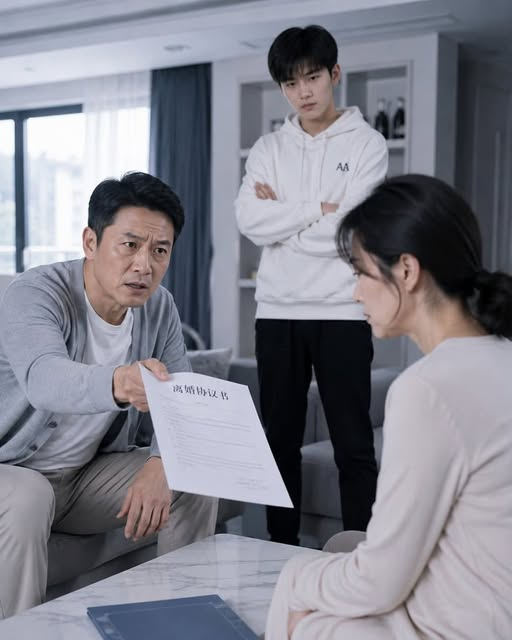
“I want a divorce.”
Tham Chu finally said it.
The dining room became completely quiet.
Tham Duong lowered his eyes.
Lam Ha had returned from her room at some point and was standing near the kitchen door, pretending not to listen.
I looked at my husband.
More than thirty years of marriage.
When he had nothing, I worked night shifts.
When our son was born, I returned to the hospital before my body had fully recovered because his salary could not support us.
When his parents became ill, I paid their medical bills.
When Tham Duong married, I paid the down payment for his apartment.
When Tieu Bao was born, I hired the postpartum nanny, the babysitter and later Lam Ha.
And now that I had retired, the man who had enjoyed everything my work provided had suddenly decided I was not “family-oriented” enough.
I nodded.
“Okay.”
Tham Chu froze.
“What?”
“I agree to the divorce.”
His mouth opened.
Apparently, he had prepared for tears.
Arguments.
Promises to change.
He had not prepared for agreement.
Tham Duong immediately stood.
“Mom, Dad is angry. Don’t take it seriously.”
I looked at him.
“Your father just asked for a divorce in front of you.”
Then I glanced at Lam Ha.
“And in front of the woman he apparently wants to replace me with.”
Lam Ha’s face turned red.
“Sister Giang, don’t misunderstand me.”
“I haven’t said anything about you yet.”
She immediately fell silent.
Tham Chu slammed his palm onto the table.
“I’m not afraid to admit it!”
He stood proudly.
“Lam Ha understands me better than you ever did.”
I almost smiled.
“Does she?”
“She knows what I can eat. She remembers my medicine. She prepares my clothes. When I’m tired, she actually asks if I’m uncomfortable.”
He looked at me with resentment.
“You only know how to give money.”
I nodded slowly.
“So after the divorce, I’ll stop.”
The room went silent again.
Tham Chu frowned.
“Stop what?”
“Giving money.”
I began counting on my fingers.
“The household expenses.”
“The nanny salary.”
“The maid.”
“Your health insurance supplement.”
“Tieu Bao’s private preschool.”
“Your car payments.”
I looked at my son.
“And the allowance I send you every month.”
Tham Duong’s expression changed.
“Mom, those are family expenses.”
“Exactly.”
I smiled.
“After the divorce, your father and I will no longer be a family unit.”
Tham Chu’s face darkened.
“You’re threatening us with money again.”
“No.”
I picked up my tea.
“I’m respecting your decision.”
He stared at me.
“You think I can’t survive without you?”
“I sincerely hope you can.”
That answer irritated him more than any insult could have.
Lam Ha stepped forward cautiously.
“Mr. Tham has a pension.”
“Yes.”
I looked at her.
“And you have a salary.”
Her expression stiffened.
I continued:
“But if you become his wife, I assume you won’t expect his ex-wife to keep paying you ten thousand a month for taking care of your own husband.”
Lam Ha went pale.
For the first time, Tham Chu looked at her.
She forced a smile.
“Of course not.”
I nearly laughed.
That “of course” sounded painful.
I stood.
“I’ll have the divorce agreement reviewed tomorrow.”
Then I remembered something.
“Oh.”
Everyone looked at me.
“I was invited back to the hospital.”
Tham Duong blinked.
“What?”
“The hospital asked me to return.”
Tham Chu frowned.
“You already retired.”
“They offered me a specialist position.”
I paused.
“With a higher salary than before.”
Nobody spoke.
I picked up my bag.
“I was going to celebrate that with you today.”
My eyes moved across the table of food Lam Ha had chosen according to Tham Chu’s tastes.
“But fortunately, you spoke first.”
That evening, I slept better than I had in years.
The next morning, I met a lawyer.
There was no dramatic battle over property.
I had kept records for decades.
The apartment we lived in had been purchased largely with money inherited from my parents and was registered in my name.
Our marital savings were divided according to the law.
Tham Chu had his pension, his share of the joint accounts and his personal property.
I did not take what belonged to him.
I simply stopped providing what had always belonged to me.
That was enough.
Three days later, Lam Ha called me.
Her voice was unusually soft.
“Sister Giang, did you forget to transfer my salary?”
“No.”
Silence.
Then:
“But it’s already the third.”
“I know.”
“I worked last month.”
“You’ll be paid for the days you worked.”
I paused.
“But your employment ends now.”
She sounded shocked.
“Why?”
I almost admired the question.
“You’re planning to marry my husband.”
“So?”
“So I no longer require a nanny for him.”
She became flustered.
“But Mr. Tham needs someone to care for him.”
“I agree.”
My voice remained pleasant.
“That’s why it’s wonderful that he has you.”
She hung up.
That afternoon, Tham Chu called.
“What did you say to Lam Ha?”
“Nothing unreasonable.”
“She’s crying!”
“Comfort her.”
“Giang Lai!”
“What?”
He lowered his voice.
“She says she cannot stay here without an income.”
I was silent for two seconds.
Then:
“Didn’t you say she cared for you because she understood hot and cold?”
He had no answer.
“Surely affection doesn’t require payroll.”
He hung up on me.
I smiled for the rest of the afternoon.
A week later, I returned to the hospital.
The moment I put on my white coat again, something inside me came alive.
Patients remembered me.
Young doctors came asking questions.
The department head laughed when he saw me.
“I knew retirement wouldn’t last.”
Neither had I.
For years, I had imagined retirement as finally having time to serve everyone at home.
Instead, I discovered I still wanted my own life.
Meanwhile, the household I had supported began experiencing reality.
The maid quit because nobody paid her.
The grocery budget suddenly mattered.
Tham Chu discovered that medicine, utilities and maintenance did not appear automatically.
Tham Duong called me one evening.
“Mom, Dad says the property management fee hasn’t been paid.”
I was reviewing a patient file.
“So?”
“It’s your apartment.”
“Yes.”
“Then shouldn’t you pay?”
“I do.”
He paused.
“What do you mean?”
“I pay for the apartment I live in.”
Silence.
I had moved into hospital-provided housing closer to work.
The old apartment was being prepared for sale.
When I told him that, Tham Duong nearly shouted.
“Sell it? Where will Dad live?”
“Wherever he chooses.”
“And Aunt Lam?”
I smiled.
“Isn’t she about to become his wife?”
“Mom, stop joking.”
“I’m not joking.”
Then my son finally said what everyone had been avoiding.
“Lam Ha says she doesn’t want to marry Dad anymore.”
I leaned back.
“That was fast.”
“She says he misunderstood.”
I laughed.
Of course.
The next morning, Tham Chu appeared at the hospital.
He looked older.
His shirt was wrinkled.
He had lost weight.
For decades, I had prepared his clothes before important appointments.
Apparently, Lam Ha’s affection had not extended to ironing once the salary stopped.
He waited until my consultation ended.
“Giang Lai.”
I took off my glasses.
“What is it?”
“Lam Ha left.”
“I heard.”
“She says she never promised to marry me.”
“That is unfortunate.”
His face tightened.
“You knew this would happen.”
“No.”
I looked at him calmly.
“I simply removed my money from the relationship.”
He stared at me.
“And she made her own choice.”
His shoulders sagged.
After a long silence, he said:
“I was confused.”
I almost laughed.
“You were very clear at the dining table.”
“I said things in anger.”
“You prepared divorce papers.”
He fell silent.
Then:
“We’ve been together for more than thirty years.”
“Yes.”
“Does that mean nothing to you?”
“It means a great deal.”
I looked at the man I had once believed I would grow old beside.
“That’s why I’m not willing to spend the rest of my life pretending what happened didn’t matter.”
He sat down.
“I thought after retirement you would finally stay home.”
“And become what?”
“My wife.”
“I was your wife while working.”
He looked away.
I continued:
“You didn’t dislike that I worked when my salary paid the mortgage, our son’s education and your parents’ medical bills.”
His face reddened.
“You only decided my career was selfish when you thought I no longer had one.”
He whispered:
“I was wrong.”
“Yes.”
“Can we start again?”
“No.”
This time, I didn’t feel triumphant.
Just calm.
“I hope you learn to take care of yourself.”
“Giang Lai…”
“But I’m no longer volunteering for the position.”
The divorce was finalized months later.
Lam Ha found another household job.
I heard she later complained that our family had “used her feelings.”
Perhaps she really had developed feelings for Tham Chu.
Perhaps she had simply liked being the most important woman in a comfortable house.
I no longer cared enough to determine which.
The bigger surprise was my son.
For a while, Tham Duong blamed me.
Then his wife returned from a business trip and learned what had happened.
She asked him one question:
“If your father needed care so badly, why did you expect your sixty-year-old mother to provide it instead of doing it yourself?”
Apparently, he had no answer.
A month later, he came to the hospital alone.
“Mom.”
“Yes?”
“I’m sorry.”
I looked at him.
He continued awkwardly.
“I thought because you could always solve everything… solving everything didn’t cost you anything.”
That sentence was more honest than every apology his father had given me.
I nodded.
“It did.”
“I know now.”
We did not repair everything in one afternoon.
But we started.
I remained part of Tieu Bao’s life.
Not as an unpaid nanny.
As his grandmother.
If I wanted to babysit, I did.
If I was busy, I said no.
And surprisingly, the world never ended.
Two years after returning to work, the hospital honored me for forty years of medical service.
Tham Duong and his wife sat in the audience.
Tieu Bao held flowers almost bigger than his body.
Afterward, he asked:
“Grandma, are you going to retire now?”
I laughed.
“Maybe someday.”
He thought carefully.
“Then you can play with me every day.”
Before I could answer, my son interrupted:
“Grandma has her own life too.”
I looked at him.
He looked slightly embarrassed.
But I smiled.
He had finally learned.
As for Tham Chu, we occasionally saw each other at family events.
He eventually learned to cook simple meals.
He joined a chess club.
He stopped looking for another woman to organize his life for him.
Once, he said quietly:
“If I had understood earlier, maybe things would have been different.”
“Maybe.”
“Do you regret divorcing me?”
I thought for a moment.
“No.”
His eyes lowered.
I added:
“But I don’t regret the years before it either.”
They had given me my son.
My grandson.
My career.
And finally, one last lesson.
For most of my life, everyone praised me for being capable.
What they really meant was that I was convenient.
I earned.
I arranged.
I paid.
I solved.
And because I rarely complained, they eventually believed I required nothing in return.
Retirement was supposed to make me useless.
Instead, it made one thing very clear.
The moment I stopped providing money and labor, everyone discovered exactly how much of their comfortable life had been resting on my shoulders.
Tham Chu said he wanted someone who knew how to care for him.
So I gave him exactly what he asked for.
I stepped aside.
And for the first time in decades,
I used all that care on myself.
