By the time Ha Canh Hanh realized I had truly left, my flight had already landed in Nam Thanh.
He called once.
Then three times.
Then sent a message.
The children are asking where you are.
I stared at it for a long time.
Five years earlier, that sentence would have dragged me back immediately.
This time, I replied:
Tell them the truth. Their mother moved for work. I will call tonight.
His answer came almost instantly.
You really intend to abandon them for a job?
I closed my eyes.
There it was.
I had stayed home for five years and become invisible.
The moment I left, suddenly I was a mother who cared only about work.
I did not argue.
My lawyer would do the arguing from now on.
Duong Phi handed me coffee.
“You okay?”
“No.”
“Going back?”
“No.”
That answer surprised even me.
The next morning, I entered the rehabilitation design laboratory where I had once spent half my youth.
My old project was still there.
Not physically.
On the wall hung a newer version of it.
A lower-limb rehabilitation device built from the concept I had drawn at twenty-three.
Duong Phi pointed at it.
“Recognize your child?”
I laughed bitterly.
“Apparently I have three.”
She opened a folder.
What she showed me erased my smile.
When Ha Thi Medical absorbed my studio after my marriage, the company received commercialization rights.
But the original patent remained registered jointly to me and the studio.
The license was not permanent.
It expired that year.
I looked up.
“Canh Hanh knows?”
“He should.”
Duong Phi shrugged.
“But judging from how his legal department has been emailing us, I think he assumed you signed the renewal years ago.”
“I didn’t.”
“I know.”
For five years, Ha Canh Hanh had introduced me as Mrs. Ha.
Meanwhile, Ha Thi Medical had built one of its fastest-growing rehabilitation product lines around technology whose creator apparently no longer had a name.
Duong Phi pushed the folder toward me.
“So, Ms. designer, what do you want to do?”
I thought about it.
“Work.”
Not revenge.
Not destruction.
Work.
Three days later, I signed with a medical engineering center in Nam Thanh as lead industrial designer.
My first assignment was to develop the next generation of the rehabilitation system I had created before marriage.
My salary was not as important as the name printed beneath the project:
Lead Designer: Jiang Lai.
Not Mrs. Ha.
Jiang Lai.
On the fifth day, the children finally video-called me.
Tieu Man appeared first.
“Mom, when are you coming home?”
My throat tightened.
“I have a new home now.”
She frowned.
“But Dad said you’re angry.”
“I’m not angry with you.”
“Tieu Du said you left because we like Linh Nghi’s mom more.”
There was movement behind the screen.
Ha Canh Hanh’s voice:
“Don’t say nonsense.”
I looked directly into the camera.
“Canh Hanh, leave the room.”
His expression hardened.
“These are my children too.”
“Yes.”
“So stop using them to talk to me.”
Silence.
Then, unexpectedly, he walked away.
I looked at my children.
“You can love Aunt Linh Nghi.”
Tieu Man blinked.
“But she is not your mother.”
“I am.”
Tieu Du appeared beside his sister.
“You left us.”
The accusation came straight from a five-year-old mouth.
I swallowed.
“Yes. I left the house.”
“Why?”
Because your father erased me?
Because another woman took my seat at school events?
Because you had been taught to call me petty whenever I tried to correct it?
No.
Those were adult burdens.
“I needed to remember how to be myself.”
Tieu Du clearly didn’t understand.
That was okay.
He didn’t have to.
Before ending the call, he said:
“Our robotics competition is Saturday.”
“I remember.”
“Aunt Linh Nghi is coming.”
“I know.”
He waited.
Maybe for me to sound hurt.
I only smiled.
“Good luck.”
Then I ended the call and cried for twenty minutes.
Leaving did not stop me from being their mother.
It only stopped me from pretending motherhood meant enduring anything.
Saturday morning, I was in a design review when my phone rang.
Ha Canh Hanh.
I ignored it.
He called again.
Then Tieu Du’s teacher.
I answered immediately.
“Mrs. Ha?”
“Jiang Lai.”
The teacher paused.
“Ms. Jiang, Tieu Du is upset.”
My heart tightened.
“Is he hurt?”
“No. His robot failed during inspection.”
I stood.
“What happened?”
“The obstacle avoidance mechanism isn’t responding.”
I knew exactly what that meant.
“What did they change?”
The teacher hesitated.
“Ms. Shen helped him replace part of the chassis.”
I closed my eyes.
The chassis I had spent seven nights building with my son.
“Put Tieu Du on.”
A moment later, his trembling voice came through.
“Mom.”
“I’m here.”
“It doesn’t work.”
“Okay.”
“I’m going to lose.”
“That’s possible.”
He went silent.
Then almost angrily:
“Aren’t you going to tell me how to fix it?”
I smiled sadly.
“I will help you think.”
For twenty minutes, I guided him through the structure.
Not as a mother rescuing him.
As a designer teaching a child how to solve his own problem.
He changed one sensor angle.
Rebalanced the front bracket.
Restarted the program.
“Try now.”
I heard wheels moving.
Then children shouting.
“It works!”
Tieu Du screamed.
“Mom! It works!”
Something inside me broke open.
Later that afternoon, his team won second place.
Not first.
He was devastated for exactly three minutes.
Then the competition judge asked him:
“Who designed your chassis?”
Tieu Du proudly said:
“My mom.”
Tham Lenh Nghi stood beside him.
The judge looked toward her.
“You?”
She smiled awkwardly.
“No.”
The judge looked at Ha Canh Hanh.
“Then where is the child’s mother?”
No one answered.
The judge turned the robot over.
His expression changed.
“This structure resembles the early Jiang rehabilitation linkage patent.”
Tieu Du blinked.
“What patent?”
The judge looked surprised.
“You don’t know?”
Then he said my full name.
My son went completely still.
That evening, he called me again.
“Mom.”
“Yes?”
“You invented the machine Dad’s company sells?”
“Part of the original system.”
“Why didn’t you tell me?”
I almost laughed.
“You never asked.”
Behind him, Ha Canh Hanh was silent.
Tieu Du continued:
“Dad said you didn’t understand programming.”
“I don’t specialize in programming.”
“But you understand robots.”
“I understand design.”
The boy looked confused.
Like he was seeing a new person.
That hurt.
But it also gave me hope.
Children were not born dismissing me.
They had simply repeated what the adults around them taught them.
The divorce mediation happened two weeks later.
Ha Canh Hanh arrived calm as always.
Until my attorney placed the studio licensing documents on the table.
His expression changed.
“You’re refusing renewal?”
“I haven’t decided.”
“Jiang Lai, Ha Thi Medical invested millions commercializing that system.”
“Yes.”
“And you benefited from that investment.”
“Yes.”
He seemed almost relieved by my agreement.
Then I continued:
“And the company benefited from my design.”
He fell silent.
I did not ask for Ha family premarital assets.
I did not want his family house.
I did not want his personal shares.
I wanted exactly what the contracts said was mine.
My studio equity.
My intellectual property interests.
And payment for any future commercial use.
His lawyer whispered something.
Canh Hanh’s jaw tightened.
“So this is why you divorced me.”
I stared at him.
“No.”
“Then why bring this up now?”
“Because for five years, I allowed everyone to behave as though my work disappeared when I became your wife.”
I leaned back.
“It didn’t.”
For the first time since I had known him, Ha Canh Hanh looked genuinely shaken.
Then he said:
“The children need you.”
My heart hurt.
But I answered:
“Then stop teaching them that needing me means they can disrespect me.”
He went silent.
The biggest surprise came from Tham Lenh Nghi.
She left the Ha household a month later.
Not dramatically.
She simply stopped coming every day.
When Ha Canh Hanh confronted her, she reportedly said:
“I helped because you kept telling me Jiang Lai didn’t care.”
Apparently, once she realized the marriage was truly ending, she no longer wanted to play substitute mother.
Tieu Man cried.
Tieu Du became angry.
And Ha Canh Hanh was finally forced to do something he had avoided for years.
Parent.
He handled fevers.
School notices.
Meals.
Bedtime arguments.
Robotics practice.
Questions he didn’t know how to answer.
Three months later, he called me at eleven at night.
I almost didn’t answer.
Then I heard Tieu Man crying in the background.
“What happened?”
“She has a fever.”
My body reacted automatically.
“What temperature?”
He told me.
I gave him instructions.
Then paused.
“Take her to the hospital if it rises further.”
He was quiet.
“Jiang Lai…”
“What?”
“I didn’t know.”
“Know what?”
“How much there is every day.”
I closed my eyes.
For years, I had wanted him to notice.
Now the acknowledgment arrived after I no longer needed it.
“I know.”
“I’m sorry.”
It was the first sincere apology he had given me.
But apology was not resurrection.
Some things could be understood too late.
Our custody arrangement gradually changed.
At first, the children remained mainly with him because their school and routines were there.
I visited every other weekend.
Then school holidays.
Then longer periods in Nam Thanh.
I never competed with their father.
Never asked them to choose.
Never spoke badly about him.
And slowly, they stopped treating me like someone who would always be available regardless of how they behaved.
One weekend, Tieu Man crawled into my bed.
“Mom?”
“Yes?”
“Can I call Aunt Linh Nghi Mom?”
My chest tightened.
“You can call people what feels comfortable to you.”
She thought about it.
“But you’re my real mom.”
I kissed her forehead.
“Yes.”
She snuggled closer.
“I forgot before.”
“No.”
I held her.
“You were little.”
That distinction mattered.
I would not punish a five-year-old for an adult’s failure.
The divorce was finalized eleven months after I left.
Ha Canh Hanh signed first.
This time, his hand paused over the paper.
Mine didn’t.
Afterward, he stood outside the courthouse.
“Jiang Lai.”
I turned.
“If I had stopped Lenh Nghi from interfering earlier…”
“No.”
“If I had respected your career…”
I shook my head.
“You’re still searching for one mistake.”
He went quiet.
“There wasn’t one.”
I looked at him.
“There were thousands of small moments when you watched me disappear and decided it was convenient.”
His face paled.
“I loved you.”
“I believe you.”
That surprised him.
Then I continued:
“But being loved badly for a long time can still destroy someone.”
He lowered his head.
“Is there another chance?”
“No.”
The answer was peaceful.
Not angry.
Not triumphant.
Just final.
Two years later, the new rehabilitation device entered clinical production.
At the launch, a large screen displayed the design team.
My name appeared first.
Tieu Du and Tieu Man sat in the front row with their father.
When I finished speaking, Tieu Du stood and shouted:
“That’s my mom!”
People laughed.
I did too.
Ha Canh Hanh did not.
He looked at the screen.
Then at me.
Perhaps for the first time, he understood the size of the life I had compressed to fit inside his home.
Afterward, Tieu Du ran toward me.
“Mom, when I grow up, can I design things too?”
“Of course.”
“Better than you?”
I smiled.
“That should be the goal.”
Tieu Man hugged my leg.
Ha Canh Hanh approached more slowly.
“Congratulations.”
“Thank you.”
He looked at the children.
“They want to spend summer with you.”
“I know.”
He nodded.
Then quietly:
“You did the right thing leaving.”
I looked at him.
That was the apology I had never expected.
“Yes,” I said.
“I did.”
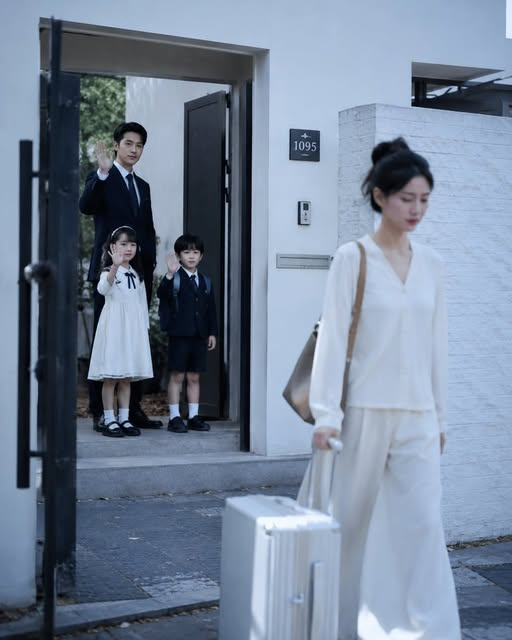
On day 1,094 of becoming Mrs. Ha, I asked for a divorce.
Ha Canh Hanh thought I would return because I could never bear to leave my children.
He was wrong about one thing.
I did not leave because I loved them too little.
I left because I finally understood that if I stayed in a house where their mother was treated as replaceable, one day they would grow up believing women were supposed to disappear quietly for the comfort of everyone else.
So I left.
I found my name again.
My work.
My voice.
And eventually, my children found me too.
Not Mrs. Ha.
Not the woman who packed lunches and waited outside school gates.
Not the mother they could replace with whoever happened to arrive on time.
Just me.
Jiang Lai.
And this time, when they called me Mom,
they finally knew the woman answering had a life of her own.
