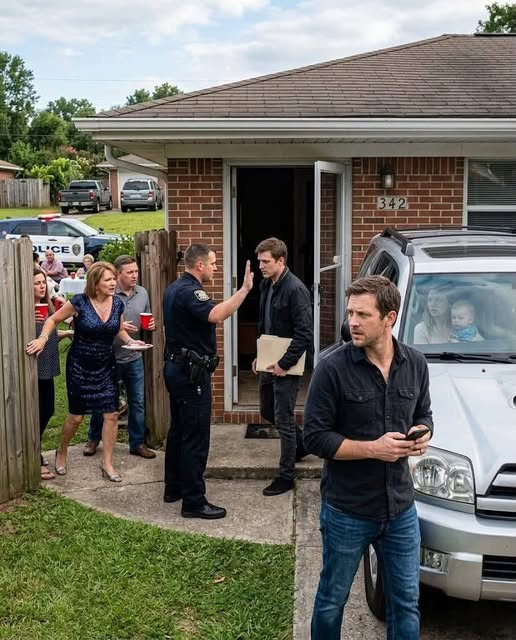
Mason froze at the front door.
The officer pointed toward the bulge beneath his jacket.
“Put the folder on the ground.”
Teresa immediately rushed forward.
“That belongs to me!”
The officer looked at her.
“Then you can explain what’s inside after he puts it down.”
Mason slowly removed the folder.
A stack of documents spilled across the porch.
The first page landed faceup.
I recognized my address.
Then I saw the title.
PROPERTY TRANSFER AGREEMENT.
My stomach dropped.
I picked up the birthday cake from the pavement and set it on the hood of my car before walking closer.
“What is that?”
Teresa shouted:
“Don’t touch my documents!”
The officer stopped me before I reached them.
“Let us handle it.”
He put on gloves and examined the pages.
There was a copy of our deed.
Bank statements.
Utility bills.
Several pages covered in signatures.
And then one document that made him look at me differently.
“Mr. Bradley, did you give your mother power of attorney?”
“No.”
Teresa interrupted.
“He was going to.”
I looked at her.
“What?”
She pointed at me as though I were an ungrateful child.
“You’re never home! Someone has to run things!”
The officer held up the document.
My name appeared at the bottom.
So did a signature resembling mine.
It wasn’t mine.
My blood went cold.
“I never signed that.”
Amy made a sound behind me.
I turned.
She was sitting inside the car with Frederick in her arms while paramedics examined him.
Her face had gone completely pale.
“Connor…”
“What?”
She whispered:
“She made me sign things.”
Everything inside me stopped.
Teresa’s expression changed.
Just slightly.
But enough.
I walked to Amy.
“What things?”
“I don’t know.”
Her voice shook.
“She would bring papers while I was feeding Frederick or when I hadn’t slept.”
“She said they were insurance forms. Bills. Things for the house.”
Teresa yelled from the porch:
“She’s lying!”
The officer immediately told her to stay where she was.
Amy started crying.
“She said you told her to handle everything.”
I crouched beside the car.
“I didn’t.”
“I know that now.”
Those four words hurt.
The paramedic interrupted gently.
“We need to take the baby in.”
Frederick’s fever was high enough that they wanted him evaluated immediately.
“I’m coming.”
Amy grabbed my sleeve.
“Connor, the folder—”
“Doesn’t matter more than him.”
For the first time that afternoon, I made the right decision without hesitation.
The police could secure documents.
My son needed his parents.
Frederick had a respiratory infection and dehydration.
The doctor told us we had brought him in at the right time.
He would recover.
That should have been enough to calm me.
It wasn’t.
Then the doctor examined Amy.
She had lost far more weight than I realized.
When I asked why, she looked away.
“Amy.”
Her eyes filled.
“Your mother controlled the grocery money.”
“What does that mean?”
“She said I ate too much.”
I stared at her.
“She told me the $3,000 you sent was for the whole household, and if I wasted it on things I wanted, she would tell you I was irresponsible.”
My voice dropped.
“Did you have access to our account?”
“She kept changing the passwords.”
I closed my eyes.
I had given Teresa control of the household account because she told me Amy was too exhausted after childbirth to deal with bills.
And I had accepted that explanation.
Because it was convenient.
Amy continued:
“When I asked you about money, you always said, ‘Mom handles it.’”
I remembered saying exactly that.
Again.
And again.
I sat beside her bed.
“Why didn’t you tell me?”
She gave me a look I will never forget.
“I tried.”
I stopped breathing.
“Three months ago, I told you your mother was making me uncomfortable.”
I remembered.
I had been standing at a construction site with a crane alarm screaming behind me.
I had answered:
She’s just trying to help. Give her time.
Amy continued.
“Then I told you she was inviting relatives over without asking.”
Another memory.
They’re family, Amy. Don’t make it bigger than it is.
Then:
“I told you she was taking my bank card.”
I covered my face.
I remembered that too.
I had said:
I’ll deal with it when work slows down.
Work never slowed down.
And Teresa learned that every time Amy reached toward me, I sent her back.
I whispered:
“I failed you.”
Amy’s eyes filled.
“I stopped telling you because you always explained her behavior before you listened to mine.”
There was nothing I could say to defend that.
So I didn’t.
“I’m sorry.”
She nodded.
But she didn’t tell me everything was fine.
I was glad.
I did not deserve easy forgiveness.
The police investigation lasted months.
The folder Mason tried to remove became only the beginning.
Mason eventually admitted Teresa had called him after seeing the police outside.
She told him:
“Get the property papers from my room before Connor finds them.”
He claimed he didn’t know they were forged.
Investigators determined that some signatures on financial forms were suspicious enough to require formal examination.
Then my bank records were reviewed.
For ten months, I had transferred Teresa $3,000 every month.
Thirty thousand dollars.
I assumed it paid for food, utilities and Frederick’s expenses.
Less than half had.
The rest went toward:
Jewelry.
Restaurants.
Payments to relatives.
Liquor.
Clothing.
And repeated cash withdrawals.
The seafood party alone had cost more than a thousand dollars.
Meanwhile, Amy had been told there was no money for the baby formula Frederick sometimes needed.
That discovery nearly made me physically sick.
But the worst document was the property transfer.
Teresa had been trying to create paperwork suggesting Amy and I intended to give her a substantial interest in the house in exchange for “full-time domestic management and childcare.”
She had even collected copies of our identification.
My signature had apparently been copied from old construction documents.
Amy’s signature appeared on supporting paperwork she did not remember signing knowingly.
Teresa insisted it had all been a misunderstanding.
The investigators did not accept that explanation at face value.
Forgery and financial fraud allegations were handled through the legal process.
The house remained ours.
It had always been ours.
Teresa called me from her attorney’s office.
“Connor, I’m your mother.”
I said nothing.
“I sacrificed everything raising you.”
Still nothing.
“Are you really going to let your wife destroy our family?”
That finally got a response.
“No.”
She paused.
“I destroyed it by refusing to listen to my wife.”
Silence.
Then she snapped:
“Amy turned you against me.”
“No.”
I looked through the hospital room window at Amy holding Frederick.
“You just counted on me never looking closely.”
Her voice became cold.
“I ran that house for a year.”
“You controlled it.”
“There’s a difference.”
“You gave Amy structure.”
“You frightened her.”
“She needed discipline.”
“She was recovering from childbirth and raising my son.”
My hands tightened.
“And today she was washing your relatives’ dishes while Frederick was sick because she was afraid you would punish her for stopping.”
Teresa scoffed.
“Punish? What dramatic nonsense.”
That word ended the conversation.
“You’re not coming back to our house.”
Her breathing stopped.
“Connor.”
“No key.”
“No visits without invitation.”
“No access to our accounts.”
“And no contact with Amy unless Amy chooses it.”
“You can’t keep my grandson from me.”
“I can keep him away from chaos while we work through what happens next.”
Then I hung up.
For once, being her son did not mean obeying her.
Amy and Frederick came home four days later.
Before they arrived, I changed every lock.
Closed the household account Teresa had accessed.
Moved all bills back under our direct control.
Installed a secure mailbox.
Then I did something harder.
I took three weeks off work.
My supervisor complained.
I told him I would live with the consequences.
For one year, I had treated my job as though eight hundred tons of concrete would collapse if Connor Bradley took a day off.
Meanwhile, my actual family had been collapsing at home.
The first morning Amy woke and found me making Frederick breakfast, she stood in the kitchen doorway.
“You don’t know how to do that.”
“No.”
I held up the instruction sheet.
“But apparently oatmeal has been documented.”
She almost smiled.
Almost.
Trust returned much more slowly.
She did not become affectionate because I changed locks.
She did not forgive me because I washed dishes for three weeks.
And I learned not to expect applause for performing tasks she had done unnoticed every day.
We started counseling.
During one session, Amy said:
“I wasn’t most afraid of Teresa.”
I looked at her.
“I was afraid you wouldn’t believe me.”
That was the sentence I carried home.
Because Teresa’s control had depended on one thing:
My absence.
Not physical absence alone.
My refusal to investigate.
My habit of assuming money counted as participation.
My belief that sending $3,000 every month made me a responsible husband and father.
I had financed the household.
I had not been present inside it.
There was a difference.
The legal case eventually ended with Teresa facing consequences for the fraudulent documents and misuse of funds.
Some charges were resolved without a dramatic trial.
Money was repaid where possible.
Restrictions were placed around contact and financial access.
Mason cooperated with investigators and admitted removing the folder at her instruction.
The other relatives scattered quickly.
Funny how twenty people can eat your food and praise your generosity, then suddenly remember they “weren’t involved” when detectives start asking questions.
I never chased them.
I had more important things to rebuild.
Frederick turned two the following year.
We celebrated with seven people.
Not twenty.
No tequila.
No seafood banquet.
No speeches about who controlled the house.
Amy chose the food.
I baked the cake.
It leaned slightly to one side.
Frederick destroyed it with both hands.
Everyone laughed.
Then I gave Amy the blue dress I had originally bought for his first birthday.
She stared at the box.
“You kept it?”
“Yes.”
She ran her fingers over the fabric.
“I don’t know if it fits anymore.”
“That’s okay.”
“We can exchange it.”
She looked at me.
The old Connor might have said:
I bought it for you. Just wear it.
Instead, I had finally learned that gifts did not create obligations.
Amy smiled.
“I’ll try it.”
That felt better than forgiveness demanded on schedule.
Teresa saw Frederick again eventually.
But not because she was his grandmother and therefore entitled to him.
Because after a long period of limited contact, accountability and clear boundaries, Amy agreed to a short supervised visit.
Teresa cried when she saw him.
Amy remained beside me.
When Teresa said:
“My grandson finally came back to me.”
I corrected her.
“He came to see you.”
Not back.
There had never been a place where he belonged to her.
She looked at me.
Then nodded.
Progress sometimes sounded that small.
Years later, Frederick found the photograph from his first birthday.
It showed Amy and me in the hospital after he recovered.
No party.
No twenty relatives.
No expensive food.
Just his mother, exhausted but smiling, and me holding a ridiculous crushed birthday cake box.
“What happened to my real birthday party?” he asked.
Amy and I looked at each other.
I answered:
“We canceled it.”
“Why?”
“Because you were sick.”
He considered that.
“Did I still get cake?”
“Eventually.”
He seemed satisfied.
Children have a way of reducing family legends to what actually matters.
Were you there?
Did you care?
Was I safe?
On Frederick’s first birthday, I came home expecting to surprise my wife.
Instead, I discovered that for months I had been paying another person to control my home while ignoring the woman who was trying to tell me something was wrong.
The hidden folder on my phone proved Amy and I owned the house.
The folder Mason carried helped expose what Teresa had been trying to do.
But neither folder contained the most important truth.
That one took me much longer to understand.
A deed can prove who owns a house.
It cannot prove who makes it a home.
For a year, Teresa kept declaring that she was the one in charge.
She was wrong.
And so was I.
Because a marriage was never supposed to have one person “in charge” while everyone else learned to be afraid.
The day the police came, I thought I was taking my house back from my mother.
What I was really doing was much harder.
I was finally becoming the husband and father who should have been paying attention long before anyone had to call 911.
