Daniel looked at Vanessa’s hand wrapped around his arm.
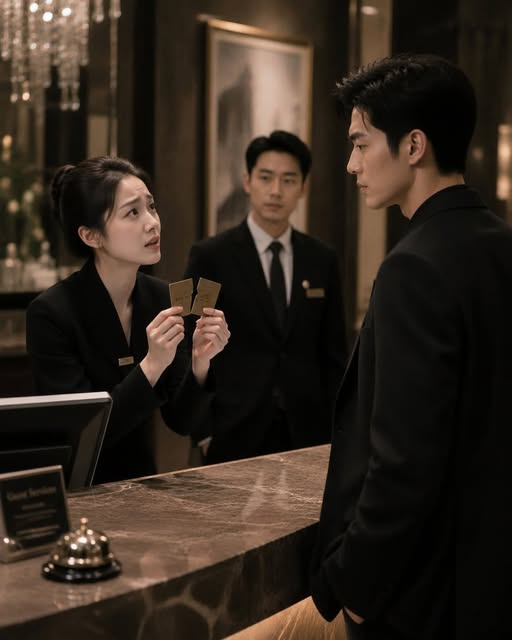
Then at the broken key card beneath her shoe.
His expression became colder than I had ever seen it.
And finally he spoke.
“Take your hand off me.”
Vanessa froze.
Daniel continued:
“And security, nobody touches my wife.”
The lobby went completely silent.
Vanessa’s fingers slipped from his sleeve.
“Your… wife?”
Daniel walked past her and stopped in front of me.
“Sofia.”
I stared at him.
He looked at the security captain.
“This is Sofia Foster. Co-owner of the hotel.”
The captain’s face drained of color.
Margaret Hayes stepped forward.
“To be precise, Mrs. Foster owns fifty percent of the property-holding company and forty percent of the hotel operating entity.”
Vanessa actually laughed.
“No.”
Nobody joined her.
She pointed at me.
“She told me nothing!”
I answered calmly:
“You never asked.”
Her face twisted.
“You came dressed like an ordinary guest with some suspicious man and demanded the presidential suite.”
Lucas finally spoke.
“We had a confirmed reservation.”
Vanessa snapped:
“That suite requires executive approval.”
Daniel frowned.
“No, it doesn’t.”
She turned toward him.
“You gave me authority over it.”
“I gave you authority to manage inventory.”
His voice sharpened.
“Not to override paid reservations.”
Then he looked down at the broken card.
“And certainly not to destroy a guest’s access card because you dislike how he looks.”
Vanessa’s confidence began to crack.
“But I was protecting the hotel.”
Lucas gave a short, humorless laugh.
“From a man checking in with his sister?”
She glared at him.
“You threatened security.”
“I told them to step aside after they approached Sofia.”
The security captain cleared his throat.
“He did not strike anyone or make a threat, sir.”
Vanessa turned on him.
“You were supposed to support me!”
That sentence hung in the air.
Support her.
Not hotel policy.
Not guest safety.
Her.
Daniel looked at Margaret.
“Is this what you were talking about upstairs?”
Margaret opened the folder she carried.
“Yes.”
My stomach tightened.
“Talking about what?”
Daniel hesitated.
That hesitation made me look directly at him.
“Sofia, there’s something I was coming downstairs to tell you.”
“You didn’t know I was here.”
“No.”
He looked at Vanessa.
“But I knew something was wrong here.”
Margaret removed several pages.
For the previous two months, the hotel’s financial controller had been reviewing unusual charges connected to executive privileges.
Complimentary suites.
Luxury meals.
Spa services.
Private events.
Airport transfers.
All approved under a management code assigned to Vanessa.
At first, the amounts were small enough to look legitimate.
Then they grew.
Vanessa had been granting free rooms to friends.
Entertaining relatives in private hotel spaces.
Charging clothing alterations and beauty services to “VIP guest relations.”
And repeatedly blocking the presidential suite for “executive hospitality.”
Except there had often been no executive guest.
I stared at Daniel.
“You knew this?”
“Not all of it.”
“When?”
“This morning.”
“And you brought Margaret here because…”
“To preserve records before Vanessa could alter anything.”
Vanessa shouted:
“This is insane!”
She looked at me.
“She planned this!”
I almost laughed.
“I didn’t even know the password to my own reservation system five minutes ago.”
Daniel’s face tightened.
Then Vanessa made her biggest mistake.
“You said I could use anything I needed!”
Daniel slowly turned.
“When?”
Her mouth opened.
Nothing came out.
Margaret immediately asked:
“Do you have that permission in writing?”
Vanessa’s eyes flickered.
“No.”
“Then we’ll rely on the records.”
Vanessa stepped backward.
“You’re choosing her over me?”
There it was.
Not boss and manager.
Not executive and employee.
Something far more personal in the way she said it.
I looked at Daniel.
He looked ashamed.
Not guilty.
Ashamed.
And I understood there was still another conversation waiting for us.
But not in the lobby.
Daniel turned to the security captain.
“Ms. Reed’s access is suspended pending investigation. Escort her to the office so HR and counsel can speak with her.”
Vanessa’s face went white.
“You’re firing me?”
“I’m suspending access.”
He looked at her.
“The investigation decides the rest.”
That distinction mattered.
This was a hotel.
Not our private kingdom.
Employees did not lose careers simply because the owner’s wife had been insulted.
But evidence would be preserved.
And facts would decide what happened next.
Vanessa looked at me one final time.
“You think you won?”
I picked up the broken pieces of my key card.
“No.”
“I came here to give my brother a quiet room.”
“You created everything after that yourself.”
She was escorted away.
Then Daniel turned toward Lucas.
“I owe you an apology.”
My brother studied him.
“You owe my sister one first.”
I almost smiled.
Lucas had been home less than two days and had already become my favorite relative again.
Daniel nodded.
“You’re right.”
The presidential suite was restored to our reservation.
Lucas refused it.
“I’ve slept in tents during storms.”
He looked around the enormous marble lobby.
“I’m suddenly comfortable with a normal room.”
I laughed for the first time that night.
He squeezed my shoulder.
“Go talk to him.”
“I don’t want to.”
“I know.”
He walked toward the elevator.
“That’s why you should.”
Daniel and I went into a private conference room.
Margaret stayed outside.
I closed the door.
“Did you sleep with her?”
Daniel’s face changed.
“No.”
“Did you kiss her?”
“No.”
“Did you want to?”
“No.”
I watched him.
Ten years of marriage teaches you when someone is choosing words carefully.
He wasn’t.
I believed him.
That did not mean I felt relieved.
“Then why did she call you Daniel?”
He looked down.
“Because I let her.”
“Why?”
“She was good at her job when I hired her.”
“That’s not an answer.”
He rubbed his forehead.
“She handled everything.”
“My calendar.”
“VIP issues.”
“Hotel crises.”
“Press.”
“Eventually she started acting like she had authority beyond her title.”
“And you liked it.”
He looked at me.
“What?”
“You liked having someone handle everything before you had to ask.”
Silence.
I continued:
“So when she became too familiar, you ignored it because she was useful.”
“Yes.”
“And when she started touching your arm?”
His face tightened.
“I told her before that it was inappropriate.”
“Once?”
He said nothing.
There it was.
I laughed softly.
“You didn’t have an affair.”
“No.”
“But you allowed another woman to behave publicly like she occupied a personal place beside you because correcting her would have been inconvenient.”
Daniel closed his eyes.
“Yes.”
I sat back.
“That is not nothing.”
“I know.”
“No, Daniel.”
“You know now because she humiliated your wife in your lobby.”
He looked at me.
“And because she used my name to control people.”
I nodded.
“That too.”
He asked:
“Why didn’t you tell her who you were?”
I stared at him.
“Why should I have to introduce myself as the owner’s wife to receive basic respect?”
He had no answer.
“That security captain almost removed us because she ordered it.”
“Employees were afraid of her.”
“Why?”
Another silence.
Then Daniel said:
“Because they thought she had my protection.”
“And did she?”
He looked down.
“For too long.”
That was the truth I needed.
The investigation took six weeks.
Vanessa’s behavior was worse than the lobby incident, but less dramatic than rumor would later make it sound.
She had not stolen millions.
She had done something more ordinary.
She had slowly converted professional access into personal privilege.
Free stays for friends.
Expensive meals.
Transport.
Unauthorized use of hotel staff.
Preferential treatment for people she wanted to impress.
And several retaliatory scheduling decisions involving employees who questioned her.
The hotel terminated her employment after the review.
The security captain kept his job.
So did the reception team.
They received additional training on guest verification, escalation procedures and the fact that no manager’s personal preference outweighed documented reservations.
Daniel also changed the reporting system so employees could challenge senior managers without going through those same managers.
That mattered more to me than Vanessa being fired.
Then Margaret called me.
“There’s one thing you should see.”
She showed me an email Vanessa had sent herself from a hotel account.
Attached were photographs of the presidential suite.
A message underneath read:
Soon I won’t need permission to use it.
Another message to a friend said:
Daniel trusts me more than anyone. Sofia never comes here anyway.
I read it twice.
Then handed it back.
“She believed I was temporary.”
Margaret sighed.
“She believed proximity was ownership.”
That sentence stayed with me.
Because perhaps Daniel had once made the same mistake.
He thought because I rarely entered hotel operations, they were his world.
Yet my money had helped buy the building.
My name sat on the ownership documents.
My signature had secured refinancing during the renovation.
I had simply never needed people to call me owner every time I walked through the lobby.
Apparently silence created space for other people to invent stories.
Daniel spent the next several months repairing something harder than a hotel policy.
Us.
One evening, he found me reviewing quarterly reports.
“You never used to read those.”
“Yes, I did.”
He frowned.
“When?”
“For years.”
I turned the laptop.
“I just never discussed them with you because you always said hotel operations bored me.”
His face changed.
“I said that?”
“Frequently.”
Daniel sat down.
“What else don’t I know?”
I smiled without humor.
“That’s finally a useful question.”
So we began again.
Not romantically.
Honestly.
He learned that I had personally reviewed the financing agreement that saved the hotel during the pandemic downturn.
I learned how much of the daily operation exhausted him.
He admitted that he had liked being the public “Mr. Foster” while treating me as if I were merely adjacent to his success.
And I admitted that I had withdrawn so completely from the business that I stopped noticing what kind of culture had developed beneath our names.
Neither of us was innocent of neglect.
But only one of us had allowed Vanessa to blur a boundary she had no right to cross.
Daniel took responsibility for that.
Without asking me to forget it.
That mattered.
Lucas stayed at the hotel two nights.
On the morning he left, Daniel met him in the lobby.
No entourage.
No manager.
Just my husband.
Daniel handed him a new key card in a small envelope.
Lucas frowned.
“What’s this?”
“A permanent guest card.”
“For what?”
“So if you ever come back, nobody treats you like you don’t belong.”
Lucas looked at me.
I shook my head.
“Don’t accept it because he feels guilty.”
Lucas handed it back.
Daniel looked surprised.
My brother smiled.
“I don’t need permanent access.”
He pointed toward me.
“If Sofia wants me here, that’s enough.”
Daniel slowly nodded.
“You’re right.”
Lucas picked up his bag.
Then added:
“But I’ll take the free breakfast.”
I laughed.
Daniel did too.
A year later, the Foster Grand Hotel celebrated its anniversary.
For the first time, Daniel asked whether I wanted to give the opening remarks.
I said no.
He blinked.
“No?”
“No.”
Then I smiled.
“But put both owners’ names on the annual report.”
He did.
No giant announcement.
No dramatic unveiling.
Just accurate paperwork.
That was enough.
I became more involved with hotel governance afterward.
Not because I wanted to prove Vanessa wrong.
Because ownership carries responsibility.
If employees were once afraid to question someone simply because they believed she had Daniel’s favor, I wanted to make sure that never happened again.
Daniel and I stayed married.
But not because he fired Vanessa.
Not because he apologized.
Because over time, he changed the behavior that had allowed her to become what she did.
And I changed too.
I stopped assuming that because my name existed on documents, everyone automatically understood my place.
Not my status.
My responsibility.
Years later, Lucas returned with his own family.
At check-in, a young receptionist smiled.
“Mr. Morales, welcome back. Mrs. Foster arranged connecting rooms.”
Lucas immediately called me.
“Sofia.”
“What?”
“You put me in a suite again.”
“It has two bedrooms.”
“I told you normal rooms.”
“You have twins now.”
He sighed.
“Fine.”
Then added:
“The staff are nice.”
I smiled.
“They should be nice whether they know you or not.”
That was the point.
The night Vanessa tore up my key card, I thought the humiliation was that she did not recognize the hotel owner standing in front of her.
It wasn’t.
The real humiliation was realizing that she believed she needed to recognize only one kind of person before offering basic dignity:
Someone powerful.
Someone important.
Someone protected by Daniel Foster.
I never wanted the Foster Grand to become that kind of place again.
Vanessa asked me:
“Who do you think you are?”
At the time, I could have answered:
The owner.
Daniel’s wife.
The woman whose signature appears on half the hotel’s documents.
But years later, I realized the best answer would have been much simpler.
It shouldn’t have mattered who I was.
Because no guest should need to own the hotel before being treated like a human being.
