Professor Daniel Reed answered less than ten minutes later.
Yes. The offer still stands. Your voice was never the only reason I believed in you.
I stared at those words until my vision blurred.
For three years, everyone around me had talked about my voice as though it were my entire identity.
Professor Reed was the first person to remind me that I had also written arrangements.
Composed melodies.
Produced demos.
Built harmonies for other singers.
There were other ways to make music.
I just hadn’t imagined needing them so soon.
I typed:
Then I want to apply.
His reply was immediate.
I’ll help you.
That was the first decision I made about my future without Ethan.
The second was even easier.
I called my lawyer and froze the additional card Ethan had been using.
Ethan discovered it that evening.
Vivian was still at the graduation showcase when he called me seventeen times.
I ignored every call.
Then a message appeared.
Why was my card declined?
I almost laughed.
His card.
For two years, Ethan had carried an additional card attached to my account because his agency frequently handled expenses connected to my performances.
I had trusted him.
So completely that I had never asked why restaurant bills, hotel charges and private medical expenses had started appearing there.
I answered:
Because it is not your card.
Three dots appeared.
Disappeared.
Returned.
Mia, don’t be childish. Vivian is still recovering. I had to pay for her treatment.
I typed slowly.
Then use your money.
He called again.
This time, I blocked him.
The showcase ended before midnight.
Vivian performed in my place.
I did not watch.
But the following morning, Professor Reed sent me a message.
Did you authorize another singer to use your arrangement of “After the Rain”?
My hands stopped.
No.
That arrangement was mine.
Not the agency’s.
Not Ethan’s.
Mine.
I had composed it during my second year, registered it under my own name and spent months rebuilding the orchestration for my graduation performance.
I called my lawyer.
By noon, Starline Entertainment had received formal notice that the arrangement performed the previous night had been used without my permission.
I did not demand they punish Vivian.
I simply corrected the record.
Three hours later, the president of Starline contacted me personally.
He had heard the arrangement.
He wanted to know who wrote it.
When I told him I had, there was a long pause.
Then he said:
“Miss Monroe, I was told Mr. Lawson’s agency owned the piece.”
“It doesn’t.”
Another pause.
“Would you be willing to send me your portfolio?”
My throat tightened.
I could barely speak comfortably.
So I answered by email.
Yes.
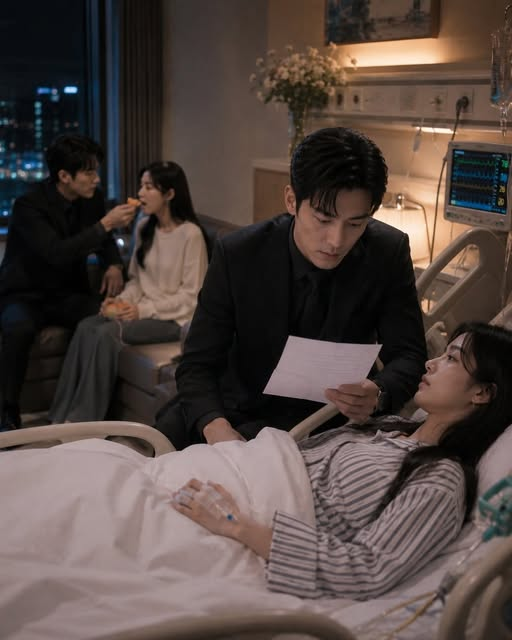
Ethan arrived at the hospital that afternoon.
Without Vivian.
Without flowers.
Without the arrogance he had carried the day before.
He closed the door.
“What did you tell Starline?”
I looked at him.
He continued:
“They called my agency.”
I opened the notes app on my phone.
I told them the truth.
He read it.
His jaw tightened.
“That arrangement was part of the showcase package.”
I typed:
The performance license was for me. Not Vivian.
“Mia, we’re engaged. Why are you treating me like an enemy?”
I stared at him.
Then slowly removed my engagement ring.
His expression changed.
I placed it on the table.
He went completely still.
“No.”
I pushed the ring toward him.
“Mia.”
My voice barely came out.
But I forced one sentence.
“We’re done.”
For the first time, Ethan looked genuinely frightened.
“What happened to your voice?”
I said nothing.
His eyes moved toward the pillow.
He saw the medical report.
I reached for it.
Too late.
He picked it up.
Read the first page.
Then the second.
His face emptied.
“No.”
I turned away.
“No, Mia.”
His breathing changed.
“The doctor told me you had smoke irritation.”
I looked back at him.
The physician had never told Ethan that.
Ethan had assumed it.
Because asking about me had not been important enough.
He stared at the report.
“You can’t sing?”
I closed my eyes.
He sat down as though his legs had stopped working.
“I made you give up the showcase.”
I shook my head.
I hadn’t signed.
That mattered.
But he understood what he had tried to do.
His voice cracked.
“I thought you were being jealous.”
I typed:
You always thought the worst of me when Vivian was involved.
He read it.
Then whispered:
“I didn’t know.”
I typed another sentence.
You didn’t ask.
He covered his face.
The fire investigation finished two weeks later.
Security footage from the venue showed something Ethan had not remembered clearly.
When part of the structure began to collapse, I had pulled him away from danger.
That movement gave him enough time to reach the exit.
I was trapped afterward.
Vivian had been closer to him when he turned back.
So he took her outside.
Then he stayed with her.
That last part mattered most.
Nobody expected Ethan to calculate perfectly in a burning building.
Panic is not mathematics.
But once he was outside, there were firefighters.
Staff.
People asking who was still inside.
And Ethan had spent those first crucial minutes with Vivian, believing I could “handle myself.”
When the investigator explained that to him, Ethan came to see me again.
He looked destroyed.
“You saved me.”
I did not answer.
“And I left you.”
I wrote:
Yes.
His eyes filled.
“I didn’t understand.”
I wrote:
That has become your favorite sentence.
He read it and lowered his head.
Then he whispered:
“I can spend the rest of my life making this right.”
I shook my head.
He looked desperate.
“Please.”
I typed:
You can spend the rest of your life becoming better. That does not mean I have to spend it beside you.
He cried.
I did too.
But I did not put the ring back on.
My lawyer uncovered the rest.
Ethan’s agency had been built partly with money I contributed when we became engaged.
I had never been merely one of his artists.
I had financed recording equipment.
Studio rent.
Marketing.
Two early tours.
He had operational control.
But my contracts were still mine.
My compositions were mine.
My publishing rights were mine.
And the account he had used for Vivian’s expenses belonged primarily to me.
I did not take the agency from him.
I did not try to destroy his career.
I simply separated everything that was mine.
My money.
My copyrights.
My recordings.
My future work.
The agency survived.
Smaller.
Less comfortable.
For the first time, Ethan had to run it without treating my resources as an extension of his own.
Vivian left shortly afterward.
Not because I forced her out.
Starline did not sign her after the showcase.
She blamed Ethan for promising opportunities he could not guarantee.
Ethan blamed nobody.
That, at least, was progress.
Months later Vivian sent me one message.
I knew the showcase belonged to you. I told myself you had other opportunities. I was wrong. I’m sorry.
I never replied.
She had made selfish choices.
But Ethan had been my fiancé.
The greater responsibility had always been his.
I moved to Boston the following spring.
My speaking voice remained limited.
Some days were easier than others.
I learned not to force it.
I used text when I needed to.
Technology when it helped.
Silence when I chose it.
And music?
Music stayed.
At Berklee, Professor Reed never once asked me to become the singer I had been.
He asked:
“What do you hear?”
So I showed him.
Strings.
Percussion.
Voices other than mine.
Songs written for people whose ranges were different from what mine had once been.
I became obsessed with production.
With building the exact emotional moment a singer needed before the first lyric even began.
The first time another vocalist performed one of my songs onstage, I stood behind the soundboard and shook harder than I ever had before my own performances.
Afterward, she ran to me.
“Mia!”
She hugged me.
“That song changed everything.”
For a second, grief hit me.
I had once imagined hearing applause from the center of the stage.
Now I was hearing it from behind the curtain.
Then Professor Reed leaned toward me.
“They’re applauding your music too.”
That was when I understood.
My career had changed.
It had not ended.
Two years later, Starline offered me a songwriting and production contract.
Not because they felt sorry for me.
Because three songs I had produced for other artists charted nationally.
I read the contract twice before signing.
Every copyright clause.
Every ownership term.
Every approval right.
Trust was no longer something I gave away because I loved someone.
That lesson had been expensive.
I intended to keep it.
I saw Ethan again at an industry awards ceremony.
He approached slowly.
He looked older.
Calmer.
“Hi, Mia.”
I nodded.
He did not expect me to answer aloud.
That mattered.
“I heard your record.”
I smiled slightly.
“The one you produced for Ava Chen.”
Another nod.
“It’s beautiful.”
I typed on my phone.
Thank you.
He read it.
Then looked at me.
“I’m sorry.”
I had heard those words from him before.
This time, I believed he finally understood what they contained.
Not just the fire.
Not just Vivian.
The years of deciding my needs were negotiable because he assumed I would remain.
He continued:
“I used to tell myself I made one terrible decision that night.”
He swallowed.
“I didn’t.”
“You were right.”
“I had been making the same decision for years.”
“Whenever the choice was between trusting you and protecting Vivian’s feelings, I chose her.”
“Whenever your work conflicted with what I wanted, I treated your work as disposable.”
“And when you couldn’t even speak for yourself…”
His eyes reddened.
“I still tried to make the decision for you.”
I looked at him for a long time.
Then typed:
Now you understand.
“Yes.”
He hesitated.
“Do you forgive me?”
I thought about it.
Then wrote:
I stopped carrying you a long time ago.
He read it twice.
I added:
That is close enough.
Ethan nodded.
No request for another chance.
No speech about destiny.
No attempt to touch me.
He simply said:
“I hope you’re happy.”
I was.
So I smiled.
Then walked away.
Years earlier, Ethan had looked at me in a hospital bed and told me that I did not need a career because one day I would be Mrs. Lawson.
He believed a wedding could replace a dream.
He believed Vivian needed my stage more than I did.
He believed my music mattered only while it came out of my own mouth.
He was wrong about all three.
I never became Mrs. Lawson.
I never returned to that graduation stage.
And I never sang professionally again.
But I wrote.
I composed.
I produced.
I built careers.
I created songs that traveled farther than my own voice ever could have.
For a long time, I thought the fire had taken the one thing that made me Mia Monroe.
Eventually I understood that my voice had never lived only in my throat.
It lived in every melody I finished.
Every artist I helped.
Every contract I finally read before signing.
Every boundary I refused to surrender.
Ethan left me behind in the fire and later asked me to give another woman my last chance to sing.
I thought that meant my story was ending.
It wasn’t.
I lost the voice he thought defined me.
Then I built a life so powerful that, for the first time, nobody needed me to sing in order to hear me.
