“Abortion?”
I repeated the word slowly.
Luc Canh Tham stared at me.
“You’re saying my mother drove you away. Then what about the hospital certificate?”
I almost laughed.
“What certificate?”
His face changed.
“The one saying you terminated the pregnancy.”
“I never terminated anything.”
His entire body went still.
For the first time since we met again, the arrogance disappeared from his eyes.
“What did you say?”
I held his gaze.
“I said I never had an abortion.”
His fingers tightened at his sides.
“Then the child…”
I interrupted him.
“Mr. Luc, our companies are here to discuss a resort project.”
I picked up my proposal.
“My private life is not part of the bid.”
I walked past him.
He grabbed nothing this time.
He simply stood there as if the entire sixty-eight-story building had shifted underneath him.
Behind me, I heard him say:
“Tram Niem.”
I stopped.
“Was there a child?”
I closed my eyes for one second.
Then answered:
“No.”
His face collapsed.
I continued:
“There were three.”
That afternoon Luc Thi’s resort presentation was suspended.
Not canceled.
Suspended.
Canh Tham’s assistant found me in the conference room.
“Ms. Tram, Mr. Luc would like to speak with you.”
“No.”
“He says it’s urgent.”
“It was urgent fourteen years ago.”
The assistant had no answer.
I gave my presentation to the evaluation committee and left.
Canh Tham did something I did not expect.
He recused himself from the selection.
Because I was his former wife.
Because our history created an obvious conflict.
The proposal would be evaluated by an independent committee.
For once, he did not use his position to force me to stay.
But while the committee reviewed my work, he began investigating the past.
And the first person he confronted was his mother.
Phuong Cam Hoa denied everything.
At first.
“You’ve lost your mind because that woman came back!”
Canh Tham placed the old abortion certificate on the table.
“I contacted the hospital.”
His mother’s face changed.
“The document number doesn’t exist.”
Silence.
“The physician whose signature appears here retired eighteen years ago.”
Her fingers trembled.
Canh Tham continued:
“And the bank confirmed the five-million-yuan check was never deposited.”
Phuong Cam Hoa looked away.
“She tore it up to manipulate you.”
“Mother.”
His voice became frighteningly quiet.
“Did Tram Niem take money from you?”
No answer.
“Did she?”
“No.”
One word.
Fourteen years destroyed by one word.
Then came the shirt.
Hua Nhuoc Lan was summoned.
She arrived believing Canh Tham wanted to discuss the upcoming anniversary gala.
Instead, the old white shirt lay on the table.
Her lipstick stain was still faintly visible.
Canh Tham asked:
“Did I sleep with you that night?”
Nhuoc Lan immediately shook her head.
“No.”
His mother snapped:
“Nhuoc Lan!”
Too late.
Canh Tham looked at her.
“Who put the lipstick there?”
Nhuoc Lan started crying.
“I was young.”
“Who?”
“I did.”
His face became expressionless.
“And the anniversary call?”
Her silence answered him.
“You called my wife while I was unconscious.”
“I loved you!”
“And you let her believe I was showering in your room.”
Nhuoc Lan cried harder.
“I thought once she left, you would finally see me.”
Canh Tham laughed.
It was an empty sound.
“Fourteen years.”
Neither woman spoke.
Then Phuong Cam Hoa finally exploded.
“She was an orphan!”
Canh Tham turned toward her.
“She had no family, no background, nothing! I was protecting you.”
“From what?”
“From a woman who wasn’t worthy of the Luc family!”
His mother pointed toward him.
“Look at what I gave you instead. Luc Thi became ten times larger. You became the most powerful man in Beijing.”
Canh Tham stared at her.
“And every night I came home to an empty house.”
Phuong Cam Hoa froze.
His voice cracked for the first time.
“You didn’t protect me.”
“You decided that my unhappiness was an acceptable price for your pride.”
Then he asked:
“Did you know she was pregnant with three children?”
“No.”
That part, at least, was true.
But it did not save her.
Canh Tham found me two days later.
I was leaving my hotel when his car stopped nearby.
He did not block me.
He simply stood beside it.
“My mother confessed.”
I kept walking.
“Hua Nhuoc Lan confessed too.”
I stopped.
“What do you want me to say?”
“Nothing.”
He looked exhausted.
“I just wanted you to know I finally know the truth.”
I laughed softly.
“Congratulations.”
He flinched.
“I deserved that.”
“Yes.”
Then he asked the question he had clearly been terrified to ask.
“Can I meet them?”
“No.”
His face tightened.
“They’re my children.”
“They are fourteen-year-old children who have never met you.”
“I didn’t know.”
“And they didn’t choose that.”
He lowered his head.
“I understand.”
“No, you don’t.”
I looked at him.
“You think discovering the truth makes you their father.”
“It doesn’t.”
“It makes you the man who contributed half their DNA.”
“Father is a relationship.”
“You don’t have one yet.”
He swallowed.
“What do I do?”
“For once?”
I picked up my bag.
“Wait until they decide.”
The children already knew.
I had never lied about their father.
I simply told them we separated before I knew I was carrying triplets.
When they were older, I explained more.
Now I told them everything.
Tinh Ha listened quietly.
Tinh Than’s face became colder with every sentence.
Tinh Nguyet cried.
Then she asked:
“Did Dad really think we were dead?”
“Yes.”
“Because Grandma lied?”
“Yes.”
Tinh Than asked:
“Did he ever look for you?”
That question hurt.
“Not enough.”
Because that was the part Canh Tham could not blame on his mother.
He had believed the certificate.
Believed I had taken money.
Believed I had left with someone else.
And instead of finding me and demanding the truth, he had buried his pain under fourteen years of work.
His mother lied.
Nhuoc Lan manipulated him.
But Canh Tham had still chosen bitterness over verification.
The children deserved that truth too.
Tinh Ha finally said:
“I’ll meet him.”
Tinh Than stared at his brother.
“Why?”
“Because I want to see what kind of man spends fourteen years becoming a billionaire instead of checking whether his wife actually disappeared with another man.”
That sounded so much like me that I almost laughed.
Tinh Nguyet raised her hand.
“I want to go too.”
We all looked at Tinh Than.
He sighed.
“I’m not letting you two go alone.”
And that was how Luc Canh Tham met his children.
Not with hugs.
Not with tears.
With suspicion.
He had arranged a private restaurant room.
The moment the three children walked in, Canh Tham stood.
Then stopped breathing.
Tinh Than looked almost exactly like him.
Same eyes.
Same expression.
Same habit of tightening his jaw when nervous.
Tinh Nguyet whispered:
“Wow.”
Canh Tham’s eyes immediately filled.
She pointed at him.
“Brother Than really does look like you.”
Tinh Than frowned.
“He looks like me.”
That broke the tension.
Even I smiled.
Canh Tham did not try to hug them.
He simply said:
“My name is Luc Canh Tham.”
Tinh Ha raised an eyebrow.
“We know.”
“Right.”
Canh Tham looked almost helpless.
This man could control negotiations worth billions.
Three teenagers destroyed him in thirty seconds.
Finally he said:
“I’m sorry I wasn’t there.”
Tinh Than answered:
“You didn’t know.”
Canh Tham looked relieved.
Then my son continued:
“But after Mom disappeared, you could have looked harder.”
The relief vanished.
“Yes.”
“You were rich.”
“Yes.”
“Powerful.”
“Yes.”
“And you still believed one piece of paper?”
Canh Tham lowered his head.
“Yes.”
Tinh Than nodded.
“At least you admit it.”
That was their beginning.
Not forgiveness.
A beginning.
Then came Luc Thi’s fifteenth-anniversary gala.
Canh Tham had prepared his inheritance announcement months before my return.
The event was broadcast live.
He still had not publicly revealed the children because they had asked for privacy.
Standing onstage, he repeated the prepared line:
“Luc Thi does not require an heir.”
Then:
“After my death, the majority of my personal estate will be devoted to charitable causes.”
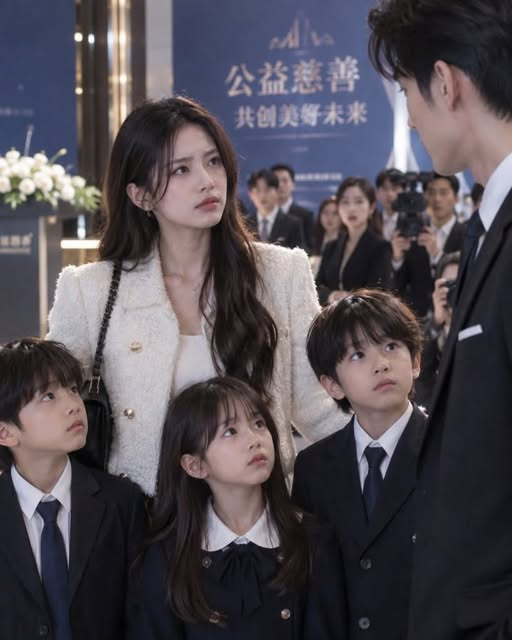
Tinh Ha, watching from backstage, frowned.
“He’s really dramatic.”
Tinh Nguyet whispered:
“Mom, can we go out?”
I looked at them.
“You understand what happens if you do?”
Cameras.
News.
Questions.
The end of anonymity.
All three nodded.
Tinh Than said:
“I’m tired of reading articles saying our father has nobody.”
So the doors opened.
The four of us walked into the hall.
The entire audience turned.
Canh Tham looked up.
And froze.
Tinh Nguyet waved.
Someone in the audience gasped.
Because no DNA test was necessary for the public to notice those faces.
I looked toward the stage.
“Luc Canh Tham.”
His microphone was still live.
“You want to announce the future of everything you own?”
I glanced at the three children.
“Perhaps meet your children first.”
The room erupted.
Canh Tham immediately stepped away from the microphone.
Not toward reporters.
Toward the children.
But Tinh Ha stopped him.
“We’re not here for your money.”
The hall quieted enough to hear him.
“We already had a mother who raised us.”
Tinh Than added:
“And we don’t become heirs just because you discovered us.”
Tinh Nguyet looked at Canh Tham.
“We came because Dad shouldn’t say he has nobody anymore.”
Canh Tham’s eyes turned red.
He crouched slightly so he was closer to her height.
“Can I say I have you?”
Tinh Nguyet thought about it.
Then answered:
“You can say you found us.”
Not have.
Found.
That difference mattered.
Canh Tham nodded.
“Okay.”
DNA testing later confirmed what everyone already knew.
Luc Canh Tham was their biological father.
He amended his estate planning after speaking to lawyers and, more importantly, to the children.
But I refused to let wealth become the foundation of their relationship.
“No private jets because you missed birthdays.”
“No companies because you feel guilty.”
“No ridiculous accounts intended to buy fourteen years.”
Canh Tham almost smiled.
“What am I allowed to give them?”
“Time.”
That was harder for him than money.
So he started there.
School events.
Dinner.
Programming competitions with Tinh Ha.
Long silent walks with Tinh Than.
Tea shops with Tinh Nguyet, who discovered very quickly that her terrifying billionaire father could be convinced to carry six shopping bags while she held nothing.
He missed things.
He made mistakes.
The children became angry.
He apologized.
Then showed up again.
Slowly, “Mr. Luc” became “Dad.”
Not all at once.
And never because I ordered it.
My resort design won the bid.
Blind scoring placed Tinh Van first.
Canh Tham did not participate in the vote.
That mattered to me more than the contract itself.
I had returned to Beijing as a designer.
Not as Luc Canh Tham’s abandoned wife.
Not as the mother of his heirs.
My work won before my children’s identities became public.
For once, what I had built belonged entirely to me.
Phuong Cam Hoa asked to see the children.
I refused at first.
Months later, Tinh Nguyet became curious.
So we met in a neutral place.
The old woman cried the moment she saw them.
“My grandchildren.”
Tinh Than stepped backward.
“No.”
Her face stiffened.
He continued:
“You don’t get to call us that before apologizing to Mom.”
Phuong Cam Hoa looked at me.
For a long time, pride fought with age.
Age finally won.
“I was wrong.”
I said nothing.
“I thought family background determined a person’s worth.”
Her voice trembled.
“And I destroyed my son’s family trying to protect the Luc family.”
I accepted the apology.
I did not erase the past.
The children developed a limited relationship with her afterward.
On their terms.
Hua Nhuoc Lan disappeared from our lives entirely.
Not destroyed.
Not ruined.
Simply no longer welcome in a story she had spent fourteen years trying to occupy.
Canh Tham asked me once if we could remarry.
Only once.
It happened almost three years after my return.
The children had gone upstairs.
We were standing outside my new apartment.
He said:
“I still love you.”
I believed him.
That was the hardest part.
I looked at the man who had once held an umbrella over me in the rain.
Then at the man who had spent fourteen years believing the worst version of me because believing it hurt less than searching for the truth.
“I loved you too.”
His eyes filled.
“Past tense?”
I smiled.
“Some love survives.”
“That doesn’t mean the marriage should.”
He nodded slowly.
“Is there someone else?”
“No.”
That seemed to hurt even more.
Because I was not choosing another man.
I was choosing the life I had built without him.
He whispered:
“Then what are we?”
I looked through the window.
Inside, our three children were arguing over who had eaten the last piece of cake.
“Parents.”
“Maybe friends someday.”
“And two people who once loved each other enough to create three extraordinary children.”
He nodded.
Then smiled.
“I can live with that.”
And he did.
Years later, Luc Canh Tham still donated enormous amounts to charity.
The children did not stop him.
Tinh Ha eventually built his own technology company.
Tinh Than studied law.
Tinh Nguyet chose architecture and told everyone she had inherited her talent from me, which irritated her father immensely.
None of them needed to wait for his death to become someone.
That was the greatest inheritance I could have given them.
Fourteen years earlier, I left Beijing in the rain believing Luc Canh Tham had chosen another woman.
He remained behind believing I had destroyed our child and sold our marriage for five million yuan.
We were both wrong.
But his mother’s lie was not the only thing that separated us.
Silence did.
Pride did.
The willingness to believe pain instead of asking one more question did.
When I returned with three children who had his face, everyone thought the greatest surprise was that Luc Canh Tham had heirs.
It wasn’t.
The real surprise was that his children did not come back asking for an empire.
They came asking whether the man who had lost fourteen years was willing to earn the years that remained.
And for the first time in his life, Luc Canh Tham discovered something money could not purchase:
the right to be called “Dad.”
