Daniel stood in the doorway staring at the ripped seam.
“Clara… what the hell did you do with my mother’s quilt?”
I slowly looked up.
Not at the brick.
Not at the metal plates.
Not at the strange bags hidden where cotton should have been.
At him.
“Our four-year-old has been waking up freezing under this thing for three nights.”
Daniel swallowed.
Then he said:
“You shouldn’t have opened it.”
Everything inside me went still.
I stood.
“Why?”
“I just mean Mom worked hard on it.”
“No.”
I pointed toward the floor.
“You knew there was something inside.”
His expression answered before his mouth did.
“Daniel.”
“It’s not what you think.”
That sentence frightened me more than anything I had found.
I immediately took Lucas out of the room and called for professional help because I had no idea what the powder was.
We were told not to disturb the contents further.
By morning, the answer came.
The powder was not an illegal substance.
It was cheap construction filler and moisture-absorbing material.
But almost three quarters of the quilt contained no proper insulating cotton at all.
Metal.
Dense fabric scraps.
Pieces of building material.
Anything heavy enough to make the quilt feel expensive when lifted.
That was why Lucas had been cold.
Weight was not warmth.
Teresa had made something that looked luxurious in photographs while removing almost everything that actually protected a sleeping child.
I turned toward Daniel.
“Did you know?”
He rubbed his face.
“Not exactly.”
“What does that mean?”
“My mother has been having money problems.”
I stared at him.
“What does that have to do with my son sleeping beneath garbage?”
Daniel finally sat down.
Then the truth came out.
Teresa had not been making quilts only for family.
Two years earlier, she had started a small community business selling “traditional handmade cotton bedding.”
Her social-media posts became popular.
Then a local charity began ordering winter quilts from her for elderly people and low-income families.
People donated money.
Businesses sponsored batches.
Teresa posted photographs of mountains of fresh cotton beneath captions about generosity and tradition.
But cotton prices had risen.
And Teresa had discovered something easier.
She bought enough good cotton for photographs and samples.
Then sold part of it.
The rest of the quilts were filled with cheaper material.
At first, Daniel claimed, it was only recycled fabric.
Then Teresa began adding weight so customers would believe the quilts contained the amount of cotton they had paid for.
I stared at him.
“You knew she was doing this?”
“I knew she was substituting material.”
“How long?”
He didn’t answer.
“How long, Daniel?”
“About a year.”
I felt sick.
“And you said nothing?”
“She’s my mother.”
I laughed.
A small, empty sound.
“Lucas is your son.”
Daniel looked away.
That hurt more than the quilt.
Then I noticed one of the metal plates on the floor.
A number had been stamped into it.
I photographed it.
Later that afternoon, I searched the number online.
It belonged to an inventory batch from a warehouse.
A warehouse owned by Daniel’s uncle.
That opened the next door.
And behind that door was something much larger.
The charity had paid Teresa for six hundred premium winter quilts.
Invoices claimed every quilt contained new cotton of a specified quality.
Daniel had helped prepare those invoices.
His signature appeared on several documents.
He had not simply known.
He had helped make the numbers look real.
When I confronted him, he exploded.
“You went through business records?”
“They’re public filings.”
“You’re trying to destroy my family!”
“No.”
I put the documents on the table.
“Your family sent a fake quilt to my child.”
“It was a mistake!”
“Was sending hundreds of them to other families also a mistake?”
His face went white.
That night Teresa arrived without calling.
She pushed past Daniel and pointed at me.
“You ungrateful woman!”
I stood between her and Lucas’s room.
She continued:
“I spent days making that quilt and you cut it apart like trash.”
“It was trash.”
Her face twisted.
“You have no respect.”
“You put pieces of brick inside your grandson’s blanket.”
“That wasn’t meant for Lucas!”
Silence.
Daniel closed his eyes.
Teresa realized too late what she had admitted.
I asked quietly:
“Then who was it meant for?”
She said nothing.
“Another child?”
Nothing.
“An elderly person?”
Still nothing.
I looked at Daniel.
He whispered:
“Mom…”
Teresa suddenly began crying.
She said the business had debts.
She said sponsors demanded impossible prices.
She said everybody exaggerated product quality.
She said she planned to replace the bad quilts eventually.
Every explanation had the same problem.
Someone else had to suffer so Teresa could protect her reputation.
And Daniel had chosen to help her.
I called the charity the next morning.
I didn’t accuse anyone.
I simply gave them the batch information and asked them to inspect the remaining quilts independently.
They did.
Within a week, distribution stopped.
Dozens of quilts were recalled and checked.
Many contained inferior filling.
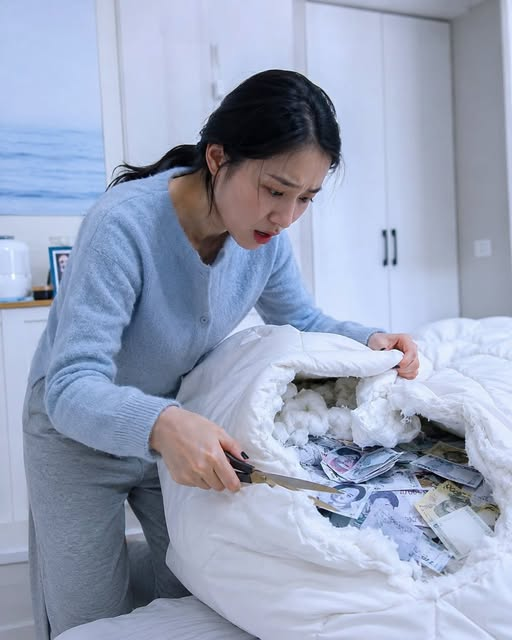
Several had been deliberately weighted.
The photographs Teresa had posted showing beautiful white cotton?
Investigators discovered the same cotton had been staged repeatedly for different batches.
The charity demanded its money back.
Sponsors withdrew.
The business was suspended while the financial records were reviewed.
Teresa blamed me for everything.
Daniel did too.
That was when I finally understood my marriage.
Whenever his mother crossed a boundary, Daniel asked me to forgive her.
Whenever I complained, he asked me to remain quiet.
Whenever she hurt me, he explained her intentions.
But when her deception reached our son, he still protected her first.
So I packed.
Daniel stood beside the suitcase.
“You’re leaving over a quilt?”
I looked at him.
“No.”
His expression hardened.
“I’m leaving because when you saw what was inside it, you were angry at me for opening it.”
He had no answer.
I took Lucas with me to my sister’s home while our lawyers arranged everything properly.
Daniel called constantly.
First angry.
Then apologetic.
Then angry again.
Finally, one evening, he said:
“I didn’t think Lucas would actually get sick.”
I closed my eyes.
There it was again.
He thought the absence of the worst possible consequence meant his choices were acceptable.
“That’s why we’re finished,” I told him.
“Because you keep measuring right and wrong by how much damage someone survives.”
The investigation lasted months.
Teresa eventually had to repay a significant amount of money.
Her handmade-quilt business closed.
The charity publicly replaced the affected bedding.
Daniel faced consequences too because of the records he had signed.
He lost his financial role in the family business and spent months cooperating with the investigation.
Our marriage did not survive.
I did not try to make Lucas hate his father or grandmother.
He was too young to carry adult betrayal.
He only knew that Mom and Dad lived in different homes now.
And that Grandma was not allowed to send bedding anymore.
The first winter after the divorce, Lucas and I went shopping together.
He chose a quilt covered in little blue rockets.
It was surprisingly light.
He lifted it suspiciously.
“Mom, this won’t be warm.”
I smiled.
“That’s what I used to think too.”
That night, I tucked him in.
At two in the morning, I woke automatically.
For months, my body had remembered those nights when I ran into his room and found him shivering.
I walked quietly to his bed.
Lucas was asleep.
His cheeks were warm.
One foot had escaped from beneath the rocket quilt.
I covered him again.
He opened his eyes slightly.
“Mom?”
“I’m here.”
“Is Grandma’s heavy quilt coming back?”
“No.”
He thought for a moment.
Then smiled sleepily.
“Good. I like this one.”
“So do I.”
I kissed his forehead and turned off the lamp.
For years Teresa had taught everyone around her that heavier meant better.
A heavier quilt meant more cotton.
More photographs meant more love.
More sacrifice meant better motherhood.
And Daniel had believed something similar.
That family loyalty meant carrying whatever weight his mother placed on us without asking what was hidden inside.
I learned differently.
Sometimes the heaviest things contain the least warmth.
Sometimes people fill emptiness with appearances and expect you to call it love.
And sometimes the only way to discover why you have been cold for so long…
is to finally cut open the thing everyone keeps telling you to be grateful for.
