I looked at Manh Phi.
“Your mother feels guilty because I upgraded?”
She nodded carefully.
“She thinks she caused you to spend an extra 3,500 yuan.”
“That’s true.”
Her smile stiffened.
I continued:
“So what exactly do you want?”
She hesitated.
Then finally said:
“There’s a small matter.”
Of course there was.
She pulled a folded form from her handbag.
“If you could sign this, everything would be easier.”
I took it.
It was a voluntary seat-change declaration.
According to the document, I had willingly given up seat 21A because I preferred another seat.
I looked up.
“You want me to lie?”
Her expression changed immediately.
“Don’t say it like that.”
“How else should I say it?”
She lowered her voice.
“The flight attendant was only trying to help an elderly passenger. If you file a complaint, she could be disciplined.”
“And?”
Manh Phi stared at me.
“You’re young. You can afford first class. Why make things difficult for someone over a seat?”
I almost admired the logic.
First, her mother took something I paid for.
Then I paid even more to avoid arguing.
And now I was being asked to falsify the record so nobody responsible would face consequences.
I handed the paper back.
“No.”
Her smile disappeared.
“Ms. Khuong, my mother really does have high blood pressure.”
“Then she should have asked the crew for medical assistance.”
“She didn’t want to make a scene.”
I looked toward business class.
“She had no problem making me one.”
Manh Phi’s face hardened.
Before she could answer, the chief flight attendant approached.
“Is there a problem?”
I pointed toward the form.
“This passenger wants me to sign that I voluntarily surrendered seat 21A.”
The chief attendant’s expression changed.
She turned toward Manh Phi.
“Where did you get that?”
For the first time, Manh Phi looked uncertain.
“The other attendant gave it to me.”
Silence.
The chief attendant took the paper.
“Please return to your assigned seat.”
Manh Phi did not move.
“Do you know who I am?”
There it was.
The sentence people use when rules are supposed to apply only to everyone else.
The chief attendant remained professional.
“I know you are a passenger on this flight.”
Manh Phi’s eyes narrowed.
“I am a platinum member. My family has flown with this airline for more than ten years.”
“And we appreciate that.”
“Then don’t humiliate my mother.”
I put down my champagne glass.
“No one humiliated her.”
Both women looked at me.
“She took another passenger’s seat and pretended to be too ill to move.”
Manh Phi snapped:
“My mother was genuinely uncomfortable.”
“Then why was she laughing and taking pictures by the window five minutes later?”
Her face froze.
The chief attendant looked toward business class.
Then at me.
“Ms. Khuong, may I ask exactly what happened?”
So I told her.
Everything.
My boarding pass.
The elderly woman in 21A.
The request to move me to economy 12C.
The pressure.
The whispers.
The upgrade.
When I finished, the chief attendant’s expression was no longer polite.
It was serious.
“Economy 12C?”
“Yes.”
She turned toward another crew member.
“Bring me the passenger manifest.”
Less than a minute later, she had it.
She read it.
Then read it again.
Her expression changed completely.
I already knew why.
Seat 12C was not an empty seat they had “arranged” for me.
It was the elderly woman’s original seat.
Her name was printed beside it.
I stared at Manh Phi.
“So that was the plan.”
She said nothing.
Her mother had bought economy.
Her friend had business seat 21B.
They wanted to sit together.
Instead of paying for an upgrade, the mother simply occupied my seat.
And the flight attendant attempted to send me to the economy seat the mother had abandoned.
Not a compassionate seat exchange.
A free upgrade.
Paid for by me.
The chief attendant asked:
“Did your mother request a medical seat change before boarding?”
Manh Phi’s lips tightened.
“I don’t know.”
The crew member checked the system.
“No request.”
“Any medical assistance requested during boarding?”
“No.”
“Any report of dizziness?”
Another pause.
“No.”
Manh Phi’s voice became sharp.
“She told the attendant verbally.”
The chief attendant looked at her.
“Then we’ll ask the attendant.”
The young flight attendant who had pressured me appeared several minutes later.
Her face was already pale.
The chief attendant asked one question.
“Why did you tell Ms. Khuong that 12C had been arranged for her?”
The girl swallowed.
“I thought she might be willing to help.”
“That wasn’t my question.”
Silence.
“Was 12C Mrs. Meng’s assigned seat?”
“Yes.”
“And did Ms. Khuong agree to exchange?”
The girl looked down.
“No.”
“Then why was Mrs. Meng allowed to occupy 21A?”
Her eyes filled with tears.
“I only wanted to help.”
Manh Phi immediately interrupted.
“She did nothing wrong. My mother was uncomfortable.”
But the chief attendant continued:
“Do you personally know this family?”
That question changed everything.
The young attendant’s face went white.
Manh Phi said sharply:
“That has nothing to do with this.”
The attendant whispered:
“I’ve served them several times before.”
“How many?”
“I don’t know.”
“Did Ms. Manh contact you before boarding?”
Silence.
The answer was obvious.
Eventually, she admitted it.
Manh Phi had messaged her before the flight.
Her mother wanted to sit beside her old friend in business class.
There were no business seats available.
So the attendant had written:
Let her sit first. Most passengers won’t argue with an elderly person.
I felt my anger disappear.
Not because it no longer mattered.
Because the truth was so much uglier than I had expected.
The dizziness was theater.
The moral pressure had been planned.
Even the “comfortable economy seat” waiting for me was simply the seat they needed me to accept so the records would balance.
The chief attendant apologized immediately.
Not the vague kind.
A real one.
“Ms. Khuong, what happened should never have occurred. Your original seat was reassigned without your consent, and you were improperly pressured to accept a lower cabin.”
Manh Phi crossed her arms.
“Is all this really necessary?”
I looked at her.
“You came into first class to ask me to sign a false statement.”
“I was protecting someone’s job.”
“No.”
I shook my head.
“You were protecting a favor you expected to keep receiving.”
She went silent.
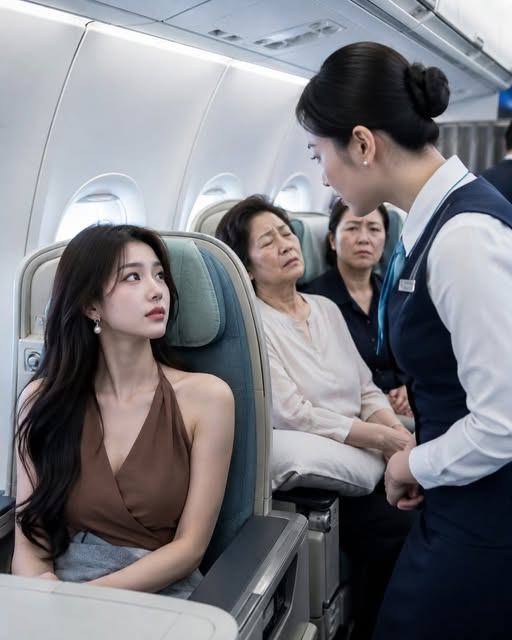
The chief attendant informed her that her mother had to return to her assigned seat.
That was when the miracle happened.
The woman who supposedly could barely walk stood up perfectly well.
She protested all the way down the aisle.
“My head is spinning!”
A nearby passenger laughed.
“You’ve been taking window photos for half an hour.”
Another added:
“You looked healthy enough when the meal cart came.”
Her face turned red.
Eventually she returned to 12C.
Seat 21A remained empty.
I stayed in 1A.
I had paid for it.
And I had no intention of moving again.
Before landing, the chief attendant returned.
“The airline will refund your upgrade charge.”
I looked at her.
“Why?”
“Because you should never have needed to purchase it in order to receive the class of service you originally paid for.”
That was reasonable.
Then she added:
“You’ll also receive a formal written response after the incident review.”
I nodded.
“Thank you.”
Manh Phi did not speak to me again.
But the story did not end on the plane.
Three days later, the airline contacted me.
The cabin records, messages and passenger statements had been reviewed.
The original attendant was removed from premium-cabin duties pending disciplinary proceedings.
Not because she had shown compassion.
Because she had deliberately displaced a paying passenger for someone she knew and then misrepresented the seat change.
The airline also reviewed previous flights involving the same family.
Apparently, this was not the first time Manh Phi’s platinum status had been used to request “small favors.”
Extra baggage ignored.
Preferred boarding.
Unauthorized seat changes.
Nothing enormous.
That was how entitlement usually grew.
Not through one massive act.
Through dozens of small exceptions nobody wanted to challenge.
Manh Phi called me once after the investigation began.
I almost didn’t answer.
Then I did.
Her first sentence was:
“Are you satisfied now?”
I laughed.
“With what?”
“My mother is embarrassed. That flight attendant may lose her position. My account is under review.”
“You contacted me.”
“You could have simply let it go.”
I was quiet for a moment.
Then I asked:
“If I had quietly sat in 12C, would you have called me afterward to apologize?”
She said nothing.
“Would your mother have felt guilty?”
Still nothing.
“Would that flight attendant have reported what she did?”
Silence.
I had my answer.
“You’re not upset because something unfair happened.”
I continued:
“You’re upset because the person expected to absorb the unfairness refused.”
Her voice turned cold.
“It was just one seat.”
“Yes.”
I smiled.
“Mine.”
Then I hung up.
Months later, I flew the same route again.
Business class.
Seat 21A.
When I reached it, the seat was empty.
Exactly as it should have been.
An elderly man in 21B smiled at me.
“Window seat?”
“Yes.”
“Lucky.”
I laughed.
“I paid for the luck.”
He laughed too.
Halfway through the flight, he asked whether I would mind switching for ten minutes so he could take a photograph of the mountains.
“Of course.”
I moved happily.
Because this time, somebody had asked.
That was the difference everyone on the first flight pretended not to understand.
I was never angry because an elderly woman wanted my seat.
If she had looked at me and said:
“I’m sorry, would you mind exchanging? I’d really like to sit beside my friend.”
I might even have agreed.
What I refused was being told that my money, comfort and choice mattered less simply because someone else could perform weakness more convincingly.
Kindness that is freely given is kindness.
Kindness demanded through shame is obedience.
And there is a simple rule I never forgot after that flight:
If you need to steal someone’s seat before asking for their compassion, you were never asking for compassion in the first place.
