“Dear Aunt Grace,
If you’re reading this, it means Mom finally kicked you out.
Please don’t come back yet.
And whatever she says, you did not steal the necklace.”
My hands began shaking.
The letter was from Ethan.
I kept reading.
“Three nights ago, I heard Mom talking to Aunt Rebecca. She said you had almost completed ten years and that Dad had promised you a large service payment.
She said paying that much to ‘a maid’ was ridiculous.
Then she said something worse:
‘If she leaves for misconduct, we owe her nothing.’
I didn’t understand until yesterday.
I saw Mom take the pearl necklace from her jewelry box herself.”
I covered my mouth.
My mother called from downstairs.
“Grace? Are you all right?”
“Yes.”
My voice barely came out.
I turned the page.
Ethan had written:
“Grandpa warned me years ago that one day Mom might do this.
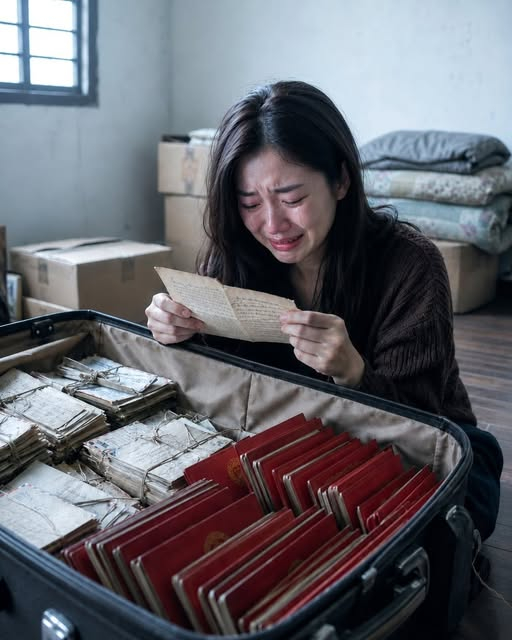
That’s why I put the deeds in your suitcase.
They are yours.
Please open envelope number two.”
I stared at the ten red booklets again.
Then I tore open the second envelope.
Inside was a flash drive.
And a note.
Watch the file before speaking to anyone.
My old laptop took several minutes to start.
When the video finally appeared, my breath stopped.
It was footage from the villa’s hallway camera.
Timestamp:
The night before I was accused.
Mrs. Harrison walked into her bedroom wearing a robe.
She opened her jewelry box.
Removed the pearl necklace.
Looked toward the door.
Then slipped it into the pocket of her dress.
Ten minutes later, another camera showed her entering the unused guest room.
She opened a drawer.
Put the necklace inside.
And left.
The next morning, she announced it had been stolen.
She had framed me.
But Ethan had saved more than one clip.
Another recording showed Mrs. Harrison speaking to her sister on the phone.
“You don’t understand. Zhou completes ten years next week.”
A pause.
“Charles’s father set up something ridiculous for her years ago.”
My entire body went cold.
Charles.
Mr. Harrison.
She continued:
“Ten properties. One for every year she raised Ethan.”
My fingers froze on the keyboard.
“One for every year.”
Mrs. Harrison laughed bitterly on the recording.
“As though she were family.”
Then came the sentence that explained everything.
“If she’s dismissed for theft before the final transfer is confirmed, I’ll challenge it.”
The video ended.
I sat there staring at my reflection in the dark screen.
Ten years.
She had not accused me because she believed I was a thief.
She accused me because she knew exactly what I had earned.
And she wanted to make sure I never received it.
With trembling hands, I opened envelope number three.
This letter was not from Ethan.
The handwriting belonged to an old man I had not seen in almost three years.
Arthur Harrison.
Ethan’s grandfather.
He had died eighteen months earlier.
“Grace,
If these papers have reached you, then Ethan has finally followed my instructions.
When you first came into our household, I assumed you would remain six months.
Instead, you remained through ten years of illnesses, arguments, birthdays, school examinations, and every disaster this family created for itself.
When Ethan was six, he once told me that he had two mothers.
I corrected him.
I should not have.
You gave that boy something none of our money could purchase: the certainty that when he called, someone would come.
So I made an arrangement.
For every completed year you stayed with the family, my private trust purchased one property in China for you.
They were never wages.
Your wages should have been paid separately and properly.
These properties were meant to ensure that one day, if this family ever convinced you that you had nowhere else to go, you would know they were lying.
I ask only one thing.
Do not return simply because you feel guilty about Ethan.
A child who truly loves you should want you to have a life of your own.”
I could no longer read.
The tears blurred everything.
Arthur Harrison had noticed.
While I was waking at five every morning thinking I was invisible…
someone had noticed.
My phone rang the following morning.
Dubai number.
Ethan.
I answered immediately.
“Aunt Grace?”
The moment I heard his voice, I started crying.
“So you found them.”
“Yes.”
“Are you angry?”
“At you?”
“No.”
He exhaled.
“Good.”
Then his voice changed.
“Dad found the necklace.”
I stayed silent.
Ethan continued:
“I showed him the recording.”
My chest tightened.
“What happened?”
“Mom said she was only trying to scare you.”
I laughed through my tears.
“Scare me into what?”
“I asked her that.”
There was a pause.
“She didn’t answer.”
Then another voice appeared.
Mr. Harrison.
“Grace.”
For ten years, I had answered that voice immediately.
“Yes, sir.”
This time he said:
“Don’t call me sir.”
I remained quiet.
He continued:
“I owe you an apology.”
My hands tightened around the phone.
“I should have spoken when Patricia accused you.”
“Yes.”
One word.
He seemed surprised.
Perhaps he expected me to make forgiveness easy for him.
I didn’t.
“I knew you,” he said. “I knew what kind of person you were. And yet I remained silent because arguing with my wife was inconvenient.”
I closed my eyes.
That was exactly what had hurt.
Not the accusation.
His silence.
He continued:
“The necklace was found exactly where the recording showed she placed it.”
“And the other employees?”
“They’ve been told the truth.”
“No.”
My voice sharpened.
“That’s not enough.”
He went silent.
“She called people while I was leaving.”
I remembered every word.
The Chinese employee. She seemed honest, but turned out to be a thief.
“I want every person she told to receive the correction from her.”
Mr. Harrison replied immediately:
“They will.”
“And my unpaid salary.”
“Already being transferred.”
“The ten-year compensation you promised.”
“You’ll receive it in full.”
“And I want a written statement confirming that I was never dismissed for theft.”
There was a pause.
Then:
“You’ll have it today.”
For the first time in ten years, I was not asking that family for kindness.
I was setting terms.
Mrs. Harrison called me herself that evening.
I almost did not answer.
Then I did.
Her voice was stiff.
“Grace.”
I waited.
“The necklace has been recovered.”
“That is an interesting way of saying you hid it.”
She went silent.
Then:
“I was angry.”
“At me?”
“At my father-in-law.”
She sounded almost offended.
“He treated you as though you were one of us.”
I thought about Arthur Harrison’s letter.
“No.”
I answered quietly.
“He treated me as though I was a person.”
That silenced her.
Then she asked the question I had been expecting.
“Will you return the deeds?”
I laughed.
Actually laughed.
“They belong to me.”
“He bought them with Harrison money.”
“Then challenge the trust.”
Her breathing changed.
She knew she couldn’t.
Arthur Harrison had completed the transfer instructions before his death.
My ten-year service anniversary had occurred four days before I was expelled.
The properties had already vested.
Mrs. Harrison had framed me too late.
Finally she whispered:
“Ethan refuses to speak to me.”
That hurt.
Despite everything, I did not want the boy caught between adults.
So I said:
“Then apologize to him.”
“For what?”
“For teaching him that people who care for your family can be thrown away the moment they become inconvenient.”
She said nothing.
I ended the call.
I never returned to work at the Harrison villa.
Mr. Harrison offered.
Then doubled the salary.
Then offered me an apartment in Dubai.
I refused everything.
Ethan was the only reason the decision hurt.
We video-called every Sunday.
The first few weeks, he cried.
Then I cried.
Eventually, we stopped crying and began talking about ordinary things again.
School.
Football.
His impossible chemistry teacher.
My mother complaining that I used too much salt.
Six months later, Ethan came to China with his father.
He was nearly as tall as Mr. Harrison now.
The moment he saw me outside the airport, he dropped his backpack and ran.
“Aunt Grace!”
I held him so tightly he complained he couldn’t breathe.
Then he whispered:
“I knew you weren’t a thief.”
That sentence meant more to me than all ten property deeds.
Mr. Harrison stood several feet away.
When Ethan finally released me, Charles approached.
He handed me a folder.
A written apology.
Confirmation of every payment.
And a notarized statement clearing my name.
“I should have defended you before my son had to.”
“Yes.”
He nodded.
“I know.”
I forgave him eventually.
But I never worked for him again.
That distinction mattered.
Forgiveness did not mean returning to the room where I had been humiliated.
The ten properties changed my parents’ lives.
Some I rented.
Two I sold.
One became my home.
And one small building outside my hometown became something I had never imagined owning.
A childcare center.
I named it Arthur House.
Not because Arthur Harrison gave me money.
Because he had understood something that wealthy people often forgot:
Care was work.
Loyalty was work.
Showing up every night for a frightened child was work.
And people who performed that work deserved security, dignity, and a future of their own.
Years later, Ethan attended university.
On his graduation day, he introduced me to his friends.
Not as the family maid.
Not as the employee who raised him.
He simply said:
“This is Aunt Grace. She’s family.”
I looked across the crowd and saw Mr. Harrison smile.
Mrs. Harrison was there too.
We were never close again.
But when our eyes met, she lowered hers first.
I no longer needed that victory.
Because the greatest lesson of those ten years was not that a poor maid could secretly become wealthy.
It was something far simpler.
Mrs. Harrison believed that because I arrived with one suitcase, I owned nothing.
So when she threw me out, she expected me to leave exactly as I had come.
She was wrong.
I left carrying ten deeds.
A letter from an old man who had seen my worth.
And the love of a boy who had hidden the truth inside my suitcase because he refused to let his family erase me.
But even those were not the most important things I carried home.
After ten years of being called only “Zhou,” I finally remembered that I had a full name.
Grace Zhou.
And for the first time in a decade—
my life belonged entirely to her.
