I looked at Ky Nien.
For twenty years, I had imagined his return countless times.
I imagined him dropping his suitcase at the door.
Complaining that foreign food had ruined his stomach.
Eating the braised ribs I made until there was nothing left.
Maybe hugging me and saying:
“Mom, I’m home.”
I never imagined he would bring the man who denied him on the first day of his life.
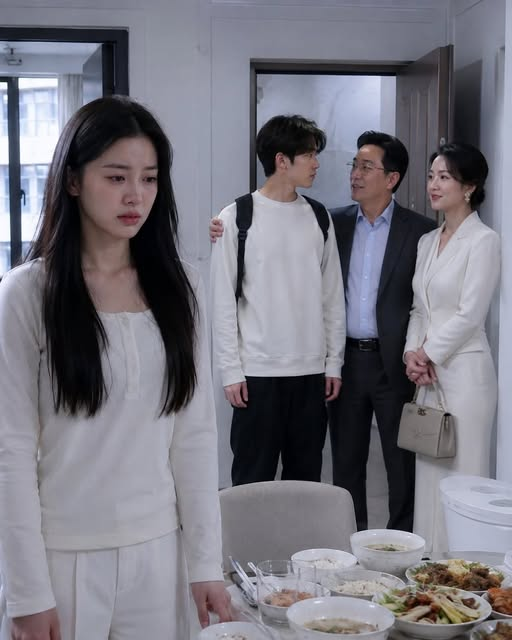
Yet there Hac Canh sat.
In my chair.
Beside the woman he had left me for.
And my son was asking me to smile.
Ky Nien pulled out a chair.
“Mom, sit down first.”
“No.”
He frowned.
“Don’t make this awkward.”
I laughed softly.
“Awkward?”
I looked at Hac Canh.
“Your father stood outside the maternity ward twenty years ago holding a DNA report that said 99.99% and still told everyone you weren’t his.”
Ky Nien’s expression changed.
“I know.”
“No.”
I shook my head.
“You know the sentence. You did not live what came after it.”
Hac Canh finally spoke.
“Thu Nghi, I was young.”
“So was I.”
“I was confused.”
“I had just given birth.”
He fell silent.
Cao Nhan gently interrupted.
“Ms. Thu, Mr. Hac has regretted it for years.”
I turned toward her.
“You married him immediately after our divorce.”
Her smile disappeared.
“That was a long time ago.”
“Yes.”
I nodded.
“That’s why I’m surprised you both traveled this far to ask me to forget it.”
Ky Nien became impatient.
“Mom, nobody is asking you to forget.”
“You told me not to hold on anymore.”
“That’s different.”
“How?”
He exhaled.
“Dad helped me.”
There it was.
Not love.
Not repentance.
Usefulness.
Ky Nien continued:
“When I needed a recommendation for my research placement, Dad introduced me to a professor.”
“When I was choosing my graduate program, he helped me.”
“He knows people in academia.”
“And Aunt Cao helped me find an internship.”
His voice softened.
“I finally understand that having more family connections isn’t a bad thing.”
I stared at him.
Then asked:
“And where was that understanding when you were six and had pneumonia?”
He froze.
“When you were nine and I worked the night shift after cleaning offices all morning?”
“Mom—”
“When you were fourteen and needed tutoring, who sold her only gold bracelet to pay for it?”
His face reddened.
“I know you sacrificed.”
“Do you?”
I leaned closer.
“Because today you walked into the home I paid for, sat your father at my table and told me his connections might be useful to you.”
Silence.
Hac Canh frowned.
“Don’t blame the boy. I contacted him too.”
I looked at him.
“You had twenty years.”
His face stiffened.
“You could have contacted him when he was three.”
“Five.”
“Ten.”
“Fifteen.”
“You waited until he had entered a prestigious university abroad.”
I smiled without warmth.
“What a coincidence.”
Ky Nien stood.
“That’s unfair!”
I looked at my son.
“Maybe.”
“But I’m allowed to be unfair in my own home after being ambushed with a reconciliation dinner.”
His face changed.
I continued:
“You may have a relationship with your father.”
“You are an adult.”
“I will never ask you to hate him for me.”
Ky Nien relaxed slightly.
Then I finished:
“But you will not use that relationship to pressure me into restoring mine.”
Hac Canh stood.
“I didn’t come only because of Ky Nien.”
I almost smiled.
Of course.
He reached into his jacket and placed a small box on the table.
Inside was a ring.
Not my old one.
A new one.
“I know what I did was unforgivable.”
Cao Nhan’s face turned pale.
I looked at her.
Then at him.
“You brought your current wife here to watch you ask your ex-wife back?”
Hac Canh hesitated.
That hesitation said enough.
Cao Nhan pushed her chair back.
“Hac Canh?”
He turned.
“I told you we were coming for Ky Nien.”
“You said we were coming to repair the family.”
His expression tightened.
She laughed bitterly.
“So I was transportation for your reunion?”
Ky Nien looked horrified.
“Dad…”
I leaned back.
Suddenly the entire performance became clear.
Hac Canh wanted everything.
The respected son.
The forgiving ex-wife.
The current wife standing politely nearby.
A perfect ending where nobody asked what it had cost us.
I closed the ring box.
“No.”
Hac Canh stared at me.
“Thu Nghi—”
“No.”
“I can compensate you.”
That made me laugh.
“Compensate?”
“For all those years.”
“How?”
“Property.”
“Money.”
“I can arrange a position for Ky Nien when he returns.”
My son’s eyes flickered.
I saw it.
The smallest movement.
But enough.
Then I understood why he had been pushing so hard.
I turned to him.
“Did your father promise you a job?”
Ky Nien looked away.
“Not promise.”
“Ky Nien.”
“He said he could introduce me to the university.”
Silence.
“And you thought getting me to forgive him would help.”
His eyes filled.
“It wasn’t like that.”
“Then tell me what it was like.”
He could not.
My heart went very quiet.
Not broken.
Quiet.
I stood.
“I think dinner is over.”
“Mom—”
“You may stay with your father tonight.”
His face went pale.
“You’re kicking me out?”
“No.”
I shook my head.
“You arrived with him.”
“You can leave with him.”
“But this is my home too.”
That sentence hurt.
Still, I answered calmly.
“This has always been your home.”
“But home does not mean you can bring someone who humiliated me into it without asking.”
He stared at me.
For the first time, perhaps, he saw me not simply as Mom.
But as a person.
He left angry.
All three of them did.
I sat alone at the table after the door closed.
Six dishes.
Soup still warm.
His favorite fish untouched.
I thought I would cry.
Instead, I took out my phone and called my lawyer.
“Mr. Lin, I want to change the documents we prepared for Ky Nien.”
A month earlier, before his return, I had planned to surprise my son too.
Two years after he went abroad, I bought a lottery ticket on the way home from one of my jobs.
I almost threw it away.
It was worth the equivalent of nearly one hundred million.
I told no one.
I paid the taxes.
Invested most of it.
Bought a small apartment.
Quit two of my three jobs.
Then, because old habits die slowly, I continued living simply.
I had planned to transfer a property to Ky Nien after graduation.
Set up a postgraduate fund.
Give him enough security to choose work he loved rather than chase money.
That night, I did not take everything away.
He was still my son.
But I changed one thing.
The assets would remain in a trust under my control.
No immediate transfer.
No blank check.
No reward for suddenly deciding family relationships should be measured by “resources.”
Three days later, Ky Nien returned alone.
He looked exhausted.
“Mom.”
I opened the door.
He did not enter immediately.
“I’m sorry.”
I waited.
He swallowed.
“I wanted Dad’s help.”
“I know.”
“And when he started treating me well, I liked it.”
That honesty mattered.
“I kept thinking maybe if you forgave him, I could have everything.”
He looked down.
“A mother who raised me.”
“A father with connections.”
“A complete family.”
I said quietly:
“You wanted the ending without living through the middle.”
His eyes reddened.
“Yes.”
Then he whispered:
“I said something cruel.”
I knew which sentence.
Don’t hold on anymore.
Ky Nien continued:
“You weren’t holding on.”
“You were remembering.”
I stepped aside.
This time, I let him in.
We talked for nearly three hours.
I told him things I had protected him from as a child.
Not to poison him against Hac Canh.
To stop pretending history did not exist.
His father had refused to recognize him despite the DNA report.
He had avoided support for years.
He had only begun sending money regularly after legal enforcement.
Then eventually stopped contacting us completely.
Ky Nien listened.
Finally he asked:
“Why didn’t you tell me all this?”
“Because I wanted you to decide what kind of relationship you wanted with him without carrying my hatred.”
He cried then.
“I thought you were jealous because he helped me.”
“No.”
I touched his hand.
“I was hurt because you treated my suffering as an obstacle to your networking.”
He covered his face.
“I’m sorry.”
This time, I believed him.
He did not cut off his father.
I never asked him to.
But the relationship changed.
Ky Nien stopped calling Hac Canh “Dad” simply because the title made academic doors easier to open.
He started asking harder questions.
Why now?
Why not twenty years ago?
Why had Hac Canh allowed another woman to replace his mother before even giving his marriage a respectful ending?
Hac Canh did not enjoy those conversations nearly as much as the late-night discussions about universities.
Cao Nhan filed for divorce several months later.
Apparently, watching her husband present a ring to his ex-wife while she sat beside him ended whatever patience remained in their marriage.
I felt no satisfaction.
Their marriage was their problem.
Mine had ended twenty years earlier.
As for the lottery money, Ky Nien discovered it by accident almost a year later.
He was helping me organize documents when he saw an investment statement.
He stared at the number.
“Mom…”
I looked up.
“What?”
His mouth opened.
Closed.
Then:
“You’re rich?”
“Apparently.”
“You won this?”
“Yes.”
“When?”
“Two years ago.”
He sat down.
“And you never told me?”
“No.”
For a second, I saw embarrassment cross his face.
Then he asked quietly:
“Were you testing me?”
That question made me pause.
“No.”
“I had already learned what I needed to learn before the money came.”
He looked relieved.
Then I told him about the trust.
Not the amount.
Not the properties.
Only that I had prepared something for his future.
He looked at me.
“And after what I did?”
“Yes.”
“Why?”
“Because you made a selfish mistake.”
I smiled faintly.
“You didn’t stop being my son.”
His eyes filled.
“But understand something.”
I continued:
“What I give you is not payment for choosing me over your father.”
“You never have to choose.”
“You simply have to stop asking me to pretend what happened did not happen.”
He nodded.
Years later, Ky Nien became a lecturer without using Hac Canh’s promised position.
He wanted that achievement to be his.
He still spoke with his father sometimes.
Their relationship became quieter.
More honest.
No worship.
No hatred.
Just consequences.
And me?
I never took Hac Canh back.
Not for his apology.
Not for his ring.
Not because he finally admitted Ky Nien was his son twenty years after science had already done so.
The man who once looked at a 99.99% DNA result and chose the 0.01% excuse had already made his choice.
I simply stopped allowing him to rewrite it.
The hardest lesson was not learning that my son could disappoint me.
Children grow up.
They become imperfect adults.
They make selfish decisions.
Sometimes they wound the person who sacrificed most for them.
But love does not require pretending the wound never happened.
And forgiveness does not require reopening every door.
That night, when Ky Nien brought Hac Canh home and told me not to “hold on anymore,” I thought twenty years of sacrifice had meant nothing.
I was wrong.
My son eventually understood.
But even if he hadn’t, my life still had value beyond being his mother.
I had survived.
Worked.
Raised him.
Started over.
And when fortune finally arrived, I discovered I no longer needed money, a husband, or even my son’s approval to prove what my life was worth.
Hac Canh once rejected his child over 0.01%.
Twenty years later, I rejected something too:
the idea that being abandoned meant I had to remain available forever when the people who left finally decided I was useful again.
