The doctor looked at me for several seconds before answering.
“It means the stroke caused significant impairment. Your mother will need rehabilitation, medication management and assistance with daily activities for quite some time.”
My heart sank.
“How long?”
“No one can promise you that.”
He continued calmly:
“The first months are important. But rehabilitation is work. The family needs to prepare.”
Family.
That word had always sounded simple in my mother’s mouth.
Family meant Uyen Tinh cooking.
Uyen Tinh washing.
Uyen Tinh enduring.
Uyen Tinh forgiving.
Now, for the first time, the doctor was looking at me when he said it.
I walked back into the hallway.
Chu Hao immediately stood.
“Brother, what did he say?”
“She’ll need long-term care.”
His face changed.
Then he asked without hesitation:
“Sister-in-law is a nurse. Call her.”
I stared at him.
It was so natural.
Eight years later, he still thought the same way.
“What?”
“She knows this stuff.”
He threw away his cigarette.
“And she’s Mom’s daughter-in-law. Who else is supposed to do it?”
That sentence hit me harder than I expected.
Who else?
Me.
You.
Dad.
The sons our mother had spent her entire life praising.
But somehow, when there was dirty work, everyone remembered the daughter-in-law they had once chased out.
I called Uyen Tinh anyway.
Not to order her home.
Because I was frightened.
She answered on the third ring.
“What happened?”
“My mother had a stroke.”
Silence.
Then her voice became professional.
“Which hospital?”
I told her.
“What did the doctor say?”
I explained.
She asked several medical questions I did not know how to answer.
Finally she said:
“Send me the discharge and imaging reports when you get them. I can help you understand the rehabilitation plan.”
I swallowed.
“Can you come?”
Another silence.
“To the hospital?”
“Yes.”
“I’ll come after my shift.”
That evening she arrived wearing her nurse’s uniform.
Eight years.
My mother had not seen her in person for eight years.
Yet the moment Uyen Tinh entered the ward, my mother’s eyes filled.
Her good hand reached toward her.
“Uyen…”
Her speech was unclear.
Uyen Tinh walked closer.
She adjusted the blanket.
Checked the chart.
Asked the attending nurse about medication.
She was calm.
Respectful.
Professional.
My mother began crying.
I thought perhaps this was the moment everything would change.
Then she struggled to say:
“Home… you… care…”
I froze.
Even now.
Even lying in a hospital bed unable to move one side of her body properly, my mother’s first instinct was still:
Bring the daughter-in-law back.
Uyen Tinh understood too.
She stood quietly.
Then said:
“Mom, I hope you recover well.”
My mother held her hand.
“Come… home.”
Uyen Tinh gently removed her fingers.
“No.”
My brother’s expression immediately darkened.
“Sister-in-law, Mom is like this and you still want to argue about old things?”
Uyen Tinh turned toward him.
“I am not arguing.”
“Then come home.”
“No.”
“You’re a nurse!”
“At the hospital, yes.”
“She’s your mother-in-law!”
“And you are her son.”
Chu Hao went silent.
I looked at my wife.
For the first time, I truly understood that she was not refusing because she enjoyed seeing my mother suffer.
She had come.
She had explained the rehabilitation plan.
She had even written down questions we should ask the doctors.
But she would not cross that house’s threshold.
Not even now.
I asked quietly:
“Is it because of those two slaps?”
Uyen Tinh looked at me.
“No.”
I froze.
She continued:
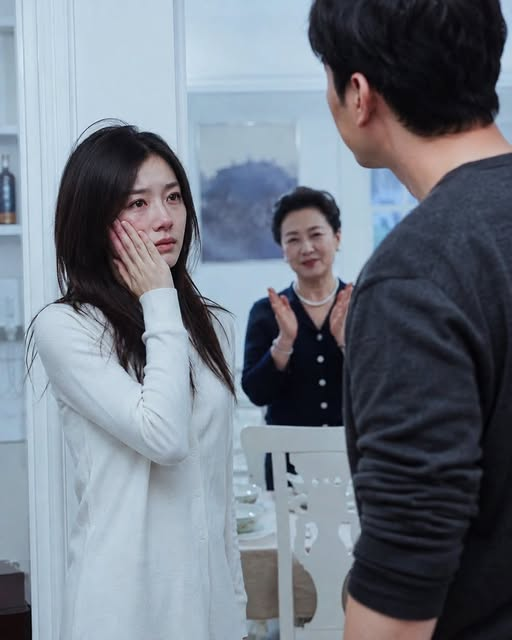
“It is because after those two slaps, your mother applauded.”
“Your brother laughed.”
“Your father watched.”
“And you never once stood in front of me and told them what happened was wrong.”
My throat tightened.
“I apologized.”
She shook her head.
“You said you had been angry.”
“You said I shouldn’t have argued with your mother.”
“You said it would never happen again if everyone calmed down.”
She looked directly at me.
“That is not an apology.”
I had no answer.
She picked up her bag.
“I’ll send you information about rehabilitation agencies.”
Then she looked at my mother.
“If you need medical advice, call me.”
And she left.
She did not step into our family home.
Not that night.
Not the next week.
Not when my mother was discharged.
For the first month, we tried to manage ourselves.
That was when I finally learned what Uyen Tinh had done for years.
My mother needed help getting dressed.
She needed assistance eating.
Medication had to be given on schedule.
Appointments had to be tracked.
Exercises had to be repeated even when she became irritated.
Sheets had to be changed.
Meals had to be prepared differently.
And because my mother had always had a bad temper, illness did not magically make her gentle.
Chu Hao lasted four days.
Then he said:
“My shop is too busy.”
His wife Ly Phuong came once.
She brought fruit.
Stayed twenty minutes.
Then said:
“I don’t know how to do medical things.”
Nobody criticized her.
Nobody called her unfilial.
Nobody demanded she quit her life.
I noticed.
For the first time, I noticed everything.
My father was old.
He could not physically manage most of the care.
So I reduced my construction work.
Then I hired a trained caregiver.
My mother complained about the cost.
“Why pay strangers? Uyen Tinh…”
I interrupted her.
“No.”
She stared at me.
“Your daughter-in-law is not coming back here to serve you.”
The room went silent.
My father looked up.
Chu Hao stared at me.
My mother became furious.
“She’s your wife!”
“Yes.”
“And I hit her.”
Her expression changed.
I continued:
“In this house.”
“With you applauding.”
Nobody spoke.
For eight years I had treated those two slaps as an old argument.
That day I finally said the word I should have said in 2015.
“I abused my wife.”
The sentence tasted terrible.
It should have.
My mother tried to wave her good hand.
“It was only twice.”
“No.”
I shook my head.
“It was twice too many.”
Chu Hao muttered:
“Brother, why bring up the past now?”
I looked at him.
“Because we kept calling it the past so none of us had to admit what it meant.”
He stopped talking.
From then on, I stopped asking Uyen Tinh to return for holidays.
I stopped sending messages saying:
“Mom misses you.”
I stopped using Tieu Ngu as an excuse.
If my parents wanted a relationship with their granddaughter, they could speak to her respectfully through video calls or meet somewhere outside the old house when appropriate.
The house was my mother’s boundary.
Not Uyen Tinh’s duty.
Months passed.
My mother improved slowly.
Not completely.
But enough to speak more clearly.
One afternoon, she asked me:
“Does Uyen Tinh still send the supplements?”
I looked at the unopened box beside the table.
“Yes.”
She stared at it.
“Why?”
I knew what she meant.
Why did a woman she had humiliated still remember her medication?
“Because she has better manners than we did.”
My mother became quiet.
Several weeks later, she asked me to call Uyen Tinh.
I did.
But I warned her:
“You don’t have to answer.”
She did.
My mother’s speech was slower than before.
“Uyen Tinh.”
“Yes.”
For a long time, nothing came.
Then:
“I was wrong.”
My wife remained silent.
My mother continued:
“That day… I should not have applauded.”
Another pause.
“I should not have called you useless.”
“Or mocked Tieu Ngu because she was a girl.”
I closed my eyes.
Eight years.
It had taken eight years and a stroke for my mother to speak those sentences.
Uyen Tinh finally answered:
“Thank you for saying it.”
My mother began crying.
“Will you come home?”
I held my breath.
Uyen Tinh’s answer was gentle.
“No.”
My mother closed her eyes.
But this time she did not curse.
She only nodded.
That was when I finally understood the lesson.
An apology could be accepted without the old door being reopened.
Uyen Tinh did not owe us a return simply because we finally admitted we had hurt her.
Later that evening, I drove home to the apartment where Uyen Tinh and Tieu Ngu lived.
My daughter was doing homework.
Uyen Tinh was peeling an apple in the kitchen.
I stood in the doorway.
“I’m sorry.”
She did not look up immediately.
“For what?”
“For hitting you.”
Not:
Because I was angry.
Not:
Because Mom provoked you.
Not:
Because we were all upset.
Just the truth.
“For humiliating you in front of my family.”
“For spending eight years asking you to return to the place where it happened instead of asking why you never felt safe enough to go back.”
She put the knife down.
I continued:
“And for thinking gifts to my parents meant you had forgiven them.”
“They didn’t.”
“I know.”
I swallowed.
“I finally know.”
She looked at me for a long time.
Then asked:
“Why now?”
“Because when Mom needed care, everyone immediately looked for you.”
I laughed bitterly.
“And I suddenly saw what our family had always done.”
“When there was respect to give, the daughters-in-law came last.”
“When there was work to do, they came first.”
Something softened in her eyes.
Not forgiveness.
Maybe recognition.
I never asked her to return to my parents’ house again.
My mother lived another several years.
She and Uyen Tinh met occasionally.
At the hospital.
At restaurants.
Once at Tieu Ngu’s school performance.
Always somewhere neutral.
Uyen Tinh remained polite.
My mother gradually learned not to demand more.
Our marriage did not magically become perfect.
Trust does not grow back because someone finally learns the correct words.
I had to change through ordinary things.
Defending my wife when relatives criticized her.
Doing my share at home.
Treating our daughter as someone worth celebrating.
Stopping the belief that being a son meant my wife inherited every responsibility I did not want.
Years later, someone asked me why Uyen Tinh still refused to enter my parents’ old house even after everyone had apologized.
Once, I would have called her stubborn.
Now I answered:
“Because forgiveness does not require returning to the place where you learned you were unsafe.”
On December 28, 2015, I slapped my wife twice.
I thought the marks disappeared within days.
They did.
What remained was the knowledge that when I raised my hand, my entire family approved.
For eight years, Uyen Tinh never stepped into that house again.
I used to think she was punishing us.
She wasn’t.
She was protecting the part of herself we had once expected her to sacrifice in the name of family.
And the lesson she spent eight years teaching me was painfully simple:
A closed door is not always revenge.
Sometimes it is the boundary that lets a marriage survive what should never have happened inside it.