For several seconds, nobody moved.
The admiral’s hand remained at his brow.
I stood there, stunned.
Then instinct took over.
I returned the salute.
It was not about rank.
It was not ceremony.
It was something older.
Personal.
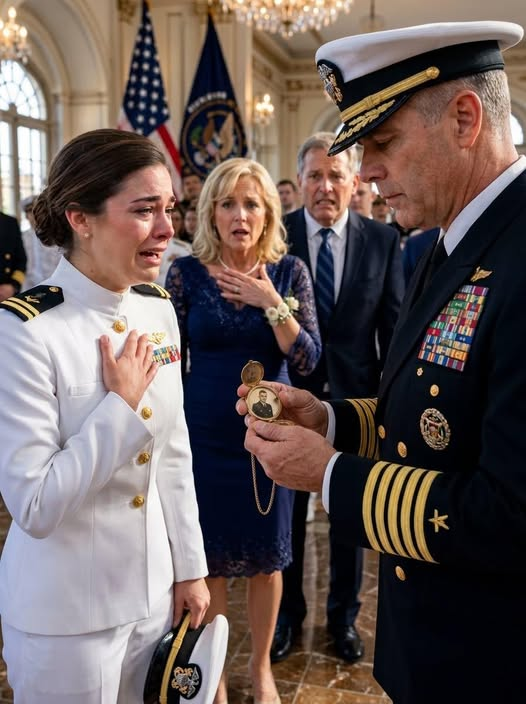
When the admiral lowered his hand, he held up the brass knife.
“Do you recognize this?”
“Yes, sir.”
My voice came out quieter than I intended.
“It belonged to my grandfather.”
My father suddenly stood.
“Where did you get that?”
The admiral looked at him.
Not angrily.
Almost sadly.
“From your father.”
Dad went white.
My mother stared between them.
“What is going on?”
The admiral turned the knife in his hand.
Engraved across the handle were five words:
NO ONE SERVES ON AN EMPTY STOMACH.
I had seen those words in photographs since childhood.
Grandpa Jack had spent more than thirty years in the Navy.
But my father rarely talked about what he had actually done.
Whenever I asked, Dad summarized it with one dismissive sentence:
“He spent most of his career in kitchens.”
As though that were the embarrassing part of an otherwise respectable life.
The admiral looked at me.
“Your grandfather was Chief Culinary Specialist Jack Callahan.”
A murmur passed through the room.
“He was also one of the best chiefs I ever served under.”
My mother blinked.
“A cook?”
The admiral heard her.
His expression sharpened.
“No, ma’am.”
Then he paused.
“He was a sailor whose specialty was feeding people.”
There was a difference in the way he said it.
And everyone heard it.
He continued.
“When I was a young lieutenant, we were deployed during a major storm. Supply lines were disrupted. Power failed in sections of the ship. Men were exhausted.”
“He kept that galley operating.”
“But that was only the visible part.”
The admiral looked around the room.
“Chief Callahan reorganized supplies, rationed fresh water, caught a contamination problem before it affected hundreds of sailors, and somehow kept hot food moving when half the crew believed it couldn’t be done.”
He smiled faintly.
“He used to say morale entered through the stomach before it reached the heart.”
My throat tightened.
That sounded exactly like Grandpa.
Then the admiral looked back at my father.
“And when the crew gave him this knife at the end of that deployment, Jack considered it one of the greatest honors of his career.”
Dad finally spoke.
“He told me it was lost.”
“No.”
The admiral’s answer was immediate.
“He gave it to me.”
My father’s face collapsed.
Aunt Linda whispered:
“Why?”
The admiral looked at the envelope in my pocket.
“Because of her.”
Every eye turned toward me.
I touched the letter.
Grandpa had given it to me shortly before he died.
One day, people will understand.
That was all he had said.
I had carried it through moves.
Deployments.
Promotions.
Bad days.
Good days.
I had never opened it.
Some part of me was afraid it would contain another goodbye.
The admiral nodded toward it.
“I think today was the day he meant.”
My hands trembled as I tore open the envelope.
Grandpa’s handwriting filled three pages.
I recognized the first line immediately.
Kiddo,
If you are finally opening this, I hope it means you stopped asking people for permission to respect the life you chose.
My eyes burned.
I continued.
He wrote about my first summer job in a restaurant.
How I came home smelling like onions and dish soap and announced that I loved the kitchen.
He remembered Dad laughing.
He remembered my mother saying:
“She’ll grow out of it.”
I hadn’t.
Then came the part that made my father sit down.
Your father believes I wanted something different for this family.
He is wrong.
What I wanted was for each of you to find work you could do with pride.
He was ashamed when you chose culinary service because he spent his childhood hearing people call me “only a cook.”
I thought I had taught him better.
Apparently I did not.
I looked at Dad.
He was staring at the floor.
The letter continued.
Years ago, I offered your father my galley knife.
He refused it.
He told me he did not want to inherit the symbol of a career he had spent his life trying to rise above.
The room disappeared around me.
I looked at the admiral.
He nodded.
“He was there.”
My father closed his eyes.
Grandpa had written:
So I gave it to a young officer I trusted.
I asked him for one favor.
If you stayed in the Navy long enough to learn that service is not measured by how close you stand to the bridge, he was to return it to you.
Not because you are my granddaughter.
Because you would have earned it.
I stopped reading.
I couldn’t see clearly anymore.
The admiral waited.
Then said:
“Two months ago, your command submitted your name for the Fleet Culinary Leadership Award.”
My mother’s mouth opened.
The admiral continued.
“You redesigned emergency meal operations during your last deployment.”
“You reduced supply waste.”
“You created a dietary tracking system that has since been adopted elsewhere.”
“And during a forty-eight-hour equipment failure, your team continued feeding more than eighteen hundred sailors.”
He looked directly at me.
“You weren’t selected because you are Jack Callahan’s granddaughter.”
“You were selected before anyone on the board knew.”
Then he smiled.
“That’s why I knew it was finally time to bring the knife.”
No one spoke.
The ceremony began twenty minutes later.
I barely remember walking to the front.
I remember my name being called.
I remember the applause.
I remember the weight of Grandpa’s knife when the admiral placed it in my hands.
And I remember looking toward my parents.
My mother was crying.
My father was not.
He simply looked old.
Afterward, he found me alone near the harbor.
For a while, neither of us spoke.
Finally he said:
“I hated that knife.”
“I know.”
He stared at the water.
“When I was young, people asked what my father did.”
“I would say Navy chief.”
“If they asked his job, I’d say logistics.”
I looked at him.
“You were ashamed of him.”
“Yes.”
The answer surprised me.
No excuses.
He continued.
“I wanted him to be an officer.”
“I wanted people to hear his job and be impressed.”
He gave a bitter laugh.
“Dad knew.”
“What happened when he offered you the knife?”
My father looked down.
“I told him I didn’t want to inherit a kitchen tool.”
My chest hurt.
“He didn’t speak to me for a week.”
“Later I apologized.”
“But I don’t think I ever understood why it hurt him.”
He finally looked at me.
“Then you joined.”
“You chose the same specialty.”
“And instead of admitting my father had built a career I was too arrogant to appreciate…”
He swallowed.
“I did the same thing to you.”
There it was.
The apology I had stopped expecting years ago.
“I told myself I wanted more for you.”
“But really, I wanted your life to make me look important.”
I said nothing.
He continued:
“I’m sorry.”
Not:
You’re too sensitive.
Not:
We only wanted the best.
Just:
I’m sorry.
I nodded.
“Thank you.”
His face changed slightly.
Maybe he expected more.
Forgiveness.
A hug.
Some instant restoration of everything his jokes had slowly damaged.
I wasn’t ready for that.
And for once, he seemed to understand.
My mother took longer.
On the drive home, she said:
“I didn’t realize cooks in the Navy did all that.”
I looked out the window.
“That’s because you never asked.”
She became quiet.
Months passed.
Things changed slowly.
My parents stopped introducing me as:
“She works in a kitchen.”
My father started saying:
“My daughter is a Navy culinary specialist.”
At first, he said it awkwardly.
Then with pride.
The first time I heard him explain my emergency-feeding program to one of his friends, I almost interrupted to correct three technical mistakes.
I didn’t.
He was trying.
That mattered.
A year later, the brass knife hung in a case in my quarters.
Not as a family trophy.
As a reminder.
Inside the case, beneath it, I placed the final paragraph of Grandpa’s letter.
Never let anybody convince you that the work keeping people alive, fed, rested or cared for is somehow beneath the people receiving the credit.
Titles impress rooms.
Service changes them.
Choose the second.
Years later, I became a chief myself.
At my pinning ceremony, Dad arrived early.
He sat in the front row.
When another parent asked what I did, I heard him answer:
“She runs a galley.”
For one second, the old pain returned.
Then he added:
“And if you think that means she just cooks, you have absolutely no idea what her job is.”
I turned away before he saw me smile.
Grandpa had been right.
One day, people understood.
But the most important person who needed to understand was never the admiral.
Never the audience.
Not even my father.
It was me.
For years, I thought being “just a cook on a ship” meant I had somehow settled for less than my family expected.
Then a four-star admiral crossed a crowded room carrying my grandfather’s knife and reminded everyone of something I should never have forgotten:
There is no “just” in honest work done with excellence.
And the knife my father once rejected eventually came to me—
not because I inherited Grandpa Jack’s name,
but because I had finally earned my own.
