That night, after the funeral, I made hot chocolate for the girls.
None of them drank it.
April fell asleep against my side.
Rachel sat on the rug staring at nothing.
Lucy disappeared into the guest room and returned carrying her mother’s old canvas backpack.
She placed it on the table.
“Grandma, Mom told us to give you this if Dad tried to send us away.”
My hands went cold.
Inside was a diary.
A flash drive.
And a sealed white envelope.
Across the front, in Rose’s handwriting, were five words:
For the woman marrying Arthur.
I looked at Lucy.
“When did she give you this?”
“Two weeks before she went into the hospital.”
My daughter had known.
Maybe not that she was going to die.
But she had known exactly what kind of man she was leaving her children with.
The first pages of the diary hurt too much to read.
Rose had written about ordinary things.
April losing her first tooth.
Rachel winning a spelling contest.
Lucy pretending she was too old to hold her mother’s hand.
Then Arthur’s name began appearing more often.
March 14: Arthur came home after midnight again. Said work. His shirt smelled like perfume.
April 2: I found messages with Melanie. He says they’re only friends.
May 20: He asked whether my life-insurance policy names him or the girls. Why would he ask that now?
Melanie.
The woman waiting in the white van at the cemetery.
Arthur’s fiancée.
I kept reading.
Rose had been seriously ill for months.
During that time, Arthur had apparently stopped pretending.
He told her he was “already emotionally gone.”
Then he became interested in something else.
Money.
Rose had inherited a modest investment account from her grandfather.
It wasn’t enormous.
But she had placed most of it in custodial accounts for the girls’ education.
According to her diary, Arthur wanted access.
Rose refused.
That was when she began recording conversations.
I inserted the flash drive into my laptop.
Arthur’s voice filled the kitchen.
Calm.
Impatient.
“Rose, if something happens to you, I’m going to be responsible for three girls alone. Transfer the accounts to me now.”
My daughter answered weakly:
“They’re for the girls.”
“I am their father.”
“Then protect the money.”
A pause.
Then Arthur:
“I have a life too. I’m not spending the next fifteen years trapped raising children by myself.”
Lucy closed her eyes.
She had heard this before.
I stopped the recording.
“You girls were never supposed to carry this.”
Lucy whispered:
“Mom said adults sometimes don’t believe children.”
That sentence almost broke me.
So Rose had given them proof.
Not revenge.
Protection.
The next morning, I called a family-law attorney.
By afternoon, we had begun an emergency guardianship petition.
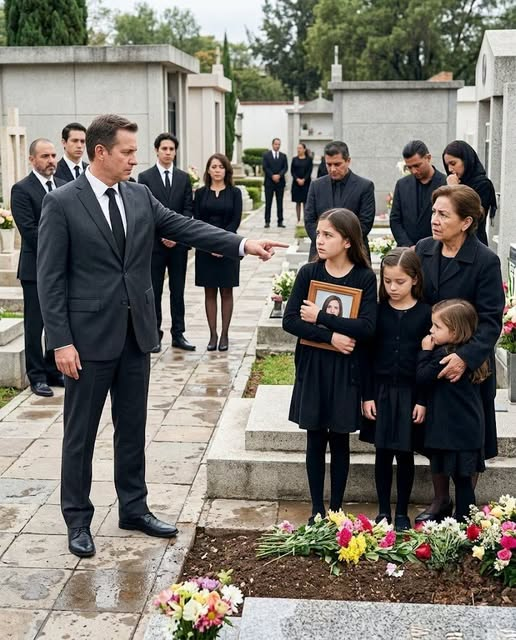
Arthur had announced publicly that he intended to place his daughters in foster care.
He had also left them with me and disappeared.
My lawyer was careful.
“He cannot simply erase his parental responsibilities by declaring he wants a new life.”
“What happens now?”
“We document everything. We protect the girls. And we ask the court for temporary orders.”
So that was what we did.
No dramatic kidnapping of the children.
No secret escape.
Paperwork.
School records.
Medical records.
Rose’s documents.
Arthur’s messages.
And witnesses from the funeral.
Three days later, Arthur called me.
“Bring the girls back.”
I nearly laughed.
“You said they were going to foster care.”
“I was emotional.”
“At your wife’s funeral?”
Silence.
Then his voice hardened.
“My attorney says what I said could look bad.”
There it was.
Not:
I miss my daughters.
Not:
I made a terrible mistake.
What worried Arthur was how it looked.
I said:
“The girls are safe.”
“You have no right to keep them from me.”
“Then speak to the court.”
He lowered his voice.
“Do not turn this into a custody war.”
“You started one beside my daughter’s grave.”
He hung up.
The sealed envelope remained unopened.
It wasn’t for me.
Rose had written Melanie’s name on the back.
I sent it through an attorney.
No note.
No threat.
Just Rose’s envelope.
Arthur and Melanie’s wedding was scheduled for six weeks after the funeral.
Six weeks.
Apparently grieving had an expiration date.
I didn’t know what was inside the envelope until Melanie called me.
Her voice was shaking.
“Mrs. Bennett?”
“Yes.”
“This is Melanie.”
I almost ended the call.
Then she said:
“I read Rose’s letter.”
I stayed quiet.
“She told me Arthur would say she hated me.”
“Did he?”
“Yes.”
“She wrote that she didn’t.”
That surprised me.
Melanie began crying.
“She said she blamed Arthur more because he was the one who made vows to her.”
That sounded like Rose.
Even dying, my daughter had aimed her anger precisely.
Then Melanie asked:
“Did Arthur really say he wanted to put the girls into foster care?”
“He said it in front of more than two hundred people.”
“He told me you had begged to raise them.”
My hand tightened around the phone.
“No.”
“He said Rose wanted the girls to live with you if anything happened.”
“No.”
Melanie became silent.
Then:
“There’s more.”
I waited.
The envelope contained copies of bank records.
Arthur had attempted twice to move money from one of the girls’ custodial accounts.
Both transfers had been rejected because Rose had structured the account to require additional authorization.
The amounts matched two payments Arthur had recently promised toward his wedding.
The venue deposit.
And Melanie’s engagement ring.
Melanie whispered:
“He told me the ring came from his bonus.”
I closed my eyes.
Of course he had.
Rose’s final paragraph to her said:
If you still marry him after reading this, that is your decision. But please understand what kind of future he is trying to purchase, and whose money he was willing to use to pay for it.
Melanie canceled the wedding four days later.
Arthur arrived at the venue anyway.
According to one of Rose’s cousins who worked there, he spent almost an hour insisting there had been a misunderstanding.
Melanie never came.
She had returned the ring through her lawyer.
The wedding ended before anyone walked down the aisle.
But that was not Arthur’s greatest consequence.
Family court was.
During the temporary hearing, his attorney tried to soften what happened at the funeral.
“He was grieving.”
My lawyer played a recording.
Arthur’s voice:
“I’m not spending the next fifteen years trapped raising children by myself.”
The room became very quiet.
Then came the financial records.
Arthur had not successfully taken the girls’ education money.
That mattered.
But he had tried.
And his repeated statements about abandoning responsibility mattered too.
The court did not magically erase him as their father.
Instead, temporary guardianship remained with me while the situation was evaluated.
Arthur received structured contact.
He was ordered not to involve the girls in financial or adult relationship disputes.
And his financial obligations to his daughters did not disappear simply because he wanted them to.
Months later, the longer-term arrangement gave me primary guardianship.
Arthur retained limited parental rights and responsibilities under the court’s conditions.
Lucy asked me afterward:
“Does that mean Dad lost?”
I shook my head.
“No.”
“But we stay with you.”
“Yes.”
“So we won.”
I pulled her close.
“You girls aren’t a prize.”
She looked at me.
“Then what happened?”
“The adults finally listened.”
That answer seemed to satisfy her.
Arthur did not.
He came to my house once after the order.
He looked exhausted.
“I lost Melanie.”
I stared at him.
“My daughter is dead, Arthur.”
His face changed.
I continued:
“And somehow you still walked here believing your broken engagement was the tragedy I should care about.”
He looked away.
“I made mistakes.”
“You abandoned three grieving children at their mother’s funeral.”
“I didn’t abandon them.”
“You announced it.”
“I thought foster care might be easier.”
“For whom?”
He had no answer.
That was Arthur’s problem.
He had spent so long arranging life around what was easiest for him that he had forgotten other people were not furniture.
He eventually asked:
“Did Rose hate me?”
I thought about the diary.
“No.”
That surprised him.
“She was furious with you.”
“She was disappointed.”
“She stopped trusting you.”
“But hate?”
I shook my head.
“She was too busy trying to protect her daughters.”
His eyes filled.
For once, I believed the tears.
But tears did not change guardianship.
They did not return Rose.
They did not erase what Lucy had heard.
So I said:
“If you want your daughters to know you someday, start becoming someone they don’t have to protect themselves from.”
Then I closed the door.
Life afterward was messy.
Rachel had nightmares.
April asked for Rose every morning for months.
Lucy tried to become the third parent until I repeatedly reminded her she was twelve.
“You are allowed to be a child.”
“But Mom told me to protect them.”
“She gave you the backpack because she was scared.”
I held her shoulders.
“Now I have it.”
“You don’t need to carry it anymore.”
Eventually, she believed me.
We kept Rose’s diary locked away.
Not because her story was shameful.
Because her daughters deserved to grow up without having to reread their mother’s pain every time they missed her.
Years later, on Lucy’s eighteenth birthday, I gave her the final page.
Rose had written it for all three girls.
It said:
If you are reading this, something probably went wrong. Do not build your lives around what went wrong. Build them around what you still have. You have each other. You have Grandma. And you have every right to become happy without asking permission from anyone who abandoned you.
Lucy cried.
So did I.
Arthur eventually rebuilt a relationship with the girls.
Slowly.
Not with all three equally.
Trust doesn’t grow on command.
He paid what he owed.
He attended counseling.
He stopped making promises he couldn’t keep.
He never married Melanie.
And I never thanked her for canceling the wedding.
She hadn’t done it for me.
She had simply read the truth before she made the same mistake Rose had spent years trying to survive.
At my daughter’s funeral, Arthur stood beside her grave and believed three little girls were the baggage preventing him from beginning a better life.
He thought he could hand them away and drive toward a new marriage.
But Rose knew him better than that.
So before she died, she left behind three things:
A diary containing the truth.
Recordings containing his own voice.
And one sealed envelope for the woman he planned to marry next.
Arthur thought he was leaving his daughters behind.
Instead, he walked away from the only people who had ever called him Dad—
and straight toward the evidence their mother had prepared to make sure they would never be abandoned quietly.
The envelope stopped his wedding.
The recordings protected the girls.
But Rose’s greatest gift was neither.
It was making sure her daughters understood one thing before she was gone:
Being left behind by someone does not mean you were the thing that wasn’t worth keeping.
