Vanessa stopped smiling.
The investigator’s name was Daniel Mercer.
He did not raise his voice.
He did not threaten her.
He simply gave one order.
“Secure the room.”
Two officers stepped forward.
Vanessa backed away from my bed.
“This is a misunderstanding.”
Daniel looked at the empty urn.
“No.”
His voice was flat.
“It’s an investigation.”
For the first time since Ana died, I saw fear on Vanessa’s face.
Not guilt.
Fear.
That difference mattered.
She immediately tried Sebastián’s name.
“General León knows I’m here.”
Daniel replied:
“We know.”
“He authorized everything.”
“We know that too.”
Her face changed.
I stared at him.
“What do you mean?”
Daniel turned toward me.
“We recovered security records from the residence, hospital access logs, internal messages and orders connected to the destruction of evidence.”
My heart began pounding.
“The complaint?”
“Was never legally withdrawn.”
I could barely speak.
“They told me it disappeared.”
“It was removed from the local system.”
Daniel paused.
“But the original submission generated an external audit trail.”
Someone had tried to bury my complaint.
They had failed to erase its shadow.
Daniel continued:
“Commander Torres, this case has been moved outside Sebastián León’s chain of command.”
That sentence did something to me.
For months, every door had closed because Sebastián’s name stood behind it.
Lawyers disappeared.
Witnesses suddenly remembered nothing.
Officials told me I was grieving and confused.
But now someone had finally moved the case somewhere Sebastián could not reach.
Vanessa was taken away that afternoon.
Sebastián arrived less than an hour later.
He entered the corridor still wearing his uniform.
The moment he saw Daniel, he stopped.
“What is this?”
Daniel showed him the order.
Sebastián barely glanced at it.
“You have no authority to question my officers.”
“I’m not questioning your officers.”
Daniel looked directly at him.
“I’m investigating you.”
Silence.
Sebastián laughed.
At least he tried to.
“My wife is unstable.”
I was standing ten feet away.
He still called me his wife when it helped him.
Daniel asked:
“Do you deny ordering evidence removed from the family residence?”
Sebastián’s smile disappeared.
“Do you deny pressuring legal personnel after Commander Torres filed her complaint?”
No answer.
“And do you deny knowing your daughter had died before you later demanded that Commander Torres force the child to apologize?”
That was the first moment I saw confusion break through Sebastián’s arrogance.
He looked at me.
Then at Daniel.
“What are you talking about?”
Daniel did not explain in the hallway.
He simply said:
“You’ll have an opportunity to answer formally.”
Sebastián turned toward me.
“This is what you wanted?”
I stared at him.
“No.”
He seemed surprised.
“I wanted my daughter alive.”
He had no response to that.
The investigation lasted months.
Not days.
There was no magical confession.
No instant conviction.
Just evidence.
Records.
Statements.
Deleted files recovered from backups.
Witnesses who finally spoke after being removed from Sebastián’s command.
A technician admitted he had been ordered to alter timestamps.
A junior officer admitted Vanessa had asked whether a recording could be “made unusable.”
The most damaging evidence came from Sebastián himself.
He had believed authority meant control.
So he documented too much.
Messages.
Instructions.
Calls.
Orders given through official systems because he assumed nobody would ever dare inspect them.
The security footage from the day Ana died had survived in an off-site archive.
I never watched it again.
I didn’t need to.
The court did.
That was enough.
Vanessa tried to save herself by blaming Sebastián.
Sebastián blamed Vanessa.
They had once protected each other so fiercely that my daughter had become expendable.
Now, facing consequences, neither wanted responsibility for the other.
The military tribunal removed Sebastián from command while the case proceeded.
His rank did not disappear overnight.
His reputation did.
Then came formal findings involving abuse of authority, obstruction, intimidation and his role in the events that led to Ana’s death.
Vanessa faced separate charges tied to the plan, evidence tampering and the treatment of Ana’s remains.
The case took nearly two years to finish.
By then, I no longer attended every hearing.
At first I thought I had to.
Then Daniel told me something I never forgot.
“You are allowed to have a life while the system handles what it should have handled from the beginning.”
So I started trying.
Not successfully at first.
I woke up expecting calls.
I checked locks twice.
Sometimes three times.
I could not walk past children’s luggage without my chest tightening.
I stopped wearing my old uniform.
Then, one morning, I put it back on.
Not because I wanted to return to who I had been.
Because I refused to let Sebastián own that part of my life too.
I accepted a training assignment outside the region.
Later, an international security fellowship.
For the first time in years, nobody introduced me as Sebastián León’s wife.
I was Commander Emilia Torres.
That was enough.
Daniel remained in contact because of the case.
At first, every conversation was professional.
Then, after the proceedings ended, months passed without hearing from him.
One afternoon I received a message.
The investigation is officially closed. I thought you should hear that from someone who knows what it cost you.
I stared at it for a long time.
Then replied:
Thank you.
Nothing happened for weeks.
Then we met by accident at a conference.
He bought coffee.
I complained that it was terrible.
He agreed.
We talked about everything except Sebastián.
That was the first thing I liked about Daniel.
He never treated the worst thing that had happened to me as the most interesting thing about me.
Our relationship developed slowly.
Very slowly.
When he first asked to have dinner with me, I said:
“I don’t know if I’m ready for anything.”
He answered:
“Then dinner can just be dinner.”
So it was.
Months later, it became something else.
Years later, we married quietly.
No military hall.
No enormous reception.
No speeches about destiny.
Just family.
A few friends.
And one photograph of Ana placed beside the flowers.
When our son was born, I panicked.
Not during the birth.
After.
I held him and felt joy arrive tangled with fear.
For days, I barely slept.
Daniel never told me to “move on.”
Never told me this child would replace Ana.
Because nobody could.
One night, I whispered:
“I feel guilty.”
“For what?”
“For being happy.”
Daniel looked at our sleeping son.
Then at me.
“You loved Ana.”
“Yes.”
“You love him.”
“Yes.”
“Those things don’t compete.”
I cried for a long time.
Not because he had fixed anything.
Because he hadn’t tried to.
Three years later came the reunion.
The room full of old colleagues.
My son in my arms.
Then my friend’s horrified question.
And Sebastián standing behind me.
He looked older.
His uniform was ceremonial, not command.
His career had never recovered.
He had eventually been allowed to retain a lesser administrative role after serving the penalties imposed through the military and civilian proceedings, but the future he once expected was gone.
He stared at my son.
The boy hid his face against my shoulder.
Sebastián whispered:
“He looks nothing like me.”
I almost laughed.
“No.”
His gaze moved to Daniel, who had just entered behind him.
Understanding arrived.
Sebastián’s face changed.
“You married him?”
“Yes.”
“The investigator?”
“Yes.”
For once, I refused to explain myself further.
He looked at my son again.
“What’s his name?”
I hesitated.
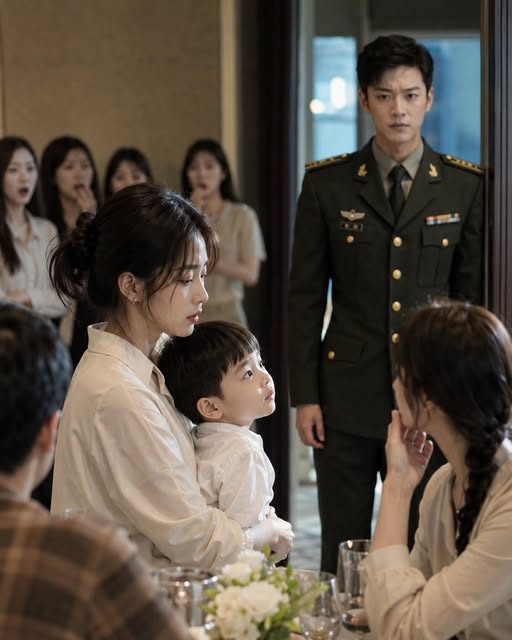
Then answered.
“Leo.”
Sebastián swallowed.
“Does he know about Ana?”
“He’s three.”
“When he’s old enough, he will.”
Silence.
People around us pretended not to listen.
Then Sebastián asked the question I knew would come.
“Do you hate me?”
Years earlier, I would have said yes.
I had hated him enough to think hatred could keep me standing.
Now?
“No.”
That hurt him more.
He looked almost angry.
“How can you not?”
“Because I don’t want to carry you that closely anymore.”
His eyes reddened.
“I think about her every day.”
“Ana?”
He nodded.
I looked at him for a long moment.
“You should.”
His face tightened.
I continued:
“But thinking about her is not the same as having loved her correctly.”
That landed.
He lowered his eyes.
“I was wrong.”
“No.”
He looked up.
“You were cruel.”
My voice remained calm.
“Calling it a mistake makes it sound like you chose the wrong road.”
“You made decisions.”
“Repeatedly.”
“And when people warned you, you used power to silence them.”
He said nothing.
Then he whispered:
“I know.”
For the first time, I believed he did.
That didn’t change anything.
Remorse was not a time machine.
It could not return Ana.
It could not undo what I had survived.
But perhaps it meant he would spend the rest of his life understanding exactly why his daughter’s name was the most painful thing he owned.
Daniel approached.
He did not stand between us.
He simply stopped beside me.
Sebastián looked at him.
Then at our son.
Something bitter passed through his expression.
“You got everything.”
Daniel answered quietly:
“No.”
Sebastián frowned.
Daniel looked at me.
“She lost something nobody gets back.”
The room became silent.
That was why I loved him.
He never turned my survival into his victory.
Sebastián nodded slowly.
Then stepped aside.
Before leaving, he said:
“Emilia.”
I turned.
“I’m sorry.”
I looked at him.
“I know.”
Not forgiveness.
Not reconciliation.
Just acknowledgment.
He left.
That night, after the reunion, Leo fell asleep in the car.
Daniel carried him upstairs.
I stayed outside for a moment.
The air was cold.
I thought about Ana.
Six years old.
Stubborn.
Funny.
Always insisting her shoes had to match even when she wore mismatched socks.
For years, the memory of her final day had swallowed everything else.
That was another thing Sebastián had taken from me without realizing.
He had turned my daughter’s entire existence into one tragedy.
I refused to let that be her legacy.
So the following spring, I created a scholarship in Ana’s name.
Not for victims.
Not for military families.
For children who loved science.
Because Ana had once told me she wanted to build machines that could “make clouds go backward.”
Every year, the scholarship letter began with one sentence:
Ana Torres believed impossible questions deserved serious answers.
That was how I wanted people to know her.
Not by the way she died.
By the way she lived.
Years after our divorce, Sebastián saw me carrying another child and believed, for one stunned second, that I had somehow returned to him.
That I had forgiven everything.
That my son was his.
He was wrong.
My life had not circled back.
It had continued.
The investigator who once walked into my hospital room carrying evidence had eventually become the man who learned how to sit beside grief without trying to control it.
My son did not replace my daughter.
My new family did not erase my old one.
And Sebastián’s punishment was never simply losing rank, status or power.
It was living long enough to understand that Ana had needed a father—
and he had chosen authority, pride and another woman’s approval instead.
I survived him.
But that was not my greatest victory.
My greatest victory was that years later, when people spoke my daughter’s name—
I no longer heard only the worst day of her life.
I heard her laughter.
And that was the one thing Sebastián could never take from me.
