That night, after Luc Hoai Xuyen left for the hospital, I did not wait for him.
The lawyer sent me the list of documents I needed.
Marriage certificate.
Property records.
Bank statements.
Identification.
I gathered everything before midnight.
Then I placed my father’s medical file on the dining table.
On top of it, I left one note.
I do not blame you because my father died.
I am leaving because today I discovered the rules you used to explain his death were rules you were willing to break for someone else.
At 2:17 in the morning, I dragged my suitcase out of our home.
Hoai Xuyen returned after four.
He called me twelve times.
I answered the thirteenth.
“Gia Hoa, where are you?”
“At a hotel.”
“What are you doing?”
“Waiting for my lawyer tomorrow.”
Silence.
Then his voice hardened.
“You’re really divorcing me because of one operation five years ago?”
“No.”
“Then what?”
“Because five years ago I trusted your explanation.”
I closed my eyes.
“You told me you couldn’t come back because a doctor could not violate hospital procedure for a family member.”
“You said rules existed for everyone.”
“But when Wen Thu Nha called, you found a way.”
“That case was different.”
“So you keep saying.”
I waited.
“Explain the difference.”
He was silent.
I laughed quietly.
“That’s why I’m leaving.”
He arrived at my hotel before sunrise.
I did not open the door.
He stood outside for almost twenty minutes.
“Gia Hoa, your father already had organ failure.”
I answered through the door.
“You never told me that when he was alive.”
“I didn’t want to destroy your hope.”
“No.”
“You told me there was still a chance if he received surgery quickly.”
He stopped talking.
I continued:
“And when I begged you to come, you didn’t call his doctors.”
“You didn’t ask whether emergency privileges could be arranged.”
“You didn’t even try.”
“That’s what hurts.”
Not that he had failed.
That he had decided.
Then, five years later, when another woman needed him, he had decided differently.
The divorce took three months.
Hoai Xuyen resisted at first.
Not dramatically.
He simply behaved as if I would calm down.
He sent food.
Medicine.
Messages reminding me that I was emotional because it was the anniversary of my father’s death.
Finally I wrote:
Stop diagnosing a decision you don’t like.
After that, he became quiet.
On the day we signed the final papers, he asked:
“Do you really believe I cared more about Thu Nha’s mother than your father?”
I looked at him.
“I believe you cared more about Thu Nha’s pain than mine.”
His face changed.
That was different.
And he knew it.
I left the city two months later.
I took my father’s medical records with me.
For almost a year, I couldn’t open them.
Then one day, I did.
Not because I wanted revenge.
Because I needed to know whether the story I had carried for years was even true.
I asked two independent cardiovascular specialists to review his case.
Neither promised me that my father would have survived.
One believed surgery might have been possible.
The other thought his condition had already become extremely dangerous.
Their conclusions differed.
But both agreed on one thing:
There had been an emergency pathway worth attempting.
A telephone consultation.
An urgent transfer request.
Temporary surgical privileges if an outside specialist was considered necessary.
None guaranteed success.
But they existed.
Hoai Xuyen had never activated any of them.
That was the answer I needed.
Not:
He could definitely have saved Dad.
Medicine did not work like that.
The truth was simpler.
For my father, Hoai Xuyen had accepted the rules as the end of the discussion.
For Wen Thu Nha’s mother, he had treated them as the beginning of a problem to solve.
I stopped wondering after that.
Life moved forward.
I changed jobs.
Moved again.
Three years after the divorce, I married.
His name was Chen Yan.
He was not a doctor.
He designed bridges.
He knew almost nothing about cardiovascular surgery and, when I first told him my entire story, he did not try to decide who had been medically right.
He only asked:
“Did you feel alone when your father died?”
I said yes.
He replied:
“Then that matters too.”
Our daughter, Mia, was born a year later.
And somehow five years passed.
Then came the medical forum.
I almost declined the invitation.
My company was sponsoring part of a patient-care technology exhibition, and I only needed to attend one afternoon.
I had no idea Luc Hoai Xuyen would be there.
Until the host asked:
“Director Luc, what was the riskiest operation of your career?”
And Wen Thu Nha took the microphone.
She told the story proudly.
The seven-hour drive.
The storm.
The abandoned award ceremony.
The hospital rules.
Then Hoai Xuyen said:
“Human lives are important. At a time like that, you can’t worry about too many rules.”
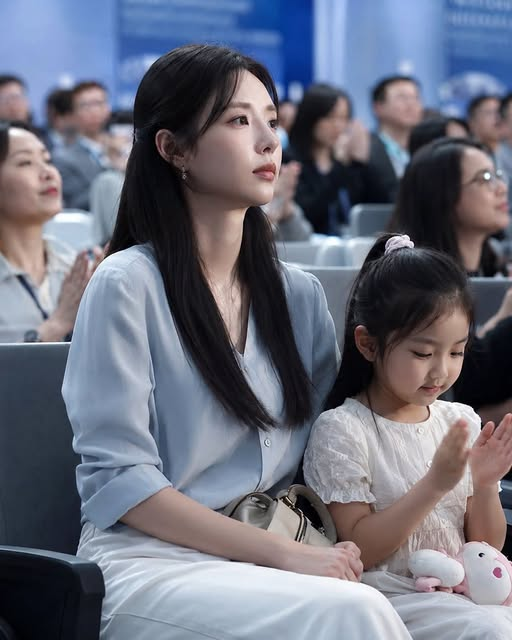
Applause filled the hall.
I did not clap.
Mia did.
She was four and believed applause was required whenever everyone else did it.
That tiny sound made Hoai Xuyen turn.
He saw me.
Then my wedding ring.
Then Mia.
His face lost all color.
After the panel ended, he found me in the corridor.
“Gia Hoa.”
I stopped.
Mia was holding my hand.
He looked at her.
“Is she…”
“My daughter.”
His eyes lowered to my ring.
“You remarried.”
“Yes.”
He stood completely still.
For some reason, that single word appeared to affect him more than our divorce papers ever had.
Then he said:
“You heard what Thu Nha said.”
“Yes.”
His jaw tightened.
“She exaggerated some parts.”
“Did you drive seven hours back?”
“Yes.”
“Did the hospital initially tell you that you couldn’t operate there directly?”
“Yes.”
“Did you find a way?”
He went silent.
That was enough.
I nodded.
“Thank you.”
He looked confused.
“For what?”
“For finally answering the question I asked five years ago.”
“Gia Hoa—”
“No.”
I wasn’t angry.
That surprised even me.
“I reviewed Dad’s case after our divorce.”
His expression changed.
“With whom?”
“Two specialists.”
“And?”
“Neither said you could definitely have saved him.”
Something like relief appeared in his face.
I continued:
“So I have never accused you of killing my father.”
The relief disappeared.
“I accused you of something else.”
“What?”
I looked straight at him.
“You told me there was nothing you could do because rules were rules.”
“But for Thu Nha’s mother, you called administrators during the drive, arranged emergency privileges, coordinated the operating room and found an exception.”
His eyes shifted.
I knew then that my information was accurate.
“You never made those calls for my father.”
He whispered:
“His condition was worse.”
“Maybe.”
That surprised him.
“I accept that.”
“Then why are we still discussing this?”
“Because you didn’t make a clinical decision and explain it honestly.”
“You hid behind policy.”
I paused.
“And when it was someone you could not bear to disappoint, suddenly policy became flexible.”
Hoai Xuyen looked toward the conference hall.
Then back at me.
After a long silence, he finally said:
“I was afraid.”
That was not the answer I expected.
“Of what?”
“Your father was family.”
He rubbed his forehead.
“I thought if I returned and operated and he died anyway, you would never forgive me.”
I stared at him.
“So you chose not to try.”
“Yes.”
The word was almost inaudible.
“And Thu Nha’s mother?”
He closed his eyes.
“When Thu Nha called, she was crying.”
“I…”
He stopped.
But I understood.
“You couldn’t bear her blaming you.”
His eyes opened.
There it was.
Five years too late.
The truth.
He had been afraid of carrying responsibility for my father.
But when Wen Thu Nha needed him, her pain had mattered enough for him to accept that same responsibility.
I nodded slowly.
“That was all I ever wanted you to admit.”
He looked at Mia.
“Is your husband here?”
“Yes.”
“Does he know about me?”
“He knows about my life.”
A man’s voice came from behind us.
“Gia Hoa.”
Chen Yan approached carrying two drinks and the pink stuffed rabbit Mia had abandoned in the auditorium.
Mia immediately ran toward him.
“Daddy!”
He lifted her.
Then looked at Hoai Xuyen.
No hostility.
No competition.
Just recognition.
“Director Luc.”
Hoai Xuyen nodded.
“Mr. Chen.”
The two men shook hands.
It was strangely ordinary.
That was when I realized I had truly moved on.
There was a time when I imagined meeting Hoai Xuyen again and making him regret everything.
Instead, I simply wanted to get dinner before Mia became hungry and impossible.
Hoai Xuyen looked at me.
“Gia Hoa.”
“Yes?”
“I’m sorry.”
I waited.
He continued:
“Not because I couldn’t guarantee your father would survive.”
“But because I made you believe I had no choice.”
His voice became lower.
“I had choices.”
“I just didn’t make the same effort.”
My eyes burned.
But I smiled.
“Thank you.”
That apology could not return my father.
It could not restore our marriage.
But it finally put the responsibility in the correct place.
Not on medicine.
Not on regulations.
On choice.
Hoai Xuyen asked:
“Did your father hate me?”
“No.”
I answered truthfully.
“Until the end, he defended you.”
That hurt him more than accusation would have.
He lowered his head.
I took Mia’s hand.
Before leaving, I said:
“My father told me doctors have rules.”
“I still believe that.”
“But rules should not become excuses we only use when the person asking us to bend them matters less.”
He nodded.
I walked away.
Later, I heard that the forum discussion caused Hoai Xuyen to propose a formal emergency consultation protocol between several regional hospitals.
Not because I demanded it.
I never contacted him again.
But the system eventually created clearer procedures for cases requiring specialists from another institution.
I liked to think my father would have approved.
Not because it changed what happened to him.
Because perhaps another family would never need to spend five years wondering whether someone could have tried harder.
That evening, Mia fell asleep against Chen Yan in the taxi.
He looked at me.
“You okay?”
“Yes.”
“Really?”
I looked at my daughter.
Then out at the city lights.
“Really.”
Five years earlier, I left my marriage believing I needed to know whether Luc Hoai Xuyen could have saved my father.
Eventually I understood that was a question nobody could answer.
The question that ended our marriage was different.
When my father needed him, did he do everything he was willing to do for someone else?
The answer was no.
And five years later, in a hall full of applause, Hoai Xuyen finally heard himself admit that human life mattered more than rules.
He looked across the room.
Saw my wedding ring.
Saw my daughter.
And understood that I had already built an entire life during the years it took him to finally say the principle he should have lived by when my father was still alive.
I did not hate him.
I did not need him ruined.
I only needed the truth.
And once I had it—
there was nothing left in the past worth returning to.
