The wonton shop was still open.
Niem An really ate two bowls.
Halfway through the second one, his eyes began to close.
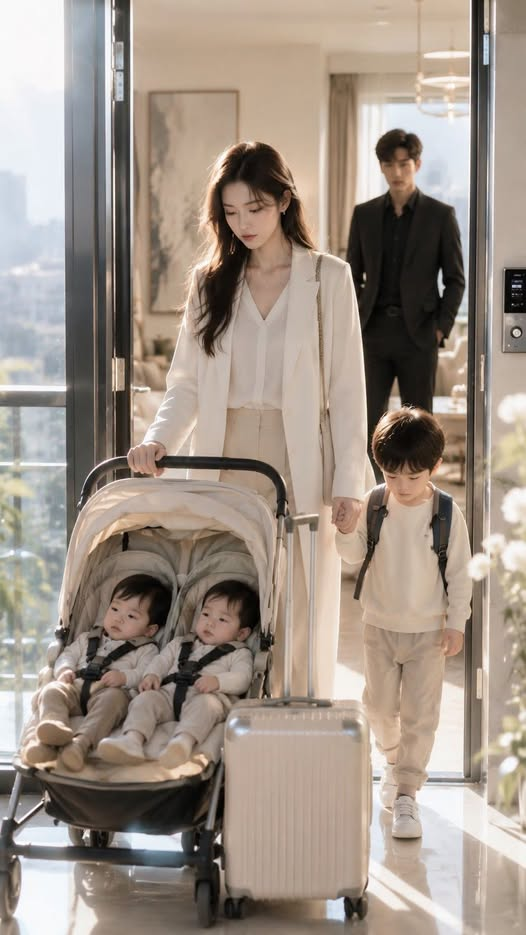
The twins slept in the stroller beside me.
I sat beneath the yellow restaurant light with 8,300 yuan in my account, three children beside me, and no idea where we would sleep permanently after tomorrow.
Strangely, I was not afraid.
I had been afraid inside my marriage for five years.
Afraid Canh Sam would not come home.
Afraid a child would get sick while I was alone.
Afraid I would ask for too much.
Afraid that one day the woman he truly cared about would return.
Now she had returned.
And I was free.
Duong Phi came for us that night.
She had been my university roommate and one of the few people who still remembered who I had been before marriage.
When she saw the stroller, two bags and Niem An asleep against my shoulder, she said nothing.
She just took one twin from my arms.
In the car, she finally asked:
“You really signed?”
“Yes.”
“And gave up everything?”
“Yes.”
She almost slammed the brakes.
“Are you stupid?”
“Probably.”
“What about the children?”
“I’m taking them.”
“No.”
I looked at her.
She sighed.
“I mean legally, you cannot write ‘they have nothing to do with him’ and magically erase their father.”
I knew that.
I just hadn’t wanted to admit it.
The next morning, Duong Phi took me to a lawyer.
He read the agreement and frowned.
“The asset waiver is your choice.”
Then he tapped the custody section.
“But the children are not property.”
I looked down.
“If their father wants a relationship with them, that issue must be handled separately.”
“What if he doesn’t?”
The lawyer looked at me.
“Then his actions will answer that.”
For the first week, Pho Canh Sam did not call.
Not once.
He sent one message through his assistant asking where to mail the finalized documents.
That was all.
I should have expected it.
Still, every time my phone lit up, some foolish part of me looked.
Niem An looked too.
On the fifth night, he asked:
“Mom, does Dad know where we live?”
“Yes.”
“Then why doesn’t he come?”
I could not answer.
So I pulled him into my arms.
“Dad is busy.”
The lie tasted exactly like all the ones I had told during our marriage.
That night, I promised myself it would be the last.
Pho Canh Sam finally returned to the apartment nine days after we left.
The lease had not yet been handed back.
The landlord had allowed me time to collect the last small things.
Canh Sam entered with his own key.
The apartment was almost empty.
The refrigerator notes were gone.
The children’s bottles were gone.
The toy basket was gone.
The mint plant on the balcony was still there.
Dead now.
On the dining table lay one notebook.
I had forgotten it.
The expense ledger.
Every payment from the card he gave me after the twins were born had been written down.
Milk powder.
Diapers.
Vaccinations.
Nanny wages.
Medicine.
Winter clothes.
Nothing for me.
At the back was a total.
Below it, one sentence:
Amount to be repaid when financially possible.
Duong Phi later told me his assistant called that afternoon.
Not me.
Her.
“Mr. Pho wants to know whether Mrs. Pho intentionally left the notebook.”
Duong Phi replied:
“Miss Tham doesn’t do anything intentionally for Mr. Pho anymore.”
Then she hung up.
That evening, he transferred money again.
Five hundred thousand.
I returned it.
He sent:
The money is for the children.
I replied for the first time:
Then establish support formally. Do not send random amounts when guilt appears.
There was no response for nearly an hour.
Then:
Guilt?
I stared at the word.
He really didn’t understand.
I blocked him again.
The woman he had waited for returned to the country that same month.
Her name was Minh Chau.
For years, I had imagined her as someone dazzling.
Someone who would make me understand why I had never been enough.
When I finally met her, she was surprisingly ordinary.
Elegant.
Calm.
About my age.
She came to Duong Phi’s studio looking for me.
I almost refused to see her.
Then curiosity won.
Minh Chau sat opposite me.
“I heard you divorced Canh Sam.”
“Yes.”
“Because I returned?”
I smiled.
“Not because you returned.”
“Because he was waiting for you to.”
Her face changed.
After a moment, she said:
“I think there is something you should know.”
I laughed softly.
“There always is.”
She lowered her eyes.
“Canh Sam and I were together when we were young.”
“I know.”
“But I ended it.”
I said nothing.
“My research position was overseas.”
“He wanted me to stay.”
“I didn’t.”
She paused.
“After that, we stayed in contact because his company funded part of my medical technology project.”
So that was the project he had asked his assistant about while I sat beside his hospital bed.
Minh Chau continued:
“He helped me a lot.”
“I won’t deny that.”
“But I never asked him to wait for me.”
I looked at her.
She took something from her bag.
A wedding invitation.
Her name.
Another man’s name.
The ceremony was in two months.
I stared at it.
“You’re getting married.”
“Yes.”
“Does Canh Sam know?”
“Since last year.”
Something inside me almost laughed.
The great white moonlight.
The woman I had feared for half my marriage.
She had already chosen someone else.
“So why did he ask me for a divorce when you returned?”
Minh Chau looked genuinely uncomfortable.
“I don’t know.”
Then she said:
“Maybe because as long as I was away, he could pretend the life he imagined was still possible.”
That sentence stayed with me.
Canh Sam had not left me for Minh Chau.
He had left me for an idea.
Perhaps that was even more humiliating.
Minh Chau looked at the photographs of my children on the desk.
“Are those his sons?”
“Yes.”
Her expression changed.
“He told me you had one child.”
I slowly looked at her.
“He never mentioned the twins?”
“No.”
Of course.
Even in the world where he shared his ambitions, investments and old feelings—
his own children were details.
Minh Chau stood.
“I’m sorry.”
“You don’t owe me that.”
“But he does.”
“Yes.”
That was the first thing about her I truly liked.
Pho Canh Sam appeared at Duong Phi’s studio that evening.
His assistant had apparently told him Minh Chau had visited.
He walked into the reception area with the expression of a man who expected answers.
“Why did she come here?”
I looked up from my computer.
“To invite me to her wedding.”
His face became unreadable.
“You met her?”
“Yes.”
“What did she tell you?”
“Enough.”
His jaw tightened.
“Gia Nghi—”
It had been a long time since he called my name instead of simply saying “you.”
I stood.
“You knew she was engaged.”
“Yes.”
“And you still divorced me when she returned.”
His eyes shifted.
“This marriage had no meaning anymore.”
“For you.”
He said nothing.
I continued:
“But you know what I finally understood?”
“You didn’t even divorce me because you loved her.”
“You divorced me because you had never really entered our marriage.”
His expression hardened.
“That’s not fair.”
I almost smiled.
“Niem An had pneumonia.”
He froze.
“When?”
“Two years ago.”
His face changed.
I told him the date.
Slowly, recognition appeared.
“The night I called you three times.”
His lips parted.
“You said he had a fever.”
“Forty degrees by the time I reached the hospital.”
He went completely still.
“You never told me.”
“I tried.”
“You said you were receiving guests.”
Silence.
I continued:
“You met the twins when they were one month old.”
“You don’t know which one laughs when he sneezes.”
“You don’t know which one refuses to sleep unless someone touches his hand.”
“You didn’t know Niem An had learned to write your surname.”
His face grew paler with every sentence.
“And now you’re asking why Minh Chau came to see me.”
I shook my head.
“You always knew what happened in everyone else’s life.”
“Just not ours.”
For the first time, Pho Canh Sam had nothing calm to say.
Two weeks later, he requested to see the children.
I agreed.
Not because I wanted him back.
Because they were his children too.
The first visit lasted less than an hour.
Niem Du cried when Canh Sam picked him up.
Niem So stared at him without recognition.
Niem An stayed beside me.
Canh Sam crouched.
“Come here.”
Niem An shook his head.
“Why?”
The boy whispered:
“Dad doesn’t like hugs.”
Canh Sam’s hand stopped in the air.
I remembered that first scene.
Niem An running to the door.
His father leaning away.
A child remembered what adults dismissed in one second.
Canh Sam did not force him.
That was the first good decision I saw him make as a father.
The visits continued.
Slowly.
He learned.
He learned Niem Du liked bananas mashed into porridge.
Niem So hated loud toys.
Niem An liked dinosaurs but was afraid of large dogs.
He began attending medical appointments.
Not because I reminded him.
Because he added them to his own calendar.
The divorce was finalized anyway.
When the lawyer asked about custody, I no longer wrote:
The children have nothing to do with him.
Instead, we created a schedule based on the children’s stability.
They lived primarily with me at first.
Canh Sam had regular time with them.
He paid support according to a formal agreement.
No mysterious transfers.
No “compensation money.”
He once asked me:
“Why did you return the first two hundred thousand?”
I answered:
“Because you called it compensation.”
He looked down.
“I didn’t know what else to call it.”
“That was the problem.”
He had believed money could replace the things he never gave.
Time.
Attention.
Presence.
I started working again.
Not immediately.
At first, Duong Phi gave me bookkeeping work at her studio.
Then client coordination.
Later, I returned to the design field I had abandoned after marriage.
My first project was small.
Children’s furniture for compact apartments.
The inspiration came from fitting three children into a room barely larger than the old bedroom we had shared.
A year later, the collection sold surprisingly well.
I opened a small studio.
Not an empire.
Not revenge.
A life.
One afternoon, Canh Sam came to pick up the children.
He stood in the doorway looking at the sketches on the wall.
“You designed these?”
“Yes.”
“I didn’t know you could.”
I laughed.
“I know.”
He closed his eyes for a moment.
Then he said quietly:
“I keep discovering things about you after losing the right to know them.”
That was probably the most honest thing he had ever said.
Three years later, Niem An brought home a school drawing.
A family picture.
I froze when I saw it.
There were five people.
Me.
Niem An.
Niem Du.
Niem So.
And Canh Sam.
His face was no longer crossed out.
He stood slightly apart from us.
But he was there.
I looked at my son.
“You drew Dad.”
Niem An nodded.
“He comes now.”
Three words.
That was all.
But they meant more than every apology Canh Sam had given me.
He had not rebuilt our marriage.
He had built something with his sons.
That was enough.
At pickup that evening, I showed him the drawing.
He stared at it for a long time.
Then looked away.
His eyes were red.
“Thank you.”
“Don’t thank me.”
I handed him the picture.
“He drew it.”
Canh Sam carefully folded nothing.
He kept the paper perfectly flat in his hands.
Before leaving, he asked:
“Gia Nghi.”
“Yes?”
“If I had been like this before…”
I already knew the question.
I stopped him.
“Don’t.”
His face tightened.
“There is no useful answer.”
He nodded.
Minh Chau had married years earlier.
Her life went one way.
Ours went another.
Canh Sam never remarried during those years.
But I never treated that as proof he still belonged to me.
A man remaining single was not repayment for a failed marriage.
And regret was not love rewritten backward.
Five years after I first married Pho Canh Sam, I left with three children, 8,300 yuan and a coat wrapped around two sleeping babies.
I thought I had failed.
Later I understood something else.
I had spent years believing a family existed wherever a marriage certificate existed.
It didn’t.
A family existed where someone noticed a child was sick.
Where someone knew which bowl he liked.
Where a father did not move away when small arms reached for him.
Pho Canh Sam eventually learned that.
But by the time he did, I had learned something too.
I did not need to return just because he finally became the man I had once waited for.
The woman who waited under the kitchen light until midnight was gone.
The woman who left that apartment finally understood:
Love cannot survive forever on the promise that one day someone might notice you.
And when Pho Canh Sam finally looked back—
the house was empty enough for him to see everything that had once been there.
