Chu Le held the letter with both hands.
Her voice became quieter as she reached the final paragraph.
“Third, everything you called ‘the Chu family’s home’ was purchased by me.
The sofa, dining table, television, appliances, curtains, beds and even the mattress your mother specifically chose were paid from my personal account.
I have removed my belongings.
I have not taken a single item belonging to Chu Khai.
Because there was almost nothing here that belonged to him.”
The room became deathly silent.
My former mother-in-law’s lips trembled.
“That’s impossible.”
Chu Le continued reading.
“The divorce agreement is already effective.
I voluntarily waived claims to the small amount of jointly accumulated property because I wanted a clean ending.
But waiving joint property does not mean giving away property I owned before marriage.
Chu Khai, you wanted freedom.
I gave it to you.
You wanted a son.
Congratulations.
From now on, please build the life you chose with your own hands.”
At the bottom was one final line.
Four minutes remain before security is notified.
My former mother-in-law screamed:
“Get out!”
This time, no one needed convincing.
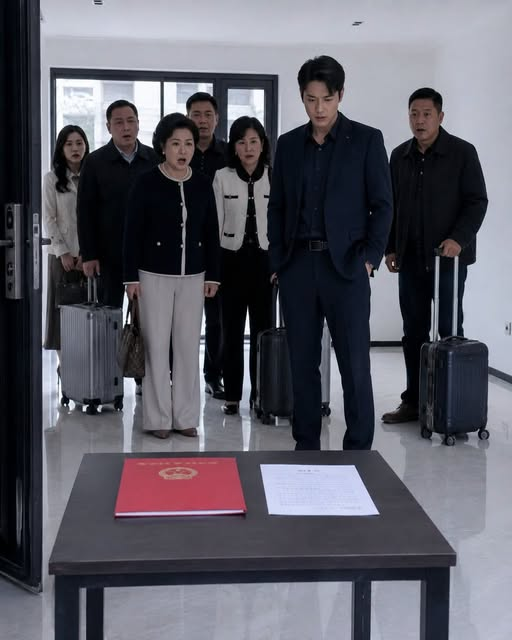
Chu Le dragged two suitcases toward the door.
The mother-in-law grabbed another.
Chu Khai remained standing in the center of the empty living room.
Only when the security system announced:
Unauthorized access detected. Please leave the premises.
did he finally move.
The door closed behind them.
And the villa became quiet again.
Exactly as I wanted.
My phone began ringing thirty seconds later.
Chu Khai.
I declined.
Again.
Declined.
On the sixth call, I answered.
“What?”
His voice exploded through the speaker.
“On Tinh, what are you trying to do?”
I looked out the window of my hotel room.
“Nothing.”
“You emptied the house!”
“My house.”
“We lived there for six years!”
“Yes.”
“So everything inside automatically belongs to you?”
“No.”
I opened the folder beside me.
“The things I purchased belong to me.”
“The things you purchased are yours.”
“You can come collect them.”
He suddenly became quiet.
Because we both knew what that meant.
His clothes.
A coffee machine.
Two golf clubs.
Several watches.
A gaming console.
That was nearly everything.
Even the bed he slept on had been bought by me before our wedding.
He lowered his voice.
“You planned this.”
“Yes.”
“For how long?”
“Long enough.”
“Why didn’t you tell me the villa was still entirely yours?”
I laughed.
“I did.”
“When?”
“The year we married.”
“I showed you the property certificate.”
“I showed you the purchase contract.”
“You said you didn’t care about paperwork because husband and wife shouldn’t calculate so clearly.”
He stopped speaking.
I continued:
“You didn’t forget because I hid it.”
“You forgot because you assumed marrying me made everything mine become yours.”
His voice hardened.
“Do you think I care about one villa?”
“No.”
“Then why do this?”
That question actually surprised me.
“You brought more than a dozen relatives to move into property you never owned the morning after our divorce.”
“And you’re asking why I revoked your access?”
Silence.
Then his mother’s voice appeared faintly in the background.
“Tell her to return immediately! Tell her I’m still her elder!”
I smiled.
“No.”
Chu Khai lowered his voice.
“On Tinh, don’t make things ugly.”
“We’re already divorced.”
“What exactly are you afraid I’ll make ugly?”
He had no answer.
So I ended the call.
The next problem arrived three days later.
The woman carrying Chu Khai’s long-awaited son came to see me.
Her name was Linh Dao.
Seven months pregnant.
I had met her only once before.
At the time, Chu Khai introduced her as the daughter of a business partner.
Now she sat opposite me in a café with both hands around a glass of warm water.
“I’m not here to fight with you.”
“Good.”
“I don’t want to.”
Neither did I.
She hesitated.
“Chu Khai told me the villa belonged to him.”
I almost smiled.
“I guessed.”
“He said after the divorce we would live there.”
“That was his plan.”
“He also said his mother would occupy the ground floor.”
“That was apparently her plan too.”
Linh Dao closed her eyes.
For a moment, she looked exhausted rather than triumphant.
Then she asked:
“Did you divorce him because of me?”
“Partly.”
Her face tightened.
I continued:
“But you weren’t the real reason.”
“What was?”
I looked at her.
“For six years, his family treated me like a failed investment because I had two daughters.”
Her eyes shifted.
Yes.
Two daughters.
That was what Chu Khai meant when he patted my shoulder outside the civil affairs office and said:
Who told you that you couldn’t give birth to a son?
Our daughters were six and four.
They were staying with my aunt during the divorce because I refused to let them hear their grandmother talk about their gender as though it were a defect.
Linh Dao whispered:
“He told me you didn’t want children anymore.”
I laughed softly.
“I told him I didn’t want a third pregnancy just to keep trying until his mother got the grandson she wanted.”
She went silent.
That was different.
After a while she said:
“The baby is definitely his.”
I nodded.
“I never questioned that.”
She seemed surprised.
“Aren’t you angry?”
“At the child?”
“No.”
I stirred my coffee.
“The baby didn’t break vows to me.”
“Chu Khai did.”
Linh Dao stared at me.
Then she asked something unexpected.
“Do you think I should marry him?”
I looked up.
“That is not a question you should ask his ex-wife.”
“I know.”
Her fingers tightened around the glass.
“But yesterday his mother told me that after I give birth, I should stay home, hand over my salary card, and let her raise the baby because I’m young and don’t understand children.”
I almost laughed.
History was efficient.
“What did Chu Khai say?”
“Nothing.”
There it was.
The answer she needed.
I said:
“Then don’t ask me what kind of husband he will be.”
“You already saw him answer.”
Linh Dao’s face slowly changed.
We never became friends.
We didn’t need to.
But she postponed the wedding.
Not because I convinced her.
Because for the first time, she began asking questions before signing documents.
The child was born healthy several months later.
A boy.
The grandson the Chu family had wanted so desperately.
I heard my former mother-in-law threw an enormous celebration.
Good for her.
A child should be welcomed.
What happened next had nothing to do with him.
The problem was the adults.
They had spent years believing a son would solve everything.
It didn’t solve rent.
It didn’t solve childcare.
It didn’t make Chu Khai more attentive.
It didn’t make his mother less controlling.
And it certainly did not turn my villa into theirs.
As for me, I did something that shocked Chu Khai more than emptying the house.
I sold the villa.
Not immediately.
Three months later.
It was too large for me and the girls.
Too full of memories I did not want.
The buyer was a family with three daughters.
When I saw the girls running up the staircase arguing over bedrooms, I signed without hesitation.
With part of the money, I bought a smaller apartment near my daughters’ school.
Three bedrooms.
One for me.
One for each girl.
My mother-in-law once said:
“Why do girls need separate rooms? Eventually they marry out.”
I thought of that sentence while helping my oldest daughter choose curtains.
She wanted stars.
Her sister wanted rabbits.
So that was what they got.
Not because curtains mattered.
Because having space that was unquestionably theirs did.
Chu Khai saw the girls regularly after the divorce.
I did not prevent it.
They loved their father.
And despite everything between us, he loved them in his own imperfect way.
But something changed after his son was born.
One afternoon, he returned the girls early.
Our eldest daughter stood at the door without entering.
“Dad.”
He crouched.
“What?”
She hesitated.
“Grandma said my little brother is the real person who carries the Chu family name.”
Chu Khai froze.
I did too.
She continued:
“Does that mean we’re fake?”
His face drained of color.
“No.”
“Then why did she say it?”
For once, Chu Khai had no clever answer.
No arrogant smile.
No sentence about tradition.
He simply looked at the daughter he had once allowed his family to treat as less valuable than a child who had not even been born.
Then he said:
“Because Grandma was wrong.”
The girl stared at him.
“Are you sure?”
“Yes.”
He looked toward me.
Then back at her.
“And I was wrong too.”
That was the first apology he ever gave that mattered.
Not to me.
To her.
Later that evening he called.
“On Tinh.”
“What?”
“I didn’t realize they heard those things.”
“They always heard.”
He was quiet.
“I thought they were too young.”
“No.”
“They were simply too young to argue back.”
That sentence stayed between us.
After that, Chu Khai changed some things.
He stopped allowing his mother to compare the children.
If she called his son the “only successor,” he corrected her.
When our daughters visited, they were not expected to serve their younger brother or give up toys because he was a boy.
It should never have taken divorce to teach him that.
But at least he learned before our daughters grew old enough to believe their grandmother.
Linh Dao never moved into his mother’s house.
She insisted on keeping her job.
She and Chu Khai eventually registered their marriage, but only after they established their own home.
I heard she was far less willing to “understand family traditions” than I had been.
Perhaps that was good for all of them.
I didn’t resent her.
By then, I had my own life.
Two years after the divorce, Chu Khai came to pick up the girls and noticed the property certificate on my desk.
My youngest had used it as a surface for drawing.
He laughed.
“You still leave important documents everywhere.”
I looked at him.
“This house is mine too.”
His smile disappeared slightly.
Then returned.
“I know.”
That simple answer contained two years of lessons.
Before leaving, he stood at the door.
“On Tinh.”
“Yes?”
“That day outside the civil affairs office…”
I knew which day.
His hand had landed on my shoulder.
His dazzling smile.
Don’t blame me. Who told you that you couldn’t give birth to a son?
His face tightened.
“I shouldn’t have said it.”
“No.”
“I thought…”
He stopped.
“What?”
“I thought having a son meant I had won something.”
I looked at him.
“And?”
He laughed bitterly.
“Turns out children aren’t prizes.”
“No.”
“And wives aren’t property.”
I raised an eyebrow.
“That lesson was more expensive.”
He actually laughed.
Then became serious.
“I’m sorry.”
I nodded.
Not forgiveness.
Not reconciliation.
Just acknowledgment.
“Take the girls home by eight.”
“I will.”
He left.
The door closed.
My two daughters immediately came running out of their room.
“Mom!”
“What?”
“Can we order pizza?”
“You just ate.”
“That was a snack.”
“It was noodles.”
“Big snack.”
I stared at them.
They stared back.
I surrendered.
“Fine.”
They cheered.
That night, sitting on the floor of our smaller apartment with two girls arguing over the last slice of pizza, I remembered the morning the Chu family arrived at the villa with suitcases.
They thought I had lost.
A divorced woman.
No son.
No husband.
No “complete family.”
But when the door opened, they finally saw the truth.
The house had never belonged to Chu Khai.
And neither had I.
He wanted a son.
He got one.
I sincerely hoped he would become a good father to that boy.
But the day he chose the idea of a male heir over the woman and two daughters already beside him, he taught me the most useful lesson of my life:
A home is not something you win by giving a family the child they demand.
It is where you and your children are treated as though you already belong.
So I stopped trying to earn my place in the Chu family.
I took my daughters—
and built a place where none of us had to earn one.
