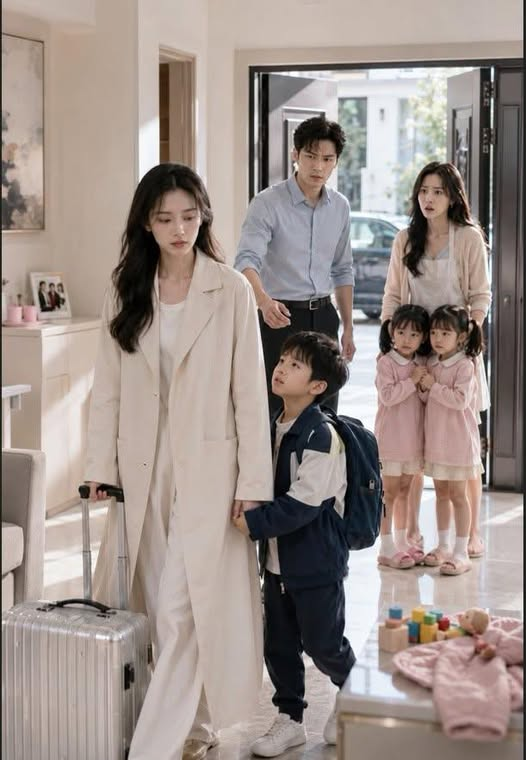
“Uncle Ha said this is our home.”
The little girl’s voice was soft.
But everyone heard it.
Lam Man immediately covered her daughter’s mouth.
“Children say whatever comes into their heads.”
I looked at Ha Dinh Chau.
He did not deny it.
That was enough.
“So you said it.”
His eyebrows tightened.
“I told them they could feel safe here.”
“You told them this was their home.”
“Is there a difference?”
I almost laughed.
“Yes.”
I pointed toward the broken wooden sign in Aunt Dao’s hands.
“There is.”
Lam Man stepped forward.
“Tinh Dao, I really can move out.”
Before I could answer, Dinh Chau said:
“No.”
Just one word.
Firm.
Automatic.
Exactly the way he used to protect me in the novel I had once believed I was living inside.
Except now he was protecting someone else.
Lam Man’s eyes reddened.
I felt strangely calm.
“Good.”
Dinh Chau looked at me.
“What?”
“I said good.”
I walked past him.
“If she doesn’t need to leave, I will.”
His expression darkened.
“You just came home.”
“No.”
I looked around the rooftop.
“This stopped being my home while I was away.”
I found Ha Du An after school.
He was sitting alone in the driver’s car with his schoolbag against his chest.
When he saw me, his eyes widened.
“Mom?”
Then he opened the door so quickly his bag fell onto the pavement.
He threw himself into my arms.
I hugged him.
For three months, I had been taking care of my mother after surgery.
Every night, Du An and I had video-called.
He always said he was fine.
School was fine.
Dad was busy.
The house was fine.
He never mentioned that his room had been given away.
I crouched in front of him.
“Why didn’t you tell me?”
He looked down.
“Dad said Grandma was sick.”
“He said if I told you things at home, you would worry and Grandma would get worse.”
My chest tightened.
“Did you want to give your room to the twins?”
He shook his head immediately.
“No.”
“Then why didn’t you say no?”
His eyes became red.
“Dad said I’m a boy.”
“I should be generous.”
I closed my eyes for one second.
There it was again.
Everyone’s comfort built on one person being told to understand.
First me.
Now my son.
I touched his face.
“You’re allowed to dislike something even if you’re a boy.”
He whispered:
“Really?”
“Really.”
He hesitated.
Then:
“Mom, are you going away again?”
“No.”
“Can I go with you?”
My throat tightened.
“Do you want to?”
He nodded so hard tears finally fell.
“I packed already.”
I remembered the small suitcase in the narrow room.
It had not been prepared for school.
My seven-year-old son had prepared to leave.
That evening, I returned to the villa with Du An.
Ha Dinh Chau was waiting.
Lam Man and the twins were no longer downstairs.
He looked at our son’s hand inside mine.
“Where are you taking him?”
“To my mother’s apartment tonight.”
His expression changed.
“Why?”
Du An instinctively moved behind me.
That tiny movement silenced the room.
Dinh Chau saw it too.
He crouched.
“Du An.”
The boy did not move.
Dinh Chau’s face became stiff.
“Come here.”
Du An tightened his fingers around mine.
“I want to stay with Mom.”
A long silence.
Dinh Chau stood again.
“He has school.”
“My mother’s apartment is twenty minutes closer to his school than this house.”
“You’re angry. Don’t make decisions involving a child while angry.”
I stared at him.
“Who moved his bedroom while I was gone?”
His jaw tightened.
“That was temporary.”
“You repainted it.”
“The paint can be changed.”
“You broke his model.”
“I didn’t know about that.”
“You moved him into a storage room.”
“It was cleaned.”
“And did you ask him?”
Silence.
I nodded.
“Exactly.”
Dinh Chau looked at Du An.
For the first time, uncertainty appeared on his face.
“Did you hate the new room?”
Du An whispered:
“Yes.”
“Why didn’t you tell me?”
The boy looked confused by the question.
Then answered:
“You already knew.”
Dinh Chau froze.
I did too.
Children have a brutal way of reducing adult excuses to one sentence.
He already knew.
He simply thought Du An would accept it.
Just as he thought I would.
I did not file for divorce that night.
I waited three days.
Not to reconsider.
To prepare properly.
I photographed my belongings.
Retrieved my documents.
Collected my mother’s copper pot from a box in the garage.
Asked a lawyer to review property and custody.
The villa had been purchased during our marriage but almost entirely with Ha family funds.
I did not fight for it.
I wanted something else.
My name.
My work.
My son’s stability.
And the ability to close a door without wondering whether someone would replace me while I was gone.
When Dinh Chau received the divorce petition, he came to my mother’s apartment.
He held the papers in one hand.
“You’re serious.”
“Yes.”
“Because I changed several rooms?”
“No.”
I looked at him.
“Because you don’t understand why changing those rooms mattered.”
His voice became impatient.
“I already had the workers restore Du An’s room.”
“That isn’t the point.”
“The baking room can be rebuilt too.”
“That isn’t the point either.”
“Then what is?”
I stared at the man who had once pursued me so relentlessly that I believed the ending of the novel had guaranteed the rest of my life.
“The point is that you believed anything of mine could be removed as long as you found a practical reason.”
He went quiet.
“My room.”
“My clothes.”
“My kitchen.”
“My son’s room.”
“My place in the house.”
I paused.
“And every time, you decided first.”
Then explained afterward.
His expression changed.
“I thought you trusted me.”
“I did.”
“That’s why it hurt.”
Lam Man contacted me before the divorce hearing.
We met once.
Without Dinh Chau.
She looked exhausted.
“I moved out.”
I said nothing.
“I found another apartment.”
“Good.”
She looked at her hands.
“I need to tell you something.”
I waited.
“Dinh Chau never touched me.”
“I know.”
She looked surprised.
“If there had been an affair, this would actually be easier to understand.”
Her face tightened.
I continued:
“You let yourself occupy my bedroom.”
“My slippers.”
“My apron.”
“My workspace.”
“You knew it was inappropriate.”
“Yes.”
At least she did not lie.
She whispered:
“After my divorce, I was scared.”
“My ex kept appearing near the children’s school.”
“Dinh Chau helped us.”
“At first, I told myself everything was temporary.”
“Then…”
She stopped.
“Then it felt good?”
Her eyes lowered.
“Yes.”
“To have someone arrange everything.”
“To have a house.”
“To have the children relaxed.”
“To feel like…”
She could not finish.
“Like the woman of the house?”
Her silence answered.
I nodded.
“I don’t forgive that.”
“I understand.”
“But I also know whose vows were made to me.”
She looked up.
I continued:
“They weren’t yours.”
That responsibility belonged to Dinh Chau.
Not to two little girls.
Not even entirely to Lam Man.
He was the one who had promised me the rooftop would always be mine.
Then decided three years of not baking meant I no longer deserved it.
He was the one who decided his son could “understand.”
And he was the one who never once called me before rearranging the life I was supposed to return to.
The divorce took five months.
Du An lived mainly with me during that period.
He still saw his father.
I never asked him to choose.
A child specialist helped us create a schedule.
Dinh Chau began picking him up himself instead of sending the driver.
At first, their weekends were awkward.
Then better.
One Sunday, Du An returned carrying the repaired spaceship model.
The broken wing had been restored.
“Dad fixed it.”
I smiled.
“That’s good.”
Du An looked at me.
“Dad said he should have asked.”
That was better.
Not because a model mattered more than the room.
Because Dinh Chau was finally learning the sentence he should have used years earlier:
What do you want?
The divorce still happened.
He signed reluctantly.
Outside the courthouse, he asked:
“Was there really no chance?”
I thought about it.
“There was.”
His eyes immediately changed.
“Then—”
“Years ago.”
He went silent.
I continued:
“There were hundreds of chances.”
“When I stopped baking.”
“When I started sleeping before you came home.”
“When I stopped asking you to go out with me.”
“When I spent three months caring for my mother and you didn’t once ask whether I missed my own home.”
I looked at him.
“You just assumed I would always return.”
His voice was low.
“I thought you would.”
“I know.”
That had been the problem.
I began baking again six months after the divorce.
At first, badly.
My hands remembered techniques my confidence had forgotten.
The first chiffon cake collapsed.
The second was dry.
Du An ate both and announced:
“Still good.”
He was a terrible critic.
My mother laughed.
Then I found the old recipe notebook she had given me.
I rented a small commercial kitchen.
Du An helped design the logo.
Two crooked clouds and a cake.
I called the studio Tinh Dao.
Not Mrs. Ha.
Not Ha Family Bakery.
Just my name.
Within a year, I was supplying desserts to three cafés.
Then wedding cakes.
Then small private classes.
Nothing enormous.
But every morning I walked into a room built for work I loved.
And nobody called it meaningless because it did not belong to a corporation.
Two years later, I received a strange order.
A birthday cake.
No decorative theme.
Only one instruction:
Spacecraft. Seven planets. No pink.
I knew immediately.
Du An’s tenth birthday.
Ha Dinh Chau came to collect it himself.
He stood inside my studio and looked around.
Copper pots.
Mixers.
Photographs.
My broken wooden rooftop sign had been repaired and hung above the entrance.
STUDIO TINH DAO.
His eyes stopped there.
“You kept it.”
“Yes.”
He looked at the crack running through the middle.
“I can have someone remake it.”
“No.”
“Why?”
I smiled.
“I like remembering that broken things don’t always need to become what they were before.”
He looked at me for a long time.
Then nodded.
“I understand.”
This time, I believed he did.
Before leaving, he said:
“Lam Man remarried.”
“I heard.”
“The twins are doing well.”
“That’s good.”
He hesitated.
“I owe you an apology that has nothing to do with her.”
I waited.
“I thought providing a house meant I had created a home.”
His voice became quieter.
“So when I moved rooms around, I thought I was only moving things that belonged inside my house.”
He looked at the sign.
“I didn’t understand those things were part of your life.”
“I know.”
“And Du An…”
His jaw tightened.
“I taught him to be understanding because it was easier than asking other people not to take too much.”
That sentence surprised me.
It was accurate.
Painfully so.
He continued:
“I’m sorry.”
I nodded.
“Thank you.”
No reunion.
No dramatic embrace.
Some apologies arrive only after the relationship they could have saved is already over.
They still matter.
They just do not change the ending.
Years ago, I believed I was living inside a novel.
The cold heir married the ordinary woman.
He pursued her.
He built her a rooftop baking room.
He promised she would be his only exception.
Then the book ended.
I used to think that meant we lived happily ever after.
Now I understood something the author never wrote.
A wedding is not an ending.
Being chosen once does not mean you will be chosen every day afterward.
Love does not preserve a room.
Attention does.
Respect does.
Asking before taking does.
And a home does not remain yours simply because your name once appeared in someone’s happy ending.
When I returned after three months, I found another woman in my apron.
Her children in my son’s room.
My belongings in storage.
My studio broken apart.
For a moment, I thought I had returned too late.
I hadn’t.
I returned at exactly the right time.
Because that day I finally stopped asking whether Ha Dinh Chau still considered me the heroine of his story.
I took my son.
Recovered my name.
Built another kitchen.
And began writing a life that did not stop at the wedding.
The novel had ended with Mrs. Ha.
My real life began again with Kieu Tinh Dao.
