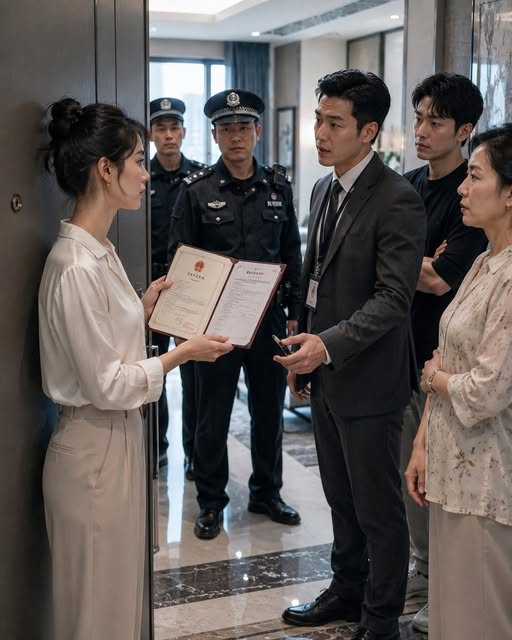
The police officer took the power of attorney from the broker’s hands.
“Who prepared this document?”
Nobody answered.
My mother finally pointed at my father.
“He handled the paperwork.”
My father’s face darkened.
“Why are you blaming me? You were the one who said Trieu Nhan would eventually agree.”
The buyer’s wife suddenly raised her voice.
“Eventually agree?”
She turned toward the broker.
“You told us the owner had already agreed!”
The broker’s forehead was covered in sweat.
“Mrs. Vuong, please calm down.”
“How am I supposed to calm down? We transferred one million yuan!”
The police officer looked up.
“To whom?”
My younger brother’s expression changed.
Too late.
The buyer’s husband opened his banking app.
“Lam Tri Vien.”
The room became completely silent.
I looked at my brother.
“So the deposit entered your account.”
He immediately defended himself.
“It was temporary.”
“For what?”
“My company needs bridge financing.”
“You used money from the sale of my house before my house was even sold?”
His voice grew impatient.
“I already told you I would repay you!”
I laughed.
“You still don’t understand.”
“There is nothing for you to repay to me.”
“You took money from buyers for property you had no authority to sell.”
The police officer looked directly at him.
“Mr. Lam, you will need to come with us and explain the source and purpose of that payment.”
My mother rushed forward.
“He is starting a business! Young people sometimes need family support!”
The officer asked:
“Did his sister agree to provide this support?”
My mother stopped.
“No.”
The answer came from me.
I looked around my living room.
New lock.
Strangers.
Forged authorization.
A buyer already measuring walls.
And my family still acted as though my biggest offense was embarrassing them.
I took my suitcase.
“Everyone leaves.”
My mother stared at me.
“This is our family matter!”
“No.”
I pointed toward the police.
“It stopped being a family matter when someone forged my signature.”
At the station, the story became uglier.
The forged authorization had not appeared overnight.
My parents had taken a photocopy of my ID from old family documents.
My father had contacted the broker.
My mother provided the household registration information.
My brother arranged for the locks to be changed after telling the locksmith that I was abroad and that my parents were “managing the property.”
The broker admitted he had never independently contacted me.
Why?
Because my parents had offered to sign an exclusive listing agreement immediately.
And because the asking price was six hundred thousand yuan below comparable properties, he believed it would sell quickly.
Commission first.
Verification later.
The buyers were furious.
But they were also victims.
They had paid one million yuan based on representations that the transaction had been authorized.
I told them directly:
“I will not sell you the house.”
The husband’s face tightened.
“Then what about our deposit?”
“You did not pay it to me.”
I looked at my brother.
“Ask the person who received it.”
Tri Vien slammed his hand on the table.
“Sister, do you really want to destroy me over money?”
I stared at him.
“You took one million yuan from strangers using my house.”
“That money is already in the company!”
My mother shouted:
“Trieu Nhan, help your brother this once!”
This once.
I almost laughed.
University tuition.
His first car.
The down payment for the apartment he later sold.
The money he borrowed when his first business failed.
Every time had been “this once.”
I asked:
“How much is left?”
Tri Vien stopped speaking.
My father looked at him.
“How much?”
Finally:
“About three hundred thousand.”
My mother’s face turned white.
“What happened to the rest?”
“I put it into the company.”
“Can you withdraw it?”
“No.”
For the first time that day, my parents looked frightened.
Not because they had entered my house.
Not because they had forged my authorization.
Because the money they thought they could replace later was no longer sitting safely in an account.
I stood.
“Then solve it.”
My mother grabbed my sleeve.
“You can’t leave!”
I pulled my arm free.
“You created this problem without me.”
“You can solve it without me.”
The sale was stopped immediately.
There was nothing to transfer.
No valid authorization.
No signature from me.
No lawful consent.
The agency suspended the broker while it reviewed how he had accepted the listing and brought clients into the property without contacting the registered owner.
The buyers pursued recovery of their deposit from the people who had taken it.
My family.
Not me.
For the first time, my mother called without giving orders.
She cried.
“Your brother’s company will collapse if he has to repay everything now.”
I was sitting in my newly re-keyed apartment.
“My house almost disappeared because his company needed money.”
“That’s different.”
“How?”
“He is your brother.”
I closed my eyes.
There it was.
The answer to everything.
He was my brother.
Therefore my house could become his financing.
My savings could become his emergency fund.
My parents could sign for me.
My consent was apparently just a formality that family affection allowed them to skip.
I said:
“Mom, if he needed help, he could have asked.”
“He knew you would say no!”
I smiled.
“Exactly.”
Silence.
Then I continued:
“So all of you decided my ‘no’ should not matter.”
She began crying harder.
I did not change my answer.
Tri Vien came to see me three days later.
The new security system stopped him downstairs.
I met him at a café instead.
He looked exhausted.
“The buyers want their money back.”
“They should.”
“I don’t have it.”
“I know.”
He leaned forward.
“If I liquidate now, the company is finished.”
“That is your decision.”
“You really don’t care?”
I looked at him.
“I care that you forged my authorization.”
“It wasn’t me who signed!”
“You received the money.”
He flinched.
I continued:
“You sent renovation plans to the family group before the buyers had even legally purchased the house.”
His expression changed.
“That design wasn’t for them.”
I frowned.
“What?”
He looked away.
“It was for me.”
For several seconds, I said nothing.
Then I understood.
“You weren’t selling the house to finance your company.”
“Not only.”
He stayed silent.
I felt something cold settle inside me.
“You planned to use part of the money for the company and then buy another place?”
“No.”
His answer was too quick.
I opened the family group.
The design he had sent.
Master bedroom converted into a gaming room.
My study turned into a child’s room.
Balcony enclosed.
The floor plan was clearly my apartment.
Not some future home.
I looked at him.
“You thought I would eventually give you the house.”
His face hardened.
“Mom said after you got married you wouldn’t need such a big place.”
“I’m not married.”
“You will be eventually.”
I stared at him.
“So the plan was what?”
“Sell it cheaply?”
“Use the deposit for your company?”
“And if the sale failed, move into it anyway?”
He said nothing.
That silence gave me more than an answer.
I stood.
“From now on, do not contact me about money.”
“Sister—”
“And do not enter my home again.”
His face finally cracked.
“You’re choosing a house over family.”
I shook my head.
“No.”
“You chose my house over family first.”
Then I left.
My parents came one final time.
This time, my father did most of the talking.
He looked ten years older.
“We were wrong.”
My mother immediately added:
“But your brother really was desperate.”
I almost laughed.
My father looked at her.
“Stop.”
It was the first time I had ever heard him say that to her.
He turned back to me.
“We thought because you were alone…”
“Finish the sentence.”
He hesitated.
Then:
“We thought you didn’t need as much.”
There it was.
Not hatred.
Not even greed in the simplest sense.
Something more familiar.
The daughter who succeeded needed less.
The son who struggled deserved more.
The daughter who bought a home should share.
The son who failed should be rescued.
Again.
And again.
And again.
Until eventually “sharing” meant forging my name.
I asked:
“If I had a husband and two children, would you have done this?”
My mother answered first.
“Of course not.”
I nodded.
“Thank you.”
She looked confused.
“For what?”
“For finally saying it clearly.”
The room became quiet.
“My property mattered less to you because you believed my life mattered less.”
My father lowered his head.
My mother began:
“That’s not what I—”
“It is.”
I was no longer angry.
That surprised all of us.
I continued:
“I will not ask you to choose between me and Tri Vien.”
“You already chose for years.”
“I’m simply stepping out of that arrangement.”
My father whispered:
“Will you never come home again?”
I looked around my apartment.
Then at him.
“I am home.”
The buyers eventually recovered their money through a repayment agreement backed by my parents selling an investment property and Tri Vien surrendering part of his company holdings.
His company survived.
Smaller.
He lost control of it to the investor who provided the remaining funds.
Nobody went from rich to homeless overnight.
But for the first time, his mistake cost him something that belonged to him.
Not me.
The broker’s agency compensated part of the buyers’ transaction expenses and tightened its verification procedures.
As for my house, I did something my mother never expected.
I renovated it.
For myself.
I replaced the shoe cabinet the broker had measured.
Turned one bedroom into a library.
Changed the balcony doors.
And installed a plaque inside the entrance:
LAM TRIEU NHAN
Nothing else.
No “daughter of.”
No “sister of.”
Just my name.
Months later, my mother sent me another voice message.
Her tone was much quieter.
“Trieu Nhan, Mom made soup. Do you want me to bring some?”
I listened twice.
Then replied:
“You can come Sunday afternoon.”
She arrived Sunday.
She stood outside the door.
And waited for me to open it.
That detail mattered.
She did not have a key anymore.
Nobody did.
When I opened the door, she held out the soup.
Her eyes moved toward the new lock.
Then toward me.
“I understand.”
I wasn’t sure she completely did.
But at least, for once, she asked before entering.
I stepped aside.
“Come in.”
The day I returned from Singapore, my family thought the biggest problem was that I had come home earlier than expected.
They were wrong.
Their real mistake was believing distance meant absence.
That because I was unmarried, my home was available.
That because I was their daughter, my signature could be imitated.
That because I had always solved their problems, I would solve the consequences of this one too.
I didn’t.
I called the police.
I showed the deed.
I showed the payment records.
And when everyone demanded that I be “reasonable,” I finally understood what that word had always meant in my family:
Give up what is yours so your brother doesn’t have to give up what he wants.
This time, I refused.
The house stayed mine.
But more importantly—
so did my right to say no.
