I stared at the old photograph.
The woman holding the baby was my mother.
I knew her face from the only photograph my grandmother had ever shown me.
But the man standing beside her—
was Uncle Chu.
My throat tightened.
“What is this?”
Uncle Chu looked at me.
“Your mother’s real name was not To Minh Anh.”
He paused.
“She was Chu Minh Anh.”
The room seemed to tilt.
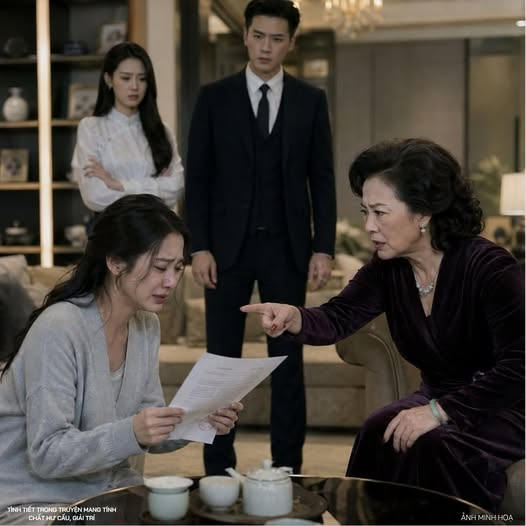
My mother-in-law suddenly stood up.
“That was decades ago. What does it have to do with Van Thanh now?”
Uncle Chu turned toward her.
“A lot.”
One of the lawyers opened the red-stamped document.
It was a notarized declaration from twenty-seven years earlier.
My mother had been the youngest daughter of the Chu family.
After a violent dispute over family assets, she had left home while pregnant and refused all contact.
When I was three, she died in an accident.
My grandmother—her former nanny and the woman I had always believed was my biological grandmother—raised me under the surname To.
Before she died, my mother had signed a trust document.
A block of shares and several properties belonging to her branch of the family would pass to me when my identity was formally confirmed.
I stared at Uncle Chu.
“Why didn’t anyone tell me?”
His eyes reddened.
“Your grandmother refused.”
“Why?”
“Because your mother did not want you growing up around the same inheritance battle that destroyed her relationship with the family.”
He placed his hand on the wooden box.
“She told me you should know only if someone tried to take what she left you.”
I looked at Hao Nhien.
He had turned completely pale.
“Then why does he know you?”
Uncle Chu’s expression became cold.
“Because six years ago, before you married him, I investigated the Tran family.”
My husband’s head snapped up.
“Enough.”
Uncle Chu ignored him.
“His father once worked for one of the Chu family’s subsidiary companies.”
“And?”
“He knew exactly who your mother was.”
My heart sank.
Slowly, I turned toward Hao Nhien.
“You knew?”
“No.”
His answer came too quickly.
“Hao Nhien.”
“I knew there were rumors.”
“Before we married?”
Silence.
My mother-in-law suddenly spoke.
“Even if he knew, what does it matter? He married you, not your money.”
I laughed.
“Then why are you pretending to be sick to force me to sell the only property my grandmother left me?”
Nobody answered.
That silence was enough.
Uncle Chu took us to the old house that same night.
I had not stepped inside for almost two years.
The second-floor room had belonged to my grandmother.
Behind an old wooden wardrobe was a small built-in safe.
I had never noticed it.
Uncle Chu entered a six-digit code.
My birthday.
The door opened.
Inside were no piles of cash.
No diamonds.
Only documents.
Original share certificates.
Bank records.
Letters.
And one sealed envelope addressed to me.
I opened it with shaking hands.
My grandmother’s handwriting filled the page.
She wrote that she had known the Tran family was asking questions about the house before I even married Hao Nhien.
She had warned me once, indirectly.
I remembered.
Two months before my wedding, she had suddenly asked:
“Van Thanh, if one day a man loves everything around you more than he loves you, what will you do?”
At the time, I laughed.
I told her:
“Hao Nhien isn’t like that.”
Now I wanted to go back and shake that foolish version of myself.
The final paragraph made my hands stop.
The house itself is not the real inheritance.
The safe contains proof that 8.7% of Chu Thinh Holdings belongs to your mother’s line.
I looked up.
Uncle Chu nodded.
“The shares are worth far more than the house.”
My mother-in-law’s knees seemed to weaken.
I finally understood.
They had never wanted only nine million yuan.
They wanted the house sold.
Emptied.
Renovated.
The safe discovered before I ever learned what it contained.
I turned toward Hao Nhien.
“You knew about the safe?”
“No.”
My mother-in-law shouted:
“He didn’t!”
Too fast.
Again.
I looked at her.
“You knew.”
Her lips trembled.
Years earlier, her husband had worked in the same subsidiary as my biological mother.
He had heard about a sealed trust connected to the Tay Ho property.
After his death, Luu Tu Lan kept the rumor alive.
Then her son met me.
Conveniently.
Courted me.
Married me.
And waited.
Maybe Hao Nhien had loved me once.
That was almost worse.
Because somewhere along the way, love had become greed.
He lowered his voice.
“Van Thanh, listen to me.”
“No.”
“I didn’t marry you for this.”
“Then when did you learn?”
He said nothing.
I repeated:
“When?”
“After the wedding.”
“How long after?”
His face tightened.
“About a year.”
Three years.
For three years he knew.
Three years of asking why I refused to sell the house.
Three years of suggesting we “simplify” our assets.
Three years of telling me the old house was inconvenient, empty, expensive to maintain.
And when persuasion failed—
his mother became “critically ill.”
I smiled.
It felt terrible.
“You could have told me.”
“I was afraid you would misunderstand.”
“No.”
I looked directly at him.
“You were afraid I would understand.”
The medical records ended the rest of the performance.
Uncle Chu’s lawyer requested formal documentation of Luu Tu Lan’s diagnosis before any family funds were used.
There was no serious illness requiring surgery in Beijing.
She had undergone routine examinations.
Nothing more.
The oxygen.
The dramatic phone calls.
The private room.
All arranged to frighten me.
The hospital administration opened its own review after discovering that a doctor known to Hao Nhien had exaggerated the written recommendation.
I did not argue with my mother-in-law.
I did not slap my husband.
I simply canceled the sale.
Then I froze every joint account that legally required both signatures and hired my own attorney.
Hao Nhien came home at two in the morning.
I was packing.
He stood at the bedroom door.
“Are you really leaving?”
“Yes.”
“What about our marriage?”
“What marriage?”
His face hardened.
“I made a mistake.”
“You planned to take nine million yuan from me.”
“I was going to return it.”
“With what?”
Silence.
“The money was going to your mother’s account.”
I folded another shirt.
“Then you planned to divorce me after the transfer.”
His face went white.
So he knew I had heard everything.
I looked at him.
“And Nhuoc Hy is pregnant.”
He closed his eyes.
“I can explain.”
“Is the baby yours?”
After a long silence:
“Yes.”
That was all I needed.
I zipped the suitcase.
He suddenly grabbed the handle.
“Van Thanh, I did love you.”
I looked at his hand.
“Move.”
“I’m telling the truth.”
“I believe you.”
He froze.
That surprised him.
I continued:
“You probably did love me.”
“Then you discovered I might be worth more than you imagined.”
“And instead of telling me the truth, you decided to see how much of me you could convert into money.”
His hand slowly loosened.
“I never planned to hurt you.”
I laughed quietly.
“People always say that after making very detailed plans.”
Then I left.
The divorce took five months.
I did not take Hao Nhien’s company.
I did not demand that his family become homeless.
I asked for a clean division of marital property and preservation of evidence related to the attempted house sale and deception.
The nine-million-yuan sale never happened.
The Tay Ho house remained mine.
The medical expenses they had claimed were largely fictional, so there was nothing for me to reimburse.
As for Nhuoc Hy, I saw her only once.
She came to my lawyer’s office.
Pregnant.
Nervous.
“I didn’t know about the house scheme.”
“I believe you.”
She looked surprised.
“Hao Nhien told me you had already agreed to divorce.”
“He told me you were only his assistant.”
Her face changed.
That was enough.
I said:
“We were both given convenient versions.”
“But he was married to me.”
“So my dispute is with him.”
She lowered her eyes.
Then whispered:
“He promised we would start over after you sold the property.”
I smiled faintly.
“I know.”
“Are you angry?”
“Yes.”
“But I’m not competing with you.”
I stood.
“If you choose him, choose him knowing exactly who he is.”
Months later, I heard they did not marry.
I never asked why.
Uncle Chu did not simply hand me a company.
That would have been ridiculous.
The shares were verified through lawyers, trustees and independent records.
My identity was confirmed.
The transfer took almost a year.
When it was finished, I became the beneficial owner of my mother’s 8.7% stake.
Worth far more than the house Hao Nhien had tried to sell.
But the money was not the part that changed me most.
The letters were.
My mother had written dozens.
Most were never sent.
In one she wrote:
If Van Thanh grows up ordinary and happy, let her remain ordinary and happy.
I cried when I read that.
Because for years I thought being “ordinary” meant being weak.
Easy to manipulate.
Easy to sacrifice.
It didn’t.
Ordinary had never been the problem.
Trusting the wrong people was.
Two years later, I renovated the Tay Ho house.
Not to sell it.
To live there.
I kept my grandmother’s bedroom almost unchanged.
The safe remained behind the wardrobe.
Empty now.
The documents were stored professionally elsewhere.
But I kept the safe because it reminded me of something.
Secrets can protect you.
They can also imprison you.
One afternoon, Hao Nhien came to the gate.
He looked older.
Nhuoc Hy was no longer with him.
I did not invite him inside.
He stood outside and said:
“I heard the Chu family recognized you.”
“Yes.”
He laughed bitterly.
“So it was all true.”
“What?”
“The shares.”
“Yes.”
He looked toward the house.
“If I had told you everything when I found out…”
I shook my head.
“Don’t.”
He stopped.
“You’re wondering whether you could have stayed married to the woman who owned those shares.”
“I’m wondering whether I could have stayed married to you.”
“No.”
The answer came easily.
His face fell.
I continued:
“The inheritance wasn’t what ended us.”
“The fake illness wasn’t even the worst part.”
“What was?”
“You looked at someone who trusted you enough to sell her grandmother’s home for your mother…”
I paused.
“And decided that kindness made her easy to rob.”
He had no answer.
Before leaving, he said:
“I’m sorry.”
I nodded.
“I know.”
Then I closed the gate.
The night I heard Hao Nhien tell his mother to pretend to be sick, I thought the greatest betrayal was that they wanted nine million yuan.
I was wrong.
Money can be replaced.
A house can be repaired.
Even a hidden inheritance can be recovered.
What cannot be restored is the moment you realize the person sleeping beside you had been measuring the value of your trust.
They thought I would sign because I was soft-hearted.
They were right about one thing.
I was soft-hearted.
But soft-hearted never meant stupid.
I did not storm into that hospital room.
I did not expose them immediately.
I simply called the one person they were terrified I would ever meet.
And by the time Uncle Chu walked through the door—
the house they wanted was still mine.
The inheritance they wanted was beyond their reach.
And the wife Hao Nhien planned to discard had already stopped being his.
