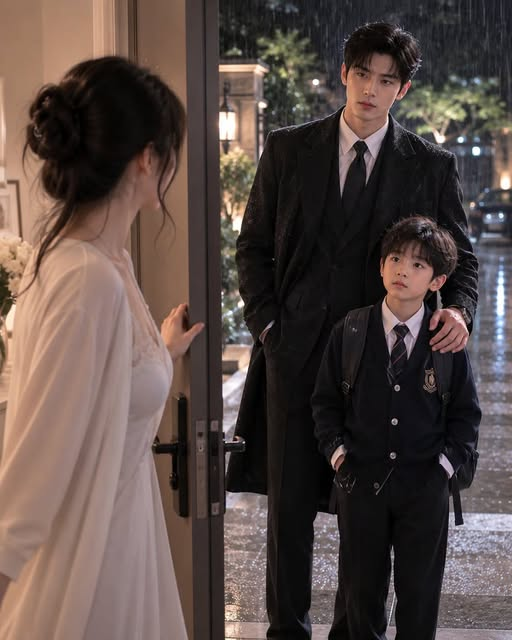
“So you did exist?”
The little boy’s voice trembled.
I couldn’t answer.
Five years.
For five years, I had imagined a child without a face.
I had wondered whether he liked milk.
Whether he was afraid of thunderstorms.
Whether he had Ethan’s eyes.
Now he stood in front of me wearing tiny black sneakers and staring at me as though I were someone he had searched for his entire life.
I crouched slowly.
“What’s your name?”
He glanced at Ethan before answering.
“Noah.”
My chest tightened.
“Noah.”
He nodded.
Then asked the question I was least prepared for.
“Why did you leave me?”
I stopped breathing.
Ethan’s expression changed.
I looked up at him.
“What did you tell him?”
His jaw tightened.
“That you chose not to stay.”
I stood.
The shock became anger.
“I wasn’t allowed to hold him.”
Ethan went completely still.
“What?”
“They took him away immediately.”
His face lost color.
I continued:
“Your mother gave me the money, told me never to return, and had security escort me out.”
Noah looked between us.
Confused.
I lowered my voice.
“Maybe we shouldn’t discuss this in front of him.”
Ethan nodded immediately.
For once, there was no argument.
He crouched beside Noah.
“Buddy, can you sit in the living room for a few minutes? I need to talk to your mom.”
Noah’s eyes widened slightly at the word.
Mom.
He walked inside slowly.
Before passing me, he whispered:
“I knew you weren’t a stone.”
I nearly cried.
The moment Noah was out of earshot, Ethan closed the door.
“You’re telling me my mother forced you to leave?”
“She didn’t need to force me.”
I laughed bitterly.
“She controlled everything.”
“The hospital.”
“The documents.”
“The money.”
“Even whether I was allowed to see my own baby.”
Ethan looked genuinely shaken.
“She told me you refused contact.”
“No.”
“She said you signed away every right.”
“I signed financial papers.”
My voice hardened.
“I was twenty-two, exhausted, frightened, and your family’s lawyer placed documents in front of me while telling me the agreement was finished.”
Ethan stared at me.
“I was told you received the final payment and left the city before I came back.”
“I stayed three days.”
His face changed.
“What?”
“I went back to the hospital twice.”
“They refused to let me upstairs.”
I swallowed.
“The third time, one of your mother’s assistants told me that if I continued appearing, they would accuse me of trying to extort the family.”
Ethan closed his eyes.
For several seconds, he said nothing.
Then:
“I wrote to you.”
My anger disappeared.
“What?”
“For almost a year.”
I stared at him.
“I never received anything.”
He took his phone from his pocket.
His fingers moved quickly.
Then he showed me a photograph.
A box.
Dozens of envelopes.
All with my old name.
All sealed.
“I found these three weeks ago in my mother’s house.”
My knees nearly gave way.
“She kept them?”
“Yes.”
“Why?”
His voice became cold.
“Because she lied to both of us.”
The truth came out in pieces.
Ethan had survived.
The treatment abroad worked far better than his doctors expected.
When he returned, Noah was almost six months old.
His mother told him I had taken the money and disappeared.
That I wanted no connection to the child.
That I considered the entire arrangement a transaction and had asked never to be contacted.
At first, Ethan believed her.
Why wouldn’t he?
His mother had controlled every part of his illness.
Every doctor.
Every appointment.
Every legal decision.
He was still recovering and barely able to care for himself, much less challenge her.
But as Noah grew older, questions began.
“Where is my mother?”
“Did she die?”
“Did she know me?”
Ethan’s mother always answered:
“She didn’t want this life.”
Then one month earlier, Noah found an old photograph of me hidden inside Ethan’s medical files.
That was the first crack.
Ethan started investigating.
Hospital records.
Payment documents.
Old staff.
Then the letters.
His mother had kept every one.
“Why did you come to my company?” I asked.
“I bought the controlling interest eight months ago.”
“That still doesn’t explain me working there.”
“I didn’t know.”
He looked at me.
“HR hired you before I arrived.”
“And when you saw me?”
His expression became unreadable.
“I recognized you immediately.”
I almost laughed.
“You acted like you had never met me.”
“I didn’t know whether you wanted me to acknowledge you.”
“You thought I abandoned your son.”
“Yes.”
“Then why didn’t you confront me?”
His jaw tightened.
“Because by then I had already found the letters.”
Silence.
“You knew?”
“I knew something was wrong.”
He looked toward the living room where Noah sat quietly.
“I wanted proof before I put him in the middle of it.”
That answer, at least, I respected.
Then I asked:
“Why bring him here tonight?”
Ethan’s expression softened.
“Because yesterday he asked me whether mothers can forget their children.”
My throat closed.
“I told him sometimes adults hide things from children because they think they’re protecting them.”
“He asked me whether that was what happened to us.”
I looked away.
Ethan continued:
“I couldn’t lie to him again.”
Noah stayed with me for two hours that night.
Not overnight.
I wasn’t ready.
Neither was he.
We sat on my sofa.
At first, he asked practical questions.
“Do you like chocolate?”
“Yes.”
“Dogs?”
“Yes.”
“Math?”
“No.”
He looked disappointed.
“I like math.”
“That’s unfortunate.”
He laughed.
The sound nearly broke me.
Then he asked:
“Did you know I was a boy?”
“No.”
His smile disappeared.
I told him the truth in the simplest way I could.
“I knew there was a baby.”
“I loved that baby.”
“But some adults made decisions that kept me away.”
He looked at Ethan.
“Grandma?”
Ethan answered before I could.
“Yes.”
Noah became quiet.
Then he asked me:
“Are you leaving again?”
I felt tears finally rise.
“No.”
I looked at Ethan.
“Not if I have a choice.”
Ethan’s eyes lowered.
“You do.”
That was the first promise he made me that I wanted to believe.
The following weeks were not magical.
I did not instantly become Noah’s mother in every practical sense simply because biology said so.
He had routines.
A school.
A bedroom.
A father he loved.
A grandmother he was suddenly angry with.
And five years of life I had missed.
So we went slowly.
Dinner twice a week.
Then weekends.
A family therapist helped us explain things without making Noah responsible for adult betrayals.
Ethan never asked him to choose.
Neither did I.
His mother tried to interfere once.
She came to my apartment without warning.
I did not let her in.
“You accepted the agreement,” she said coldly from the hallway.
I stared at her.
“I accepted money because my mother needed surgery.”
“That does not mean I agreed to being deceived afterward.”
“You knew what kind of family this was.”
“No.”
“I knew you were wealthy.”
“I didn’t know you believed wealth gave you ownership over people.”
Her face hardened.
“Without me, Ethan might have died.”
“And that frightened you.”
“Yes.”
“So you used two vulnerable people to get what you wanted.”
Silence.
Her eyes flashed.
“I gave you enough money to change your life.”
I smiled bitterly.
“And then you took away the part of my life money could never replace.”
She had no answer.
Ethan arrived minutes later.
When he saw her standing outside my door, his face turned cold.
“Leave.”
She looked stunned.
“Ethan.”
“You lied to me for five years.”
“I gave you a son.”
“No.”
He looked toward me.
“You stole his mother.”
His mother went pale.
That was the last time she came uninvited.
Ethan’s lawyers reviewed the old agreement.
So did mine.
Some parts were enforceable financial arrangements.
Others were far more questionable because of the way consent, medical vulnerability and information had been handled.
I did not pursue revenge.
I wanted one thing:
my legal relationship with Noah formally recognized and protected.
Ethan supported it.
No fight.
No threats.
No attempt to use his money against me.
When the attorney asked him whether he wanted restrictions on my contact because I had been absent for five years, he answered:
“She was absent because my family kept her away.”
That sentence mattered.
More than apologies.
More than money.
He put the truth on paper.
Eventually, we established a parenting plan that reflected Noah’s actual needs rather than anyone’s guilt.
Ethan remained his primary residential parent at first.
Then, gradually, we expanded my time.
I had five years to learn.
I refused to pretend love could erase that.
Months later, Noah asked me something while doing homework at my kitchen table.
“Did Dad love you?”
I nearly dropped the pencil.
Ethan, sitting across the room, looked up sharply.
“Noah.”
“What? I’m asking.”
I looked at Ethan.
Then at our son.
“I don’t think we knew each other well enough for that.”
Noah frowned.
“But you made me.”
Ethan’s expression tightened.
I chose my words carefully.
“What happened back then was complicated, and adults made choices for us that they should not have made.”
Noah stared at the page.
Then:
“Do you like each other now?”
I smiled.
“Sometimes.”
Ethan almost laughed.
Noah rolled his eyes.
“That means no.”
“It means your father is annoying.”
“I heard that,” Ethan said.
“Good.”
Noah laughed again.
That became our beginning.
Not romance.
Family.
A strange, imperfect version built from truth instead of contracts.
I kept my job.
Ethan offered me a transfer once because he worried people would gossip.
I refused.
“If anyone has a problem, that’s their problem.”
He nodded.
“You’re right.”
He never offered again.
At work, he remained Mr. Graves.
At home, when Noah was there, he became the man who burned pancakes and forgot where the clean towels were.
I preferred the second version.
A year passed.
Then another.
One evening, after Noah fell asleep during a movie at my apartment, Ethan carried him to bed.
When he returned, he stood beside the window.
“I owe you an apology.”
“You’ve given me several.”
“Not this one.”
I waited.
He looked at me.
“The first months after I found out the truth, I kept thinking about what my mother took from me.”
“Five years with you.”
“Watching you meet Noah.”
“Knowing the truth.”
He paused.
“Then I realized I was still making myself the center of it.”
I said nothing.
“She took more from you.”
His voice dropped.
“You carried him.”
“And you weren’t even allowed to know whether he was a boy.”
My eyes burned.
“I’m sorry.”
I nodded.
“Thank you.”
Then he asked:
“Do you hate me?”
“No.”
“Do you forgive me?”
“That’s more complicated.”
He accepted that.
No pressure.
No offended expression.
Just:
“Fair.”
Maybe that was when I began trusting him.
Not loving him.
Trusting.
There was a difference.
Three years after he appeared at my door, Ethan asked me to dinner.
Without Noah.
I stared at him.
“Is this a date?”
“Yes.”
“That seems like a terrible idea.”
“Probably.”
I laughed.
Then went anyway.
We did not pretend our past was romantic.
It wasn’t.
What had happened five years earlier had been built on desperation, coercion and decisions made by other people.
We refused to turn it into a love story.
Whatever happened between us afterward had to begin somewhere else.
With choice.
It took another year before I kissed him.
Another before we even discussed living together.
Noah was nine by then.
When we finally told him we were dating, he looked disgusted.
“You took long enough.”
I threw a cushion at him.
Ethan laughed harder than I had ever heard him laugh.
We never had a grand wedding.
Years later, we registered quietly.
No contracts.
No family negotiations.
No one exchanging money.
Before signing, Ethan looked at me.
“You can still walk away.”
I smiled.
“So can you.”
He nodded.
“That’s why this time matters.”
And it did.
Not because fate had reunited us.
Not because we had a child.
Not because suffering had somehow made us belong together.
But because this time, nobody chose for us.
Five years earlier, I thought I had sold my future to save my mother.
Ethan thought he was dying.
His mother thought fear gave her the right to control everyone around her.
And Noah was born into an arrangement neither of his parents had been allowed to understand honestly.
For years, I blamed myself for taking the money.
Then I learned something.
Desperation is not consent to every cruelty that follows.
Money did not erase my motherhood.
A contract did not erase Ethan’s responsibility to learn the truth.
And biology alone did not make us a family.
We became one later.
Slowly.
By showing up.
By telling Noah the truth in ways he could understand.
By refusing to make him pay for the mistakes that created his beginning.
The first night he stood at my door, Noah asked:
“So you did exist?”
Years later, when he was old enough to understand more, I gave him the only answer that mattered.
“Yes.
I existed.
I loved you.
And once I finally found you—
I never disappeared again.”
