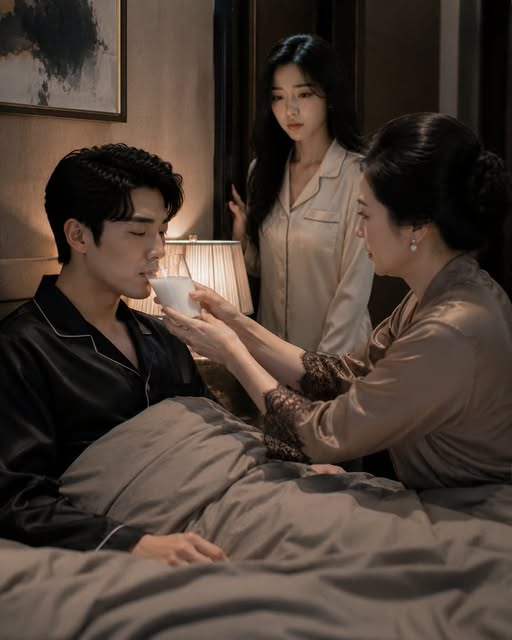
Margaret stood at the end of the hallway holding another glass of milk.
“Claire,” she repeated, “don’t ever touch what isn’t yours.”
I looked at the glass.
Then at Ethan.
He was still sitting on the sofa, trembling, confused and exhausted.
For months, I had doubted myself.
Not anymore.
I took out my phone.
“I’m calling a doctor.”
Margaret’s expression changed immediately.
“There’s no need.”
Ethan looked at her.
“Mom… what’s in the milk?”
“Nothing.”
“Then why did I feel different the one night I didn’t drink it?”
She tightened her fingers around the glass.
“You’re sick because Claire interfered with your routine.”
I stood between them.
“Then a hospital can confirm that.”
Margaret suddenly became angry.
“My son does not need a hospital. He needs rest.”
Ethan slowly raised his head.
“Mom.”
She stopped.
“What have you been giving me?”
For the first time, Margaret looked afraid.
Twenty minutes later, we were in the emergency department.
I brought the glass with us.
I did not taste it.
I did not try to identify anything myself.
I handed it directly to the medical staff and told them exactly what had happened.
Several hours later, a physician entered Ethan’s room.
His expression was serious.
“Mr. Miller, we found evidence that you have been repeatedly exposed to a prescription sedating medication.”
Ethan stared at him.
“What?”
“Have you been taking anything for sleep?”
“No.”
“Anxiety?”
“No.”
The doctor looked toward me.
Then back at him.
“It appears you may have developed physical dependence after prolonged exposure. That could explain why you felt unwell after suddenly missing what your body had become accustomed to.”
Ethan turned white.
I did not look at Margaret.
She was sitting outside the room.
I already knew.
The doctor continued:
“We need to monitor you and manage this medically. Do not take anything else from home until we know exactly what you have been receiving.”
Ethan whispered:
“My mother has been giving me milk every night.”
The doctor’s face tightened.
“That information needs to be documented.”
The next question came from Ethan.
“How long would this have to happen?”
The doctor did not give him the answer he wanted.
“Long enough that we should investigate carefully.”
That afternoon, Ethan finally asked Margaret directly.
She denied everything.
Then she changed her story.
First:
“It was only vitamins.”
Then:
“It was something mild to help you sleep.”
Then:
“You used to take it years ago.”
And finally:
“I knew what my son needed better than some stranger who married into the family.”
That was when Ethan understood.
The prescription had originally been given to him temporarily after his father died.
Years earlier.
Margaret had remembered how quiet he became while taking it.
How dependent he became on her routines.
How easily she could tell him:
You’re tired.
You’re overwhelmed.
Let Mom handle everything.
The medication had been discontinued long ago.
Margaret never accepted that.
When Ethan began suffering stomach problems months earlier, she moved into our house.
And the nightly milk returned.
Regularly.
Precisely.
9:30.
Every night.
The police did not drag her away in some dramatic scene.
Real life was slower.
Records were collected.
Doctors documented Ethan’s condition.
The contents of the drink were tested.
Margaret’s medications and communications were reviewed.
And I learned something even more disturbing.
She had been doing more than controlling his sleep.
She had been controlling information.
My work promotion?
Margaret told Ethan I had complained that his illness was interfering with my career.
I never said that.
The evening I stayed late at work?
She told him I had chosen my boss over him.
The weekend I arranged a respiratory specialist for his stomach-related symptoms?
She canceled the appointment from our home phone and told Ethan the doctor had postponed it.
Then she told me Ethan did not want to go.
Piece by piece, she had been placing herself between us.
And Ethan had allowed it.
That part mattered.
Because although what Margaret had done to him was a violation, it did not magically erase every decision he had made.
He had still looked at me when she insulted my clothes and said:
“Mom is right.”
He had still allowed her to question my work.
He had still watched me become smaller inside my own home and told me to be patient.
Three days into his hospital stay, Ethan asked me:
“Are you angry with me?”
I sat beside the window.
“Yes.”
His eyes filled.
“I didn’t know what she was doing.”
“I know.”
“Then why are you angry?”
I looked at him.
“Because she didn’t make every choice for you.”
He became still.
“I told you I was uncomfortable.”
“I told you she was taking over our home.”
“I asked you to defend me.”
I swallowed.
“And every time, you chose the easiest explanation.”
That I was sensitive.
Jealous.
Ungrateful.
Difficult.
Ethan lowered his head.
“You’re right.”
That was the first time in months he said those words without adding but.
Margaret was eventually ordered to stay away from the house while the investigation continued.
She blamed me.
Of course.
She sent Ethan dozens of messages.
Claire is turning you against your mother.
I sacrificed my life for you.
Nobody will love you the way I do.
One message finally broke something in him:
A wife can leave. A mother never will.
Ethan stared at it.
Then blocked her.
Not because I told him to.
I didn’t.
He did it himself.
A week later, I packed a suitcase.
Ethan watched from the bedroom door.
“Where are you going?”
“My sister’s.”
His face fell.
“You said Mom can’t come back.”
“This isn’t about Margaret.”
“Then what is it about?”
“Me.”
I closed the suitcase.
“For months, I kept asking myself whether I was imagining everything.”
“I changed my clothes because she criticized them.”
“I stopped wearing red lipstick.”
“I started leaving work earlier.”
“I apologized for meetings I had every right to attend.”
I looked around the room.
“I nearly disappeared trying to convince both of you that I was a good wife.”
Ethan stepped toward me.
“Claire, I’m getting help.”
“I know.”
“I’m going to therapy.”
“Good.”
“I’ll never let her control our marriage again.”
I believed that he meant it.
But promises made during crisis were easy.
I needed to know who he would become after the crisis passed.
So I left.
Not forever.
Not with a dramatic divorce filing waiting on the table.
I left because for the first time, Ethan needed to recover without replacing dependence on his mother with dependence on me.
And I needed to remember who I was when nobody was telling me how a wife should behave.
Over the following year, Ethan changed.
Slowly.
Painfully.
He worked with doctors.
He went to counseling.
He learned something that should have been obvious:
Care without consent can become control.
And love without boundaries can become possession.
Margaret never accepted that lesson.
She insisted she had only wanted to help.
Even when confronted with medical evidence, she said:
“I kept my son calm.”
Ethan answered:
“You kept me dependent.”
She cried.
He did not take the words back.
The legal case did not transform into some dramatic lifetime sentence.
But what Margaret had done was formally documented, restrictions were imposed, and she was required to comply with treatment and legal conditions arising from the investigation.
More importantly, she no longer had unrestricted access to Ethan.
Or to me.
Six months into our separation, Ethan came to see me.
We met in a café.
He looked healthier.
Not completely healed.
But awake in a way I had not seen for years.
“I heard you got the promotion.”
I smiled.
“I did.”
The job Margaret once mocked had become a department leadership position.
“Congratulations.”
“Thank you.”
He was quiet for a while.
Then:
“I owe you an apology.”
“You’ve apologized.”
“Not for the right thing.”
I waited.
He continued:
“I kept telling myself Mom was the reason our marriage fell apart.”
I said nothing.
“But she isn’t the whole reason.”
That surprised me.
He looked at his hands.
“She manipulated me.”
“She gave me something without my knowledge.”
“She lied.”
His voice tightened.
“But you were standing right in front of me asking to be respected.”
“And I didn’t need medication to hear you.”
That was it.
The sentence I had been waiting for.
Not:
I was sick.
Not:
My mother made me.
Responsibility.
He looked at me.
“I don’t expect you to come home.”
“Good.”
A sad smile appeared.
“But if someday you wanted to have dinner with me…”
I raised an eyebrow.
“This is dinner.”
“I mean another one.”
I smiled despite myself.
“Maybe.”
We did not move back together.
Not then.
We started with coffee.
Then dinner.
Then weekends.
For the first time since our marriage began, Ethan learned to make decisions without asking his mother whether they were correct.
And I learned not to confuse forgiveness with surrender.
A year and a half later, we had a choice.
Sign divorce papers.
Or build something new.
I asked him one question.
“If your mother called tomorrow and said she needed you to choose between her and me, what would you do?”
Ethan shook his head.
“I wouldn’t choose between you.”
I frowned.
Then he continued:
“I’d tell her she doesn’t get to create that choice.”
That was the answer.
We stayed married.
But not because I forgot.
And not because what happened suddenly became harmless.
We stayed because Ethan finally understood that a marriage cannot survive when a third person controls the rules.
Margaret never moved back in.
She never reorganized my kitchen again.
She never commented on my lipstick.
And she never prepared Ethan another glass of milk.
Years later, one night at exactly 9:30, I walked into the living room.
Ethan was sitting on the sofa.
He looked at the clock.
Then at me.
“You know what’s strange?”
“What?”
“I used to think I couldn’t sleep without that glass.”
I sat beside him.
“And now?”
He smiled.
“Now I know I just wasn’t allowed to discover that I could.”
That sentence stayed with me.
Because the glass had never been only milk.
It was routine.
Guilt.
Dependence.
A mother who needed her adult son to remain a child.
And a husband who had spent too long allowing his wife to become the outsider in her own marriage.
For months, I thought I was overreacting.
One night, I replaced the milk with water.
I did not know it then—
but that small act did not merely expose what was inside the glass.
It exposed everything that had been hidden inside our marriage.
