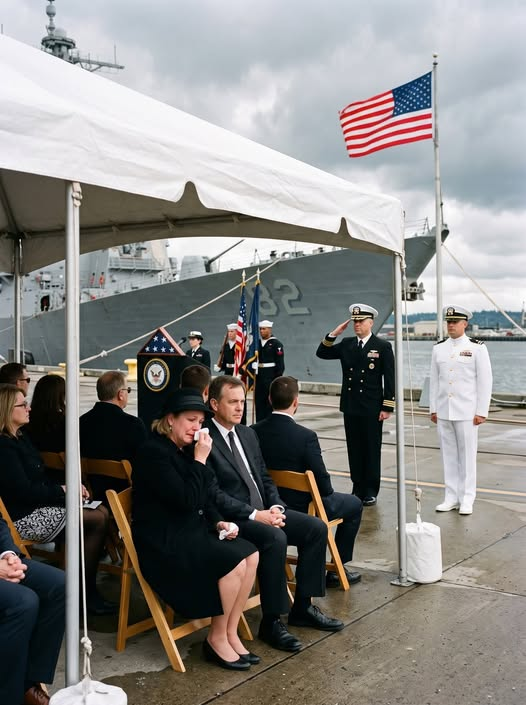
Commander Nathaniel Hayes stopped in front of me.
Then saluted.
“Captain Carter, ma’am.”
The entire front row went silent.
“We’ve been expecting you.”
My mother’s fingers froze around her pearls.
Dad stopped smiling.
Ryan stared at me as though someone had replaced his sister while he wasn’t looking.
I stood and returned the greeting.
“Commander.”
Hayes glanced at the chair beside me, then at the reserved seat near the stage.
“There seems to have been a seating mistake.”
“It’s fine.”
“No, ma’am.”
His voice remained polite.
“It isn’t.”
The security guard immediately checked his list again.
I saw the exact moment he found the other entry.
Not:
Emily Carter — Sister of Candidate Ryan Carter.
But:
Captain Emily Carter — Distinguished Guest.
My mother stood abruptly.
“Captain?”
Nobody answered her.
Hayes looked at me.
“We reserved a place beside the command staff.”
I picked up my purse.
Before walking away, I looked at Ryan.
His face was pale.
I could have enjoyed it.
I didn’t.
This was still his ceremony.
So I said only:
“Congratulations, Ryan.”
Then I followed Commander Hayes to the stage.
My family spent the next twenty minutes discovering that the “disappointing sister” had not been figuring things out.
I had figured them out years ago.
When I left college at twenty, I had not simply dropped out and disappeared.
I transferred into a military medical program.
Later, I served in Naval Special Warfare support medicine.
No secret assassinations.
No heroic stories I was eager to tell at dinner.
Mostly long hours, emergency planning, recovery programs, training and years spent helping injured service members return home alive and rebuild their lives afterward.
My work was rarely public.
I preferred it that way.
But one part of it had become well known inside the community.
A recovery and casualty-response framework my team developed had been adopted across several training commands.
The official name was long and forgettable.
Everyone shortened it.
The Carter Protocol.
Ryan knew that name.
Every SEAL candidate did.
I saw the realization strike him from twenty feet away.
He had studied my work.
He had been tested on it.
And never once had he wondered who Carter was.
Commander Hayes stepped to the microphone.
Before continuing the ceremony, he said:
“We also have Captain Emily Carter with us today. Many of our candidates know her work even if they have never met her personally.”
Applause began.
I hated it.
I leaned toward Hayes.
“Keep it short.”
His mouth twitched.
“Yes, ma’am.”
He added only:
“She has spent the better part of a decade making sure service members come home with more than medals. We’re grateful she could join us.”
Then he returned immediately to Ryan’s class.
Exactly as I wanted.
No stolen spotlight.
No public humiliation.
No speech about how terrible my family had been.
Ryan had earned his Trident.
Whatever existed between us did not erase that.
So when his name was called, I stood.
And applauded.
He looked directly at me.
For the first time that morning, there was no arrogance in his face.
Only shame.
The confrontation came after the ceremony.
Of course it did.
My mother reached me first.
“Emily.”
I continued toward the reception building.
She caught up.
“Why didn’t you tell us?”
I stopped.
“Tell you what?”
“That you were a captain!”
Dad arrived behind her.
“Your mother means your career.”
I looked at both of them.
“I did.”
Silence.
Mom frowned.
“No, you didn’t.”
“I sent you an invitation to my commissioning.”
Her face changed slightly.
Dad said:
“We never got one.”
“You did.”
I remembered the phone call perfectly.
Mom had said Ryan’s regional football championship was that weekend.
Dad had said:
“We can’t keep rearranging the family around every new thing Emily tries.”
I had stopped asking after that.
I continued:
“When I completed advanced training, I called.”
Dad looked away.
“When I received my first major assignment, I emailed.”
Mom’s lips parted.
“When I came home after eighteen months away, you spent dinner asking Ryan about college recruitment.”
Nobody spoke.
I shrugged.
“I didn’t hide my life.”
“You just stopped listening.”
Ryan had walked up behind them.
He looked as if I had struck him.
“You wrote the Carter Protocol?”
“Yes.”
“I studied that for months.”
“I know.”
“How?”
I almost smiled.
“You complained about it in the family group chat.”
His eyes closed.
Right.
He had called the author a sadist because the examinations were difficult.
I had even replied:
Study harder.
He had sent back a laughing emoji.
He never asked why I knew so much about it.
My mother whispered:
“But the scars…”
I looked at her.
“What about them?”
“You never explained.”
“You never asked without making it sound like an accusation.”
She started crying.
For years, tears from my mother had made me immediately soften.
Not today.
She reached for my hand.
“Emily, we thought you were ashamed.”
“No.”
I stepped back gently.
“You were ashamed of me.”
That distinction mattered.
Dad’s face hardened.
Perhaps shame felt too unfamiliar, so he tried anger instead.
“This isn’t fair.”
I looked at him.
“What isn’t?”
“You let us look like fools today.”
I stared at him for several seconds.
Then laughed softly.
“I sat in the chair you told me to sit in.”
His face reddened.
“I didn’t announce anything.”
“I didn’t correct Mom.”
“I didn’t tell Madison to stop.”
“I didn’t ask Commander Hayes to walk over.”
“You did all of that yourselves.”
He had no answer.
Mom whispered:
“We would have treated you differently if we knew.”
That hurt more than everything else.
I looked at her.
“That’s exactly the problem.”
Her face collapsed.
“I shouldn’t need a rank for my mother to defend me.”
Silence.
“I shouldn’t need a distinguished-service record for Dad to stop calling me a disappointment.”
I looked toward Ryan.
“And I shouldn’t need your commander to salute me before my brother decides I’m not an embarrassment.”
Ryan lowered his eyes.
For once, he did not defend himself.
At the reception, I stayed for thirty minutes.
I congratulated Ryan’s teammates.
Spoke briefly with Hayes.
Ate half a sandwich.
Then picked up my bag.
Ryan found me outside.
“Are you leaving?”
“Yes.”
“You drove six hours.”
“And I saw what I came to see.”
He swallowed.
“My ceremony.”
“Yes.”
His eyes reddened.
“Even after what I said?”
I looked at him.
“You being cruel this morning doesn’t mean you didn’t work for what happened today.”
That seemed to make him feel worse.
Good.
Not because I wanted to punish him.
Because for the first time, he understood that respect was possible even when love was complicated.
He whispered:
“I thought you were jealous of me.”
“Why?”
“Mom and Dad always said…”
He stopped.
I waited.
“They said you disappeared whenever something good happened to me because you couldn’t handle not being the successful one.”
I almost laughed.
“I missed your college graduation because I was overseas.”
His face changed.
“Dad told me you were traveling.”
“I was.”
“Just not on vacation.”
He looked sick.
“What about my wedding?”
“I was in a military hospital recovering from an injury.”
His mouth opened.
Nothing came out.
“And Christmas three years ago?”
“On duty.”
“The year before that?”
“Training.”
Every absence he had been taught to interpret as rejection had another explanation.
But I did not let him escape completely into blaming our parents.
“You were an adult for most of those years, Ryan.”
He looked at me.
“You had my number too.”
That landed.
He nodded slowly.
“You’re right.”
It was the first meaningful thing he said all day.
Then:
“I’m sorry.”
No excuse.
No “but.”
I looked at him.
“I believe you.”
His eyes lifted.
“But I’m not pretending this morning didn’t happen.”
“I know.”
“Good.”
I turned toward the parking lot.
Then Ryan called:
“Emily?”
I looked back.
“Can I call you sometime?”
I thought about it.
“Yes.”
“But start by asking me a question.”
He frowned.
“What question?”
I almost smiled.
“Anything you actually want to know about me.”
Then I left.
Ryan called four days later.
He did not ask whether Commander Hayes liked him.
He did not ask whether I could help his career.
He said:
“What made you choose medicine?”
So I told him.
Not everything.
Enough.
The next week he asked where I had lived.
Then what I liked doing when I wasn’t working.
He discovered I hated running despite spending years surrounded by people obsessed with it.
That I loved terrible detective novels.
That I had a dog named Murphy.
That black was my favorite color and had nothing to do with funerals.
Little things.
The kind siblings should have known all along.
We did not become close overnight.
But we became real.
That was better.
My parents took longer.
Mom sent apologies.
At first they were mostly explanations.
We were worried about you.
We didn’t understand.
You were always so private.
I did not answer those.
Six months later, another letter arrived.
This one was different.
I made Ryan’s achievements proof that I had succeeded as a mother, and I made your independence feel like rejection. I compared you because it made me feel important. You did not deserve that.
I answered.
Slowly.
Dad took almost two years to stop defending himself.
Our relationship never returned to what it had been.
That was fine.
I no longer wanted the old relationship.
A year after Ryan’s Trident ceremony, I received an award at a small military medical conference.
Nothing famous.
No cameras.
No national attention.
When I walked into the auditorium, Ryan was sitting in the front row.
Alone.
He stood when he saw me.
“You came.”
He smiled.
“You drove six hours for mine.”
I laughed.
“Fair.”
After the ceremony, one of my colleagues asked:
“Captain Carter, is this your brother?”
Before I could answer, Ryan said:
“Yes.”
Then he added:
“I’m her very proud younger brother.”
No joke.
No comparison.
No embarrassment.
Just pride.
I looked at him.
He looked embarrassed.
“What?”
“Nothing.”
I smiled.
“It just took you long enough.”
He laughed.
“Yeah.”
“It did.”
Years earlier, my family had built an entire story around me without knowing almost anything about my life.
Emily was difficult.
Emily was lost.
Emily was jealous.
Emily was disappointing.
Then one morning at Coronado, a commander walked across a ceremony field and saluted the woman they had just tried to move out of the front row.
For a few minutes, I thought that salute would be the satisfying part.
It wasn’t.
The satisfying part came much later.
When Ryan finally learned that respect did not mean being impressed by my rank.
It meant calling when there was no ceremony.
Listening when nobody important was watching.
And knowing his sister well enough that she no longer needed a uniform, a title or someone else’s salute to prove who she was.
My mother once called me “the disappointing sister.”
Commander Hayes called me “Captain Carter.”
But the title I valued most came a year later, when Ryan introduced me without shame:
“This is my sister, Emily.”
Nothing more.
For the first time, nothing more was needed.
