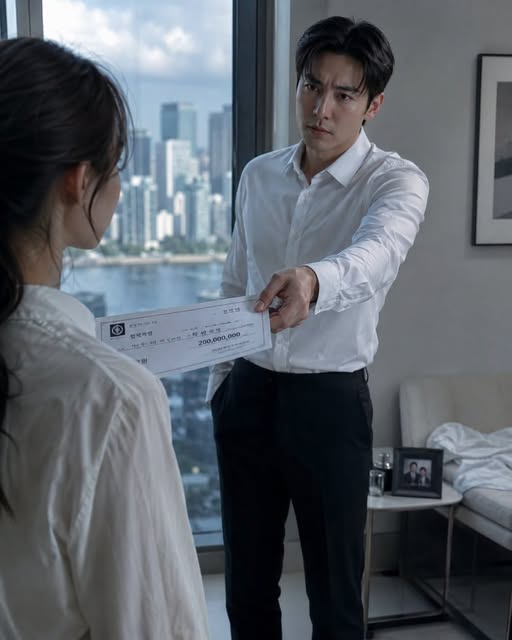
One hour later, the two hundred million arrived.
I looked at the banking notification once.
Then locked my phone.
Co Dien Chau seemed almost disappointed.
He had probably expected me to throw the check back at him and shout that love could not be bought.
Instead I said:
“Thank you.”
His eyes narrowed.
“For what?”
“For putting a price on the end of our marriage.”
Lam Tieu Nha gave a soft laugh.
“At least Sister Tham knows when to leave.”
I looked at her.
Then at the hand she had placed over her supposedly pregnant stomach.
“Take good care of your healthy heir.”
Her smile became brighter.
“I will.”
I said nothing else.
Because the truth did not need to arrive immediately.
It was already on its way.
Twenty minutes later, the hospital director entered my room personally.
Behind him came the chief of neonatology and three people in dark suits.
Co Dien Chau frowned.
“What is this?”
The oldest man bowed slightly toward me.
“Miss Tham, the transfer team is prepared.”
Dien Chau froze.
Lam Tieu Nha blinked.
I removed the hospital blanket and carefully swung my feet toward the floor.
“Are both babies stable enough?”
The neonatologist nodded.
“Yes. We have coordinated with the Tham Medical Center. Their neonatal intensive-care team is ready.”
Dien Chau stepped forward.
“Tham Medical Center?”
He knew that name.
Everyone in Hai Thanh did.
It was part of the Tham family’s national medical network.
I looked at him.
“My sons are leaving.”
His face darkened.
“You just had surgery. Stop causing trouble.”
The man beside me calmly introduced himself.
“Mr. Co, I am Tham Quang Minh, Miss Tham Ngu’s elder brother.”
Silence.
Dien Chau stared at him.
Then at me.
Finally, he laughed.
“You?”
“Yes.”
“The Tham family?”
“Yes.”
His expression slowly collapsed.
Lam Tieu Nha whispered:
“But she’s an orphan from an ordinary family…”
I smiled.
“That was the story people knew.”
Twenty years earlier, I had been separated from my family after an accident.
By the time I was found again, I was already an adult.
I chose not to announce my identity.
Then I met Co Dien Chau.
And because I wanted at least one person to love me without calculating what the Tham name could offer, I kept quiet.
What an excellent experiment.
I finally had the result.
Dien Chau’s face became rigid.
“You lied to me.”
I almost laughed.
“I never told you I had no family.”
“You assumed.”
His eyes moved toward my brother.
Then toward the divorce agreement in his hand.
Something resembling panic appeared.
“Tham Ngu, wait.”
“No.”
His voice lowered.
“We can discuss this.”
“You already finished discussing it.”
I pointed toward the papers.
“You called our children burdens.”
“You threatened me.”
“You gave me two hundred million.”
“And I signed.”
I smiled faintly.
“Congratulations. For once, you got exactly what you asked for.”
My sons were transferred that afternoon.
I went with them two days later, once my doctors cleared me.
At the Tham Medical Center, the first thing I asked was not whether they would become “normal.”
I asked:
“What do they need now?”
The specialist answered calmly.
Time.
Respiratory support.
Monitoring.
Nutrition.
And patience.
He also corrected something that Co Dien Chau and Lam Tieu Nha had twisted into a verdict.
Prematurity carried risks.
It did not allow anyone to look at two newborn babies and declare what kind of lives they would have.
Weeks passed.
Then months.
Both boys survived.
I named them An and Minh.
An was smaller.
Minh cried louder.
At four months, An needed extra physical therapy.
At six months, Minh was already trying to steal his brother’s toys.
At ten months, both had developed a habit of waking me before sunrise.
Not exactly the useless children their father had predicted.
Just babies.
Messy.
Demanding.
Alive.
I kept the two hundred million.
Every yuan.
Not because I needed it.
Because Co Dien Chau had voluntarily included it in the divorce settlement.
My attorney reviewed the agreement.
The clauses concerning the children required separate legal treatment; private signatures could not simply erase their rights.
So I did things properly.
The court received the threats documented in the hospital.
The divorce agreement.
Witness statements.
His expressed refusal to participate in their treatment.
I received primary custody and decision-making authority.
Any future attempt by him to establish contact would need to go through formal channels.
No surprise visits.
No taking children because they carried the Co surname.
No using the word “heir” as if that created ownership.
The two hundred million went into a protected account for An and Minh’s care, education and future.
Co Dien Chau had called it my last bit of dignity.
I made it the first money he ever contributed responsibly to his sons.
Then came Deep Blue Capital.
I did not call anyone and order them to destroy Co Thi Group.
That would have been childish.
Instead, I disclosed the divorce to Deep Blue’s investment committee.
For years, I had quietly opened doors for Co Dien Chau.
Introductions.
Joint ventures.
Meetings that somehow became available when every other company had been told the schedule was full.
He had thought those doors opened because everyone recognized his brilliance.
Some did.
Others opened because I had called first.
Now I stopped calling.
That was all.
The investment committee independently reviewed Co Thi Group’s outstanding projects.
Two remained sound and continued.
One proposed expansion was rejected because its debt level was too high.
Another partnership went to a competing bidder.
Co Thi did not collapse.
Employees kept their jobs.
But for the first time, Dien Chau had to stand on his own record without an invisible hand clearing obstacles ahead of him.
He hated it.
Three months after the divorce, he finally discovered who chaired Deep Blue’s strategic committee.
Me.
He called seventeen times.
I answered the eighteenth.
“Tham Ngu.”
“Yes?”
“You’re Deep Blue.”
“Part of it.”
“Those projects over the years…”
“Some introductions came from me.”
His breathing became rough.
“You were helping me?”
“Yes.”
“Why didn’t you tell me?”
I looked at An sleeping against my shoulder.
“Because I loved you.”
Silence.
Then:
“Why stop?”
I almost smiled.
“Because I no longer do unpaid work for my ex-husband.”
He had no answer.
The cruelest revelation came from Lam Tieu Nha herself.
Five months after I left, she disappeared from Co Dien Chau’s house.
Then a private clinic contacted him regarding inconsistencies in the pregnancy documentation she had shown him.
The dates did not match.
Neither did several records.
Eventually, the truth came out.
She had been pregnant.
But the pregnancy had begun before she and Dien Chau resumed their relationship.
She had known there was serious uncertainty about paternity.
She simply allowed him to believe exactly what he wanted to believe:
A healthy son.
A perfect replacement.
A reason to discard two premature babies without guilt.
A paternity test after the child was born confirmed it.
The baby was not his.
I learned all of this from my lawyer because Co Dien Chau immediately petitioned to establish contact with An and Minh.
Not because he suddenly discovered fatherhood.
Because he had discovered he had no replacement.
That distinction mattered.
I opposed immediate unsupervised contact.
The court agreed.
If he wanted a relationship with the twins, he first had to prove that he understood they were children, not assets returned after a failed investment.
He came to see me outside the courthouse.
For the first time in seven years, Co Dien Chau looked afraid.
“Tham Ngu.”
I stopped.
“You knew Tieu Nha’s child wasn’t mine?”
“No.”
He searched my face.
“You’re not happy?”
“Why would I be?”
“She lied to me.”
“You believed her because the lie gave you permission to abandon two babies you considered imperfect.”
His face turned white.
“I was wrong.”
“Yes.”
“The doctors exaggerated.”
“No.”
I shook my head.
“The doctors said there were risks.”
“You turned risk into worthlessness.”
He lowered his eyes.
Then:
“I want to see my sons.”
I looked at him.
“Why?”
His head snapped up.
“They’re mine.”
“Wrong answer.”
His face froze.
I continued:
“They are not property you discovered was still valuable.”
“They are two little boys.”
“An hates bananas.”
“Minh is afraid of the vacuum cleaner.”
“One needs more therapy than the other.”
“Both throw food when they’re angry.”
I stepped closer.
“If you want to know them, start by learning their names before you talk about bloodlines.”
His eyes reddened.
Then, for once, he said nothing.
Co Dien Chau spent almost a year doing what the court required.
Counseling.
Parenting education.
Scheduled supervised meetings.
The first time he met An and Minh properly, they were almost two.
Neither ran toward him.
Neither magically recognized their father.
Minh hid behind my brother’s leg.
An stared at Dien Chau’s expensive watch.
Then tried to pull it off.
I nearly laughed.
Dien Chau knelt.
No gifts.
No speech about the Co family.
He simply said:
“Hello. I’m Dien Chau.”
An looked at him.
Then wandered away.
That was all.
Perfect.
Trust did not arrive because DNA demanded it.
He had to build it.
Years passed.
Dien Chau became more consistent.
Not perfect.
But better.
Eventually the boys knew he was their father.
They spent limited, structured time with him.
I never taught them to hate him.
I also never lied about our history.
When they became old enough to ask difficult questions, I promised myself the truth would be given carefully, without forcing them to carry my anger.
They were children.
Not evidence of his failure.
Not weapons in mine.
As for me, I returned fully to Deep Blue.
For years I had hidden behind analysts and committees because I thought being visible would threaten my marriage.
Now there was no marriage left to protect.
Three years later, I stood onstage at our annual investment conference.
My sons were sitting with my brother in the front row.
An wore glasses.
Minh had somehow convinced security to give him two cookies instead of one.
Both healthy.
Both noisy.
Both completely uninterested in being anyone’s heirs.
Afterward, Co Dien Chau approached me.
He had come to pick them up for his scheduled afternoon.
His company had recovered too.
Smaller expansion plan.
Less debt.
Better governance.
He no longer needed Deep Blue’s shadow.
That was good.
He looked toward the boys.
“They’re waiting.”
“I know.”
Then, quietly:
“I still think about the hospital.”
“So do I.”
He swallowed.
“I called them…”
“Don’t.”
He stopped.
I did not need to hear those words again.
He understood.
He nodded.
Then he said:
“I thought money measured risk.”
“And?”
His eyes moved toward An and Minh arguing over a toy car.
“I learned children aren’t investments.”
A little late.
But true.
He took the boys’ backpacks.
Before leaving, he looked at me.
“Do you think you’ll ever forgive me?”
I thought about it.
“I stopped waking up angry a long time ago.”
Hope flickered.
I finished:
“That isn’t the same as wanting you back.”
He gave a small, sad smile.
“I know.”
Then he left with our sons.
People later loved telling the story as if I had won because I was secretly richer than Co Dien Chau.
That was never the point.
If I had truly been poor, what he did would still have been cruel.
If my family had never found me, his threats would still have been wrong.
If An and Minh had grown up with serious disabilities, they would still have been worthy of care.
The Tham name did not make me deserving of respect.
Deep Blue did not make my children deserving of love.
Those things only made it harder for Co Dien Chau to pretend his judgment had been correct.
On the day my sons were born, he looked at two premature babies and saw damaged heirs.
I looked at them and saw my children.
He gave me two hundred million yuan and told me to take them away.
So I did.
I took the money.
I took my sons.
I took back my name, my work and the life I had reduced for seven years to fit inside his world.
Years later, Co Dien Chau finally earned a limited place in his children’s lives.
But he never regained mine.
Because the most important thing I took from that hospital was not his money.
It was the certainty that neither I nor my sons would ever again need to prove our value to a man who had already assigned us a price.
