Chu Nghiem stood at the door of the ward.
The nurses immediately scattered.
He looked at me.
“You’re awake?”
“Unfortunately.”
His mouth twitched.
“The surgery team confirmed appendicitis. They’re preparing you now.”
Then his expression became cold again.
“Have you contacted your family?”
“No.”
His jaw tightened.
“You really intend to do everything alone?”
I looked at him.
“Wasn’t that what you told me to do three years ago?”
His face changed.
Before he could answer, a nurse rushed in.
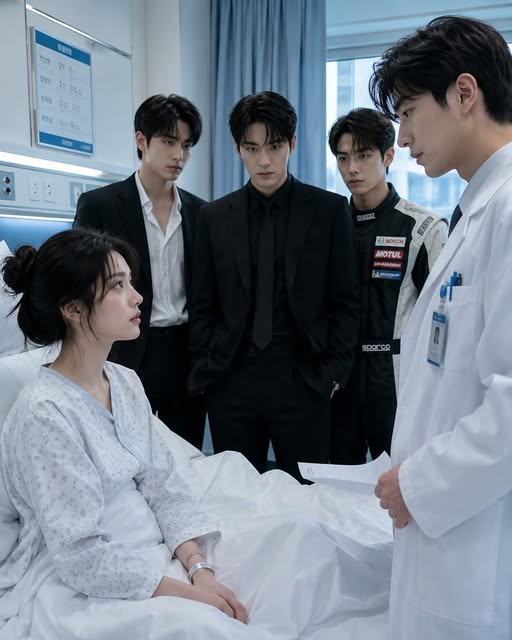
“Dr. Chu, there are… three gentlemen outside asking for the patient.”
“Three?”
The first man entered wearing a cap and mask.
Even so, the nurse beside me nearly screamed.
It was Lâm Dịch, one of the most famous singers in the country.
He pulled off his mask.
“You had abdominal pain and didn’t call me?”
Before I could answer, another man walked in wearing a dark suit.
Tạ Minh Khải, vice president of a major investment group.
He put his phone down.
“I’ve already postponed my meetings. Which doctor is responsible for her?”
Chu Nghiem’s eyebrows twitched.
Then came the third.
A tall man carrying a motorcycle helmet.
Phùng Gia Hạo, the racing champion whose face appeared on sports advertisements everywhere.
He looked at me.
Then exploded.
“You fainted and nobody told me?!”
I covered my face.
“This is why I didn’t call you.”
The three began talking at once.
“Which surgeon?”
“What anesthesia?”
“How long will she stay?”
“Why was she alone?”
“Has she eaten?”
“Can we transfer her to a private room?”
Chu Nghiem finally spoke.
“Enough.”
All three men looked at him.
His expression was perfectly professional.
Only his ears were red.
He turned toward me.
“You said…”
He stopped.
Then forced the words out.
“These three men are all your family?”
“Yes.”
His mouth tightened.
I raised an eyebrow.
“Does the hospital have a rule that family members cannot exceed three?”
Gia Hạo laughed first.
Minh Khải covered his mouth.
Even Lâm Dịch looked away.
Chu Nghiem’s face darkened.
Then Lâm Dịch suddenly recognized him.
His smile disappeared.
“So you’re Chu Nghiem.”
Chu Nghiem looked at him.
“You know me?”
“Of course.”
He walked closer.
“The ex-husband who divorced our little sister because he thought she was leaving with another man.”
The room went silent.
My heart stopped.
“Brother.”
Too late.
Chu Nghiem slowly turned toward me.
“Little sister?”
I closed my eyes.
The three men were not my biological brothers.
We had grown up together in the same orphanage.
Lâm Dịch was adopted first.
Minh Khải two years later.
Gia Hạo last.
But every year, no matter where life took us, we returned to see one another.
They were the closest thing to family I had ever known.
When I married Chu Nghiem, all three were overseas.
And because my relationship with them had become strained over my decision to marry so quickly, none attended the wedding.
Chu Nghiem knew I had grown up in an orphanage.
He did not know about them.
Or rather—
he had seen one of them once.
Three years ago.
The night before our divorce.
Chu Nghiem stared at Minh Khải.
“You.”
Minh Khải frowned.
Then recognition appeared.
“Oh.”
Chu Nghiem’s face turned pale.
“You were the man outside our apartment.”
“Yes.”
“You hugged her.”
“She was my sister.”
“You told her to come home with you.”
Minh Khải looked at him as though he were stupid.
“Because she had called me crying at two in the morning.”
Chu Nghiem’s eyes moved toward me.
“You told me he was nobody.”
I laughed bitterly.
“And you told me Bach Nguyet Quang was none of my business.”
His face froze.
There it was.
The divorce neither of us had ever properly explained.
Three years earlier, I had gone to Chu Nghiem’s hospital to surprise him after a night shift.
Instead, I found Bach Nguyet Quang asleep in his office wearing his jacket.
His mother had always adored her.
Everyone called her his first love.
When I asked what she was doing there, Chu Nghiem had already been exhausted from thirty hours of work.
He answered:
“She fainted during rounds. Stop imagining things.”
Then his phone rang.
His mother.
I heard her say:
“Nguyet Quang is finally back. This time don’t let her go again.”
I asked Chu Nghiem:
“Do you want her back?”
He rubbed his forehead.
“I don’t have the energy for this.”
That sentence destroyed me.
I went home.
Called Minh Khải.
And packed.
When Chu Nghiem returned, he saw another man carrying my suitcase.
He asked:
“Who is he?”
I was angry.
Humiliated.
So I answered:
“Someone who actually comes when I call.”
Chu Nghiem’s pride did the rest.
The divorce papers were signed two weeks later.
Neither of us asked one more question.
Back in the hospital room, Chu Nghiem looked as if someone had removed the floor beneath him.
Then he asked:
“And Bach Nguyet Quang?”
I crossed my arms.
“You tell me. Apparently she’s your girlfriend.”
“What?”
A nurse near the door immediately looked guilty.
Chu Nghiem stared at me.
“I have never dated Bach Nguyet Quang.”
Now it was my turn to freeze.
“What?”
“She is my mother’s friend’s daughter.”
“Your first love.”
“My mother’s description. Not mine.”
He looked almost offended.
“She came back from Boston to join the cardiology department.”
“And your jacket?”
“She had collapsed.”
I said nothing.
He continued:
“She got engaged last year.”
My mouth opened.
“To someone else.”
Silence.
Gia Hạo finally muttered:
“You two divorced because neither of you knew how to ask a second question?”
Nobody answered.
Then he looked at the ceiling.
“Unbelievable.”
I threw a pillow at him.
The surgery went smoothly.
When I woke properly several hours later, all three brothers were asleep around the room.
Lâm Dịch had folded himself into a chair with sunglasses still on.
Gia Hạo was snoring beside the window.
Minh Khải was answering emails silently.
And outside the glass door stood Chu Nghiem.
He didn’t enter.
He had transferred my case to another surgeon once he learned the patient was his ex-wife.
For the first time since we met again, he respected a boundary without being asked.
The next morning, he came carrying breakfast.
Minh Khải stopped him.
“Visiting hours.”
Chu Nghiem stared.
“I work here.”
“And?”
“I’m a doctor.”
“You’re not her doctor anymore.”
I almost laughed.
Chu Nghiem looked at me.
“Can I come in?”
That question surprised me.
I nodded.
He put the food down.
Then noticed the ring on my finger.
His eyes darkened.
“The nurses said you were married.”
I followed his gaze.
Then laughed.
“This?”
I removed it.
Inside were four tiny engraved letters.
The initials of the four children who had grown up together.
Each of us had one.
“It’s a family ring.”
Chu Nghiem closed his eyes.
Gia Hạo whispered loudly:
“He’s going to have a heart attack before the patient does.”
“Get out,” Chu Nghiem said.
Gia Hạo grinned.
For the first time, I saw Chu Nghiem embarrassed.
It suited him.
When I was discharged, he did not ask me to return to him.
He only said:
“I owe you an apology.”
“So do I.”
He shook his head.
“No.”
“Yes.”
I looked at him.
“You assumed the worst about Minh Khải.”
“I assumed the worst about Nguyet Quang.”
“We were both proud.”
He stared at me for a long time.
Then said:
“I searched for you after the divorce.”
I froze.
“What?”
“Six months later.”
“Why?”
“Because I finally stopped being angry enough to think.”
His smile was bitter.
“But your old number was gone. Your apartment was empty.”
I had moved back near my brothers.
For the first year, I deliberately removed every trace Chu Nghiem could follow.
I had thought it was survival.
Perhaps part of it had also been pride.
He continued:
“I told myself if you wanted me, you would come back.”
I laughed sadly.
“I told myself exactly the same thing.”
Three years.
Two stubborn adults.
One misunderstanding.
And enough silence to turn it into a divorce.
But understanding the past did not automatically restore the marriage.
Chu Nghiem seemed to know that.
He started with coffee.
Then lunch.
Then one afternoon he showed up while I was fixing a leaking pipe in one of my buildings.
He stared at the wrench in my hand.
“You do this yourself?”
“Sometimes.”
“You’re terrible at it.”
“Go away.”
He took the wrench.
Five minutes later, the leak became worse.
I stared at him.
“You’re a surgeon.”
“Different pipes.”
I laughed so hard my stomach hurt.
That was the first time we laughed together in three years.
We began again slowly.
No promises.
No pretending the divorce had never happened.
My brothers interrogated him ruthlessly.
Lâm Dịch asked:
“What will you do the next time you see her with a strange man?”
Chu Nghiem answered:
“Ask who he is.”
Minh Khải:
“And if she’s angry?”
“Ask twice.”
Gia Hạo:
“And if she says ‘believe whatever you want’?”
Chu Nghiem looked at me.
“Ask three times.”
I smiled.
He had learned.
So had I.
One year later, Chu Nghiem took me to dinner.
At the end, he placed a small box on the table.
I stared at it.
“No.”
He blinked.
“I haven’t even opened it.”
“I know what boxes that size mean.”
He laughed.
Then pushed it toward me.
Inside was not a ring.
It was a folded piece of paper.
I opened it.
Question number one: Do you still love me?
I looked up.
“Yes.”
He exhaled.
I turned the page.
Question number two: Do you trust me enough to try again?
I thought longer.
“Yes.”
Then the final line.
Question number three: If I ask you to marry me again, will you answer only after you’re completely sure?
My eyes burned.
I looked at him.
“I’m completely sure.”
This time, when we married, my three brothers attended.
Gia Hạo cried the loudest and denied it afterward.
Minh Khải made Chu Nghiem sign a ridiculous handwritten “brother-in-law conduct agreement.”
Lâm Dịch sang at the reception and complained that nobody had paid his appearance fee.
And Bach Nguyet Quang?
She attended with her husband.
The moment I met her, she laughed.
“So you’re the woman everyone thought hated me.”
I covered my face.
Chu Nghiem looked extremely pleased.
I stepped on his shoe.
Years earlier, I went to the emergency room alone and found my ex-husband standing over my test results.
He mocked me for having no man beside me.
The next day, three men appeared.
He thought they were rivals.
They were family.
Then I learned something even more ridiculous.
The woman I had spent three years believing replaced me had never been his girlfriend at all.
Our marriage had not ended because either of us stopped loving the other.
It ended because pride filled every silence with the worst possible answer.
We lost three years to that.
We could not get them back.
So the second time around, Chu Nghiem and I made one rule.
When something hurts—
ask.
When something looks suspicious—
ask again.
And when pride tells you silence is safer—
ask one more time.
Because sometimes the person standing between two people who still love each other is not another man.
Not another woman.
Not even family.
Sometimes—
it is simply the question neither of them was willing to ask.
