Adrián stood in the bedroom holding the divorce papers.
For almost a minute, he did not move.
Then Rosa appeared at the door.
“Sir…”
He turned sharply.
“Where did she go?”
“I don’t know.”
“You helped her leave?”
Rosa swallowed.
“I helped carry the baby’s things.”
Adrián’s jaw tightened.
“When?”
“Thirteen days ago.”
Thirteen.
Clara had left two days after he flew to Paris.
Which meant that while he was dining beside the Seine with Isabella, posting photographs, buying jewelry and ignoring calls from home—
his wife had been dismantling their life.
Rosa extended the second envelope.
“The lady said this was only for you.”
Adrián opened it.
The photograph came first.
Isabella leaving the Paris hotel wearing his coat.
Then several pages.
Credit-card statements.
Hotel receipts.
Restaurant charges.
The diamond necklace.
All highlighted.
At the bottom was a notice from Clara’s attorney.
Every joint card had been frozen.
Her salary and savings had been separated.
A formal accounting of marital funds had been requested.
And the divorce petition had already been filed.
There was also one final page.
A proposed temporary parenting arrangement.
Adrián read the first sentence twice.
All contact regarding the child will be arranged through counsel until both parties establish a stable schedule.
His face changed.
“My daughter.”
He dropped the papers and grabbed his phone.
Clara did not answer.
He called again.
Blocked.
He tried the nanny.
The pediatrician.
Clara’s lawyer.
No one gave him her address.
Then the doorbell rang.
Adrián rushed downstairs.
For one insane second, he thought Clara had returned.
It was Isabella.
She stood outside with two suitcases.
Adrián stared at them.
“What are those?”
Her smile faded.
“My things.”
“Why?”
Isabella looked past him into the mansion.
“Because she finally left.”
Silence.
Then she smiled again.
“You don’t have to hide me anymore.”
That sentence landed harder than the divorce papers.
“What are you talking about?”
Isabella frowned.
“Adrián, don’t do this.”
“Do what?”
“You told me Clara would eventually understand.”
“I told you nothing would change.”
“Exactly.”
She stepped closer.
“And now she’s gone.”
Adrián looked at her as if he had never seen her before.
Isabella’s voice softened.
“We can finally stop pretending.”
“No.”
She froze.
“What?”
“No one is moving into this house.”
Her face hardened.
“You spent fifteen days with me in Paris.”
“Yes.”
“You bought me a necklace.”
“Yes.”
“You told me I was the only woman who understood you.”
Adrián closed his eyes.
He had said all those things.
But somewhere inside his selfishness, there had always been another assumption.
Clara would remain.
Clara would raise their daughter.
Clara would keep the mansion warm.
Clara would forgive.
Isabella was supposed to exist outside that structure.
An escape.
A fantasy.
Never the person replacing it.
Isabella finally understood.
Her voice became cold.
“You never intended to leave her.”
Adrián said nothing.
She laughed bitterly.
“So I was good enough for Paris, but not for your house?”
“Isabella…”
“No.”
She stepped backward.
“You let me believe I was waiting for my turn.”
He looked toward the staircase.
Toward the empty rooms.
“I thought Clara would always be here.”
Isabella stared at him.
Then she said something he would remember for years.
“That doesn’t make you faithful, Adrián.”
“It makes you greedy.”
She picked up her suitcases.
He did not stop her.
That evening, Adrián finally reached Clara through her lawyer.
The call lasted six minutes.
“Clara.”
I was sitting beside the fireplace with my daughter asleep against me.
“What do you want?”
“I need to see her.”
“You will.”
His breathing changed.
“When?”
“When we have a proper arrangement.”
“I’m her father.”
“Yes.”
“Then you can’t keep her from me.”
“I’m not.”
My voice remained calm.
“But you disappeared for fifteen days while she was less than two weeks old.”
“I was working.”
“No.”
Silence.
I looked down at my daughter.
“You were in Paris with Isabella.”
“I made a mistake.”
“Fifteen days is not a mistake.”
His voice cracked.
“I didn’t know she had a fever.”
“You didn’t answer.”
“I thought Rosa would handle anything serious.”
That was when I finally understood how far apart our definitions of fatherhood were.
“You thought the staff could replace you.”
“No.”
“You thought I would handle everything until you felt like coming home.”
He said nothing.
Then:
“Come back.”
I almost smiled.
“No.”
“I’ll end everything with Isabella.”
“It already ended.”
“How do you know?”
“Because this was never about Isabella.”
He went silent.
I continued.
“If she disappeared tomorrow, you would still be the man who looked at his wife recovering from childbirth and decided Paris could not wait.”
His voice became desperate.
“I love you.”
“I know.”
That surprised him.
I added:
“But you loved knowing I would always be there more.”
The legal process lasted nine months.
Adrián fought the divorce at first.
Not over money.
Over the idea that I could actually finish what he thought was temporary anger.
He sent roses.
I returned them.
He sent jewelry.
I sent it to his lawyer.
He arrived outside my new house once.
I did not open the door.
Instead, I sent him a message.
You asked me to come back. You have not once asked what you would need to change to deserve being invited.
He did not answer for two days.
After that, something shifted.
He stopped sending gifts.
He began showing up for his daughter.
At first, through scheduled visits.
Then pediatric appointments.
Vaccinations.
Weekends.
He learned how much formula she needed.
Which lullaby calmed her.
That she hated peas.
That she would throw one specific stuffed rabbit across the room and then cry until someone returned it.
For the first time, Adrián was learning that fatherhood was not a photograph.
It was repetition.
Presence.
Ordinary responsibility.
I never used our daughter to punish him.
Whatever he had done to me, she deserved the opportunity to know her father if he was willing to become one.
And, slowly, he did.
The divorce became final before her first birthday.
After signing, Adrián looked at me outside the courthouse.
“No champagne roses?”
I asked.
He smiled sadly.
“I finally realized you hate them.”
I stared at him.
Eight years together.
And he had only just learned.
“I never liked roses much.”
His face changed.
“But I bought them every anniversary.”
“I know.”
“Why didn’t you tell me?”
“I did.”
He looked confused.
“The first year.”
Then he remembered.
I had once told him I liked wildflowers.
He had laughed and said champagne roses were more elegant.
After that, I stopped correcting him.
Adrián looked away.
“That’s our marriage in one sentence, isn’t it?”
“What?”
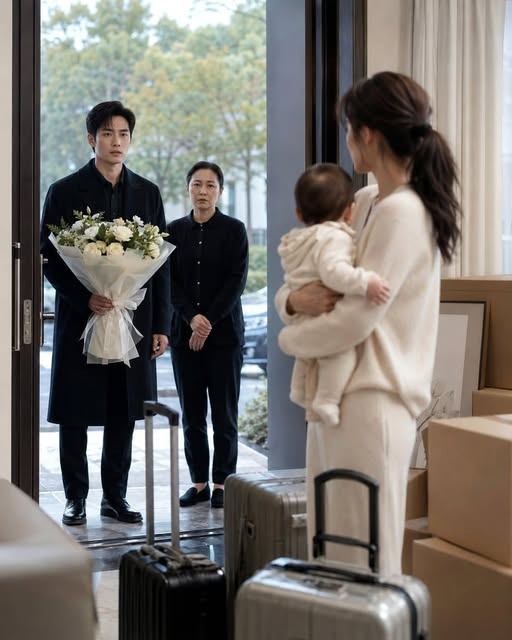
“You told me who you were.”
He swallowed.
“And I kept replacing the answer with what I preferred.”
For once, I did not need to explain anything.
Isabella disappeared from our lives shortly afterward.
Months later, she sent me one message.
I owe you an apology. I knew you existed. I told myself your marriage was already dead because that made what I was doing easier.
I stared at it for a while.
Then answered:
It was dying. But you did not kill it alone.
We never spoke again.
Two years passed.
My daughter began talking.
Running.
Asking impossible questions.
My new house stopped feeling new.
It became ours.
The white blanket from the day I left the mansion became the blanket she dragged everywhere.
I returned to work gradually and built a routine that belonged to me.
Not dramatic.
Not luxurious.
Just mine.
Adrián continued to be part of our daughter’s life.
One evening, he brought her home after dinner.
She had fallen asleep in the car.
He carried her inside and placed her gently on the sofa.
For several seconds, we stood looking at her.
Then he said:
“I used to think providing money meant I was taking care of both of you.”
I said nothing.
“I thought because you had the house, Rosa, the driver, doctors—everything—you didn’t really need me.”
I looked at him.
“And Isabella did?”
He smiled bitterly.
“She made me feel needed.”
There it was.
Finally.
The truth beneath Paris.
He had not abandoned me because Isabella was better.
He had gone where his ego felt larger.
I had been exhausted, recovering, focused on a newborn.
Isabella admired him.
Needed him.
Made him feel like the center of the room.
He whispered:
“I was selfish.”
“Yes.”
“I’m sorry.”
“I know.”
He looked at me.
“Is there really no way back?”
I thought about it.
Not because I was tempted.
Because he deserved an honest answer.
“No.”
His eyes reddened.
I continued gently:
“But that doesn’t mean what we had was fake.”
He looked surprised.
“I loved you.”
“I think you loved me too.”
“Then why can’t that be enough?”
“Because love is not the only thing a marriage needs.”
I looked toward our sleeping daughter.
“It also needs someone who comes home.”
Adrián nodded.
This time he did not argue.
Before leaving, he stopped at the door.
“Clara?”
“Yes?”
“What flowers do you actually like?”
I smiled.
“Wildflowers.”
He laughed softly.
“Of course.”
Then he left.
The following week, when he came to pick up our daughter, there was a small bunch of wildflowers beside the diaper bag.
No card.
No attempt to win me back.
I knew they were an apology.
I put them in water.
And that was all.
Three years after the night I left the mansion, I drove past it by accident.
Someone else lived there now.
Adrián had sold it.
The place looked smaller than I remembered.
Maybe because I had once mistaken size for security.
I thought about the woman who had packed a crib while still recovering, terrified but determined not to let her daughter grow up believing absence was normal.
She had thought she was escaping a broken marriage.
In reality, she was building the first peaceful home she had ever known.
Adrián spent fifteen days in Paris with his first love.
He thought he could return with roses, apologize, and find everything exactly where he had left it.
Instead, he found empty rooms.
Divorce papers.
And one sentence:
Come back with a lawyer.
He did.
But over time, he learned something more painful than losing the divorce case.
He had spent years believing home was a place that would always wait for him.
It wasn’t.
Home was the people waiting inside.
And once he taught his wife and newborn daughter how to live without waiting—
the roses came too late.
