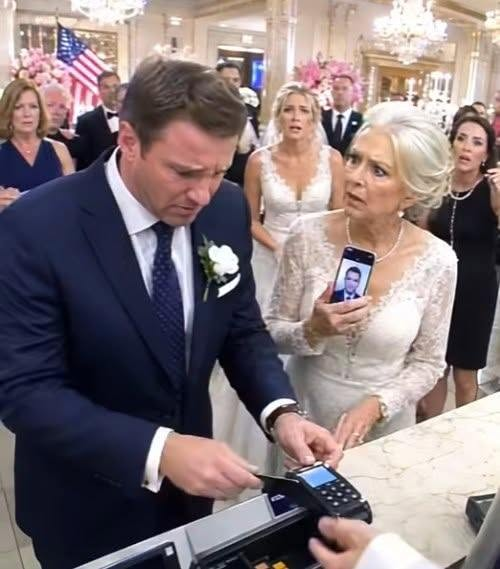
The terminal beeped.
DECLINED.
Jason stared at the screen.
“Try it again.”
The event director did.
Another beep.
Declined.
Carol’s smile vanished.
Jessica whispered:
“What do you mean declined?”
Jason pulled out another card.
Then another.
Both failed.
The event director remained painfully polite.
“Mr. Jason, the outstanding balance is $41,870. We also need payment for the additional champagne service your family approved this afternoon.”
Carol hissed:
“Use your joint account.”
Jason opened the banking app.
And finally understood.
The money he expected to find there was gone.
Not every dollar.
Only the money that was legally and demonstrably mine.
My salary had stopped being deposited there.
The savings I had transferred into the account from my premarital funds had been moved back after I spoke to an attorney from the airport.
Jason’s own money remained.
Unfortunately for the Caldwell family image, it was nowhere near enough to finance the wedding they had chosen.
Jessica’s face turned white.
“Jason, you said everything was covered.”
“It was.”
Carol grabbed his arm.
“Call your wife.”
Across the Atlantic, I was drinking coffee near Piazza Navona when an unknown Charleston number appeared.
I answered because I already knew.
Jason’s voice exploded.
“What did you do?”
I looked at the fountain outside.
“Good afternoon to you too.”
“Why is the account empty?”
“It isn’t.”
“You moved the money!”
“My money.”
“We’re married!”
I almost laughed.
“That didn’t seem important when your family was deciding who was respectable enough to attend Jessica’s wedding.”
Silence.
Then he lowered his voice.
“Come on. Don’t do this now.”
“Do what?”
“My sister is getting married.”
“I know.”
That stopped him.
“You knew?”
“I watched the livestream.”
For several seconds, he said nothing.
Then:
“My mother wasn’t serious.”
“She seemed healthy too.”
His breathing changed.
“I can explain.”
“Your mother was never sick.”
“No.”
“You lied so I wouldn’t come.”
“It wasn’t my decision.”
That sentence almost impressed me.
Even caught, Jason still reached for somewhere else to put responsibility.
“Did somebody force you to drive to Charleston?”
“No.”
“Force you to put on the suit?”
Nothing.
“Force you to stand beside your mother while she laughed about me?”
His voice softened.
“You know how she is.”
“Yes.”
I took a sip of coffee.
“And now I know how you are.”
Behind him I heard Carol.
“Tell her to release the money!”
I smiled.
“Is your mother there?”
Jason hesitated.
I continued:
“Put me on speaker.”
He did.
Carol immediately started.
“This is childish. Whatever little argument you and Jason are having can wait. There are almost two hundred guests here.”
“That sounds expensive.”
“You know perfectly well this wedding was planned months ago!”
“No. I wasn’t invited.”
Jessica suddenly took the phone.
Her voice was shaking.
“Please. I didn’t know Jason told you Mom was sick.”
I believed that part.
Jessica had never been kind to me.
But she sounded genuinely panicked.
“I’m not trying to ruin your wedding.”
“Then please pay the balance.”
There it was.
Not:
I’m sorry you were excluded.
Not:
I’m sorry my family lied to you.
Just:
Pay.
I asked quietly:
“Why would I pay for a wedding I wasn’t welcome at?”
Nobody answered.
The event director eventually gave them thirty minutes.
Carol called relatives.
Jessica’s new husband, Marcos, transferred part of the money.
His parents covered more.
Jason used what remained in his personal savings.
And Carol had to put nearly fifteen thousand dollars on a credit card she had spent years claiming she never needed.
The reception continued.
But the mood was gone.
People knew.
Whispers spread through the ballroom.
Apparently the rich, polished Pike family had staged a luxury wedding they couldn’t finish paying for without the daughter-in-law they had deliberately left in Brooklyn.
And that was only the first bill.
The following morning, Jason finally looked through our finances properly.
That was when he discovered the $62,000 transfer made six weeks earlier.
From our joint savings.
To a company called Palmetto Events LLC.
He called me from another number.
“This sixty-two thousand—”
“I saw it.”
He stopped.
“That was for Jessica’s wedding.”
“I know.”
“You knew before you left?”
“Yes.”
I had found it the morning I discovered the catering sheet.
The transfer memo said:
Family medical reserve.
My hands had gone cold when I saw that.
Jason had told me his mother needed money available for possible treatment.
I had agreed.
The money was supposed to remain untouched unless a medical emergency occurred.
Instead, it financed flowers, catering deposits, photography and the ballroom.
I said:
“You used money I approved for your mother’s health to pay for a wedding I was specifically excluded from.”
Jason went silent.
Then:
“I was going to put it back.”
“When?”
No answer.
“When your bonus came?”
Silence.
“Or after I forgot to ask?”
His voice became desperate.
“It was my sister. I wanted her to have something beautiful.”
“That was your choice.”
I looked across Rome from my hotel balcony.
“You just made it with my money.”
Three days later, I sent him the divorce petition.
That was when Jason stopped being angry.
He became frightened.
He called forty times.
Sent flowers to our Brooklyn apartment.
Then discovered I had extended my stay in Italy.
I wasn’t hiding.
I simply had nowhere I needed to rush back to.
His mother called too.
I answered once.
Carol skipped the apology.
“You’re destroying my son over one wedding.”
“No.”
“You embarrassed us in front of everyone.”
“I wasn’t even there, Carol.”
That silenced her.
Then I added:
“You managed that yourselves.”
Her voice became sharper.
“Jason chose his blood family. A wife should understand that.”
I stared out at the old Roman buildings.
“A wife is family.”
Silence.
“If you never believed that, then at least now we finally agree on something.”
“What?”
“I don’t belong in yours.”
I hung up.
The financial review during the divorce uncovered more than the wedding.
Not crimes.
Something personally worse.
A pattern.
Jason had been quietly sending money to his mother for years.
Property taxes.
Jessica’s credit-card payments.
Repairs to Carol’s house.
Mia’s tuition.
Family vacations.
Whenever I asked why our savings were growing more slowly than expected, he blamed inflation, repairs, taxes.
I earned almost twice what Jason did.
He had started treating that difference as permission.
My money filled the gaps.
His money maintained his family’s lifestyle.
Then came the detail that finally killed whatever tenderness remained.
The Rome trip I had always wanted?
Jason had promised me three times that we couldn’t afford it.
Too much money.
Bad timing.
We needed to save.
Yet in the eighteen months before Jessica’s wedding, he had transferred more than enough to his family to pay for that trip five times.
When he eventually flew to Rome to find me, I agreed to meet him in the hotel lobby.
He looked exhausted.
“You cut your hair.”
“Yes.”
“I like it.”
I almost smiled.
Six years together, and this was how he opened the conversation that would end our marriage.
He sat across from me.
“I’m sorry.”
“For what?”
His face tightened.
“For lying.”
“Which lie?”
That hurt him.
He looked down.
“My mother wasn’t sick.”
“I know.”
“I should have taken you.”
“Yes.”
“I should never have used that money.”
“Yes.”
Then he whispered:
“I thought you would make the wedding uncomfortable.”
I stared at him.
There it was.
The truth.
“Why?”
“My mother doesn’t like you.”
“I know.”
“She thought some of her friends would ask questions.”
“About what?”
He hesitated.
“My family.”
“No.”
I leaned forward.
“About me.”
Jason said nothing.
I understood.
They were embarrassed by my background.
My parents had owned a small hardware store.
I had put myself through graduate school.
I worked in financial risk management and earned more than Jason, but apparently that kind of success still wasn’t elegant enough for Carol’s social circle.
She preferred pretending her son had married into nowhere.
Jason whispered:
“I just wanted one day without conflict.”
I laughed sadly.
“So you removed your wife from the picture.”
“I was coming back to you.”
“That’s the problem.”
He looked confused.
“You assumed you could humiliate me temporarily and return afterward to the same marriage.”
His eyes reddened.
“I love you.”
“I loved you too.”
“Loved?”
“Yes.”
His face broke.
I continued:
“Love can survive a difficult mother-in-law.”
“A rude family.”
“Even exclusion.”
I paused.
“What it cannot survive forever is a husband who keeps volunteering his wife as the person who should absorb the damage.”
He reached across the table.
I moved my hand.
“Come home.”
“No.”
“I’ll cut them off financially.”
“You should set whatever boundaries you want.”
“I’ll make Mom apologize.”
“That’s between you and her.”
“Then what do I need to do?”
For the first time, Jason genuinely did not know.
I answered:
“You need to understand that sometimes the consequence comes after the apology.”
The divorce took nine months.
I recovered my share of the funds used for Jessica’s wedding through the property settlement.
I did not demand Jessica sell gifts or return money.
The wedding was over.
My issue had always been with Jason.
He had been the person who promised me partnership.
Carol and I never repaired our relationship.
She sent one letter months later.
Half apology.
Half explanation.
I returned no answer.
Jason changed more than I expected.
He stopped financing his entire family.
Jessica and Marcos began paying their own bills.
Carol sold the oversized Charleston house and moved into something smaller.
Apparently the family did not collapse when Jason stopped solving every problem.
They just had to live within their means.
I returned from Rome after six weeks.
But not to Jason.
I rented an apartment across the city.
On the wall above my desk, I framed one photograph.
Me in a camel coat.
Short hair.
Trastevere behind me.
The photograph Jason’s family saw before the wedding bill arrived.
One year later, I went back to Italy.
This time I did not run away from anything.
I went because I wanted to.
At a restaurant in Florence, my phone buzzed.
A message from Jason.
Today would have been our anniversary. I hope you’re somewhere you actually wanted to go.
I looked around.
Wine.
Warm lights.
A street I had chosen myself.
I replied:
I am.
Nothing more.
I did not hate Jason.
Eventually, I stopped being angry with his family too.
But forgiveness did not require returning to the same table.
The morning Jason left Brooklyn, he told me his mother was sick.
He thought the lie was small.
One weekend.
One wedding.
One wife left safely at home.
But some betrayals become enormous because they reveal the structure beneath them.
The secret transfers.
The embarrassment.
The assumption that I would pay.
The certainty that I would still be waiting when he came back.
His family thought the crisis began when his card declined at the reception.
It didn’t.
The real account had been emptying for years.
Not the bank account.
The marriage.
And when Jason finally reached for what he thought would always be available—
my money, my patience, my place beside him—
he discovered I had stopped funding all three.
