The phone rang a fourth time.
Then my father answered.
“Sweetheart?”
Carter smiled and leaned against the counter.
“Mr. Bennett, your daughter is having another one of her dramatic episodes.”
There was a pause.
My father’s voice changed immediately.
Not louder.
Colder.
“Put my daughter on the phone.”
Carter laughed.
“She’s fine.”
“Put her on.”
Mrs. Eleanor rolled her eyes.
“Tell him she needs to learn how to behave in her husband’s house.”
My father heard her.
Then he heard me struggling to speak.
“Dad…”
That was enough.
“Where are you?”
“Home.”
“Are you hurt?”
Carter grabbed the phone closer.
“She tripped. Don’t encourage this nonsense.”
My father ignored him.
“Sweetheart, I need one answer. Do you need an ambulance?”
Carter’s smile disappeared.
I looked directly at him.
“Yes.”
My father said:
“Good. Stay where you are.”
Carter frowned.
“What does that mean?”
My father’s voice remained perfectly calm.
“It means I’m calling emergency services from another phone while I keep you on this line.”
Carter’s face changed.
He lunged for the screen.
I heard my father say:
“And Carter?”
“What?”
“Do not touch my daughter again.”
Carter actually laughed.
“Do you have any idea who you’re talking to? My uncle is a senior prosecutor.”
“Yes.”
My father paused.
“I know exactly who your uncle is.”
For the first time, Carter stopped smiling.
My father continued:
“My name is Thomas Bennett.”
Mrs. Eleanor frowned.
“So?”
Carter did not.
He knew.
He stared at me.
Then back at the phone.
“Judge Bennett?”
My father had spent nearly thirty years on the federal bench before retiring to the small Virginia town where I grew up.
No mansion.
No driver.
No newspaper interviews.
He repaired fences himself and drove an old pickup because he liked it.
When Carter met him once before our wedding, my father had introduced himself simply as:
“Tom. Retired.”
Carter had never bothered asking from what.
I had never corrected him.
My father disliked people who used titles as weapons.
And I had wanted to know whether Carter could respect my family without one.
Now I had my answer.
Carter’s voice became unsteady.
“Sir, there’s been a misunderstanding.”
My father replied:
“That is something you can explain to the officers.”
Sirens arrived minutes later.
Carter tried to compose himself.
Mrs. Eleanor suddenly became concerned.
“She’s pregnant. She’s emotional. She lost her balance.”
I said nothing.
I did not need to.
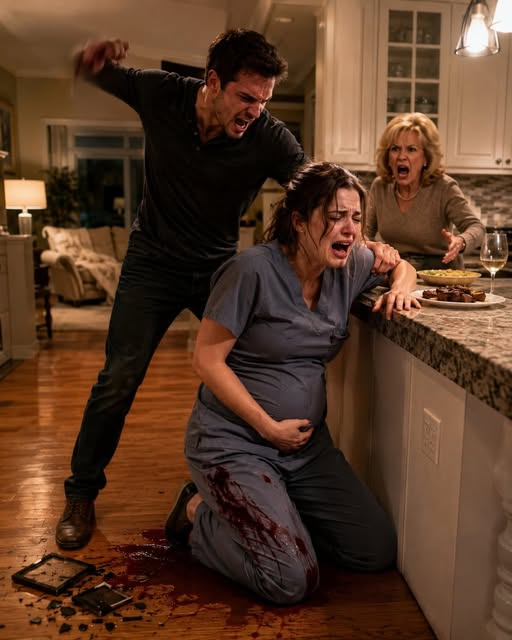
My phone lay broken across the kitchen.
My lip was injured.
The officers had walked into a house where a visibly distressed pregnant woman had asked for medical help while her husband stood beside the phone he had destroyed.
And my father was still on the line.
One officer separated Carter from me.
Another spoke to Mrs. Eleanor.
Paramedics took over.
The last thing I remember before the ambulance doors closed was Carter standing on the driveway.
He looked frightened.
Not for me.
For himself.
At the hospital, everything moved quickly.
Doctors told me the pregnancy was in serious danger.
My son had to be delivered early.
I signed forms with shaking hands while a nurse stayed beside me.
For the first time that night, someone asked:
“Who do you want contacted?”
“My father.”
Not my husband.
My father.
My son, Noah, was born that night.
Far too early.
Tiny.
Fragile.
But alive.
He was taken to neonatal intensive care.
When I woke properly the next morning, my father was sitting beside the bed wearing the same faded brown jacket Carter had once mocked.
He had driven through the night.
I looked at him.
“Is Noah alive?”
“Yes.”
That was when I finally cried.
Dad held my hand.
“He’s fighting.”
I closed my eyes.
“I should have left earlier.”
My father did not tell me what I should have done.
He only said:
“You’re leaving now.”
I nodded.
“Yes.”
Carter tried to enter the hospital later that morning.
He was not allowed into my room.
He called.
Sent messages through relatives.
Then his mother started.
You’re destroying Carter’s career.
Think about your child.
Families solve problems privately.
That last message almost made me laugh.
Privately.
That was exactly how they had survived for years.
Everything had to happen behind doors.
Humiliation privately.
Threats privately.
Fear privately.
Then everyone smiled in public.
Not anymore.
My attorney filed for a protective order and divorce.
Carter hired an aggressive legal team.
His first argument was predictable:
I was unstable.
Overworked.
Emotional from pregnancy.
He claimed the incident had been exaggerated because I wanted an advantage in divorce proceedings.
Then the evidence started arriving.
The emergency call records.
The photographs taken by hospital staff.
The damaged phone.
The officers’ reports.
Rosa, our next-door neighbor, had heard shouting through the shared wall more than once.
A coworker testified that I had arrived at work previously with injuries I had dismissed as accidents.
And then my father produced something I did not know existed.
Months earlier, I had called him after Carter screamed at me for buying the wrong brand of coffee.
I had been crying.
My father had asked:
“Has he ever hurt you?”
I said no.
Then Carter came into the room.
I had forgotten to end the call.
My father had heard enough afterward to understand why I was frightened.
He had kept his notes.
Not as a judge.
As a father who hoped he was wrong.
Carter’s uncle tried to contact people involved in the case.
That was his mistake.
The moment anyone raised a potential conflict involving a relative in the prosecutor’s office, the matter was referred away from him.
Whatever protection Carter thought his family name could provide disappeared.
His uncle could not simply make evidence cease to exist.
And suddenly, Carter was no longer speaking proudly about connections.
He was insisting he had never asked anyone for favors.
The law firm where he worked placed him on leave while his conduct was reviewed.
His professional license also became the subject of a disciplinary process.
Mrs. Eleanor blamed me.
She came to one hearing dressed in black as though I had killed someone.
Outside the courtroom, she hissed:
“You could have handled this quietly.”
I looked at her.
“I did.”
She stopped.
“For two years.”
I stepped closer.
“You liked me quiet.”
Her face changed.
“You confused it with permission.”
Then I walked away.
Noah remained in the hospital for several weeks.
Carter was eventually allowed contact with him under conditions established through the legal process.
I did not use my son to punish him.
Noah deserved decisions based on his safety, not my anger.
But Carter also learned that the word father did not erase everything that had happened before it.
The divorce took nearly a year.
Carter fought hardest over the house.
His mother had always called it “our family home.”
There was one problem.
The down payment had come almost entirely from an inheritance my mother left me.
The mortgage payments had largely come from my salary.
The records existed.
So did the truth.
When the financial disclosures were completed, another surprise emerged.
Carter had been sending money to his mother for years.
Thousands at a time.
He had complained whenever I bought anything for myself.
Yet he covered Eleanor’s vacations, club fees and credit-card balances without telling me.
He had not merely treated me badly.
He had been financing the person who encouraged him to do it.
The final settlement gave me enough to start over safely.
I did not need my father’s money.
That mattered to me.
Dad offered.
I refused.
“You’ve already done enough.”
He smiled.
“No.”
“What?”
“I answered the phone.”
I looked down at Noah sleeping in my arms.
“Exactly.”
Two years later, Noah was healthy enough to run through my father’s backyard chasing bubbles.
Dad still drove the same pickup truck.
He still wore shirts from hardware stores.
Noah adored him.
One afternoon, my son pointed at the truck.
“Grandpa, is that your fancy car?”
Dad looked at me.
I laughed.
“Very fancy.”
My father nodded solemnly.
“Extremely.”
I had returned to work.
Not twelve-hour shifts.
Not anymore.
I changed departments, found a schedule that gave me evenings with Noah, and bought a small townhouse twenty minutes from my father.
Nothing about my life looked impressive from the outside.
That was exactly how I liked it.
Carter saw Noah according to the arrangements eventually approved.
He changed over time.
Whether from regret, consequence or necessity, I did not know.
I stopped needing to know.
Once, after dropping Noah off, he stood on my porch.
“I thought your father ruined my life.”
I looked at him.
“And now?”
He swallowed.
“I ruined it.”
I said nothing.
“My mother kept telling me you made me look weak.”
His eyes dropped.
“And I was stupid enough to believe cruelty made me strong.”
That was the closest thing to accountability I had ever heard from him.
He asked:
“Do you hate me?”
“No.”
That surprised him.
I continued:
“I just don’t trust you.”
His face tightened.
“And that matters more.”
He nodded.
Then left.
Years earlier, Carter had stood in our kitchen and told me his connections meant I could never win.
His mother laughed about my father.
They imagined an old man in a pickup truck racing helplessly toward Alexandria.
But my father never stormed into the house.
He never threatened Carter.
He never used his former title to demand special treatment.
He simply heard his daughter say:
“I need help.”
And believed her.
That was the difference between the family I escaped and the family I returned to.
Carter thought power meant knowing the right prosecutor.
Mrs. Eleanor thought power meant controlling the person in front of you.
My father taught me something else.
Real power is having the ability to intimidate someone—and choosing instead to use the truth, the law, and the evidence.
That night, Carter laughed when I told him to call my father.
He stopped laughing when the phone connected.
But that was not the moment his world changed.
It changed when I finally understood that I did not need a powerful father to save me forever.
I only needed one safe door to walk through—
and the courage never to walk back through Carter’s again.
