Savannah tucked herself under Marcus’s arm.
Judge Whitmore looked at them.
Then at me.
Then at the court officer who had taken that step forward.
His voice remained completely level.
“Officer.”
“Yes, Your Honor.”
“Secure the courtroom recording.”
Bennett Ashford stood.
“Your Honor, I object to—”
“You may object after I finish speaking.”
Bennett sat.
My father looked toward the clerk.
“Preserve the audio, video, and all courtroom security footage from the last fifteen minutes.”
The clerk nodded.
“Immediately.”
Savannah stopped smiling.
Marcus straightened.
“What exactly is happening?”
Judge Whitmore finally looked at him.
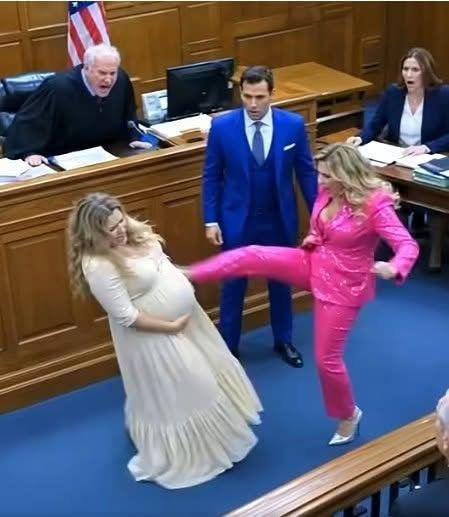
“Mr. Vale, a physical incident occurred in my courtroom.”
“It was an accident.”
Savannah spoke too quickly.
My father ignored her.
“Ms. Vale will be offered medical evaluation. The court officer who witnessed the incident will prepare a statement.”
Bennett stood again.
“With respect, Your Honor, this appears wildly disproportionate.”
My father’s eyes moved toward him.
“You just asked me to characterize physical contact involving a pregnant litigant as minor before the facts were established.”
Bennett said nothing.
Then came the sentence that changed the room.
“And before this matter proceeds any further, I am disclosing a conflict.”
Marcus frowned.
My father looked at me.
For the first time.
Not as a judge.
As Dad.
“Mrs. Emily Vale is my daughter.”
The room went completely silent.
Savannah stepped away from Marcus.
Bennett’s face lost all expression.
Marcus stared at me.
Then at Judge Whitmore.
Then back at me.
“You…”
His voice cracked.
“You never told me.”
I picked up the divorce papers.
“You never asked.”
My father continued before anyone could speak.
“I have had no contact with my daughter concerning the merits of this case.”
He turned to the clerk.
“I am recusing myself effective immediately.”
Marcus looked almost relieved.
Then my father added:
“The courtroom incident that occurred before disclosure of the relationship remains part of the official record.”
That relief disappeared.
“And this matter will be reassigned.”
Bennett cleared his throat.
“Your Honor, given the relationship, surely any observations—”
“My observations are irrelevant.”
My father looked toward the officer.
“The recording is not.”
That was the moment Marcus understood.
My father was not going to save me by bending the law.
He was going to make certain nobody else bent it either.
The hearing ended.
I was evaluated before leaving the courthouse.
The baby was monitored.
Everything was stable.
Claire sat beside me while I stared at the ceiling.
“You knew your father had the case?”
“No.”
That was true.
My father and I had been estranged for almost four years.
Marcus knew I came from a legal family.
He knew my father had been a judge.
He simply never cared enough to remember his full name.
To Marcus, people mattered according to what they could do for him.
My father could do nothing for Vale Capital.
Therefore, Robert Whitmore had remained background information.
Claire asked:
“Why were you estranged?”
I closed my eyes.
“Because he told me not to marry Marcus.”
She waited.
“He said Marcus listened to rooms, not people.”
“What does that mean?”
“At our engagement dinner, Dad noticed Marcus remembered every investor’s title but forgot my aunt’s name three times.”
Claire gave a faint smile.
“That sounds like a judge.”
“I called him controlling.”
“And?”
“I didn’t speak to him for years.”
She was quiet.
Then:
“And he never contacted you about this case?”
“No.”
“He recused immediately.”
“Yes.”
I looked toward the monitor beside me.
“That’s exactly who he is.”
My father came to the hospital that evening.
Not in robes.
Not as Judge Whitmore.
Just an older man carrying two coffees he had forgotten I could not drink.
He stopped at the doorway.
“Emily.”
“Dad.”
Twenty-eight years.
That was how long he had been my father.
Not how long he had been waiting to destroy Marcus.
He had been waiting twenty-eight years for something much simpler.
For me to call him when I needed him.
He set the coffee down.
“I’m sorry.”
I blinked.
“For what?”
“For being the judge today.”
“You didn’t choose the assignment.”
“No.”
He sat slowly.
“But when I saw you…”
His voice failed for the first time.
I looked away.
“I’m fine.”
“I know.”
Then he said:
“That sentence has always worried me when you say it.”
I almost laughed.
For years, I had imagined that if my father and I ever spoke again, we would argue about Marcus.
Instead, he asked:
“Do you want me here?”
I looked at him.
That mattered.
Not:
I’m your father.
Not:
I know what is best.
Just:
Do you want me here?
“Yes.”
He stayed.
The reassigned judge reviewed the courtroom incident separately from the divorce.
Savannah’s conduct became its own issue.
Marcus’s reaction became relevant too—not because failing to defend me automatically decided property or custody, but because his legal team had been building a narrative that I was unstable, manipulative, and dangerous.
The video complicated that narrative.
So did something else.
The discovery process.
For months, Marcus had claimed I contributed almost nothing to Vale Capital.
That I was “a social spouse.”
A woman who attended dinners and benefited from his success.
Claire had warned me not to argue emotionally.
“Let the records speak.”
So we did.
The records showed that before Marcus was a billionaire, I was the person reviewing pitch decks at two in the morning.
I had introduced him to his first institutional compliance attorney through my mother’s old contacts.
I had deferred my own career twice when he relocated the company.
And most importantly, the original marital agreements did not say what Marcus’s lawyers now claimed they said.
There was no clause stripping me of everything.
There was a carefully drafted agreement protecting premarital holdings while allowing marital appreciation and jointly created assets to be examined under ordinary legal rules.
Marcus had known that.
His legal team simply expected me to become frightened before anyone read closely.
Then came the emails.
Marcus to Bennett:
Push the instability argument hard. If she thinks she may lose access to the child after birth, she’ll settle.
I read that sentence three times.
Claire watched me.
“Emily.”
“I’m fine.”
She gave me the same look Dad had.
I corrected myself.
“No.”
I put the page down.
“I’m not.”
That was healthier.
Marcus called me that night.
I answered once.
“Emily.”
“What?”
“You’re leaking private communications.”
“No.”
“My attorneys produced them.”
Silence.
“You’re trying to destroy me.”
“No.”
“You want to take Vale Capital.”
“I don’t.”
That stopped him.
“What?”
“I don’t want your company.”
He sounded suspicious.
“Then what do you want?”
“My lawful share.”
“Protection for the baby.”
“And freedom from you.”
He went quiet.
Then:
“Savannah was upset.”
I laughed.
Even then.
Even after court.
He was still explaining Savannah.
“She kicked you because she thought you were trying to ruin us.”
“Marcus.”
“What?”
“Stop.”
Silence.
“I am not divorcing you because Savannah hates me.”
“I am divorcing you because you watched her humiliate me and decided I was the embarrassing one.”
He breathed heavily.
“You made me look like a monster in front of your father.”
I closed my eyes.
“You still don’t understand.”
“What?”
“My father saw exactly what everyone else saw.”
Then I hung up.
Savannah’s relationship with Marcus did not survive the next six months.
Not because I did anything.
Pressure simply removes decoration.
When depositions began, Savannah learned Marcus had never intended to marry her immediately after the divorce.
He had promised her a property.
The property was held through a company trust.
He had promised her financial independence.
The payments were discretionary.
He had promised her that my marriage was “already dead.”
Then she saw messages from the same period in which Marcus had been negotiating with me about a second child.
Savannah contacted Claire once.
She offered information.
Claire asked what she wanted in exchange.
Savannah said:
“Protection.”
From Marcus?
No.
From the legal consequences of lying for him.
That was when the case changed again.
Savannah admitted Marcus’s team had encouraged her to document moments when I appeared emotional.
Arguments.
Crying.
Raised voices.
Anything that could later be described as instability.
Not every piece was illegal.
Much of it was simply ugly.
But one thing became undeniable:
Marcus had spent months preparing for divorce before telling me.
He had not wanted fairness.
He had wanted control.
The final settlement came almost a year after that first hearing.
I did not get half of an imaginary empire.
Marcus did not lose everything.
Vale Capital continued.
Its board, however, forced stricter separation between company resources and Marcus’s personal legal matters after certain expenses were questioned.
Marcus remained wealthy.
Powerful.
And no longer married to me.
I received what the agreements and financial records supported.
Enough to raise my child securely.
Enough to restart my own life.
No revenge.
No empire handed to me.
Just what was mine.
Our son, Noah, was born before the divorce became final.
Marcus requested involvement.
I did not block him.
Children should not become weapons adults use to punish one another.
But contact happened under structure.
Schedules.
Boundaries.
No Savannah.
No public relations team.
No pretending we were still a family when we were not.
Marcus gradually learned that fatherhood could not be delegated to assistants.
My father met Noah when he was two weeks old.
He held him like something priceless and terrifying.
I watched.
“Dad.”
“Yes?”
“Were you really waiting twenty-eight years for that courtroom moment?”
He frowned.
“What?”
“The way you looked at Marcus.”
My father almost smiled.
“No.”
Then he looked down at Noah.
“I spent twenty-eight years waiting for you to learn that coming home is not the same thing as losing.”
My throat tightened.
“I thought you’d say you told me so.”
“I did tell you so.”
I glared at him.
He smiled.
“But being right is overrated when your daughter is hurting.”
That sounded like him.
Two years later, I returned to court.
Not for Marcus.
My father was retiring.
The ceremony was small.
Colleagues told stories about his discipline.
His patience.
His refusal to let personal feelings enter the record.
When it was my turn to speak, I did not mention Marcus by name.
I said:
“My father taught me that power is not proving you can control an outcome.”
I looked at him.
“It is knowing when you have no right to.”
His eyes reddened.
Afterward, Marcus approached me outside.
He looked older.
Less polished.
“Emily.”
“Marcus.”
He glanced toward my father.
“I used to think he ruined me.”
“He recused himself.”
“I know.”
“Then why?”
Marcus looked down.
“Because once he stepped away, I couldn’t blame him for what happened next.”
That might have been the first honest thing he had said about the case.
He continued:
“I blamed Savannah.”
“Then Bennett.”
“The press.”
“The board.”
“You.”
I waited.
“But the worst things on that record came from me.”
“Yes.”
He looked at me.
“I’m sorry.”
“I know.”
“Will that ever matter?”
“It already does.”
Hope appeared.
I shook my head.
“Not in the way you want.”
His smile faded.
Some consequences come after the apology.
He understood.
Years earlier, Marcus had built his life around people who feared his money.
Lawyers.
Employees.
Assistants.
Lovers.
He mistook fear for authority.
Then he entered a courtroom where the judge happened to be my father.
Marcus thought that was the danger.
It wasn’t.
My father’s most powerful act that day was not punishing him.
It was stepping down.
Leaving behind the recording.
The witnesses.
The documents.
And Marcus’s own choices.
Twenty-eight years after becoming my father, Robert Whitmore finally watched me stop asking powerful men to protect me from the consequences of loving the wrong person.
And Marcus finally learned something no three-million-dollar legal team could negotiate away:
My father did not destroy him.
Savannah did not destroy him.
I did not destroy him.
He walked into court believing money could control the story.
Then the evidence told it without him.
