The Rolls-Royce door closed.
The rain disappeared behind tinted glass.
The driver looked at me through the mirror.
“General Manager Lam, headquarters is waiting.”
I nodded.
“Go.”
For three years, I had rejected that word.
Headquarters.
Board.
Chairwoman.
Capital committee.
Whenever they called, I said I was busy.
Sometimes I was cooking dinner.
Sometimes accompanying Co Tram Chu to business banquets.
Sometimes waiting for him to come home.
I had once controlled investment decisions involving tens of billions.
Then I got married and voluntarily reduced my world to grocery lists, household accounts and whether my husband preferred soup before or after eight.
Nobody forced me.
That was important.
I chose it.
And now I was choosing something else.
When the car entered the underground garage of Van Thinh International, twelve executives were already waiting.
The elevator opened on the eighty-sixth floor.
The entire board stood.
“General Manager Lam.”
I walked to the head of the table.
On the screen were three words:
CO GROUP EXPOSURE REVIEW
I sat.
“Start.”
The finance director opened the report.
“Current exposure to Co Group includes four categories.”
“First, 7.2 billion yuan in revolving credit facilities through three affiliated funds.”
“Second, 11.8 billion in pre-IPO anchor commitments.”
“Third, guarantees supporting two overseas acquisition loans.”
“Fourth, a strategic European merger facility awaiting your final approval.”
He paused.
“If everything proceeds, our total direct and contingent exposure could exceed twenty-six billion.”
The room was silent.
I looked at the numbers.
Three years ago, Co Group had almost collapsed.
Banks refused to lend.
Suppliers demanded cash.
Creditors surrounded the company headquarters.
Co Tram Chu thought he survived because “the market suddenly turned.”
The market had not turned.
I had.
I had authorized the first bridge facility anonymously through an affiliated fund.
Then the second.
Then a guarantee.
Then another extension.
Every time Co Tram Chu said:
“We were lucky.”
I smiled.
I loved him.
So I let him keep believing it.
I looked at the finance director.
“Which commitments are legally cancellable before drawdown?”
“Most of the IPO anchor allocation.”
“And the European merger?”
“Still pending your final signature.”
“Cancel both.”
Several directors exchanged glances.
The finance director continued carefully:
“And the revolving facilities?”
“Do not accelerate anything without contractual grounds.”
I looked around the table.
“We are not destroying Co Group.”
“We are ceasing preferential treatment.”
That sentence mattered.
“Any facility due for renewal will be evaluated under ordinary risk standards.”
“No family consideration.”
“No special extensions.”
“No unexplained guarantees.”
One director asked:
“What about the two acquisition loans?”
“Review collateral.”
“If the covenants are satisfied, continue.”
“If not, follow contract.”
He nodded.
I leaned back.
“For three years, Co Group was treated like a protected account.”
“Starting tonight, it becomes a normal investment.”
Nobody spoke.
Then the chairman of the risk committee smiled slightly.
“Understood.”
Sometimes revenge is dramatic.
Sometimes it is simply removing the exception.
The first call reached Co Tram Chu at 8:17 the next morning.
He was having breakfast with Bach Uyen Nhu.
His CFO sounded breathless.
“President Co, Van Thinh Capital withdrew from the European merger consortium.”
Co Tram Chu frowned.
“What?”
“And the anchor allocation for our IPO has been canceled.”
He put down his coffee.
“That’s impossible.”
“It was confirmed this morning.”
“Why?”
“We don’t know.”
His phone rang again.
Then another.
One of the banks requested an updated liquidity plan.
A foreign partner postponed signing.
Two investors asked whether Van Thinh had discovered hidden risk.
By nine thirty, the board demanded an emergency meeting.
Bach Uyen Nhu followed him to the company.
She had returned from overseas with a title prepared for her.
Vice President of Strategic Investment.
The share transfer he had placed beside my divorce agreement was supposed to give her part of the future.
But the future suddenly looked less certain.
Inside the boardroom, the CFO projected a chart.
Red.
Everywhere.
Co Tram Chu stared.
“Contact General Manager Chen at Van Thinh.”
“We did.”
“And?”
“He said the decision came from headquarters.”
“Then call the chairman.”
“He said the same.”
Co Tram Chu’s face hardened.
“Who at headquarters?”
The CFO hesitated.
Then answered:
“General Manager Lam.”
The room became very still.
Co Tram Chu looked up.
“Which Lam?”
Nobody wanted to say it.
Finally, the CFO slid a public corporate profile across the table.
There was my photograph.
Not in an apron.
Not standing behind Co Tram Chu at a banquet.
Not introduced as Mrs. Co.
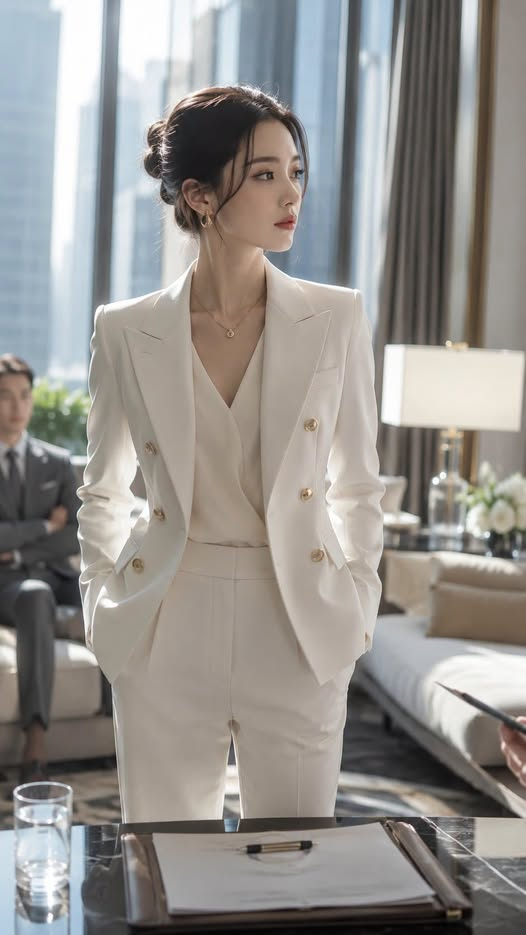
I was wearing a charcoal suit.
Underneath:
LAM VAN — CONTROLLING BENEFICIARY AND EXECUTIVE CHAIR, VAN THINH INTERNATIONAL INVESTMENT GROUP.
Co Tram Chu did not move.
Bach Uyen Nhu took the page from his hand.
Her face changed.
“This is her?”
The CFO nodded.
The next slide was worse.
Three years earlier.
Co Group’s first emergency bridge facility.
Authorized by Van Thinh affiliate.
Six months later.
Supplier-credit guarantee.
Another Van Thinh affiliate.
Then the debt rollover that prevented a forced asset sale.
Then the overseas acquisition support.
Every “lucky” moment had the same shadow behind it.
Me.
Co Tram Chu suddenly stood.
“No.”
His voice sounded strange.
“She never told me.”
The CFO looked at him.
“President Co…”
“She was an orphan.”
Nobody answered.
He grabbed his phone and called me.
It rang once.
Twice.
I declined.
He called again.
Declined.
Then I sent one message:
Contact Van Thinh through the corporate channel. Personal matters are over.
For the first time in three years, he understood what that phrase felt like.
His mother came to headquarters that afternoon.
Not Van Thinh headquarters.
Co Group.
She entered his office holding the same five-million-yuan bank card she had thrown at me.
“Tram Chu, what is going on?”
He was standing at the window.
“Mother.”
“They say Lam Van controls Van Thinh.”
He said nothing.
She laughed nervously.
“That cannot be right.”
Still nothing.
“An orphan?”
He turned.
“Stop saying that.”
She froze.
It was perhaps the first time in his life he had spoken to her that way.
He looked exhausted.
“She funded the bridge.”
“What?”
“The loan renewals.”
“The IPO commitments.”
“The European deal.”
His mother slowly sat down.
Then whispered:
“Why would she hide it?”
Co Tram Chu closed his eyes.
Because I loved him.
But saying that aloud would have made everything worse.
Bach Uyen Nhu entered without knocking.
She had already read enough to understand the situation.
“Tram Chu.”
He turned.
“The share transfer needs to be postponed.”
Her face stiffened.
“Why?”
“Because the valuation may change.”
“So?”
“So we wait.”
She stared at him.
“You told me those shares would be transferred before the IPO.”
“The IPO itself is now uncertain.”
Her expression changed.
That was when Co Tram Chu finally saw something I had seen years earlier.
Bach Uyen Nhu had returned at exactly the moment Co Group was preparing to list.
Beautiful timing.
Perhaps love.
Perhaps not only love.
He asked:
“If the IPO is delayed, will you still stay?”
She looked offended.
“What kind of question is that?”
He said nothing.
Sometimes the questions we avoid asking are the ones we already know the answer to.
Two days later, Co Tram Chu came to Van Thinh headquarters.
He was stopped in the lobby.
“I want to see Lam Van.”
The receptionist smiled professionally.
“Do you have an appointment?”
His face tightened.
“I am her husband.”
The receptionist checked the screen.
“According to the legal note attached to her profile, you are in divorce proceedings.”
Silence.
“Do you have a corporate appointment?”
“No.”
“Then I cannot send you upstairs.”
He stood there for twenty minutes.
The man who once made me wait outside conference rooms because “family shouldn’t interfere in business” was now sitting beneath my company logo asking permission to see me.
Eventually, I agreed.
Five minutes.
He entered my office and stopped.
Behind me, the city stretched beneath glass.
On the table was the European merger file.
He looked at me.
“You’re really General Manager Lam.”
“Yes.”
“Why didn’t you tell me?”
I almost laughed.
“Would it have changed anything?”
“Everything!”
That answer came too quickly.
I looked at him.
Exactly.
He realized.
His face slowly changed.
I asked:
“If you knew three years ago that I controlled Van Thinh, would your mother have called me an orphan?”
“No.”
“Would you have thrown five million yuan at me?”
“No.”
“Would you have given my place to Bach Uyen Nhu?”
His lips parted.
No answer.
I nodded.
“That is why I never told you.”
He walked closer.
“Then why invest in Co Group?”
“Because it was investable.”
“Only that?”
“No.”
I looked directly at him.
“Because I loved you.”
His eyes reddened.
I continued:
“But I never ordered my people to invest in a bad company just because you were my husband.”
“Every deal passed risk review.”
“I only gave Co Group one advantage.”
“What?”
“Patience.”
When other lenders would have demanded harsher terms, I approved more time.
When an acquisition needed a guarantee, I allowed my team to consider it.
When your liquidity was tight, I told them not to panic.
I did not build Co Group for him.
But I had given it breathing room when no one else would.
Co Tram Chu whispered:
“Now you’re taking everything away.”
“No.”
I shook my head.
“That’s the part you still don’t understand.”
“The money already invested remains governed by contract.”
“The facilities you qualify for will remain.”
“The ones you do not qualify for will end.”
He stared at me.
“I am not taking your company.”
“I am only stopping my company from loving you.”
The room went silent.
That sentence finally broke him.
Co Group did not collapse.
It came close to humiliation, not destruction.
The IPO was delayed eleven months.
The European merger failed because, without Van Thinh’s guarantee, the debt structure became too aggressive.
Two expansion projects were canceled.
The board brought in an independent chief financial officer.
Several family-controlled spending privileges were cut.
Co Tram Chu remained CEO.
But for the first time, he had to build without an invisible hand beneath him.
And, surprisingly, he could.
Slower.
Smaller.
More honestly.
That mattered.
Because I had never wanted to prove he was incompetent.
I wanted him to understand he had never been alone.
Bach Uyen Nhu left four months after the delayed IPO was announced.
Officially, she received a position in Singapore.
Unofficially, the relationship between them had cracked the moment the future stopped looking guaranteed.
Co Tram Chu called me after she left.
I did not answer.
Her departure did not restore our marriage.
Another woman leaving does not repair the disrespect that made room for her.
Our divorce became final six months later.
At mediation, Co Tram Chu offered me half his shares.
I refused.
He stared at me.
“You once asked what the three years meant.”
“Yes.”
“I want to compensate you properly.”
I almost smiled.
“You still think this is about compensation.”
His face tightened.
“What do you want?”
“Nothing from Co Group.”
“Then what was the point of all this?”
I looked at him.
“The point was never to take what you built.”
“It was to stop hiding what I built.”
He lowered his head.
Then asked quietly:
“Did you ever regret marrying me?”
I thought about the basement.
The fever.
The soup.
The nights when we genuinely had nothing except each other.
“No.”
He looked surprised.
“I regret what we became.”
“That’s different.”
He nodded.
Then:
“Can we start again?”
“No.”
This time, there was no anger.
Only pain.
“Because of Uyen Nhu?”
“No.”
I closed the file.
“Because when you believed I had nothing, you decided I was worth five million yuan and an eviction notice.”
He looked down.
“I can forgive another woman.”
“I cannot build a life with someone whose respect depends on my balance sheet.”
He had no answer.
Two years later, Van Thinh completed the European merger with another partner.
At the signing ceremony, reporters asked why I had returned to executive management after three years away.
I answered:
“I had personal matters to finish.”
Nothing more.
Co Group eventually completed its IPO too.
Without Van Thinh as anchor investor.
On the first trading day, I saw Co Tram Chu on financial television ringing the bell.
Older.
Calmer.
He did not mention luck.
In an interview, someone asked:
“What was the greatest lesson of the company’s difficult period?”
He paused.
Then said:
“I used to think surviving meant I was stronger than everyone else.”
His eyes lowered.
“Later I learned that sometimes survival means someone believed in you quietly.”
I turned off the television.
That was enough.
On the third anniversary of our marriage, Co Tram Chu pushed a divorce agreement toward me and said:
“After leaving the Co family, your life will not be better than it is now.”
He genuinely believed it.
Because for three years, he had only seen the woman who cooked his soup.
The woman who waited for him.
The woman who never mentioned boards, funds, guarantees or Europe.
He thought that was all I was.
That same night, I returned to the eighty-sixth floor of the company I had left for love.
The board asked whether I wanted to pull every yuan out of Co Group.
I said no.
Because money already invested was not a weapon.
I simply stopped extending privileges that had never belonged to them.
That was enough.
The IPO shook.
The merger disappeared.
The board panicked.
And Co Tram Chu finally discovered the truth behind all those years he called himself lucky.
It had been me.
Not because he deserved endless rescue.
Because I loved him.
And that was the part he understood too late.
He thought my biggest difficulty would begin after I left him.
In reality—
leaving him was the moment my biggest difficulty ended.
The Co family once offered me five million yuan to disappear quietly.
Two years later, I signed a European transaction worth thousands of times more.
But even then, the number was not what mattered.
What mattered was that my name was finally visible again.
Lam Van.
Not Mrs. Co.
Not an orphan.
Not a discarded wife.
And never again—
someone else’s invisible capital.
