The security guards moved toward me.
I did not step back.
I looked straight at Luc Tan.
“Captain Luc, since you said every detail was verified, answer one question.”
His face had already gone pale.
I raised the microphone.
“Did the real hostage ever authorize you to give her case material to this production?”
The auditorium went dead silent.
Lam Tinh Van’s smile disappeared.
Luc Tan stood.
“To Niem.”
My name sounded like a warning.
I ignored it.
“Answer.”
He clenched his jaw.
“No.”
One word.
Enough to change the entire room.
Reporters immediately surged forward.
“What material did he provide?”
“Was the film based on a real kidnapping?”
“Is she the victim?”
“Did production know?”
Tinh Van grabbed the host’s microphone.
“This is ridiculous. The film is a fictional adaptation.”
I turned toward her.
“Then why did your director receive the original case chronology?”
Her face froze.
“The interrogation transcript?”
“The medical evacuation timeline?”
“The seven-day operational notes?”
Luc Tan stepped toward the stage.
“To Niem, stop.”
I laughed.
“You already told my story.”
“Now you’re afraid I’ll tell yours?”
He stopped.
I opened my bag.
Pulled out a folder.
Inside were screenshots of messages between Luc Tan and the production team.
I had obtained them only that afternoon.
A junior assistant on the film had recognized me in the lobby and, perhaps from guilt, forwarded what she still had.
One message from Tinh Van read:
The previous script is too weak. I need something real enough to shock people.
Luc Tan replied:
I have an old hostage case. Change the names and locations.
Another:
Can you send video? Actors need physical reactions to study.
His answer:
I’ll send selected material. Keep it internal.
My hands trembled.
But my voice did not.
“You did not invent a character.”
“You took a real woman who survived something she never chose…”
“And decided her worst days belonged to your friend’s comeback.”
No one applauded now.
Luc Tan climbed onto the stage.
For the first time, there was no command in his voice.
Only panic.
“I thought they would fictionalize it.”
I stared at him.
“They did.”
I pointed toward the screen.
“They turned me into a greedy woman who deserved what happened.”
His face collapsed.
“I never approved that interpretation.”
“But you gave them the material.”
Silence.
That was the point.
He kept trying to separate intention from consequence.
I refused to help him.
Tinh Van said quickly:
“We changed everything identifiable.”
I looked at her.
“You used my exact necklace.”
Her lips parted.
“The scar on my wrist.”
The room went quiet again.
“The phrase I said during the rescue.”
Her face drained.
“You didn’t protect me.”
“You disguised me just enough to sell me.”
Then I handed the microphone back to the host.
“I’m done.”
Luc Tan reached for me.
“To Niem.”
I stepped away.
For seven days, years earlier, I had waited for him to find me.
That night, for the first time—
I hoped he wouldn’t follow.
The film was pulled from several major screenings within forty-eight hours.
Not because I demanded that everyone involved be ruined.
Because lawyers started asking questions no publicity department could answer.
Who owned the footage?
Who authorized its release?
Was the real victim informed?
Had protected operational material been transferred outside approved channels?
The production company first called it a misunderstanding.
Then a creative adaptation.
Then an internal compliance failure.
The phrases changed every day.
The evidence did not.
Luc Tan was placed under administrative review.
He was not imprisoned.
He did not lose his entire military career.
But the investigation found that he had shared restricted case material outside authorized professional use.
His operational clearance was temporarily reduced.
A promotion recommendation was withdrawn.
He was transferred away from direct case training while the review continued.
The part that hurt him most had nothing to do with rank.
I refused to see him.
For three weeks, he stood outside my apartment more than once.
I never opened the door.
Then one evening, he left a handwritten letter.
I read only the first line.
I thought because I was the one who rescued you, I understood what happened to you.
I folded it.
That sentence told me everything.
Luc Tan had confused witnessing my survival with owning the story.
He had saved my life once.
Years later, he used that fact as permission to decide what could be done with my pain.
I hired a lawyer.
The production settled.
Part of the agreement required the film to remove material traceable to the real case before any future release.
Another part compensated me for the unauthorized use.
I did not become rich.
I did not want to.
I wanted my life removed from their marketing campaign.
Tinh Van issued a public apology.
I believed she regretted the scandal.
I never decided whether she regretted hurting me.
It didn’t matter.
I stopped needing that answer.
Then I left.
Quietly.
No farewell party.
No dramatic confrontation.
I accepted a position in Geneva with an international risk-analysis firm that worked across Mandarin, French, and English.
My visa came through months later.
Then another permit.
Years passed.
Eventually Switzerland stopped feeling like the place I had escaped to.
It became home.
I learned to ski badly.
Bought a tiny apartment with a balcony.
Started drinking coffee without sugar.
Changed my phone number.
And for the first time since the kidnapping, people around me knew nothing about the story unless I chose to tell them.
That freedom was worth more than revenge.
Luc Tan wrote to me for nearly three years.
Not constantly.
One letter every few months.
I read some.
Ignored others.
He never asked me to return.
That was probably the first boundary he truly respected.
In one letter, he wrote:
I kept thinking I was protecting the memory by making the film accurate. I never asked whether accuracy itself could violate you.
Another:
I wanted Tinh Van to succeed. I told myself the footage was only research. I cared more about helping her than protecting what was yours.
That one I kept.
Not because it softened me.
Because it was finally honest.
He had chosen his childhood friend.
Not romantically.
Not necessarily.
But morally.
When her career needed something powerful—
he paid with my history.
That was betrayal enough.
Ten years later, I returned for a former classmates’ reunion.
I had avoided those gatherings for years.
This time, I was tired of avoiding cities because one man lived in them.
Everyone had changed.
Marriage rings.
Children’s photographs.
Gray hair appearing at temples.
Then someone laughed and said:
“Nien Niem, Luc Tan must still be waiting for you.”
Another added:
“He never married.”
I smiled.
“That doesn’t mean he was waiting.”
Then the door opened.
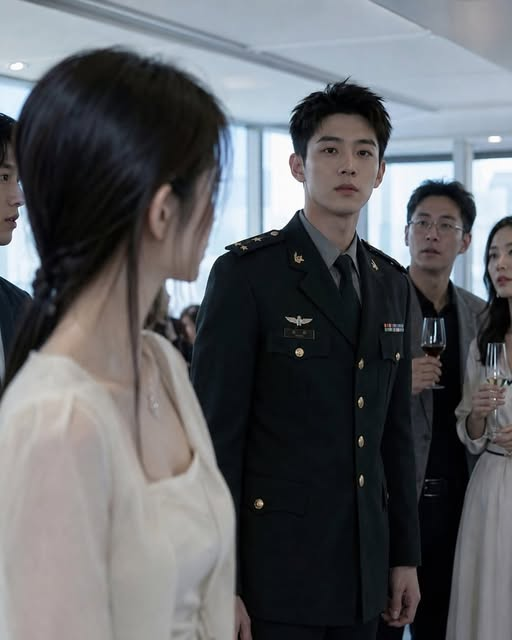
Luc Tan walked in wearing his uniform.
Older.
Calmer.
The entire table became strangely quiet.
Someone had deliberately left the chair beside me empty.
He noticed.
So did I.
Luc Tan sat down.
For a long moment, he looked at me.
Then:
“Nien Niem, long time no see.”
“Yeah.”
“Long time.”
That was all.
People around us exchanged disappointed looks.
They had expected tears.
Regret.
A romantic reunion after ten years.
Life was less theatrical than they wanted.
During dinner, Luc Tan barely spoke to me.
He asked once:
“How is Geneva?”
“Cold.”
He smiled.
“You used to hate winter.”
“I bought better coats.”
A tiny laugh escaped him.
Then he said:
“I heard you became regional director.”
“Yes.”
“Congratulations.”
“Thank you.”
No pleading.
No references to the past.
For almost two hours, he behaved like a man who finally understood that familiarity was not permission.
When dinner ended, rain had started outside.
Everyone crowded beneath the awning.
One friend whispered:
“Luc Tan drove. Let him take you back.”
I shook my head.
“I have a car coming.”
Luc Tan heard.
He did not insist.
That, strangely, moved me more than all his letters.
The younger Luc Tan would have taken my suitcase.
Opened the door.
Decided what was best.
Then called it care.
The man standing beside me simply waited.
Finally, he said:
“Can we walk for five minutes?”
I looked at him.
“Five.”
We stepped beneath the hotel canopy.
Rain shimmered across the pavement.
He kept both hands in his coat pockets.
“I owe you one apology I never wrote correctly.”
I waited.
He looked ahead.
“I used to think the worst thing I did was letting the film insult you.”
I said nothing.
“It wasn’t.”
His voice became quieter.
“The worst thing was believing I had the right to give them anything at all.”
I finally turned toward him.
“Yes.”
He nodded.
“I understand that now.”
“Good.”
He swallowed.
“Do you forgive me?”
I thought about the premiere.
The screen.
The applause.
The feeling that hundreds of strangers had been invited into something I had spent years trying to survive.
Then Geneva.
My apartment.
My work.
The quiet life I had rebuilt.
“I don’t hate you.”
His eyes shifted.
“That isn’t what I asked.”
“No.”
I smiled slightly.
“But it may be all the answer I have.”
He accepted it.
Then asked the question everyone else had been asking for him.
“Have you ever thought about us?”
“Yes.”
Hope appeared in his face.
I continued:
“I thought about why I loved you.”
He waited.
“You made me feel safe.”
His eyes lowered.
“And then you became the person who proved safety can also be taken away by someone you trust.”
The hope disappeared.
I was not cruel when I said it.
It was simply true.
Luc Tan whispered:
“I never married.”
“That was your choice.”
“I know.”
He looked at me.
“I don’t expect it to mean anything to you.”
“It doesn’t.”
He nodded.
That answer hurt.
But he did not punish me for it.
Progress.
My car arrived.
Before I left, Luc Tan said:
“Nien Niem.”
I turned.
“Are you happy?”
Ten years earlier, I would have wanted him to know every detail.
Who I became.
What I survived.
How well I lived without him.
Now I just answered:
“Yes.”
And got into the car.
I returned to Geneva two days later.
The mountains were white.
My apartment was cold because I had forgotten to leave the heat high enough.
On the table sat a package delivered while I was away.
Inside was a photograph from the reunion.
Everyone smiling.
Luc Tan at one end.
Me at the other.
No one had forced us into the same frame.
I placed it in a drawer.
Not the trash.
Not the wall.
Just a drawer.
That was where the past belonged.
For years, people told the story as though Luc Tan and I had tragically missed our chance.
They were wrong.
We had our chance.
He loved me once.
I loved him too.
Then he made one decision that changed what trust meant between us.
He gave away something that was never his.
Not merely a video.
Not merely a case file.
My right to decide who knew my story.
Ten years later, Luc Tan was still single.
So was I.
That did not make us unfinished.
Some relationships do not need reconciliation to become complete.
Sometimes the ending is simply this:
He learned to regret.
I learned to live.
And when we met again after ten years, I finally understood something I could not understand at the premiere—
surviving him was not the same as waiting for him.
So when he said:
“Long time no see.”
I smiled.
Because for the first time, those ten years did not feel like distance between us.
They felt like my life.
