“Abortion?”
Luc Canh Tham stared at me as though the word had torn something open inside him.
I laughed once.
Coldly.
“You really believed I took five million yuan, terminated the pregnancy and ran away with another man?”
His face changed.
“My mother showed me the hospital certificate.”
“I never took her money.”
“What?”
“I tore up the check in front of her.”
His fingers tightened.
“And I never had an abortion.”
The entire elevator lobby seemed to fall silent.
Canh Tham took one step toward me.
“Tram Niem.”
I moved back.
“Don’t.”
His voice became hoarse.
“Then the child…”
I looked straight at him.
“Children.”
He stopped breathing.
For fourteen years, I had imagined this moment.
Sometimes I screamed at him.
Sometimes I slapped him.
Sometimes I told him nothing.
Now that he was standing in front of me, all I felt was exhaustion.
“I was pregnant with triplets.”
His face went completely white.
“Where are they?”
“My children are none of your concern.”
“They’re mine.”
“No.”
My voice hardened.
“They are biologically yours.”
“That does not mean you get fourteen years of fatherhood back in one sentence.”
Before he could answer, the bidding team arrived.
I picked up my documents.
“Mr. Luc, I came here for business.”
“If Luc Thi cannot separate my proposal from our past, I will withdraw.”
Then I walked away.
He did not stop me this time.
That afternoon, Luc Canh Tham did something he should have done fourteen years earlier.
He investigated.
Not me.
His own family.
The original hospital had archived records.
There was no abortion procedure under my name.
There was, however, a record of emergency treatment after threatened miscarriage.
Pregnancy:
Twelve weeks. Triplets.
The fake certificate his mother had given him used a physician’s seal that had been retired months earlier.
Then he checked the five-million-yuan check.
Never cashed.
Never deposited.
Never replaced.
Finally, he questioned Hua Nhuoc Lan.
At first, she denied everything.
Then Canh Tham placed the old phone records in front of her.
My anniversary night call had originated from her phone.
His face became terrifyingly calm.
“You called my wife while I was unconscious?”
Hua Nhuoc Lan’s lips trembled.
“You were drunk.”
“Did I ask you to answer my phone?”
“No.”
“Did I sleep with you?”
She immediately shook her head.
“No.”
That part was true.
She had created a scene designed to look like betrayal.
The lipstick.
The perfume.
The phone call.
His absence.
All of it.
But Canh Tham was not innocent.
He had allowed another woman to remain close enough for the lie to work.
He had ignored my calls.
Stayed away from home.
Allowed his mother to humiliate me.
And when he found the divorce agreement and fake abortion certificate—
he chose anger instead of investigation.
That was his sin.
Not adultery.
Cowardice.
Three days later, Phuong Cam Hoa came to my hotel.
She was older.
Smaller.
But her eyes were the same.
The first thing she said was:
“Where are my grandchildren?”
I almost closed the door.
Instead, I asked:
“Your grandchildren?”
Her face stiffened.
“The Luc family’s blood.”
There it was.
Not my children.
The Luc family’s blood.
I smiled.
“You haven’t changed.”
“Tram Niem, I admit I handled things badly.”
“Badly?”
“I wanted Canh Tham to marry someone suitable.”
“So you forged an abortion certificate.”
She looked away.
“I didn’t know you were carrying three.”
I laughed.
“That makes it better?”
“No.”
Her voice weakened.
Then, surprisingly:
“No.”
For the first time, she looked ashamed.
“I thought you would disappear for a few years.”
“I thought Canh Tham would marry Nhuoc Lan.”
“I thought everything would settle.”
“And instead?”
Her eyes reddened.
“He became someone I no longer recognized.”
I looked at her quietly.
“You lost your son’s happiness.”
She swallowed.
“But I lost fourteen years raising three children alone.”
That ended the conversation.
I closed the door.
Luc Canh Tham did not come to see me again immediately.
That earned him more respect than another apology would have.
Instead, he sent one message.
I will not approach the children without your permission.
Then:
But if they ever want to know me, I will be there.
I did not reply.
That evening, I told the triplets everything.
Not the glamorous version.
Not:
Your father is the richest man in Beijing.
Not:
You are heirs.
I told them:
“He did not know you existed.”
Then I explained why.
Tinh Ha listened without interrupting.
Tinh Than’s face grew colder with every sentence.
Tinh Nguyet cried.
Not because she missed a father she had never known.
Because she realized how young I had been when I raised them alone.
Finally Tinh Ha asked:
“Does he want us now?”
“Yes.”
Tinh Than immediately said:
“That’s convenient.”
Tinh Nguyet nudged him.
“Mom said he didn’t know.”
Tinh Than looked at me.
“But he believed the worst about you.”
That child had Canh Tham’s face.
And my memory.
“Yes.”
I answered.
“He did.”
Then I said the only thing that mattered:
“You do not owe him forgiveness.”
“And you do not owe me rejection of him.”
“You may decide for yourselves.”
A week later came Luc Thi Group’s fifteenth-anniversary fundraising event.
The entire event was streamed globally.
I had no intention of attending.
Then the children watched the livestream.
The host asked Canh Tham about succession.
He answered:
“Luc Thi doesn’t need an heir.”
“After I die, all assets in my name will be donated.”
Then he added:
“There is no one left worthy of continuing my life.”
Tinh Than stood up.
“That’s irritating.”
I looked at him.
Tinh Ha had already opened the Luc family trust documents our lawyer had sent that morning.
Fourteen years earlier, Canh Tham’s grandfather had established a descendant trust containing a minority block of Luc Thi shares.
Those shares were not Canh Tham’s personal property.
They belonged to qualifying descendants after verification.
Tinh Ha tapped the page.
“He can donate his own property.”
“But he can’t talk as if we don’t exist while a trust already gives descendants rights.”
Tinh Nguyet looked at me.
“Mom.”
“No.”
“Mom.”
“No.”
“We’re going.”
Twenty minutes later—
the three bronze doors opened.
I walked in with my children.
Hundreds of people turned.
Luc Canh Tham stopped speaking.
The microphone remained in his hand.
His face lost all color.
I removed my sunglasses.
“Luc Canh Tham.”
My voice carried across the hall.
“You want to donate what belongs to my children too?”
Behind me, three fourteen-year-olds raised their heads.
The resemblance was undeniable.
Gasps spread through the auditorium.
Cameras turned.
Canh Tham did not seem to see them.
Only the children.
His children.
Tinh Ha stepped forward first.
“We don’t want your company.”
Canh Tham’s eyes reddened.
Tinh Than continued:
“But please don’t stand on television and announce that you have no descendants.”
Tinh Nguyet added softly:
“We exist.”
That was the sentence that broke him.
Not heir.
Not shares.
Not money.
We exist.
Canh Tham lowered the microphone.
For several seconds he could not speak.
Then, in front of everyone, he said:
“I was wrong.”
The hall went silent.
He looked at the cameras.
Then at the children.
“The personal property I described is mine to donate.”
“The descendant trust is separate.”
“And more importantly…”
His voice shook.
“I have three children I did not know existed.”
He looked at me.
“I will not discuss their mother’s private life or blame her for my failure to know.”
That surprised me.
Then:
“I owe them fourteen years.”
Tinh Than immediately answered:
“You can’t repay time.”
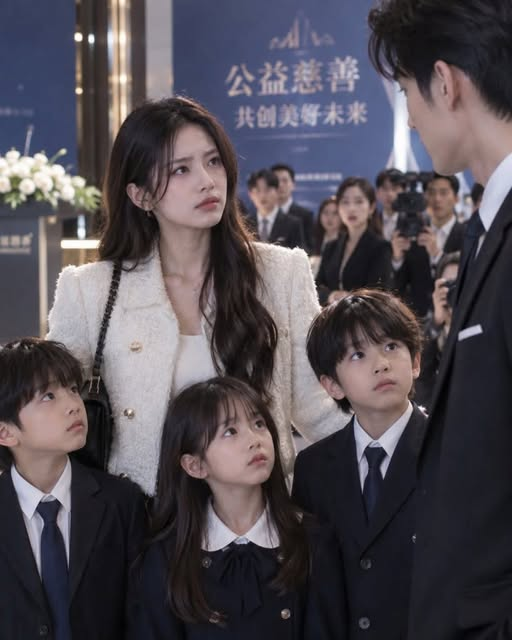
Canh Tham almost smiled through wet eyes.
“No.”
“I can’t.”
For once, he understood.
The DNA tests were done privately.
All three were confirmed.
Canh Tham did not throw a public celebration.
I would not allow it.
He met them for the first time in a small restaurant.
No assistants.
No bodyguards at the table.
No grandmother.
Just four people who shared blood and almost nothing else.
Tinh Ha asked business questions.
Tinh Than barely spoke.
Tinh Nguyet asked:
“Did you really keep Mom’s wedding ring for fourteen years?”
Canh Tham froze.
Then nodded.
She sighed.
“That’s romantic and stupid.”
I nearly laughed from the next table.
Slowly, they built something.
Not instant love.
A relationship.
Canh Tham attended school events when invited.
He learned their birthdays.
Not just the date.
What each child liked.
What they hated.
What made them nervous.
He discovered Tinh Ha hated expensive watches.
Tinh Than loved astronomy.
Tinh Nguyet wanted to study animation and had absolutely no interest in Luc Thi.
His dream of three perfect heirs disappeared quickly.
Good.
Children are people.
Not succession plans.
As for me—
Canh Tham asked once whether we could remarry.
Only once.
We were standing outside the cemetery after visiting his grandmother.
“I know I don’t deserve to ask.”
“Then don’t.”
He smiled bitterly.
“I expected that.”
I looked at him.
“You were deceived fourteen years ago.”
“Yes.”
“But you also chose to believe I was capable of taking money, ending our child’s life and leaving with another man.”
His eyes lowered.
“That is the part I cannot forget.”
“I know.”
He did not defend himself.
That mattered.
But it was not enough to rebuild a marriage.
I had spent fourteen years becoming someone outside Luc Canh Tham’s world.
I liked that woman.
I was not going to erase her because the misunderstanding was finally exposed.
Phuong Cam Hoa met the children months later.
On my conditions.
No demands about surnames.
No talk about heirs.
No insulting their upbringing.
The moment she saw them, she cried.
Tinh Than stared at her and asked:
“Are you the grandmother who drove Mom away?”
I almost stopped breathing.
She went pale.
Then slowly answered:
“Yes.”
“Did you apologize?”
“Yes.”
“To Mom?”
“Yes.”
Tinh Than looked at me.
I nodded.
He turned back.
“Then we can start from there.”
Not forgiveness.
A beginning.
That was enough.
Three years later, Luc Thi’s resort opened.
My design firm won the bid fairly.
Not because Canh Tham chose me.
He recused himself from the final selection.
An independent panel scored the proposals.
Mine won.
At the opening ceremony, someone asked whether my children would eventually inherit Luc Thi.
Tinh Ha answered before I could.
“Maybe.”
Tinh Than said:
“Probably not me.”
Tinh Nguyet laughed.
“I want nothing to do with corporate finance.”
Canh Tham stood behind them smiling.
For the first time, he looked less like the king of Beijing’s business world—
and more like a father.
That was his real inheritance.
Not giving the company to them.
Learning not to treat them like extensions of himself.
Fourteen years earlier, I left Beijing pregnant with triplets.
I thought my husband had betrayed me.
He thought I had destroyed our children.
His mother believed she had successfully removed an unsuitable daughter-in-law.
Hua Nhuoc Lan believed one lipstick mark and one phone call could rewrite a marriage.
For a while—
they were all right.
The marriage ended.
I disappeared.
The children grew up without their father.
No truth discovered later could return those years.
But truth could still stop the lie from owning the rest of our lives.
Luc Canh Tham never became my husband again.
He became something more difficult.
A man who learned how to be a father to children who had every right not to need him.
And my three children never “destroyed” his trillion-yuan empire.
They did something much more important.
They walked into a room where the most powerful man in Beijing had just announced that no one existed after him—
and calmly proved him wrong.
He thought he had no heir.
I thought I had no family except the children I raised.
We were both wrong.
But the difference was this:
I had spent fourteen years loving the people in front of me.
Luc Canh Tham had spent fourteen years mourning people he never bothered to verify were truly gone.
The day those bronze doors opened, he did not regain a wife.
He did not automatically gain three heirs.
He received only one thing:
the chance to finally know his children.
And this time—
he knew better than to waste it.
