Angela Moore did not begin by asking what Brittany had done that afternoon.
She asked something stranger.
“Emily, when was the first time your parents told you to say you were clumsy?”
I stared at her.
That question frightened me more than anything else.
Because she already understood.
I looked toward the curtain. Dad’s shadow moved on the other side.
Then I whispered:
“When I was nine.”
Angela did not react.
She simply opened her notebook.
“What happened when you were nine?”
I told her about the argument over a broken tablet.
About Brittany losing her temper.
About Dad driving me to an urgent care clinic forty minutes away instead of the hospital near our house.
And about Mom rehearsing the story with me in the parking lot.
You fell off your bicycle.
Say it exactly like that.
I had.
At ten, it was the stairs.
At twelve, gym class.
At fourteen, I had supposedly slipped in the bathroom.
Different clinics.
Different explanations.
Always the same rule afterward.
We handle family matters at home.
Angela’s pen stopped.
“Did anyone ever ask questions?”
“My school nurse did.”
“What was her name?”
I remembered immediately.
“Mrs. Patterson.”
Detective Nolan, who had been standing quietly near the wall, took out her phone.
“What school?”
“Westbrook Middle.”
She stepped outside.
I kept talking.
Once I started, I couldn’t stop.
I told Angela how Brittany’s anger controlled the entire house.
If she had a bad day, everyone became careful.
If she shouted, Mom closed the windows so the neighbors wouldn’t hear.
If something happened to me, Dad’s first question was never whether I was okay.
It was:
“What did you do to upset her?”
But the worst part wasn’t Brittany.
It was realizing that my parents had spent years teaching me that protecting her mattered more than protecting me.
Angela asked:
“Why?”
I looked down at my hands.
“Because Dad says Brittany has a future.”
The words sounded ridiculous once spoken aloud.
“What does that mean?”
“She’s in nursing school. She wants to work at Dad’s hospital network someday. He says one police report could ruin everything.”
Angela went completely still.
My father was a senior administrator for a private medical group.
Suddenly, the different clinics made sense to her.
Maybe they had always made sense to him too.
Ten minutes later, Detective Nolan returned.
But she wasn’t alone.
A gray-haired woman walked behind her carrying an old canvas bag.
I recognized her before she reached the bed.
“Mrs. Patterson?”
My former school nurse covered her mouth.
“Oh, Emily.”
Dad heard her voice outside.
“What is she doing here?”
Nobody answered him.
Mrs. Patterson sat beside Angela and removed a thick folder from her bag.
“I kept copies,” she said.
My heart began pounding.
“Copies of what?”
“Everything.”
She opened the folder.
Incident reports.
Notes from teachers.
Dates I had visited her office.
Photographs taken for school documentation.
Three separate requests recommending that my parents seek further medical evaluation.
And then something I had never known existed.
A report Mrs. Patterson had filed when I was twelve.
Angela looked up.
“You reported concerns?”
“Yes.”
“What happened?”
Mrs. Patterson’s expression hardened.
“Her father came to the school the next morning.”
Outside the curtain, everything became silent.
“He brought documentation saying Emily was already receiving treatment and that the family situation had been reviewed.”
Detective Nolan leaned forward.
“Who signed it?”
Mrs. Patterson turned the page.
Then she placed it on the table.
The name at the bottom belonged to a physician who worked inside my father’s medical network.
Angela photographed the document.
“Did you ever speak directly with that physician?”
“No.”
Mrs. Patterson shook her head.
“The school was told the matter had been handled privately. Two weeks later, Emily was transferred.”
I remembered.
Dad had said Westbrook was “not academically strong enough.”
I had cried because I didn’t want to leave my friends.
Now I finally knew why.
He hadn’t moved me for my education.
He had moved me because someone had started asking questions.
The curtain suddenly flew open.
Dad stood there.
“That document proves nothing.”
Detective Nolan stepped between us.
“You were told to remain outside.”
“My daughter is being manipulated.”
Then Mom said something.
Very quietly.
“Stop.”
Everyone turned.
She stood behind him, crying.
Dad stared at her.
“Linda.”
Mom’s hands were shaking.
“Stop talking.”
His expression changed.
It was the first time I had ever seen fear in his face.
Mom entered the room and sat down.
For several seconds she couldn’t speak.
Then she looked at me.
“I’m sorry.”
I didn’t answer.
She turned toward Angela.
“There’s a box.”
Dad moved immediately.
“Linda, don’t.”
Detective Nolan blocked him.
Mom continued.
“In our bedroom closet. Top shelf. Gray box.”
“What’s inside?” Angela asked.
Mom closed her eyes.
“Medical bills. Old discharge papers. School letters.”
My stomach dropped.
Dad said sharply:
“She doesn’t know what she’s saying.”
Mom looked at him.
“And the photographs.”
Silence.
Even Brittany stopped crying.
Mom had documented incidents for years.
Not because she planned to expose anyone.
Because she was afraid someday Brittany would seriously hurt someone and Dad would claim none of it had ever happened.
She had kept the evidence.
Then hidden it.
That contradiction was almost worse than having nothing.
She had known enough to save proof.
But not enough to save me.
Police obtained the box later that night.
What they found ended the story my parents had protected for years.
There were records from multiple clinics.
Messages between Mom and Dad discussing what explanation I should give.
Emails about changing doctors whenever questions became uncomfortable.
And one message from Dad after Mrs. Patterson’s report:
Transfer Emily before the school turns this into something bigger.
The next morning, Brittany finally asked to speak to Detective Nolan without our parents present.
For years, my parents had protected her from consequences.
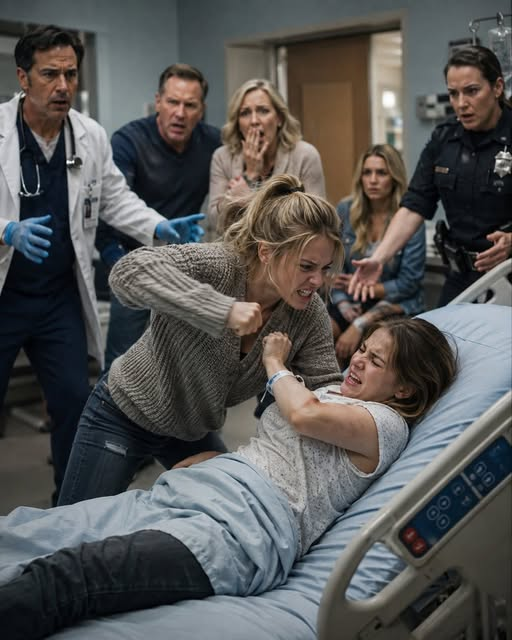
Now, with that protection disappearing, she told the truth.
She admitted what she had done.
She also admitted Dad had repeatedly told her:
“Emily won’t say anything. She knows what happens to this family if she does.”
That sentence destroyed him.
Not because it proved everything by itself.
Because it matched years of documents.
My father had always believed being calm made him innocent.
He never shouted like Brittany.
He never lost control.
He simply cleaned up afterward.
That had been his role.
And somehow, I found that even harder to forgive.
I did not go home from the hospital.
CPS arranged for me to stay temporarily with Aunt Rebecca, my mother’s younger sister.
When she arrived, she hugged me and cried.
Then she said something I would remember forever.
“I asked about you for years.”
I pulled away.
“What?”
“Your father stopped letting me visit because I kept asking why you were always getting hurt.”
Another piece fell into place.
I had believed Aunt Rebecca stopped caring.
Dad had simply removed another person who noticed too much.
The investigation lasted months.
Brittany entered a court-supervised treatment program while her case moved forward.
My mother cooperated with investigators and separated from my father.
Dad lost his position after his employer began its own investigation into whether he had improperly used professional relationships to conceal what was happening at home.
But none of that fixed me overnight.
Real endings aren’t that clean.
For months, I still apologized whenever I dropped something.
I still froze when people raised their voices.
I still caught myself inventing explanations for things nobody had accused me of.
Then one afternoon, Mrs. Patterson visited.
She brought the old file.
Not the official evidence.
Just a photocopy of one page.
At the top was something she had written when I was twelve:
Emily is not clumsy.
Emily is frightened.
I read those two lines again and again.
At twelve, somebody had seen me.
I just hadn’t known.
Three years later, Aunt Rebecca and I returned to Westbrook for Mrs. Patterson’s retirement ceremony.
She spotted me in the crowd and immediately smiled.
Afterward, she asked what I wanted to do after graduation.
I thought about it.
For years, every adult in my house had taught me that silence protected families.
They were wrong.
Silence had protected the people causing the harm.
So I told her:
“I think I want to study social work.”
She squeezed my hand.
“That sounds like you.”
That evening, Dad sent me another letter from his attorney.
I didn’t open it.
I had spent enough of my childhood listening to his explanations.
We’ll handle this at home.
It was the sentence that had kept everyone outside.
Teachers.
Doctors.
Relatives.
Police.
Anyone who might have looked too closely.
But the last time he said it, Dr. Marisol Grant looked at my scans and refused to look away.
She made one phone call.
Then another person asked one question.
Another opened an old file.
Another told the truth.
And suddenly the secret my family had protected for years could no longer survive.
My father had always believed strangers were the danger.
In the end, strangers were the people who saved me.
And the home he had worked so hard to protect?
It was the one place I finally learned I never had to return to.
