I left the villa at 11:43 that night.
One small suitcase.
An old white T-shirt.
Faded jeans.
My notebook.
Three books.
A few photographs.
And 1,860 yuan in an account I had opened before meeting Liam.
That was everything that was truly mine.
I left the villa key on the security desk.
Then I opened the banking app and disabled the supplementary card Liam had given me four years earlier.
I did not spend one final cent.
Not on a hotel.
Not on dinner.
Not even on the taxi.
I took the bus.
For the first time in four years, nobody knew where I was going.
Including me.
Liam returned the next morning.
Ava was with him.
According to the housekeeper, he walked upstairs casually.
He probably expected me to have cried all night.
Maybe he thought I would be sitting on the bed waiting to apologize.
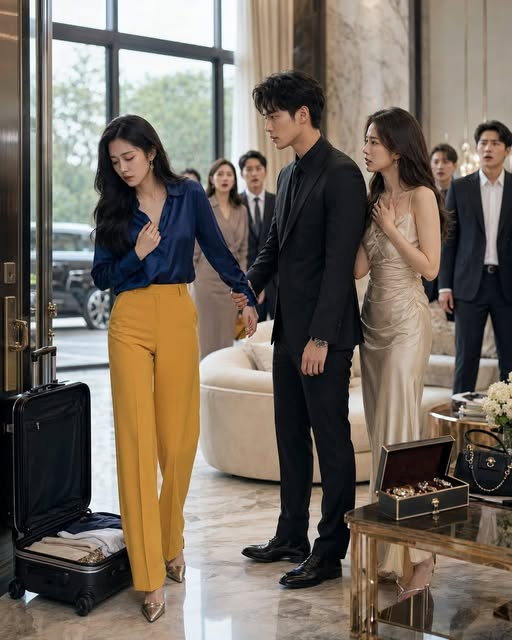
Instead, he found the blue dress folded over the chair.
Beside it were the bracelets.
The earrings.
The diamond necklace he had given me on my twenty-third birthday.
Every expensive dress remained in the closet.
Every designer handbag remained on its shelf.
Only one section was empty.
The small corner where I kept things from before him.
His expression changed.
He immediately called me.
Disconnected.
Again.
Disconnected.
Then his assistant received a message from the bank.
The supplementary card had been voluntarily canceled by the cardholder.
That was when Liam finally understood.
I had not staged an exit.
I had left.
Ava stood in the doorway.
“She really took nothing?”
Liam gave her a cold look.
“She’s being dramatic.”
But that night, he did not sleep.
Because I knew something about Liam Foster.
He could tolerate anger.
Tears amused him.
Arguments made him impatient.
But silence?
Silence frightened him.
And I had finally given him all of mine.
My first room after leaving was barely large enough for the bed.
The bathroom was shared with three other tenants.
The window faced a brick wall.
I loved it.
Because I could close the door without wondering whether Liam would appear at midnight, expecting me to smile because he had decided to visit.
On the second morning, I bought instant noodles.
On the third, I started looking for work.
My résumé was almost empty.
Four years earlier, I had been twenty-one.
I had worked reception desks, convenience stores and temporary office jobs while trying to settle the debts my father had left behind.
Then Liam appeared.
For a while, being kept in a villa had felt like rescue.
Eventually, rescue became another word for dependence.
But those four years had not been completely empty.
Liam was often gone.
Sometimes for weeks.
To keep from losing my mind, I had taken free online courses.
Illustration.
Layout.
Digital design.
I filled my notebook with sketches while waiting for a man who rarely came home.
That notebook became my first portfolio.
A tiny publishing studio hired me as a junior design assistant.
The salary was terrible.
My chair squeaked.
The office coffee tasted burned.
On my first payday, I bought myself a winter coat.
Nothing expensive.
I stood in front of the mirror wearing it for almost ten minutes.
Because nobody had chosen it for me.
Nobody had decided what color made me look prettier.
It was mine.
That made it beautiful.
Liam lasted twelve days before trying to send me money.
Five hundred thousand yuan.
No message.
Just a transfer.
I sent it back.
An hour later, his assistant called.
“Miss Emma, Mr. Foster says this isn’t charity.”
“I know.”
“He says it’s compensation for the last four years.”
That made me laugh.
“Tell him I’m not submitting an invoice.”
The assistant became quiet.
Then Liam took the phone.
“You’re working in some tiny publishing company?”
I froze.
Of course he had found out.
His voice remained controlled.
“How much are they paying you?”
“Enough.”
“You’re living in a rented room.”
“Yes.”
“You take the bus.”
“Yes.”
He seemed almost offended by every answer.
“Emma, stop this.”
“Stop what?”
“Punishing yourself to punish me.”
I looked around my tiny room.
A cheap lamp.
Secondhand desk.
My drawings spread across it.
For the first time in years, the mess belonged to me.
“I’m not suffering for you, Liam.”
“You don’t know how to live like this anymore.”
I smiled.
“You met me when I lived like this.”
Silence.
Then he said the cruelest thing in a softer voice.
“You’ll come back when reality catches up with you.”
I answered:
“Maybe.”
And hung up.
But I never did.
Ava moved into the villa three months later.
That was what everyone expected.
The woman Liam had loved first finally returned.
The inconvenient substitute was gone.
Perfect ending.
Except it wasn’t.
Ava lasted eleven weeks.
Later, one of Liam’s friends told me how it ended.
Apparently, the first argument began over tea.
Liam came home late.
He walked into the kitchen and asked:
“Where’s the jasmine tea?”
Ava stared at him.
“How would I know?”
He opened three cabinets.
Then muttered:
“Emma always kept it here.”
Silence.
Another day, Ava changed the flowers in the living room.
Liam looked at them and said:
“Emma never bought lilies. She knew I hate the smell.”
Ava put down the vase.
“You talk about her a lot.”
“I don’t.”
“You just compared me to her twice before breakfast.”
His face went cold.
“That’s ridiculous.”
But it continued.
The house had been shaped around four years of my invisible labor.
The shirts arrived from dry cleaning because I scheduled them.
His medicine was replaced before it ran out because I noticed.
The guest rooms were prepared because I remembered his mother’s preferences.
His favorite foods appeared because I knew which days he came home exhausted.
He had called me entertainment.
But apparently his entertainment had been running his private life.
One night, Ava finally asked him:
“If she was nothing, why does this entire house feel like it’s waiting for her?”
Liam had no answer.
Ava left the following morning.
Not because I won.
There had never been a competition worth winning.
She simply discovered that Liam did not love women very well.
He loved what they represented to him.
Ava was the woman he had lost.
I was the woman who never left.
Until I did.
A year passed.
Then two.
I moved out of the rented room.
Not into a mansion.
Into a small apartment with enough sunlight for a drafting table.
The publishing studio became a larger company.
I became a full-time illustrator.
Then senior designer.
One of my book covers unexpectedly won an industry award.
At the exhibition, I saw Liam again.
He stood in front of one of my illustrations for a long time.
It showed a woman walking away from a brightly lit house at night.
She carried one suitcase.
Nothing else.
When I approached, he turned.
He looked older.
Not ruined.
Not broken.
Just less certain.
“Is that me?” he asked.
“The house?”
“Yes.”
“No.”
He frowned.
“It’s me.”
His expression changed.
I continued:
“I spent years thinking leaving you meant losing everything.”
“So I drew the moment I realized I was the thing I still had.”
Liam looked at the picture again.
Then said:
“I was horrible to you that day.”
“Yes.”
“I shouldn’t have called you entertainment.”
“No.”
“I shouldn’t have told you to take off the dress.”
My voice became colder.
“No.”
He lowered his eyes.
“I think about that more than anything else.”
I said nothing.
Eventually he asked:
“Did you ever run out of money?”
The question surprised me.
Then I smiled.
“Twice.”
His head lifted.
“The first winter I had forty-three yuan left before payday.”
“Why didn’t you call me?”
“Because being poor was frightening.”
I paused.
“But going back was worse.”
That answer hurt him.
I could see it.
Good.
Some truths should.
Liam took a breath.
“I want to give you what I should have given you then.”
“No.”
“Emma—”
“No.”
“I’m not trying to buy you.”
“Then don’t offer money.”
He stopped.
After several seconds, he asked:
“Can I at least apologize properly?”
I looked at him.
“You just did.”
Hope appeared in his eyes.
I recognized it immediately.
The dangerous kind.
So I ended it.
“An apology can correct the way you carry the past.”
“It doesn’t automatically give you a place in my future.”
The hope disappeared.
He nodded slowly.
This time, he did not argue.
Maybe that was the first genuinely respectful thing he ever did for me.
Before leaving, he looked once more at the painting.
Then said:
“You really never loved the money, did you?”
I almost laughed.
Four years together.
And he was only understanding now.
“I loved you.”
His face went still.
“That was the problem.”
Then I walked away.
I never returned to the villa.
Years later, I heard Liam sold it.
I did not ask who bought it.
I did not care.
The blue dress probably disappeared with everything else.
That was fine.
I no longer needed proof that I had once been the woman wearing it.
People sometimes asked whether I regretted leaving without taking the jewelry.
Maybe I could have sold it.
Paid rent.
Made the first year easier.
Perhaps.
But I needed one clean decision.
Not because accepting gifts would have made me impure.
Not because women have to prove dignity through poverty.
I left them because that particular night, I needed to know there was nothing Liam could point to later and say:
You still live because of me.
And there wasn’t.
I struggled.
I worked.
I failed.
I started again.
I bought my own clothes.
My own furniture.
My own ticket to my first exhibition overseas.
None of those things were as expensive as what Liam had once given me.
They meant infinitely more.
Four years earlier, he looked at Ava and called me entertainment.
Maybe he believed it.
Maybe that was easier than admitting the woman he had hidden had become part of his life.
But by then, his opinion no longer mattered.
Because the most important thing I took from Liam Foster’s villa was not jewelry.
Not cash.
Not revenge.
It was the girl who had entered at twenty-one believing some powerful man had to save her.
I walked out wearing her old jeans.
Her old T-shirt.
Carrying her old suitcase.
But I was not the same girl.
That first Emma had entered hoping Liam would choose her.
The woman who left no longer needed to be chosen.
And when Liam finally understood what he had thrown away, I was already far enough from that house to understand something too:
I had never been his hobby.
I had only spent four years treating his attention like my life.
The moment I stopped—
I got my life back.
