For several seconds, I couldn’t speak.
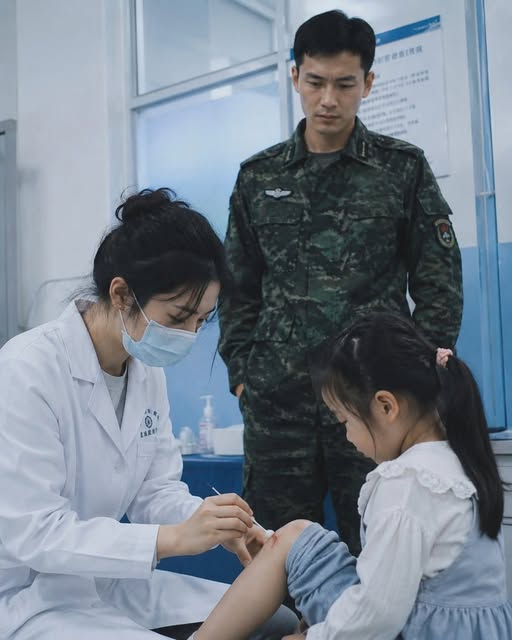
Lily sat on the examination table with tears running silently down her cheeks.
I lowered myself until we were eye level.
“Lily, I’m glad you told me.”
Her lips trembled.
“Are you going to tell Dad?”
“Yes.”
Fear immediately crossed her face.
“No! He’ll be angry.”
“He may be scared. He may be upset. But not with you.”
I kept my voice gentle.
“When something is happening because you’re afraid of losing someone, adults need to help you carry that fear. You shouldn’t have to carry it alone.”
She stared at me.
“Will he still go away?”
That question hurt more than anything else she had said.
I understood suddenly.
This wasn’t about attention.
It was about abandonment.
Someone had taught this child that people she loved could disappear.
I called Ethan.
He arrived seventeen minutes later.
No uniform jacket.
No controlled captain’s expression.
Just a terrified father.
“Lily.”
She looked down.
Ethan approached slowly.
“What happened?”
I asked the soldier who had brought her to wait outside.
Then I told Ethan the truth.
Not every detail in front of Lily.
Only what mattered.
His daughter was frightened every time he deployed, and she had begun believing that being unwell was the only way to keep him home.
Ethan’s face went completely still.
Then he knelt.
“Lily, look at me.”
She refused.
He tried again.
“Please.”
Finally she raised her eyes.
“Am I in trouble?”
Ethan broke.
I saw it happen.
The decorated special-operations captain who had reportedly walked through gunfire without blinking covered his face for two seconds.
Then he pulled himself together.
“No.”
His voice cracked.
“You’re not in trouble.”
“Are you leaving next week?”
Silence.
That silence was answer enough.
Lily began crying.
Ethan immediately took her hand.
“No mission is more important than you.”
She whispered,
“But you always say you have to go.”
He closed his eyes.
And I knew he finally understood that children did not measure love by medals, duty, or explanations.
They measured it by who remained when the door closed.
I arranged for Lily to be evaluated by the pediatric mental-health team.
Ethan didn’t argue.
He canceled his afternoon meetings.
Then he called someone.
“Olivia, come to the hospital.”
My chest tightened despite myself.
Twenty-five minutes later, a woman entered.
She was beautiful in an effortless way, wearing paint-stained jeans and carrying Lily’s forgotten sweater.
She rushed directly toward the child.
“Baby.”
Lily hugged her.
“Mom.”
There it was again.
The life Ethan had built after me.
I stepped away.
But Olivia turned.
“You’re Isabel Bennett.”
I froze.
“You know me?”
She looked at Ethan.
Then back at me.
“For ten years.”
Ethan’s expression changed.
“Olivia.”
“No.”
She almost sounded irritated.
“If you don’t tell her now, I will.”
I stared between them.
Olivia sighed.
“First, something you should know.”
She pointed at Ethan.
“He is not my husband. He has never been my husband.”
I thought I had misheard.
“But the hospital records—”
“Legal father.”
She sat beside Lily.
“Not biological.”
Ethan looked exhausted.
Olivia continued.
“Lily’s biological father was Noah Reed.”
The name struck me.
I knew it.
Everyone in the military medical system knew it.
Major Noah Reed.
Killed during an evacuation operation nine years earlier.
Ethan’s closest friend.
Olivia’s husband.
Lily had been six months old.
“After Noah died,” Olivia said, “Ethan practically moved into our spare room. Not because we were together.”
She gave him a look.
“Because this idiot had promised Noah that if anything happened, Lily would never grow up without a father.”
Lily leaned against Ethan.
“He adopted her legally when she was four,” Olivia finished.
My mind returned to Teresa.
Captain Mercer.
His wife.
Beautiful family.
Rumors.
Assumptions.
Exactly the same things I had believed ten years ago.
I looked at Ethan.
“Why didn’t you correct me?”
His answer was immediate.
“Because I thought you were married.”
“What?”
“You wear a ring.”
I looked down.
The silver band on my right hand had belonged to my mother.
I almost laughed.
Ten years apart.
Two military officers trained to evaluate situations under pressure.
And somehow we had both surrendered to assumptions without asking a single useful question.
Olivia stood.
“I am taking Lily home.”
Ethan frowned.
“We should discuss—”
“You two have apparently needed to discuss something since the invention of electricity.”
She kissed Lily’s head.
Then she looked at me.
“Doctor, thank you.”
When they left, Ethan and I remained alone.
The silence felt heavier than the hospital walls.
Finally I asked,
“Why did you leave me?”
His eyes lowered.
Ten years earlier, Ethan had ended our relationship in less than five minutes.
No explanation.
No argument.
Just:
This won’t work anymore.
I had begged him to tell me why.
He never did.
Now he leaned against the examination table.
“I was selected for a special operations program.”
“I know.”
“The survival rate for the assignments they were preparing us for wasn’t exactly comforting.”
My anger rose immediately.
“So you decided for me.”
“Yes.”
“You decided I couldn’t handle waiting.”
“Yes.”
“You decided breaking my heart would somehow protect me.”
His voice became quieter.
“Yes.”
I laughed once.
There was no humor in it.
“You were an arrogant idiot.”
“I still am occasionally.”
“Frequently.”
“That’s fair.”
Then his expression changed.
“I came looking for you eighteen months later.”
My smile disappeared.
“What?”
“You had transferred.”
I stared at him.
“I transferred because you left.”
“I know that now.”
He swallowed.
“I asked your commanding officer where you went. He told me you had requested that no personal information be released.”
I remembered.
I had signed that request after months of trying to forget Ethan.
He had actually come back.
Too late.
Just as I had returned now.
Too late.
Or perhaps not.
“I never married,” Ethan said.
I looked at him.
“That’s not my responsibility.”
“I know.”
“I didn’t spend ten years waiting for you.”
“I know.”
“And we’re not twenty-three anymore.”
A sad smile appeared.
“I definitely know that every morning when my knee makes noises.”
Despite myself, I laughed.
It was small.
But Ethan heard it.
And for one second, he looked exactly like the cadet sitting beside me with a dislocated wrist.
“Did you win?” he asked softly.
The memory hit me instantly.
Our first conversation.
I shook my head.
“Don’t.”
But I was smiling now.
Ethan smiled too.
“No,” I said. “Not yet.”
He didn’t ask for more.
That mattered.
Over the following months, Lily received professional support.
Ethan requested reassignment from continuous deployment duties and accepted a training command on base.
Not because anyone forced him.
Because he finally understood that being Lily’s father required more than returning alive.
It required returning consistently.
Lily slowly became herself again.
Loud.
Funny.
Terrible at walking instead of running.
And she kept finding excuses to visit my office.
Usually perfectly healthy.
One afternoon, she placed a drawing on my desk.
Three people stood beneath an enormous yellow sun.
Olivia.
Ethan.
Lily.
Then, slightly to the side, she had drawn another woman in a white coat.
Me.
“You made me too tall,” I said.
“No.”
She studied the picture seriously.
“Dad says he remembers you taller.”
I nearly choked.
“Your father talks too much.”
From the doorway Ethan said,
“I’ve been told.”
A year after our reunion, he asked me to dinner.
Not to restart anything.
Not to recover the past.
Just dinner.
I said yes.
Months later, I said yes again.
We went slowly.
Painfully slowly.
There were arguments.
Old wounds.
Ten years could not be erased because two people still remembered how to laugh together.
But something new grew where the old relationship had ended.
Something less reckless.
More honest.
One evening, Ethan walked me to my door.
Lily and Olivia were waiting in the car.
He looked at me.
“I spent ten years believing leaving you was the most selfless thing I’d ever done.”
“And?”
He smiled bitterly.
“Turns out it was probably the most selfish.”
I studied the scar near his jaw.
The lines around his eyes.
All the years I hadn’t witnessed.
“You can’t change it.”
“I know.”
“But you can stop making decisions for people because you’re afraid.”
He nodded.
Then he asked,
“May I make one decision?”
“What?”
“To stay.”
This time, I didn’t promise forever.
I simply reached for his hand.
“Then stay today.”
Two years later, my personnel file was returned for its annual update.
Name.
Rank.
Emergency contact.
Family.
For years I had written:
None.
I stared at the blank line.
Then I smiled.
I wrote Ethan’s name.
Below it, almost as an afterthought, I added:
Lily Mercer — family.
Because sometimes the person you lose does not return to restore the life you once imagined.
Sometimes they return older.
Scarred.
Different.
And if both of you have changed enough, you don’t rebuild the old story.
You finally write the one you were too young to understand the first time.
