The lawyer’s words were so absurd that, for several seconds, I thought I had misunderstood.
—Adrian filed for custody?
—Not full custody yet —Daniel Mercer, my attorney, corrected carefully.—He’s requesting an emergency parenting order and formal recognition of his parental rights.
I gripped the phone.
—He hasn’t seen Mateo in four years.
—I know.
—He didn’t even know what his favorite food was yesterday.
—I know that too.
Daniel paused.
—But Adrian’s lawyers are arguing that his absence was “professional necessity” and that you deliberately prevented him from maintaining contact.
I laughed.
It came out dry and empty.
—Prevented him?
I still had every unanswered message.
Every birthday photograph.
Every medical update.
Every video of Mateo learning to crawl.
Every email I had sent during the first eighteen months.
Adrian had answered exactly three.
“Busy.”
“Received.”
And once:
“Don’t distract me before competition.”
After that, I stopped sending them.
—Daniel.
—Yes?
—Tell him I’ll see him in court.
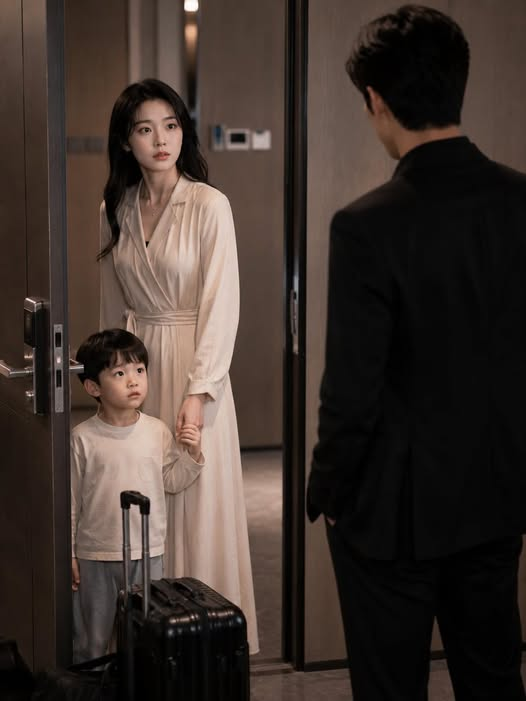
The next morning, the videos from my doorstep were everywhere.
The headline everyone used was almost identical:
NATIONAL HERO RETURNS HOME—THREE-YEAR-OLD SON ASKS: “WHO IS THAT MAN?”
Adrian’s public-relations team worked quickly.
By noon, newspapers were publishing a different version.
“Coach Cruz sacrificed family life for national glory.”
“Four years apart caused painful misunderstanding.”
“Wife allegedly restricted contact during overseas training.”
That final sentence made my hands go cold.
Then Clara gave an interview.
She sat beneath studio lights with tears glistening perfectly in her eyes.
—Coach Cruz talked about his son constantly.
I stared at the television.
Mateo was building a tower beside me.
Clara continued:
—There were many nights when he wanted to call home, but circumstances were complicated.
Complicated.
Adrian had lived in a training compound with internet, journalists, sponsors, and livestreamed competitions.
Apparently, only calling his pregnant wife had been technologically impossible.
Then Clara made her mistake.
She smiled sadly and said:
—I was probably the person who saw how much he suffered from missing Mateo.
I turned the television off.
Mateo looked up.
—Mommy, was that the lady from yesterday?
—Yes.
—Is she Dad’s friend?
I hesitated.
—She’s someone who worked with him.
He thought for a moment.
Then asked:
—Why does Dad know her but not me?
I had no answer suitable for a three-year-old.
Two days later, Adrian came to my attorney’s office.
No medal.
No cameras.
No Clara.
Just him.
For the first time since his return, he looked tired.
—Drop the lawyers, Elena.
I stared at him.
—You filed first.
—Because you wouldn’t let me see my son.
—You met him forty-eight hours ago.
—He’s still mine.
There it was.
Not I miss him.
Not I want to know him.
Mine.
I leaned back.
—What’s Mateo’s middle name?
Adrian stopped.
—What?
—His middle name.
Silence.
—His birthday?
He knew the year.
Not the exact date.
—His pediatrician?
Nothing.
—His allergy?
His face changed.
He hadn’t known Mateo had one.
I continued:
—Favorite bedtime story?
Silence.
—What does he call the stuffed rabbit he has slept with since he was eleven months old?
Adrian slammed his palm against the table.
—Enough!
Daniel stood slightly.
I didn’t move.
—No, Adrian. Not enough.
My voice remained calm.
—You want a court to call you his father because biology is easier than actually becoming one.
He lowered his voice.
—I did everything for our future.
—Whose future?
—Ours!
I laughed.
—Four years ago you left a pregnant woman standing in a doorway and told her to wait until you had achieved everything.
I looked at him.
—You didn’t build our future.
You built a life that didn’t require us.
His face tightened.
Then I asked the question that had been bothering me since the lawyer called.
—Why now?
He looked away.
That was enough.
—Why do you suddenly need custody, Adrian?
Silence.
Daniel opened a folder.
—Perhaps this explains it.
He slid several printed emails across the table.
My attorney had obtained them through the custody disclosure process.
One was from Adrian’s new sports-management agency.
Another from a major sponsor.
They were discussing a documentary series.
“THE CHAMPION RETURNS HOME.”
The proposed campaign centered on Adrian’s comeback, his “devoted family,” and his role as a father balancing legacy and domestic responsibility.
The sponsorship value was enormous.
I looked up.
Adrian’s face had gone pale.
—You came for a commercial.
—That’s not true.
—Then why was the documentary proposal dated three weeks before you returned?
—My agency suggested it.
—And why does it say filming would include your wife and son?
He said nothing.
I felt something inside me finally become completely still.
He had returned expecting me to stand beside him.
Not because he had missed me.
Because his heroic story needed a family in the final scene.
—You weren’t coming home to us.
I pushed the papers toward him.
—You were coming home to complete your brand.
—Elena—
—Leave.
For the first time, he did.
The custody hearing took place six weeks later.
Adrian arrived with three lawyers.
I arrived with one.
But I brought four years.
Hospital records showing I had attended every prenatal appointment alone.
Mateo’s birth certificate.
Medical bills.
Daycare records.
Photographs from birthdays.
Messages sent to Adrian.
Emails unanswered.
Video calls declined.
Bank statements showing that while Adrian’s income had increased dramatically, he had contributed almost nothing toward Mateo’s regular expenses.
Then Daniel played Adrian’s own old voice message.
I had forgotten I still had it.
Mateo was six months old.
I had sent Adrian a video of him laughing for the first time.
Adrian’s response had been:
“Elena, please stop sending me things during training. I need to focus.”
The courtroom became silent.
Adrian stared at the table.
His lawyer tried to explain that elite competition required extraordinary sacrifice.
The judge asked one question:
—Did elite competition prevent Mr. Cruz from making a five-minute video call on his son’s birthday?
Nobody answered.
Adrian did receive visitation rights.
I never tried to erase him from Mateo’s life.
That would have made Mateo pay for his father’s mistakes.
But there was no immediate shared custody.
No removing Mateo from the only stable home he had ever known.
No documentary access.
No cameras during visits.
And absolutely no right to use Mateo commercially without my written consent.
The sponsorship campaign collapsed within days.
Then Clara disappeared from Adrian’s side.
Not immediately.
First, she posted a statement:
“My relationship with Coach Cruz has always been based on gratitude and professional respect.”
Then reporters uncovered photographs.
Dinners abroad.
Vacations between tournaments.
A hotel balcony.
Nothing proved when their relationship had become romantic.
It didn’t matter to me anymore.
But it mattered enormously to the public image Adrian had spent years constructing.
He called me that night.
—Did you release those pictures?
—No.
I hadn’t.
Someone from his own team had.
Apparently glory creates admirers.
It also creates people waiting for you to fall.
Three months later, Adrian came for his scheduled visit with Mateo.
He arrived without an assistant.
Without a driver.
Without his medal.
Mateo opened the door holding his toy truck.
He still didn’t call Adrian “Dad.”
He called him Adrian.
At first, that devastated him.
But for once, Adrian didn’t demand anything.
He sat on the carpet.
Built roads.
Learned that Mateo hated peas, loved helicopters, and became frightened during thunderstorms.
He discovered the stuffed rabbit was named Captain Potato.
He learned his son’s middle name.
His pediatrician.
His allergy.
His favorite bedtime story.
Slowly.
Painfully.
Without applause.
One evening, almost a year after his return, Adrian brought Mateo home after visitation.
Our son fell asleep in the car.
Adrian carried him carefully to the sofa.
When he placed him down, Mateo stirred.
His eyes opened halfway.
Then he murmured:
—Dad?
Adrian froze.
So did I.
Mateo was already asleep again.
Adrian remained kneeling beside the sofa.
His shoulders began to shake.
He covered his face.
And the man who had once stood beneath stadium lights while thousands chanted his name cried silently because a sleepy four-year-old had finally called him father.
I didn’t comfort him.
Some moments belong to the person who earned them.
Later, at the door, he said:
—Elena.
I waited.
—I thought winning everything would make me worthy of coming back.
I looked at him.
—You had it backward.
He nodded.
—I know now.
His eyes were red.
—When I left, I thought you and Mateo would stay exactly where I put you.
That sentence was more honest than anything he had said since returning.
—I thought I could pause my family and come back when I was ready.
I smiled sadly.
—People aren’t trophies, Adrian.
—I know.
—You can’t put them on a shelf until the competition ends.
He looked down.
Then asked:
—Is there any chance for us?
Once, I had imagined that question every night.
Now the answer came without pain.
—No.
He closed his eyes.
I continued:
—But there can still be a chance for you and Mateo.
That became our ending.
Not reconciliation.
Not revenge.
Something harder.
Adrian learned to become the father he had assumed biology automatically made him.
I rebuilt my career.
Mateo grew.
And Clara eventually accepted a coaching position in another country, far away from the family she had once spoken for as if she belonged inside it.
Two years later, Adrian was inducted into the national sports hall of fame.
Mateo and I attended.
Not as props.
As guests.
Adrian stood at the podium beneath the brightest lights he had ever known.
His gold medal achievements filled the giant screen behind him.
Then he stopped reading his prepared speech.
He looked toward Mateo.
—Years ago, I believed the greatest sacrifice an athlete could make was leaving his family behind to pursue greatness.
The auditorium became quiet.
His voice tightened.
—I was wrong.
He swallowed.
—The people I left behind were the ones making the sacrifice.
Mateo squeezed my hand.
Adrian continued:
—I came home expecting my son to be proud of my medals.
A sad smile crossed his face.
—Instead, he asked me who I was.
Nobody laughed.
—I have won championships people will remember for decades.
He looked directly at Mateo.
—But the hardest title I ever earned was the day my son finally called me Dad.
The audience applauded.
Mateo smiled.
I did too.
Not because I wanted Adrian back.
Because the man who had once believed glory excused abandonment had finally understood something no medal could teach him.
When we left the auditorium, Mateo ran ahead to Adrian.
—Dad!
Adrian turned immediately.
No cameras were pointed at him.
No journalists were watching.
No trophy waited nearby.
And yet he ran toward his son faster than I had ever seen him run toward any podium.
That was when I knew Mateo would be all right.
As for me, I had stopped waiting years before.
Adrian returned as a national hero believing the hardest thing would be convincing the world that he was still a good husband and father.
He was wrong.
The world had already forgiven him.
The person whose forgiveness he actually had to earn was a little boy who once looked up at him in front of an entire country and asked:
“Mommy… who is that man?”
