Luc Tan’s face had gone completely white.
For several seconds, the entire theater was silent.
Then I repeated the question.
“Captain Luc, did you tell them that?”
Lam Tinh Van grabbed the microphone.
“This is inappropriate. The film is an artistic adaptation—”
“Then why did you advertise it as being based on verified material?”
Her smile disappeared.
I turned toward Luc Tan.
“You were the officer who rescued To Niem.”
His fingers curled at his sides.
“You received the original evidence.”
Police photographs.
Medical records.
Statements.
The recordings recovered from the kidnappers.
Things I had spent years trying to forget.
Things that should never have left an evidence archive.
“You knew what actually happened.”
Luc Tan finally spoke.
“Nien Niem, we should discuss this privately.”
The audience erupted.
Privately.
The word almost made me laugh.
“You made my worst seven days public.”
My voice stayed calm.
“Now you want privacy?”
His lips tightened.
Lam Tinh Van stepped forward.
“Captain Luc gave us only material that had already been cleared—”
“No.”
This time, Luc Tan interrupted her.
Everyone froze.
Tinh Van turned.
“Luc?”
He didn’t look at her.
His eyes remained on me.
“I gave you the files.”
The room exploded.
Reporters rushed toward the stage.
Camera flashes became almost blinding.
Tinh Van’s face changed.
“You said they could be used!”
“I said you could use them to understand the case.”
“You were our special adviser!”
“I never authorized you to rewrite the victim.”
I smiled bitterly.
Too late.
He was finally defending me when there was almost nothing left between us worth defending.
I opened my handbag and removed a small flash drive.
“I brought something too.”
Luc Tan’s expression changed.
“What is that?”
“The version you forgot existed.”
Ten years earlier, before leaving the country, I had requested copies of every piece of evidence I was legally entitled to receive.
At the time, I didn’t understand why.
Maybe some part of me had known that one day I would need proof that my memories weren’t lies.
I handed the drive to the technician.
A minute later, the screen behind us changed.
I did not show the violence.
I would never turn my suffering into another spectacle.
Instead, I showed timestamps.
Police reports.
The kidnappers’ messages discussing how they had selected me randomly after following the wrong vehicle.
Toxicology results proving I had not voluntarily taken anything.
And most importantly, Luc Tan’s original rescue report.
His own signature appeared at the bottom.
The line was simple:
“Victim demonstrated continued resistance and attempted escape repeatedly despite severe psychological and physical distress.”
The theater became silent again.
I looked at him.
“This was your report.”
Luc Tan closed his eyes.
“Yes.”
“Then why did your childhood friend’s film show the opposite?”
He had no answer.
Tinh Van did.
“Because nobody would watch a two-hour film about a perfect victim!”
The sentence escaped before she could stop it.
Everyone heard.
Her face instantly changed.
Reporters shouted questions.
She backed away.
“I didn’t mean—”
I looked at her.
“You needed me to be guilty of my own suffering because that made your movie more interesting.”
“That’s not what I said.”
“It’s exactly what you said.”
Luc Tan turned toward her.
“You told me the story would preserve Nien Niem’s dignity.”
Tinh Van’s eyes filled with tears.
“And you believed me!”
That sentence struck him harder than anything I could have said.
She continued desperately.
“You gave me everything because you wanted my comeback to succeed!”
Luc Tan stopped breathing.
There it was.
The truth.
Not artistic integrity.
Not public education.
Not justice.
He had handed over the darkest part of my life because the woman he had grown up protecting needed a successful film.
I looked at him.
“Was it worth it?”
His voice broke.
“No.”
I nodded.
“Good.”
Then I gave the microphone back to the host.
“I’m finished.”
Luc Tan grabbed my wrist as I passed.
“Nien Niem.”
I looked down at his hand.
He released me immediately.
“Please.”
His eyes were red.
“Give me one chance to explain.”
“I understood ten years ago.”
“You disappeared.”
“Yes.”
“I searched for you everywhere.”
“And still couldn’t understand why I left?”
His face collapsed.
I leaned closer.
“You saved my life once, Luc Tan.”
For a second, hope appeared in his eyes.
Then I continued.
“And afterward, you taught me that being rescued by someone doesn’t mean you’re safe with them.”
I walked away.
Three days later, the film was removed from several major platforms while distributors reviewed allegations of unauthorized use of case material.
An investigation opened into how protected evidence had reached the production.
Tinh Van’s studio issued an apology calling the controversy a “creative misunderstanding.”
It lasted less than twenty-four hours.
Then journalists obtained her internal messages.
One sentence destroyed her defense:
“Make the girl less sympathetic. If she looks innocent, the kidnappers become too simple.”
Another message said:
“Luc will never object. He always gives me what I ask for.”
I read that line twice.
Then deleted the article.
I had spent ten years building a life where neither of them mattered.
I wasn’t going to let their downfall become my new obsession.
I returned to Switzerland.
My apartment overlooked a quiet lake.
I worked as a translator for an international medical foundation.
I had friends who knew nothing about the woman in that old case unless I chose to tell them.
For the first time, my life belonged entirely to me.
Six months later, a package arrived.
No sender.
Inside was a medal.
Luc Tan’s military commendation from the rescue operation.
And a handwritten letter.
I almost threw it away.
Instead, I read only the first page.
Nien Niem,
For ten years I told myself that I had saved you. It allowed me to avoid admitting that afterward I betrayed the trust that rescue created.
I stopped.
There were six more pages.
I didn’t read them.
I placed the medal and letter back into the box.
Some apologies deserve acknowledgment.
They do not always deserve access.
Two years later, I returned once more for Professor Han’s retirement dinner.
That was when I saw Luc Tan again.
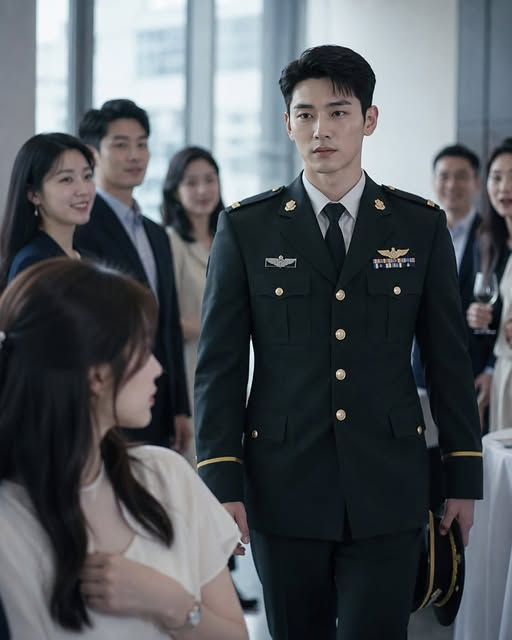
He stood across the room in uniform.
Older.
Quieter.
When our eyes met, he did not approach.
That surprised me.
At the end of the evening, as I put on my coat, he finally stopped several meters away.
“Nien Niem.”
“Yes?”
“I heard you received permanent residency.”
“I did.”
His eyes softened.
“I’m glad.”
“Thank you.”
Then silence.
Years ago, silence between us had been full of things we were afraid to say.
Now it was simply silence.
Luc Tan looked down.
“I won’t ask you to forgive me.”
“Good.”
“I also won’t ask you to come back.”
“Good.”
A faint, painful smile appeared.
“You haven’t changed.”
“I changed completely.”
He looked at me.
And then he understood.
The woman who once waited for him outside the barracks, who believed his promise that he would always protect her, no longer existed.
He had spent ten years refusing every relationship because he believed remaining single proved how much he loved me.
But love was never measured by how long someone waited after hurting you.
It was measured by what they protected when they still had the chance.
Before I left, Luc Tan said:
“There is one thing I’ve always wanted to know.”
I stopped.
“What?”
“If I had refused to give Tinh Van those materials… would we have married?”
Ten years earlier, that question would have destroyed me.
Now I could answer honestly.
“Probably.”
His eyes reddened.
I continued:
“We might have had a home. Maybe children. Maybe we would have grown old together.”
He looked as though each possibility physically hurt.
“But that life doesn’t exist.”
I opened the door.
Cold evening air entered the hallway.
“Nien Niem.”
I looked back once.
Luc Tan stood beneath the lights, the same man who had once carried me out of an abandoned building and promised I would never have to be afraid again.
I didn’t hate him.
That was the strangest part.
I simply no longer belonged to the version of myself who loved him.
“Goodbye, Luc Tan.”
His lips moved.
“Goodbye.”
I stepped outside.
Ten years earlier, three criminals had taken away seven days of my freedom.
What Luc Tan did afterward had almost allowed those seven days to define the rest of my life.
But they didn’t.
Neither did the film.
Neither did his betrayal.
Neither did my scars.
I had crossed an ocean believing I was running away from my past.
Only years later did I understand that I had actually been walking toward a life where nobody else would ever own my story again.
