Gerardo looked at the inside pocket of my coat.
Then at the bronze key.
His face had gone completely pale.
“Give me that paper.”
I almost smiled.
“What paper?”
“Ximena.”
His voice had changed.
Minutes earlier he had been impatient to remove me from his life.
Now he stood between me and the door.
Susana noticed it too.
“What is happening?”
Gerardo ignored her.
“Where did you find the key?”
“In your cabinet.”
“That cabinet is mine.”
“No.”
I looked around the study.
“This house was ours until fifteen minutes ago.”
His jaw tightened.
“You already signed the divorce.”
“Exactly.”
I stepped around him.
“So you no longer have to worry about what I do.”
He grabbed my left wrist.
Not hard.
But hard enough.
I looked down at his hand.
He released me immediately.
“Ximena, listen to me.”
“No.”
“You don’t understand what you found.”
“That is what worries you?”
I took the folded sheet from my coat.
His eyes followed it.
The page contained equipment numbers.
Delivery times.
A name.
And one handwritten sentence:
Replace the locking pin before rehearsal.
Below it were the initials:
G.P.
Gerardo Palacios.
My former husband.
Susana leaned closer.
“What locking pin?”
Gerardo snapped:
“Stay out of this.”
Her expression hardened.
“You brought me into this family, Gerardo. Don’t tell me to stay out now.”
I looked at her.
Then I finally understood something.
She didn’t know.
Whatever had happened two years earlier, Susana was not frightened by that piece of paper.
Gerardo was.
I folded it again.
“The accident report said the piano workshop lift failed because of metal fatigue.”
He said nothing.
“The manufacturer said the same part had been replaced only three months earlier.”
Still silence.
“I asked you about it.”
“You were hospitalized.”
“You told me to stop thinking about the accident.”
“I was trying to protect you.”
I laughed.
That sentence.
Men like Gerardo always discovered the word protect when they needed a prettier name for control.
I walked toward the door.
He blocked me again.
“Where are you going?”
“Home.”
“This is your home.”
“No.”
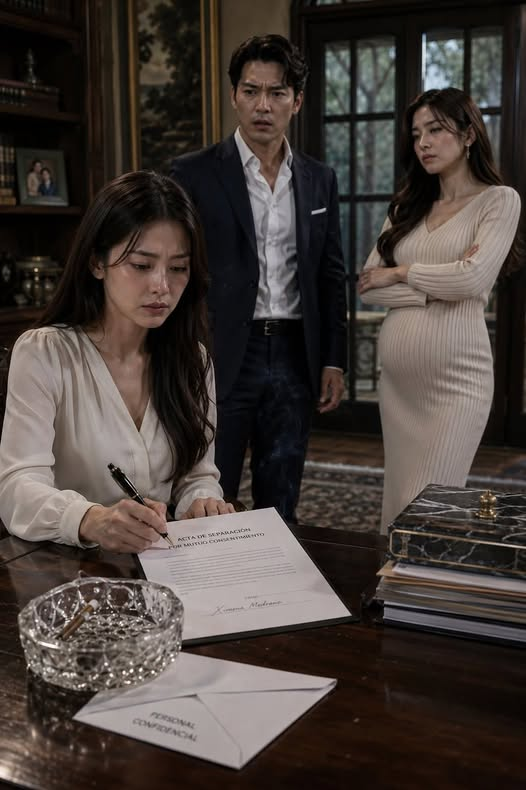
I looked toward the kitchen where the divorce papers were still lying beside his cigarette.
“Not anymore.”
I left without another argument.
But before closing the front door, I returned once.
Neither Gerardo nor Susana saw me.
They were still in the study.
His voice was low and furious.
“You never touch that cabinet again.”
Susana answered:
“Then tell me why you’re terrified.”
I walked to the kitchen table.
Under the glass ashtray, I placed a small white envelope.
No name.
No explanation.
Then I left.
That envelope contained only three things.
A copy of the page I had found.
A photograph.
And a card with the name of a forensic engineer.
I had kept the originals.
Because after five years of marriage, I had finally learned something from Gerardo.
Never give the person who betrayed you the only copy.
The photograph had been taken twenty-four hours before my accident.
I had found it months earlier buried inside an old cloud backup.
At first, I thought it meant nothing.
It showed the interior of the music restoration workshop where I used to practice.
In the background stood the mechanical platform used to move grand pianos.
Beside it—
Gerardo.
He had told investigators he had never visited the workshop before the accident.
But there he was.
And next to him stood another man.
The workshop’s former maintenance supervisor.
A man named Ramón Ortega.
Ramón disappeared three weeks after my injury.
Gerardo told me he had moved north for work.
For two years, I believed him.
Until three months before the divorce, when I received an anonymous email.
Only six words:
Your accident was not an accident.
Attached was Ramón’s phone number.
I met him in a roadside café outside Morelia.
He looked ten years older than I remembered.
He wouldn’t look me in the eyes.
“I didn’t know you were going to be hurt that badly.”
That was his first sentence.
My body went cold.
“What did you do?”
He covered his face with both hands.
“Gerardo came to me.”
“Why?”
“He said he needed the platform to fail during rehearsal.”
I stared at him.
“Why?”
Ramón shook his head.
“He didn’t tell me.”
“And you agreed?”
“He paid me.”
“How much?”
“Eighty thousand pesos.”
My right hand began aching.
It always did when the weather turned cold.
A permanent reminder.
“What exactly did he ask you to do?”
“Tamper with the safety lock so the equipment would malfunction.”
I closed my eyes.
Ramón immediately said:
“He swore nobody would be seriously injured. He said the rehearsal would be stopped before anything happened.”
“But it wasn’t.”
“No.”
“Why?”
“I don’t know.”
That part, I later discovered, was true.
Ramón had sabotaged the equipment.
But someone had changed the rehearsal schedule afterward.
Someone who knew I would be there alone.
The following morning, Gerardo called me fourteen times.
I answered the fifteenth.
“What?”
His breathing sounded uneven.
“What did you leave under the ashtray?”
“You opened it?”
“Who else has this?”
I leaned against the window of the small apartment I had rented.
Not:
Is it true?
Not:
Are you okay?
Only:
Who else knows?
“Enough people.”
“Ximena.”
“Goodbye, Gerardo.”
“Wait.”
His voice cracked.
“For once, listen to me before doing something irreversible.”
I laughed softly.
“Two years ago, I lost most of the function in my right hand.”
My voice remained calm.
“That felt fairly irreversible.”
Silence.
Then he whispered:
“It wasn’t supposed to happen like that.”
Everything inside me stopped.
He realized immediately what he had admitted.
I slowly sat down.
“What wasn’t supposed to happen?”
No answer.
“Gerardo.”
“I can explain.”
“Then explain.”
He remained silent for almost ten seconds.
Finally:
“I only wanted you to miss the audition.”
I couldn’t breathe.
“What?”
“The Mexico City Philharmonic audition.”
The memory came back instantly.
It had been the most important opportunity of my career.
Only six musicians had been invited.
I was one of them.
Gerardo had smiled when I received the letter.
He had bought champagne.
Then, two days later, he started asking questions.
If I won, would I move?
Would I travel?
Would I still have time for marriage?
I told him we would figure it out together.
Apparently, he had chosen another solution.
“You sabotaged the equipment so I would miss an audition?”
“I thought the workshop would close for the day.”
His words came faster.
“I never intended for you to get hurt.”
“You paid someone to cause a mechanical failure.”
“I was desperate.”
“Why?”
Then he said the sentence that ended whatever little doubt remained in me.
“Because if you had become successful, you would have left me behind.”
I closed my eyes.
For two years I had mourned the woman I could have become.
The pianist.
The performer.
The life that vanished when my right hand no longer obeyed me as before.
And the man who held me while I cried had helped cause it.
“You destroyed my career because you were afraid I would outgrow you.”
“No.”
His voice broke.
“I loved you.”
“That wasn’t love.”
I hung up.
Gerardo came to my apartment that evening.
I didn’t let him inside.
He stood in the hallway.
“I’m begging you.”
The irony almost made me laugh.
Two days earlier, he had expected me to walk out of his mansion with nothing.
Now he was the one asking.
“Ramón gave a sworn statement.”
His face turned gray.
“You found him.”
“Yes.”
“What does he want?”
“Nothing.”
“Everyone wants something.”
“That’s the difference between us, Gerardo.”
I looked at him.
“You still think every conscience has a price.”
He lowered his voice.
“If this goes public, my company is finished.”
“Maybe.”
“My father’s reputation—”
“Not my problem.”
“Susana is pregnant.”
I stared at him.
“Do not use her child as a shield.”
He flinched.
Then asked:
“What do you want?”
There it was again.
Money.
Settlement.
Negotiation.
I opened the door a little wider.
“I wanted you to sign the divorce.”
“You already got that.”
“Yes.”
“So what else?”
“Nothing.”
He looked genuinely confused.
“I don’t want your mansion.”
“I don’t want your accounts.”
“I don’t want your company.”
I held up my injured hand.
“I want the truth attached to the person who caused this.”
His eyes reddened.
“You’ll destroy me.”
“No.”
I shook my head.
“You made that decision two years ago.”
Susana learned the rest three days later.
She came to see me without Gerardo.
Her face was pale.
“Did he really do it?”
“Yes.”
She sat down slowly.
For the first time since I had met her, there was no triumph in her eyes.
Only fear.
“He told me you blamed him because you couldn’t accept that your career was over.”
“Of course he did.”
She looked at my hand.
Then away.
“I didn’t know.”
“I believe you.”
Her head snapped up.
That surprised her.
I continued:
“But you did know he was married.”
Her eyes filled with tears.
“Yes.”
“You stood beside him while he humiliated me publicly.”
“Yes.”
“You allowed everyone to treat me like an obstacle to your happiness.”
She lowered her head.
“Yes.”
I nodded.
“Then we understand each other.”
She wiped her eyes.
“There’s something you don’t know.”
I went still.
“What?”
Susana opened her bag.
Inside was another key.
Bronze.
Identical to Gerardo’s.
“He gave me this a year ago.”
My heartbeat changed.
“What does it open?”
“I thought it was for a deposit box.”
She placed a bank receipt on my table.
A private vault in Morelia.
Registered under Gerardo’s company.
“I went there yesterday.”
“Why?”
“Because after seeing your envelope, I stopped believing anything he told me.”
She pushed a folder toward me.
Inside were bank transfers.
Payments to Ramón.
Payments to a hospital administrator.
And then one transaction that made my skin turn cold.
Dated twelve days after my accident.
A payment to Dr. Mauricio Serrano.
The surgeon who had treated my hand.
I looked at Susana.
“What is this?”
“I don’t know.”
But I did.
Or at least I knew where to begin.
The medical review took two weeks.
Three independent specialists examined my original scans and surgical notes.
Their conclusion was devastating.
The initial injury had been serious.
But not necessarily career-ending.
There had been a second treatment option.
A specialized reconstruction procedure in Mexico City.
The original emergency physician had recommended immediate transfer.
That recommendation disappeared from my file.
Instead, Dr. Serrano documented that reconstruction was “unlikely to provide meaningful functional improvement.”
I had never been told another option existed.
The surgeon later admitted Gerardo contacted him.
Gerardo claimed I was psychologically fragile.
That I couldn’t handle another procedure.
That as my husband, he wanted “conservative treatment.”
And shortly afterward, his company transferred money to a consulting account connected to Serrano.
For the second time, Gerardo had made a decision about my hand without asking me.
The first destroyed it.
The second made certain I never had the chance to recover what could still be saved.
The case exploded.
Not because I called journalists.
I didn’t.
The medical review triggered formal investigations.
Then came Ramón’s testimony.
Financial records.
Workshop evidence.
Gerardo’s recorded phone call in which he admitted arranging the sabotage.
His company’s board suspended him immediately.
Business partners withdrew.
His father publicly claimed he knew nothing.
Maybe he didn’t.
I stopped caring.
Susana left Gerardo before the baby was born.
She never became my friend.
Some wounds don’t transform into friendships simply because two women discover they were deceived by the same man.
But she did something important.
She testified.
And when Gerardo’s lawyers offered her money to change her story—
she refused.
Six months later, I returned to a concert hall.
Not as the pianist I had once been.
My hand would never return completely to what it was.
That truth hurt.
But it no longer controlled me.
I had started working with a rehabilitation foundation for musicians injured by accidents and medical negligence.
I taught young pianists.
I arranged music.
And after months of therapy, I discovered I could still play certain pieces by adapting the fingering.
The first time I performed publicly again, it wasn’t a grand concerto.
It was a simple composition I had written myself.
For the left hand.
And the limited movement that remained in the right.
When the final note faded, the audience stood.
I did not cry because I had recovered my old life.
I cried because I finally understood that Gerardo had failed to take everything.
The divorce settlement remained exactly as I had signed it.
I demanded no mansion.
No luxury car.
No portion of his personal fortune.
People called me foolish.
They didn’t understand.
I had already walked away with the one thing Gerardo had spent years trying to control.
My future.
Almost a year later, I received one final letter from him.
There was no return address.
Only a sentence:
If I had let you go to that audition, would you have stayed with me?
I read it twice.
Then put it through the shredder.
Because that was still Gerardo’s mistake.
He thought the tragedy was that he had been too afraid to let me succeed.
It wasn’t.
The tragedy was that he believed loving someone gave him the right to decide how small her life should become so she would never leave.
He had once feared that if I discovered what I was capable of, I would walk away.
In the end—
he was right.
But not because of the audition.
Not because of fame.
Not because of money.
I left because the small white envelope beneath that glass ashtray finally exposed the truth:
the person who claimed to love me most had been the one quietly making sure I could never become more than he could control.
And when I closed that mansion door forever, Gerardo lost far more than a wife.
He lost the woman who had once been willing to forgive almost anything—
except the truth.
