Lawyer Tan Nghien closed the last folder and looked at me for several seconds.
“Tong Duong.”
“Yes?”
“You understand that once these letters go out, there is no going back.”
I smiled.
“There was no going back when they put employee number 0582 on the dismissal list.”
He nodded.
Then pressed Send.
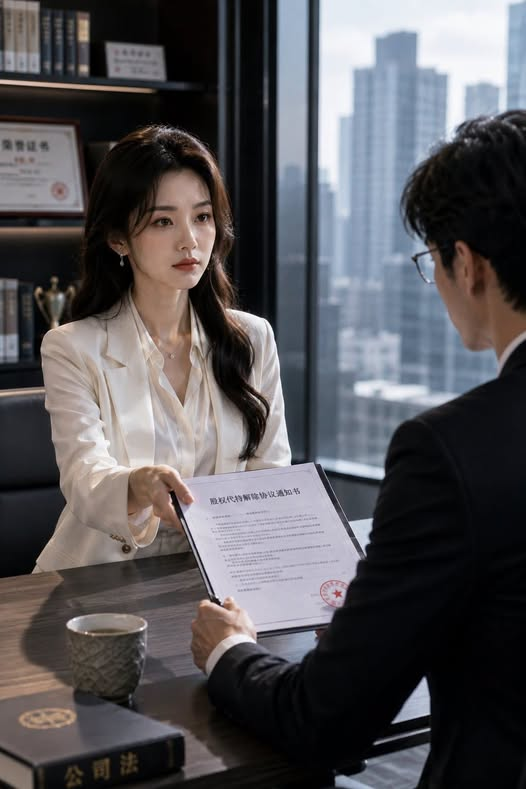
Four legal notices left his office at exactly 3:07 p.m.
One went to Co Nghien Bach.
One to Giang Van.
One to the investors.
And the last to every commercial partner involved in the spring collection.
The first notice concerned my shares.
The second concerned intellectual property.
The third—
was the one that would hurt most.
It informed the company that the exclusive license covering seventeen of its best-selling core designs was suspended pending an ownership dispute.
For five years, everyone believed those designs belonged entirely to the company.
They didn’t.
When Co Nghien Bach and I started the business, we had no money to pay me a proper design salary.
So the first investor’s lawyer drafted a simple agreement.
I retained ownership of my original designs.
The company received an exclusive commercial license as long as I remained either an employee or an active shareholder.
At the time, Co Nghien Bach laughed.
“Why bother with all this?”
I answered:
“Because one day you might fire me.”
He put an arm around my shoulders.
“Impossible.”
Five years later—
he proved why contracts matter.
At 3:11 p.m., my phone started vibrating.
Co Nghien Bach.
I ignored it.
3:12.
Again.
3:13.
Giang Van.
3:14.
Finance Director.
3:15.
Unknown number.
Then an email arrived from the company’s legal department.
Miss Tong, please suspend all actions. There may have been a misunderstanding regarding today’s personnel adjustment.
I showed it to Tan Nghien.
He laughed.
“Misunderstanding.”
I picked up my water.
“Four hours ago I was dismissed.”
“Apparently being fired has become a misunderstanding now.”
At 4:20 p.m., the new collection meeting collapsed.
I learned about it from Tieu Chu.
She sent me a voice message.
Her whisper sounded almost excited.
“Miss Duong, chaos.”
“What happened?”
“The legal department came running into the design center.”
“And?”
“They confiscated all seventeen spring designs.”
I closed my eyes.
Exactly as expected.
“And Hua Lam?”
There was a pause.
Then Tieu Chu whispered:
“He’s crying.”
I nearly smiled.
Not because he was crying.
Because three months earlier, when I told him his work wasn’t ready, Giang Van accused me of bullying a young designer.
Now reality was giving him a harsher critique than I ever had.
Tieu Chu continued:
“Director Giang keeps saying the designs belong to the company.”
“They don’t.”
“I know.”
“She also said you stole company secrets.”
That made me laugh.
“Of course.”
The oldest trick in the book.
If you cannot prove you created something—
accuse the creator of stealing it.
Then Tieu Chu lowered her voice even further.
“General Manager Co came back.”
I stopped.
“He was out meeting investors.”
“He came back ten minutes ago.”
“What did he say?”
“Nothing.”
A pause.
“He tore your dismissal notice off the tea-room door himself.”
I stared out the window.
Too late.
At 5:02 p.m., Co Nghien Bach finally sent a text instead of calling.
Come back. We’ll talk.
I didn’t answer.
Five minutes later:
Your dismissal has been revoked.
Then:
I didn’t approve the final notice.
That one made me stop.
I opened the termination document stored on my phone.
His electronic authorization appeared clearly at the bottom.
Co Nghien Bach.
Approved 11:46 a.m.
I sent him the screenshot.
Nothing else.
He stopped messaging for twenty minutes.
Then:
Tong Duong, I can explain.
I typed:
Explain it to my lawyer.
And blocked him.
The following morning, the company’s stock transfer meeting was held urgently.
Technically, the business was not publicly listed.
But its ownership structure was complicated.
The first institutional investors held twenty-nine percent.
Co Nghien Bach held twenty-seven.
Giang Van’s family investment vehicle held seventeen.
Several early employees held small percentages.
And I—
held twenty-one percent.
Twenty-one percent that everyone had conveniently stopped mentioning once the company became successful.
Why?
Because for three years, I had signed a voting proxy allowing Co Nghien Bach to represent me at shareholder meetings.
I was designing twelve hours a day.
I hated board politics.
And I trusted him.
That proxy expired the moment my employment relationship ended.
Which meant that when they fired me—
Co Nghien Bach lost control of my voting rights instantly.
But that wasn’t even the real problem.
My original shareholder agreement contained a founder-protection clause.
If I was terminated without cause, I could demand that the company repurchase my shares at the higher of two values:
the latest financing valuation—
or an independent fair-market valuation.
Tan Nghien had already calculated the preliminary number.
Two hundred and eighty-six million yuan.
The company had less than forty million in unrestricted cash.
They could not pay me.
And the agreement gave them thirty days.
If they defaulted, I could seek enforcement against certain pledged founder assets.
Including—
Co Nghien Bach’s voting shares.
That was why he had stopped calling for twenty minutes.
Someone in Legal had finally read the contract he signed five years ago.
At nine thirty that morning, Giang Van arrived at Tan Nghien’s law office without an appointment.
She entered wearing the same confident red coat she had worn the day before.
But there were dark circles under her eyes.
“I want to speak to Tong Duong alone.”
Tan Nghien looked at me.
I nodded.
He left the room.
Giang Van put her handbag on the table.
“You planned this.”
“No.”
“You prepared evidence before leaving.”
“Yes.”
“That means you planned it.”
I looked at her.
“No.”
“It means I stopped trusting you long before you finally gave me a reason to leave.”
Her face hardened.
“You think twenty-one percent makes you powerful?”
“No.”
I opened the folder in front of me.
“My designs do.”
She stared at it.
“You created them while working for the company.”
“Not all.”
I pulled out the first original sketch.
Dated before incorporation.
Then another.
Then another.
Eight of the seventeen foundational designs had been created before the company legally existed.
The remaining nine were governed by my licensing agreement.
Giang Van’s face changed.
“You can’t stop the spring launch.”
“I’m not stopping it.”
“You sent legal warnings to every partner!”
“Yes.”
“Factories are refusing production.”
“That is their decision.”
“Retailers are demanding clarification.”
“Also their decision.”
She slammed her hand on the table.
“You are destroying hundreds of employees because your feelings were hurt!”
I stared at her.
For the first time, my voice became cold.
“Don’t use employees as your shield.”
She froze.
“I handed over every project file.”
“I preserved every operational document.”
“I didn’t delete a single company record.”
“I didn’t interfere with payroll.”
“I didn’t stop the company from using anything it legally owns.”
I pushed the licensing agreement toward her.
“I only stopped you from using what belongs to me.”
She looked down.
Silence.
Then she said:
“Come back.”
I almost thought I had misheard.
She repeated it.
“Return to the R&D center.”
“You can resume as project director.”
“And Hua Lam?”
Her face tightened.
“He can report to you.”
I smiled.
Yesterday, I had been too arrogant to remain.
Today, they wanted me supervising their favorite genius.
“No.”
“We’ll increase your salary.”
“No.”
“Board seat.”
“No.”
Her patience broke.
“What do you want?”
I looked at her.
“Nothing from you.”
That answer frightened her more than any demand.
Because a person asking for money can be negotiated with.
A person who has already decided to leave cannot.
At noon, the investors called an emergency board meeting.
I attended by video.
Co Nghien Bach sat at the far end of the conference table.
He looked as though he had not slept.
Hua Lam was not there.
Giang Van sat beside him.
The lead investor opened the meeting.
“Miss Tong, are you prepared to withdraw your share repurchase demand if your employment is reinstated?”
“No.”
“Would you consider maintaining the design licenses?”
“Under new commercial terms.”
Co Nghien Bach finally spoke.
“Tong Duong.”
His voice sounded hoarse.
I looked at him.
“We started this company together.”
“Yes.”
“Then why are you treating it like an enemy?”
I was silent for several seconds.
Then I asked:
“Who approved my dismissal?”
His expression tightened.
“Answer.”
He looked away.
“I did.”
There it was.
Giang Van immediately said:
“Nghien Bach, you don’t need—”
I interrupted.
“Why?”
He rubbed his forehead.
“Hua Lam threatened to resign.”
I laughed.
Several directors shifted uncomfortably.
He continued:
“Giang Van believed the brand needed younger creative leadership.”
“And you?”
Silence.
“What did you believe?”
He looked at me through the screen.
“I thought you would leave for a while.”
I frowned.
“What?”
“I thought after you calmed down, we could bring you back as an external consultant.”
For a moment, I couldn’t speak.
So that had been the plan.
Humiliate me.
Remove my authority.
Give Hua Lam my department.
Then wait until I became frightened outside the company—
and invite me back under weaker terms.
Co Nghien Bach whispered:
“I never thought you would really cut everything off.”
I smiled.
“That’s because you never believed I could leave.”
His face changed.
Exactly.
That had always been the problem.
Not Giang Van.
Not Hua Lam.
Not even the dismissal notice.
Co Nghien Bach had become certain that everything I created would remain available to him forever.
My work.
My loyalty.
My shares.
My silence.
The lead investor cleared his throat.
“There is another issue.”
He opened a report.
“Our external counsel reviewed the spring collection.”
Giang Van stiffened.
“What issue?”
The investor looked directly at her.
“Six designs credited to Hua Lam substantially overlap with archived Tong Duong drafts.”
No one spoke.
I didn’t need to say anything.
Tan Nghien had already sent the evidence.
Version histories.
Email timestamps.
Original drawings.
Factory fitting notes.
And the recording.
The investor pressed Play.
Giang Van’s voice filled the boardroom.
“Change the neckline and the sleeve. Remove Tong Duong’s internal code. Hua Lam can present it as a reinterpretation.”
Then Hua Lam:
“What if she notices?”
Giang Van laughed.
“She won’t be here forever.”
Silence.
Absolute silence.
Co Nghien Bach slowly turned toward her.
“What is this?”
Giang Van’s face lost all color.
“Nghien Bach…”
He stood.
“You told me Hua Lam developed those designs himself.”
“He did most of the adaptation.”
“From Tong Duong’s work?”
She said nothing.
His eyes became cold.
“You knew?”
“I was protecting the launch.”
“No.”
For the first time, the woman who had always controlled the room had no answer.
The investors suspended the spring launch that afternoon.
Not because I demanded it.
Because no major retailer wanted to risk selling disputed designs.
Then the financing bank learned about the founder-share repurchase obligation.
The company’s credit line was reviewed.
A new investor withdrew from negotiations.
Two manufacturers demanded deposits before continuing production.
Within a week, the cash-flow problem became severe.
Online rumors said the company was going bankrupt because I withdrew my shares.
That wasn’t entirely accurate.
A healthy company does not collapse because one employee leaves.
But this company had built too much of its value on three things it didn’t actually control:
my designs,
my shareholder support,
and the illusion that Co Nghien Bach could never lose me.
When all three disappeared at once—
everything underneath was exposed.
Hua Lam resigned on the eighth day.
Before leaving, he sent me a message.
Miss Duong, I’m sorry.
I read it.
Then another arrived.
Director Giang told me everyone copied references when they were young. I believed her.
I replied once.
Learn the difference between inspiration and ownership before you call yourself a designer.
Then I blocked him too.
He was twenty-three.
Young enough to rebuild.
But not young enough to avoid consequences.
On the fifteenth day, Co Nghien Bach came to see me.
Not at the office.
At the small studio I had rented.
There were fabric rolls on the floor.
Three mannequins.
Two sewing machines.
A long table covered in sketches.
He stood at the doorway.
His eyes moved around.
“You opened another company.”
“No.”
“Then what is this?”
“My studio.”
He looked at the designs.
“When did you start?”
“The day after I left.”
His face tightened.
“You really didn’t plan to come back.”
“No.”
He stepped inside.
“Twelve factories called me today.”
I kept drawing.
“Why are you telling me?”
“Three will stop working with us next month.”
I said nothing.
“Two retailers canceled orders.”
Still nothing.
“Finance says we have maybe six weeks before we miss payroll unless investors inject more money.”
My pencil finally stopped.
I looked at him.
“I’m sorry for the employees.”
He laughed bitterly.
“But not for me.”
“No.”
That honesty hurt him.
He stood there for a long time.
Then whispered:
“Was I really that bad to you?”
I looked at the man I had followed into a freezing office after graduation.
The man who once promised me shares because he couldn’t afford my salary.
The man who later pushed me out of photographs because I “didn’t like attention.”
The man who watched another woman take credit for half the soul of the brand.
“Yes.”
His eyes reddened.
“I thought giving you freedom in design was enough.”
“No.”
“I thought you didn’t care about titles.”
“I didn’t.”
“Then what did you want?”
I smiled sadly.
“Respect.”
He closed his eyes.
Such a cheap thing.
And somehow the company could no longer afford it.
Then he placed a document on my table.
“What is this?”
“My shares.”
I frowned.
He continued:
“I’m transferring six percent of my personal stake to you.”
“No.”
“Tong Duong—”
“I don’t want it.”
“You deserve it.”
“I deserved it five years ago.”
He froze.
“I don’t want compensation now because you finally understand.”
I pushed the document back.
“Take it.”
His hand remained on the table.
Then he whispered:
“Can the company survive?”
I answered truthfully.
“Yes.”
Hope appeared.
I continued:
“But not the way it is now.”
He looked at me.
“Sell the vanity projects.”
“Cancel the unnecessary stores.”
“Renegotiate the factories.”
“Remove Giang Van from creative decisions.”
“Stop pretending marketing can replace product.”
“And find a real design director.”
His lips tightened.
“You.”
“No.”
The hope vanished.
“I said a real design director.”
I smiled.
“Not the woman you fired and expect to rescue you.”
Three months later, Co Group’s fashion subsidiary entered restructuring.
It did not disappear completely.
But the billion-yuan valuation collapsed.
Two stores closed.
Giang Van resigned from management after the board investigation concluded that she had improperly reassigned authorship on multiple projects.
Her family’s investment vehicle sold most of its shares.
Co Nghien Bach remained.
But no longer as the untouchable founder everyone feared.
The board appointed a professional CEO above him.
For the first time, he had to report to someone else.
My share dispute was settled through mediation.
Instead of forcing the company to repurchase the entire twenty-one percent immediately, I sold part of my position to an institutional investor and retained a smaller passive stake.
Why?
Because hundreds of employees had helped build that company too.
I wanted consequences.
Not collateral damage.
My design licenses ended.
Every future collection had to stand on its own.
Without my hidden sketches.
Without my name erased from internal files.
Without me.
A year later, I launched my first independent collection.
No giant stage.
No celebrity ambassador.
No red carpet.
Just forty buyers, several journalists and a narrow runway inside an old converted warehouse.
On every seat was a card.
Creative Director: Tong Duong.
My name.
Printed large enough for everyone to see.
Tieu Chu sat in the front row.
When the first model walked out, she started crying.
Afterward she hugged me.
“Miss Duong, do you know what everyone at the old company says?”
“What?”
“That if they hadn’t fired employee 0582, none of this would have happened.”
I laughed.
“They’re wrong.”
She looked confused.
I glanced toward the runway.
“If they hadn’t fired me, it would simply have taken me longer to leave.”
Near the exit, someone stood alone.
Co Nghien Bach.
He had come without telling me.
Our eyes met.
He walked closer.
“The collection is beautiful.”
“Thank you.”
He looked at my name on the wall.
Then smiled bitterly.
“I remember the first competition.”
“So do I.”
“You said my shirt could sell for three times the price.”
“Yes.”
“You were right.”
He paused.
“You were always right more often than I wanted to admit.”
I said nothing.
Then he asked:
“If I had taken down that dismissal notice before you saw it…”
I shook my head.
“It wouldn’t matter.”
“Why?”
“Because the paper wasn’t the real problem.”
I looked at him.
“The problem was that somewhere along the way, you became the kind of person who believed my name belonged on it.”
He lowered his head.
There was nothing left to argue.
I walked back toward the runway.
Behind me was the man who once promised that when the company became successful, he would give me whatever I wanted.
Years later, I finally knew what I wanted.
Not his shares.
Not his position.
Not his regret.
Just a place where no one could erase my name from my own work.
They thought they were cleaning out one employee’s desk.
Instead, they removed the woman holding together the designs, the founder agreement, the licensing rights and twenty-one percent of the company.
Ten minutes after being dismissed, I left with one cardboard box.
Months later, their billion-yuan empire was fighting to survive.
And for the first time since the beginning—
every dress I created carried the correct name.
Mine.
