Tran Chau watched me pack for another ten minutes.
In the end, he smiled as if he had finally understood.
“You don’t need to bring so much. We can buy everything again after we get to America.”
I folded my last sweater and placed it in the suitcase.
He still thought I was packing to follow him.
That realization hurt less than I expected.
Perhaps because, somewhere between the conversation I overheard and the immigration form he placed in front of me, my heart had already finished leaving.
Three days later, his American visa was approved.
That evening, he opened a bottle of wine.
“We should celebrate.”
“I can’t. I have work.”
He frowned.
“You’ll have plenty of time to work in Boston.”
I looked at him.
“Tran Chau, when are you leaving?”
“Next Thursday.”
I nodded.
“My flight is Friday.”
His expression immediately brightened.
“You booked already?”
“Yes.”
He walked over and kissed my forehead.
“I knew you wouldn’t really choose some research institute over your husband.”
I closed my eyes.
For the last time, I allowed him to misunderstand me.
“Your flight is Friday too?” he asked.
“Yes.”
What I didn’t tell him was that his plane would fly west.
Mine would fly east.
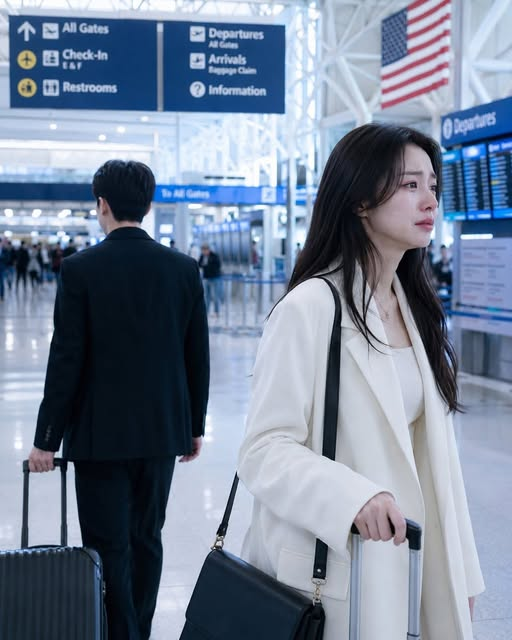
At the airport, Tran Chau hugged me tightly.
Lam Tuyet had already sent him four messages that morning.
I saw her name flashing on his screen.
He quickly turned the phone over.
“Once I settle down, I’ll send you the address. Come as soon as possible.”
I looked at the man I had loved for six years.
There had been a time when I thought his ideals were part of why I loved him.
Now even those ideals had become negotiable if Lam Tuyet happened to be waiting somewhere else.
“Tran Chau.”
“Yes?”
“If one day you discover that the person waiting for you isn’t there anymore, will you regret going?”
He laughed.
“What strange question is that?”
Then he touched my hair.
“Don’t overthink things. Just follow me.”
Just follow me.
That had been our marriage in four words.
I smiled.
“Have a safe flight.”
He walked through security without turning around.
Just like that.
Not once.
I watched until he disappeared.
Then I returned to our apartment, slept alone for the first time in years, and the next morning boarded my own flight.
When the plane landed, my father was waiting outside the arrival gate.
His hair had gone almost completely gray.
The moment he saw me, his eyes reddened.
“You’re really back.”
I hugged him.
“Yes, Dad.”
“What about Tran Chau?”
I was silent for a second.
Then I handed him the envelope in my bag.
Inside were the divorce papers.
“He chose America.”
I looked back at the airport behind me.
“I chose myself.”
Tran Chau discovered the truth forty-eight hours later.
He called me seventeen times.
I answered on the eighteenth.
His voice exploded through the phone.
“Where are you?”
“At home.”
“What home?”
“My country.”
There was silence.
Then:
“Tan Suong, stop joking.”
“I’m not joking.”
“What about your immigration application?”
“I never submitted it.”
His breathing became heavier.
“You told me you went to the embassy!”
“I did.”
“To complete my return documents.”
“You lied to me!”
I almost laughed.
“You secretly signed an American employment contract. You prepared immigration documents without discussing them with me. You decided where I would live, where I would work and what I would sacrifice.”
I paused.
“But you’re angry because I didn’t tell you I was leaving?”
“You’re my wife!”
“Not for much longer.”
Silence.
Then his voice changed.
“What does that mean?”
“The divorce agreement should reach you tomorrow.”
He seemed unable to speak.
Finally:
“You want a divorce because I changed jobs?”
“No.”
“Then because of Lam Tuyet?”
I closed my eyes.
“No, Tran Chau.”
“I’m divorcing you because somewhere along the way, you stopped seeing me as a person capable of choosing her own life.”
He immediately softened his voice.
“Tan Suong, don’t be impulsive. Come to Boston. We’ll talk face to face.”
“I spent years talking.”
“You never said you were this unhappy.”
“I did.”
“You cried.
“You called me unreasonable.
“I disagreed.
“You called me difficult.
“I wanted astrophysics.
“You convinced me to abandon it.
“And now you expect me to cross an ocean because you’ve decided another woman needs you.”
He went quiet.
I continued:
“You once told Tuong Ky that I was the most suitable woman to marry.”
His breathing stopped.
“You heard that?”
“Yes.”
“Tan Suong, I can explain.”
“I don’t need an explanation.”
“Nothing happened between Lam Tuyet and me.”
“That isn’t the point.”
I looked through the window of my father’s apartment.
The city outside was completely different from the one I had left years earlier.
New buildings.
New laboratories.
New roads.
A country that had continued moving forward while I was gone.
“I hope America gives you the life you wanted.”
Then I hung up.
The divorce took several months.
Tran Chau delayed signing twice.
The third time, my lawyer informed him that I would proceed without further discussion.
He finally signed.
Meanwhile, I began work at the National Institute for Fundamental Physics.
On my second week, the director called me into his office.
He had read my doctoral thesis.
Then he placed another file before me.
“Why did you leave astrophysics?”
I didn’t know how to answer.
Finally I said:
“Personal reasons.”
He studied me.
“Do you still want to return to it?”
My heart stopped.
“Is that possible?”
He smiled.
“We’re forming a new research group combining theoretical physics with astrophysical modeling.”
Then he pushed the folder toward me.
“Your strange academic detour may actually make you exactly the person we need.”
For years, I had hated myself for giving up my first dream.
Suddenly, that abandoned road had curved back toward me.
I accepted.
Tran Chau’s life in America initially went exactly as he expected.
He posted photographs of the university.
The laboratory.
Boston in autumn.
Lam Tuyet appeared in several pictures.
Mutual friends sent them to me.
I deleted every one.
Six months later, Tuong Ky called.
“You don’t want to know?”
“No.”
“You might enjoy this.”
“I doubt it.”
He laughed.
“Lam Tuyet has a boyfriend.”
I became quiet.
Apparently, she had been dating an American researcher for almost two years.
She had never asked Tran Chau to come.
Never promised him anything.
When he arrived, she simply treated him as an old friend.
Tran Chau had built an entire future around a fantasy that existed only in his imagination.
I felt no satisfaction.
Only exhaustion.
“That has nothing to do with me anymore.”
Tuong Ky sighed.
“You really let him go.”
“Yes.”
Two years passed.
Our research group published its first major results.
Then another.
I began attending international conferences again.
The woman who had once given up astrophysics because her husband disapproved was invited to lead a national research project connected to the field.
At the opening ceremony, a journalist asked:
“Why did you return when you had opportunities abroad?”
I thought of Cambridge.
Of Tran Chau.
Of the immigration application.
Then I answered:
“Because going somewhere developed can give a person a good life.”
I smiled.
“But helping build something meaningful gives my life a reason.”
The interview spread online.
Tran Chau saw it.
That night, he emailed me for the first time in almost a year.
I think I finally understand why you left.
I didn’t reply.
By then, he had obtained American citizenship.
He had made the decision quickly because he believed his future was there permanently.
Years earlier, he had mocked the idea that nationality mattered when opportunity was greater elsewhere.
But America never became the life he imagined.
Lam Tuyet married someone else.
His academic career stalled.
The position he had expected to become permanent was restructured.
Meanwhile, his parents grew older.
His father became seriously ill.
And suddenly, the country he had been so eager to leave became the only place he wanted to return to.
He began trying to restore the status he had willingly given up.
The first application failed.
Then the second.
Then the third.
Each time, the answer was the same.
His circumstances did not qualify for the restoration process he expected to be simple.
Tuong Ky told me Tran Chau became obsessed.
“He keeps saying there must be someone he can talk to.”
“There probably is.”
“He thinks you could help.”
I looked up from my research notes.
“Me?”
“You’re connected to several national institutions now.”
I laughed softly.
“I study stars, Tuong Ky. I don’t issue passports.”
But Tran Chau contacted me anyway.
We met during an international conference five years after our divorce.
I barely recognized him.
He looked older.
Not physically ruined.
Just diminished.
He stared at me for a long time.
“You haven’t changed.”
“I have.”
He smiled bitterly.
“Yes.”
Then he lowered his head.
“I heard you’re leading the new observatory project.”
“I am.”
“That was always your dream.”
“It still is.”
His eyes reddened.
“I was wrong.”
I didn’t answer.
“I thought you’d follow me because you loved me.”
“I did love you.”
“Then why—”
“Because love isn’t obedience.”
He fell silent.
Finally, he took a folder from his bag.
“My latest application was rejected.”
I didn’t touch it.
“I want to come back.”
“Then keep applying through the proper process.”
“They told me my chances are very low.”
“I’m sorry.”
He stared at me.
“That’s all?”
“What else should there be?”
His voice cracked slightly.
“Tan Suong, if I had known you would really leave…”
I smiled sadly.
That was still his problem.
Even after all these years.
“If you had known I would leave, you might have treated me better.”
I shook my head.
“But only because you were afraid of losing me.”
I stood.
“I wanted you to respect me even when you believed I would stay.”
He looked down.
For once, Tran Chau had nothing to say.
Before leaving, I stopped.
“Do you remember the night before you went to America?”
He nodded.
“You walked through airport security without looking back.”
His face tightened.
“I regret that every day.”
I looked at him calmly.
“I don’t.”
Outside the conference hall, several young researchers were waiting for me.
Tomorrow we would leave for the observatory.
There was work to do.
A future to build.
Behind me was a man who had once believed I would abandon every dream simply because he told me to follow.
In front of me was the life I had almost surrendered.
So I did exactly what Tran Chau had done at the airport years earlier.
I turned around.
I walked away.
And this time, I never looked back.
