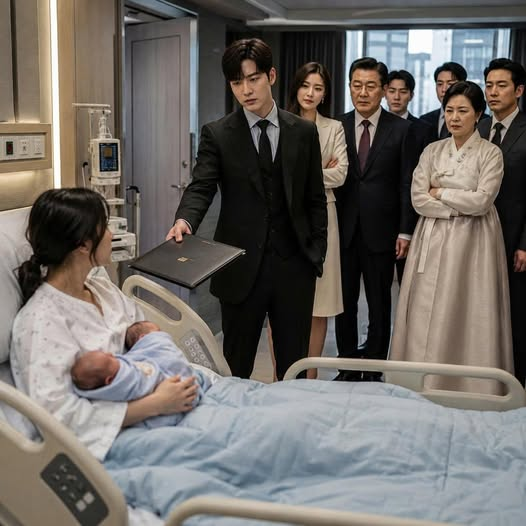
For the first time since entering my hospital room, nobody in the Kang family spoke.
The two investigators showed their identification.
The older one looked toward Tae-jun’s father.
“Chairman Kang Seung-ho, we have a warrant concerning transactions connected to Kang Mirae Holdings.”
My father-in-law’s face hardened.
“This is a hospital.”
“Yes.”
“And my daughter-in-law has just given birth.”
I almost laughed.
Five minutes earlier, that same fact had not stopped him from demanding that I surrender my babies.
Now suddenly my health mattered.
The investigator glanced at me.
“Mrs. Kang contacted our office through her attorney several weeks ago.”
Tae-jun turned toward me.
“You did what?”
I reached for the envelope beside my bed.
Inside was a flash drive.
Six months of transaction records.
Patent licensing agreements.
Internal emails.
Invoices.
And copies of documents Tae-jun’s family believed had disappeared.
I held it out.
The investigator accepted it.
My father-in-law took one step forward.
“Seo-yeon.”
His voice had changed.
No longer commanding.
Warning.
“You have no idea what you’re doing.”
I looked at my sleeping sons.
Then at him.
“I know exactly what I’m doing.”
Tae-jun suddenly grabbed the custody agreement from the table.
“Everyone leave.”
Nobody moved.
He looked at me.
“We need to talk privately.”
“No.”
“Seo-yeon.”
“You brought nine people into my hospital room to take my children.”
My voice remained quiet.
“You don’t get privacy now.”
Chae-rin finally spoke.
“Tae-jun, maybe we should go.”
Something in her tone made me look at her.
Not confidence anymore.
Fear.
And that was when I understood.
She knew too.
I turned toward the investigators.
“You should ask Ms. Yoon about Mirae Consulting.”
Chae-rin went pale.
Tae-jun stared at me.
“How do you know that name?”
There it was.
The confirmation I had been waiting for.
I smiled faintly.
“Thank you.”
He realized his mistake immediately.
But it was too late.
I had discovered Kang Mirae Holdings by accident.
Six months earlier, one of the companies using my patents had sent a royalty statement to an old email address.
The numbers were wrong.
Very wrong.
I had developed three industrial energy-storage patents before marrying Tae-jun.
At the time, Kang Group was struggling to enter the next-generation battery market.
I licensed the technology to them at favorable rates because Tae-jun told me we were building our future together.
After our wedding, I stopped checking the details.
I trusted him.
That had been my first mistake.
My second was believing the Kang family considered trust something honorable rather than exploitable.
According to the statement, the company had paid almost four times the royalty amount I had received.
The difference had gone to an intermediary.
Kang Mirae Holdings.
I searched deeper.
That company controlled several others.
One of them was Mirae Consulting.
Its registered director was a seventy-two-year-old retired accountant who had once worked for my father-in-law.
But the internal authorization records told another story.
Payments required approval from three people.
Chairman Kang.
Tae-jun.
And Yoon Chae-rin.
For years, millions had been redirected through shell companies before the remainder reached me.
My own inventions were helping fund a hidden network I hadn’t even known existed.
At first, I thought it was simply theft.
Then I found the acquisition documents.
Kang Mirae had quietly been buying shares in companies connected to Kang Group.
If the transactions continued for another year, my father-in-law would control a private block powerful enough to bypass parts of the public board.
And several purchases had been financed using revenue generated by my patents.
They had been building a private empire with technology they did not own.
That was why the divorce contract contained the strange clause.
They didn’t merely want me gone.
They wanted me legally prevented from looking backward.
The investigators asked the Kang family to leave.
Tae-jun refused.
“This is my wife.”
My attorney, Lee Min-jung, entered behind them.
“Not for much longer.”
Everyone turned.
She carried two folders.
One blue.
One red.
She placed the blue folder beside me.
“Emergency custody petition.”
Then the red.
“Petition for divorce, asset preservation, and injunction against further transfer or use of Dr. Han Seo-yeon’s intellectual property.”
Chae-rin whispered:
“Doctor?”
My mother-in-law looked at me.
For three years, she had introduced me at dinners as:
“My daughter-in-law. She stays home with Tae-jun.”
Never once:
Dr. Han.
Never once:
The engineer whose patents helped save their battery division.
They had found my achievements inconvenient.
So eventually they pretended those achievements had never existed.
Tae-jun laughed bitterly.
“You’re seriously doing this now?”
I looked at him.
“You chose the timing.”
“You just gave birth.”
“Yes.”
“And you’re going to drag our children through a divorce?”
“No.”
I pointed toward the custody agreement he had brought.
“You came here three days after I gave birth and tried to buy my motherhood for three hundred million won.”
His eyes flickered.
“That was my father’s idea.”
Chairman Kang’s head snapped toward him.
I almost admired how quickly Tae-jun abandoned loyalty when consequences appeared.
“You signed it,” I said.
Silence.
“You brought it.”
Silence again.
“You stood beside Chae-rin while your mother explained that another woman would raise my babies.”
His jaw tightened.
“That doesn’t mean I wanted to take them away permanently.”
“What did you think sole custody meant?”
He had no answer.
My attorney did.
“Mr. Kang, from this moment, all communication regarding the children goes through counsel.”
My mother-in-law finally lost control.
“You cannot take Kang heirs away from this family.”
I looked at her.
“They are not heirs.”
Her face froze.
“They are children.”
I reached toward the bassinet and rested my fingers gently beside my son’s tiny hand.
“And they will grow up knowing they are people before they are surnames.”
The investigation lasted eleven months.
The Kang family spent the first three trying to destroy me.
Anonymous stories appeared online.
I was called unstable.
Greedy.
A woman who had trapped a chaebol heir with pregnancy.
Someone leaked photographs of me leaving a postpartum clinic and claimed I was “partying” while Tae-jun begged to see his children.
It might have worked.
Except Tae-jun had made one fatal mistake.
He had underestimated how thoroughly I kept records.
Every message.
Every transfer.
Every patent agreement.
Every request from his family asking me to sign technical approvals while publicly pretending I had nothing to do with the company.
Then prosecutors found something even I hadn’t known.
Mirae Holdings had falsified licensing amendments using a copied version of my signature.
That changed everything.
The investigation expanded.
Kang Group’s independent directors commissioned their own audit.
My father-in-law was removed from day-to-day management.
Two executives resigned.
Three shell companies were frozen.
Chae-rin was questioned for fourteen hours.
And Tae-jun?
He called me the night before the board suspended him.
I almost didn’t answer.
“Seo-yeon.”
He sounded exhausted.
“Did you ever love me?”
I closed my eyes.
Of all the questions he could have asked, that was the one he chose.
“Yes.”
He was silent.
“Then why are you doing this?”
I opened my eyes again.
Because suddenly I understood something.
Tae-jun genuinely believed love should have protected him from consequences.
“I loved you,” I said.
“That is why you had access to my trust.”
I paused.
“It was never permission to steal from me.”
He breathed unevenly.
“My father handled most of it.”
“You approved the transfers.”
“I didn’t understand everything.”
“You understood enough to put a financial-investigation ban inside my divorce agreement.”
Silence.
Then he said:
“I was scared.”
“So was I.”
His voice softened.
“Seo-yeon, if you withdraw the complaint, I can fix this.”
“No.”
“For the boys.”
“No.”
“For us.”
I almost laughed.
“There is no us.”
A long silence followed.
Then, very quietly:
“What about Chae-rin?”
I stared at the dark window.
“What about her?”
“There was never going to be a marriage.”
That surprised me.
He continued quickly.
“My parents wanted her beside me because her family controlled part of the voting block. I let you believe…”
He stopped.
“You let me believe you were replacing me.”
“I was trying to make you sign.”
There it was.
Even worse than infidelity.
Calculation.
He had brought another woman to my hospital room three days after childbirth because he believed humiliation would make me easier to control.
I said nothing.
“Seo-yeon?”
“I almost preferred thinking you loved her.”
Then I ended the call.
The custody ruling came first.
Tae-jun did not lose his children.
I never wanted that.
But he did lose the power to treat them as property.
I received primary custody.
His visits were structured until the court was satisfied that the conflict surrounding the Kang family would not affect the twins.
The clause demanding that I surrender all parental rights became one of the strongest pieces of evidence against him.
The divorce followed.
I refused the ₩300 million.
Instead, I reclaimed what had always been mine.
My patents.
Unpaid royalties.
My shares in two technology subsidiaries.
And control over every future licensing agreement involving my research.
The final amount wasn’t symbolic.
It was enormous.
But the money was never the most important part.
For the first time in three years, nobody could use my work while pretending I had contributed nothing.
Fourteen months after that afternoon in the hospital, Kang Group held an emergency shareholders’ meeting.
I attended.
Not as Tae-jun’s wife.
Not as the mother of Kang heirs.
As Dr. Han Seo-yeon.
Patent holder.
Investor.
Shareholder.
When I entered the auditorium, conversations stopped.
Tae-jun was already seated near the front.
He looked thinner.
His father wasn’t there.
Chairman Kang had resigned after prosecutors formally charged him over several financial violations.
Chae-rin had left the company months earlier after cooperating with investigators.
Tae-jun saw me.
For a moment, the old arrogance disappeared.
He stood.
I walked past him.
“Seo-yeon.”
I stopped.
He looked at me for a long time.
“I heard you’re creating your own research company.”
“Yes.”
“With the battery patents?”
“With several technologies.”
He nodded.
Then he gave a hollow smile.
“You always were better at this than people realized.”
I looked at him.
“No.”
He frowned.
“They realized.”
I glanced toward the board members.
“The problem was that your family benefited from pretending otherwise.”
He lowered his eyes.
Then he asked:
“Are the boys well?”
“Yes.”
“Do they…”
He swallowed.
“Do they know who I am?”
That question hurt.
But not enough to make me cruel.
“You’re their father, Tae-jun. I have never hidden that.”
His eyes reddened.
“Thank you.”
I nodded once.
Then turned away.
Behind me, he said:
“Seo-yeon.”
I stopped again.
“If I hadn’t brought those papers to the hospital…”
I knew what he wanted to ask.
Would we still be married?
Would I have forgiven him?
Would the Kang family still possess everything?
I looked back.
“If you hadn’t brought those papers, I might have spent another year pretending I hadn’t discovered the truth.”
His face fell.
“So I destroyed everything.”
“No.”
I shook my head.
“You exposed what was already destroyed.”
And this time, I walked away.
Two years later, I returned to the same hospital.
Not as a patient.
My company had funded a neonatal technology program there.
The twins ran ahead of me down the corridor, laughing so loudly that a nurse asked them to slow down.
They were almost three.
Healthy.
Wild.
Completely uninterested in corporate succession.
I watched them race toward the elevator and smiled.
For years, the Kang family had spoken about legacy as though it meant money, shares and names carved into buildings.
I understood it differently now.
Legacy was what your children learned by watching you.
I wanted my sons to remember that their mother did not stay silent because powerful people told her she should be grateful.
That love did not require surrender.
That family did not mean ownership.
And that no amount of money could buy the right to erase someone.
As the elevator doors opened, one of my sons reached up for my hand.
The other copied him.
I took both.
Three days after they were born, an entire family had entered my hospital room believing I had nothing.
No powerful surname.
No protection.
No leverage.
They offered me ₩300 million to disappear.
They never understood that the most valuable thing in that room wasn’t their money.
It wasn’t their company.
It wasn’t even the evidence inside my envelope.
It was the fact that I had finally stopped being afraid of them.
And once that happened, there was nothing left they could take from me.
