Min-jae looked at me for several seconds.
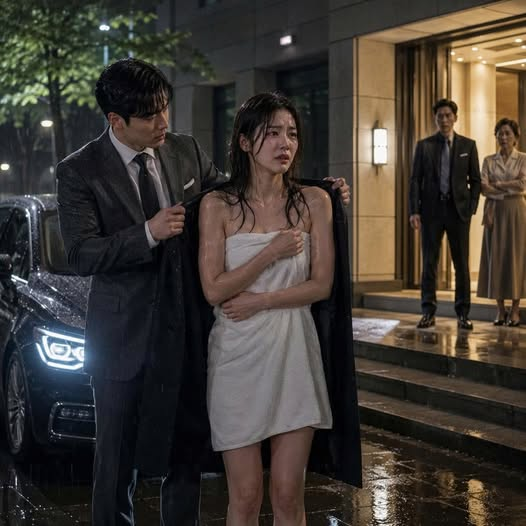
The rain slid from his hair onto the collar of his shirt.
“Sora.”
His voice became quieter.
“Who did this?”
I looked up at the apartment.
Tae-jun was still standing behind the glass.
Even from the street, I could see the confidence disappearing from his face.
“My husband.”
Min-jae followed my gaze.
Then he saw Tae-jun.
Something in his expression changed.
He did not shout.
That was what made Min-jae frightening.
When he was truly angry, his voice became softer.
“Get in the car.”
I shook my head.
“My clothes are upstairs.”
“I’ll have someone collect them.”
“No.”
I tightened his coat around me.
“I want to go back myself.”
Min-jae looked at my face.
“Are you sure?”
“Yes.”
For six years, everyone had decided what was best for me.
Tae-jun.
His mother.
His relatives.
Even people who meant well.
Not tonight.
Min-jae nodded once.
“Then I’m going with you.”
The elevator ride was silent.
Two security guards from Min-jae’s car came with us but remained several steps behind.
When the apartment door opened, Tae-jun was standing in the living room.
His mother was beside him.
The moment she saw my brother, her expression changed.
“Director Kang?”
Min-jae didn’t acknowledge her.
Tae-jun tried to smile.
“Brother-in-law. This is a family misunderstanding.”
Min-jae looked at him.
“Don’t call me that.”
The smile disappeared.
I walked past them toward the bedroom.
Mi-sook stepped forward.
“Sora, you’re really bringing outsiders into your marital home?”
I stopped.
Then I turned.
“Outsiders?”
She lifted her chin.
“This is my son’s house.”
For the first time that night, I smiled.
“No.”
Her expression stiffened.
“What?”
“This apartment belongs to me.”
Tae-jun laughed.
“Sora, stop embarrassing yourself.”
I looked at him.
“You’ve lived here for six years and never once checked the deed?”
His face changed slightly.
The apartment had been purchased three months before our wedding.
My father had transferred the money through a family property company.
After we married, Tae-jun began referring to it as our apartment.
Eventually, it became his apartment.
I never corrected him.
At first, because I didn’t care.
Later, because I had become accustomed to letting him feel larger than he really was.
Min-jae took out his phone.
“Attorney Choi.”
He placed the call on speaker.
A man’s voice answered.
“Yes, Director Kang.”
“Who owns the residence at Haneul Tower, unit 4802?”
A few keyboard clicks.
Then:
“Registered owner: Park Sora. Acquired as separate premarital property through Haesung Family Holdings.”
Nobody spoke.
Mi-sook stared at me.
Tae-jun’s face darkened.
“That doesn’t matter. We’re married.”
“It matters tonight.”
I walked into the bedroom.
“I am the one deciding who lives here.”
His mother finally understood.
Her lips tightened.
“So you’re throwing your husband’s mother into the street?”
I looked at the woman who had smiled while her son threw me outside barely dressed.
“No.”
I shook my head.
“You never moved in.”
I changed clothes.
Jeans.
Sweater.
Flat shoes.
Ordinary things.
But when I looked at myself in the mirror, I barely recognized the woman staring back.
Not because my face had changed.
Because something behind it had.
When I returned to the living room, Min-jae was standing by the window.
Tae-jun was arguing quietly with him.
“You can’t interfere with my company because of a marital dispute.”
My steps stopped.
Min-jae turned.
“My company?”
Tae-jun realized his mistake.
“I mean…”
Min-jae smiled faintly.
“Interesting choice of words.”
Tae-jun’s face tightened.
He had spent four years boasting that Taejin BioTech was his company.
His vision.
His risk.
His empire.
What he didn’t know was that when his business nearly collapsed during its second year, the emergency investment had come from Hanseong Capital.
A fund Min-jae controlled.
But even that wasn’t the complete truth.
The original investment money had come from my family trust.
My father had structured it that way because I asked him to.
At the time, I wanted Tae-jun to believe someone invested because they trusted his ability.
I didn’t want him feeling indebted to my family.
Another kindness he eventually mistook for weakness.
Min-jae opened a document on his tablet.
“Hanseong Capital currently holds thirty-eight percent of Taejin BioTech.”
Tae-jun said immediately:
“Thirty-eight isn’t control.”
“Correct.”
Min-jae swiped to the next page.
“But the shareholder agreement gives us board nomination rights and veto authority over major financing, executive compensation, related-party transactions, and changes in control.”
Tae-jun went still.
His mother looked between them.
“What does that mean?”
I answered.
“It means your son is CEO.”
I paused.
“He never owned the kingdom he thought he did.”
Tae-jun turned toward me.
“You knew?”
“Yes.”
“All these years?”
“Yes.”
His voice rose.
“You let me believe—”
I laughed.
“Believe what?”
“That you built everything alone?”
His face reddened.
“I did build it.”
“You worked hard.”
I nodded.
“So did I.”
I reminded him of the first year.
The investor dinners I organized.
The product presentations I rewrote.
The nights I sat beside him reviewing contracts because he couldn’t afford an experienced strategy team.
The introductions my father made.
The clients my brother persuaded to give an unknown company a chance.
I had never asked Tae-jun to thank me publicly.
I only wanted him to remember privately.
He hadn’t.
Instead, once the company became successful, he told me I should be grateful for the life he gave me.
Tae-jun looked at Min-jae.
“You’re going to remove me because Sora and I had an argument?”
Min-jae shook his head.
“No.”
Relief appeared.
Then my brother continued:
“I don’t make board decisions because my sister’s feelings are hurt.”
His gaze became cold.
“But I do investigate a CEO who publicly humiliates a major beneficial investor while apparently believing company resources are his personal property.”
Tae-jun froze.
“Beneficial investor?”
I looked at him.
Another truth.
“The family trust that funded Hanseong’s original position was assigned to me after my father retired.”
His lips parted.
“In practical terms,” Min-jae said, “Sora is the economic beneficiary behind much of the capital that kept your company alive.”
Mi-sook sat down.
For once, she had nothing to say.
Tae-jun looked at me as though I had become a stranger.
“You hid this from me.”
“No.”
“You never told me.”
“You never asked.”
“That is the same thing.”
“No.”
I stepped closer.
“You knew my family had money.”
“You knew my father invested.”
“You knew Min-jae helped secure your first institutional round.”
“But every time I tried to discuss finances, you told me not to interfere because business was a man’s responsibility.”
His face stiffened.
I continued:
“So eventually I stopped explaining things you were too arrogant to ask about.”
His mother suddenly stood.
“This is ridiculous. Tae-jun is still your husband. Whatever belongs to you belongs to him too.”
Attorney Choi’s voice was still coming through the phone.
“Not under the applicable ownership documents.”
Mi-sook’s face changed.
I almost smiled.
She had spent years telling me that everything belonging to her son belonged to the Kang family.
Apparently, that philosophy became less appealing when the valuable things belonged to me.
Then Tae-jun did something unexpected.
He softened.
“Sora.”
The anger disappeared from his voice.
He approached carefully.
“Tonight got out of control.”
I stared at him.
“You hit me.”
His face tightened.
“I lost my temper.”
“You threw me outside.”
“I was angry.”
“In a towel.”
His eyes moved away.
“My mother was provoking both of us.”
Mi-sook turned toward him.
“Tae-jun!”
He ignored her.
“Sora, we can fix this.”
There it was.
Not apology.
Calculation.
Thirty minutes earlier, I was a useless wife with nowhere to go.
Now he knew the apartment was mine.
The investment was tied to me.
The man he feared most had come personally to collect me.
Suddenly, our marriage was worth saving.
I felt nothing.
That frightened me more than anger would have.
“I already called my lawyer from the car.”
His face changed.
“For what?”
“Divorce.”
Mi-sook gasped.
Tae-jun shook his head.
“No.”
I almost laughed.
“You don’t get to refuse.”
“We’ve been married six years.”
“Yes.”
“You can’t destroy everything in one night.”
I looked directly at him.
“You didn’t destroy it in one night.”
The room went quiet.
“You did it every time your mother insulted me and you told me to endure it.”
“Every time you used my family connections, then acted ashamed that I had helped you.”
“Every time you told people you made me.”
I touched my cheek lightly.
“And tonight you simply made the truth impossible to ignore.”
I did not throw Tae-jun into the street that night.
That would have been theatrical.
Attorney Choi arranged temporary access conditions while the separation was formalized.
I moved to my brother’s guest residence for several days.
Tae-jun remained in the apartment until the legal notice requiring him to vacate was properly processed.
Mi-sook never moved in.
That alone nearly caused another family war.
Apparently she had already sold half her furniture.
Not my problem.
The company situation was handled separately.
Exactly as Min-jae promised.
No revenge vote.
No impulsive dismissal.
An independent governance review began.
And Tae-jun made the mistake that finally destroyed his position himself.
Investigators found that he had been charging several personal expenses to the company.
A luxury vehicle used by his mother.
A renovation deposit for a property she planned to occupy.
Private travel labeled as client development.
None of it was enough to bankrupt Taejin BioTech.
But it was enough to prove that the CEO had begun treating the company like an extension of his household.
The board removed him from direct control over expenditures.
Three months later, after another conflict involving undisclosed related-party payments, Tae-jun resigned as CEO.
He remained a shareholder.
He wasn’t left penniless.
He wasn’t destroyed.
He simply lost the throne he had started believing was his by divine right.
That was more fitting.
Our divorce took six months.
Tae-jun fought over the apartment.
He lost.
He argued that years of living there gave him ownership.
The title records disagreed.
He claimed my family’s investment in Taejin BioTech was a marital contribution.
The trust structure disagreed.
He accused me privately of planning everything from the beginning.
That accusation almost made me laugh.
If I had planned everything from the beginning, I would never have given him six years.
Mi-sook called me repeatedly.
At first, she threatened.
Then negotiated.
Then cried.
“Sora, families fight.”
“Yes.”
“Men make mistakes.”
“Yes.”
“You shouldn’t destroy his future over one slap.”
I was silent for several seconds.
Then I said:
“You still think I’m divorcing him because of one slap.”
“What else could it be?”
That told me everything.
I ended the call.
Tae-jun came to see me after the divorce was finalized.
I was back in the Haneul Tower apartment.
Mine again.
I had changed almost nothing.
Only the lock.
He stood outside holding a small box.
“What is that?”
He opened it.
My wedding ring.
I frowned.
“You left it in the bathroom.”
I remembered.
The night he threw me out, I had removed it before showering.
I never put it back on.
He handed it to me.
I didn’t take it.
“You keep it.”
His hand lowered.
For a while, neither of us spoke.
Then he looked through the open doorway.
“I miss this place.”
I knew he didn’t only mean the apartment.
“I know.”
He smiled bitterly.
“Your brother still hates me.”
“Min-jae doesn’t think about you enough to hate you.”
That hurt more.
I could see it.
Then Tae-jun asked:
“Did you ever love me?”
I stared at him.
“Very much.”
His eyes reddened.
“Then how did you leave so easily?”
I almost laughed.
“Easily?”
He said nothing.
I stepped outside and closed the door behind me.
“Tae-jun, I left my career for you.”
“I sat through dinners where your mother humiliated me.”
“I let you take credit for introductions I made.”
“I protected your pride from knowing how much of your early success came through my family.”
I shook my head.
“I didn’t leave easily.”
“I stayed too long.”
His shoulders dropped.
Then he whispered:
“I thought you needed me.”
“I did.”
That surprised him.
“For a long time, I thought I did.”
I looked at him calmly.
“But the night you threw me outside, I discovered something.”
“What?”
“The first person who came for me wasn’t my husband.”
His face tightened.
“It was my brother.”
I continued:
“And the first person who made me homeless…”
I glanced at the apartment.
“…was a man living in my house.”
Tae-jun closed his eyes.
There was nothing left to argue.
A year later, I returned to work.
Not at Taejin BioTech.
I joined Hanseong Capital as an investment director.
Min-jae offered me a senior title immediately.
I refused.
“I’ll earn it.”
He laughed.
“You already own more than half the fund’s economic interest.”
“That isn’t the same thing.”
So I started lower.
Reviewed companies.
Built models.
Sat in meetings.
Learned the parts of finance I had once avoided because Tae-jun said business was stressful enough for one spouse.
Three years later, I became managing director.
Not because I was someone’s sister.
Because the investment committee voted unanimously.
That mattered to me.
I encountered Tae-jun once at a startup conference.
He was advising a smaller biotech company.
No entourage.
No mother beside him.
No assistants following him.
He looked healthier.
Less arrogant.
When he saw me, he smiled.
“Sora.”
“Tae-jun.”
“I heard about your promotion.”
“Thank you.”
He hesitated.
Then:
“I finally understand why you never argued about the apartment.”
I raised an eyebrow.
“Why?”
“Because you didn’t need to prove ownership.”
That was unexpectedly insightful.
I smiled slightly.
“Maybe you’ve changed.”
“Too late.”
“Yes.”
He nodded.
“I know.”
Then he looked toward the conference hall.
“My mother lives in Busan now.”
I said nothing.
“She still blames you.”
“I assumed.”
“I don’t.”
That surprised me.
Tae-jun looked at me.
“I blamed you for months.”
“For the company.”
“The apartment.”
“Everything.”
He exhaled.
“Then I realized all you did was stop protecting me from information I should have known.”
I held his gaze.
That was exactly right.
The company had not vanished because I left.
The apartment had not suddenly become mine because I divorced him.
The investment had not changed ownership overnight.
The truth had always existed.
I simply stopped hiding how much of his comfortable life depended on the woman he called useless.
“Take care, Tae-jun.”
“You too.”
We walked in opposite directions.
For years, people repeated the story incorrectly.
They said Kang Tae-jun threw his wife into the street…
and her powerful brother arrived to destroy him.
That made a good headline.
But it wasn’t what happened.
Min-jae did not save me.
He gave me his coat.
He stood beside me.
He reminded Tae-jun that I had people who loved me.
But the decisions afterward were mine.
I filed for divorce.
I reclaimed my home.
I authorized the financial review.
I returned to work.
I rebuilt the part of myself I had abandoned while trying to keep a marriage alive.
The black sedan wasn’t the moment my life changed.
The moment came a few minutes earlier.
Standing barefoot in the rain, with a locked door behind me, I finally understood something I should have known for years.
Kang Tae-jun had thrown me out because he believed everything belonged to him.
The apartment.
The company.
My loyalty.
Even my dignity.
He was wrong about all four.
And when Min-jae stepped from that car and asked who had done this to me, I finally answered the question I had avoided for six years.
Not just:
“My husband.”
But:
“A man who will not be my husband much longer.”
