The first time my mother-in-law called my unborn son “hers,” everyone laughed.
They thought it was a joke.
I did too.
I was seven months pregnant then, sitting at the long dining table in the Whitmore family home with one hand resting on my belly and the other gripping a glass of water so tightly my fingers had gone numb. The house smelled like roasted chicken, lemon polish, and old money. Crystal chandeliers glittered overhead. Family portraits stared down from the walls like silent judges.
Across from me, my mother-in-law, Patricia Whitmore, smiled over her wineglass and said, “When my grandson arrives, I’ll finally have my baby back.”
The table chuckled.
My husband, Daniel, gave an uncomfortable laugh and squeezed my knee under the table.
I smiled because I didn’t want to cause a scene.
But my baby kicked hard, as if he had heard her.
Patricia noticed my hand move over my stomach.
Her eyes softened in a way that looked almost tender—until she said, “He already knows Grandma.”
Not “his grandma.”
Just Grandma.
Like a title.
Like ownership.
That night, while Daniel drove us home, rain sliding down the windshield in silver lines, I asked, “Did your mom’s comment feel strange to you?”
He kept his eyes on the road.
“She’s excited, Claire.”
“She said she’ll have her baby back.”
“She lost a child. You know that.”
I did know.
Daniel had told me early in our marriage that Patricia’s first baby, a little boy named Samuel, died three days after birth. She never fully recovered. The family never spoke of him. There were no pictures in the house, no tiny shoes preserved in glass, no memorial frame on a mantel. Just silence. A sealed room in everyone’s memory.
And because I knew that, I swallowed my discomfort.
I told myself grief made people say strange things.
I told myself a lot of things.
By eight months, Patricia had stopped pretending.
She arrived at our house one Tuesday morning with three delivery men and a truck full of furniture.
I was in the kitchen wearing Daniel’s oversized sweatshirt, trying to butter toast while my swollen feet throbbed against the tile, when the doorbell rang.
When I opened it, Patricia swept past me like she owned the place.
“Careful with that crib!” she called behind her. “It’s Italian.”
I blinked. “What crib?”
She turned with a delighted smile. “For the nursery.”
“We already have a nursery.”
“Oh, sweetheart.” She touched my cheek with two cold fingers. “Not that little room you painted yellow. I mean the proper nursery.”
The men carried in white furniture with gold trim, a rocking chair upholstered in cream velvet, boxes of tiny clothes, silver rattles, imported blankets. Patricia walked through my house giving instructions while I stood there barefoot and breathless.
“Where is this going?” one mover asked.
Patricia pointed upstairs.
“To my bedroom.”
My heart gave one hard, painful thud.
“Your bedroom?”
“At my house, of course,” she said. “This is just temporary storage until Daniel brings the baby home.”
I stared at her. “Daniel isn’t bringing my baby to your house.”
Her smile froze.
For one second, I saw something raw beneath her polished face. Not embarrassment. Not confusion.
Anger.
Then it vanished.
“We’ll talk when you’re less hormonal,” she said.
That became her favorite word.
Hormonal.
Whenever I objected, I was hormonal.
When she told relatives she would “handle the night feedings permanently,” I was hormonal.
When she corrected strangers by saying, “Our baby is due any day now,” I was hormonal.
When I found a monogrammed blanket embroidered with the initials “S.W.” instead of the name Daniel and I had chosen, I was hysterical.
Our son’s name was going to be Noah Daniel Whitmore.
Patricia said she preferred Samuel.
Daniel told me to be patient.
“She’s not trying to hurt you,” he said one night as I sat on the nursery floor folding tiny blue onesies with shaking hands.
“She told your aunt that I’m too fragile to raise him.”
“She worries.”
“She told the pediatrician’s office she was the primary caregiver.”
That made him pause.
I looked up at him. “You didn’t know?”
Daniel rubbed his face. He looked exhausted. He had been working long hours at his father’s investment firm, coming home late with his tie loosened and guilt in his eyes.
“I’ll talk to her,” he said.
“You always say that.”
“I will this time.”
But he didn’t.
Or if he did, Patricia didn’t care.
At thirty-eight weeks pregnant, I woke up one night to find her standing in our nursery.
The house was dark except for the moonlight spilling through the curtains. I had gone to get water because heartburn had lit my chest on fire. Passing the nursery, I saw a shadow moving inside.
For one horrifying second, I thought someone had broken in.
Then I saw Patricia.
She was standing over the crib, both hands gripping the rail, whispering.
I stepped into the doorway. “What are you doing?”
She turned slowly.
She wasn’t startled.
That was the worst part.
She looked like she had expected me.
“I couldn’t sleep,” she said.
“It’s two in the morning.”
“I wanted to see where he’ll start.”
“Start what?”
Her eyes moved around the little yellow room, over the stuffed elephant Daniel had bought, over the framed print I had chosen, over the mobile with clouds and stars.
“This room won’t be enough,” she said softly. “You don’t understand what a child needs.”
A coldness moved through me.
“And you do?”
Her face changed again. The grief came first, then the rage.
“I was a mother before you knew what motherhood meant.”
I held my stomach. “Then you should know why I won’t let anyone take my child.”
For a moment, she only stared.
Then she walked toward me until we were inches apart.
“You’re young,” she whispered. “You’ll have others.”
My breath stopped.
The baby kicked.
Patricia looked down at my belly, and her expression softened like she had never spoken at all.
“There he is,” she murmured.
I backed away.
The next morning, I told Daniel everything.
For the first time, he didn’t defend her.
He sat on the edge of our bed, face pale, hands clasped between his knees.
“She said you’ll have others?” he asked.
“Yes.”
He closed his eyes.
“Daniel.”
“I’ll fix it.”
“How?”
He stood up too quickly. “I said I’ll fix it.”
But the tremor in his voice frightened me more than Patricia’s anger.
That afternoon, he left work early and went to his mother’s house.
He came back three hours later with a split lip.
I was sitting on the couch when he walked in.
I struggled to stand, but he rushed over and knelt in front of me.
“Don’t,” he said. “I’m fine.”
“What happened?”
“My father.”
“Your father hit you?”
Daniel looked away.
That was answer enough.
Arthur Whitmore had always been quiet in a terrifying way. He didn’t shout like Patricia. He didn’t cry. He didn’t manipulate with trembling hands and wounded eyes. He simply watched, signed checks, and made problems disappear.
“What did you say to them?” I asked.
“I told them to leave us alone.”
“And?”
Daniel’s jaw tightened.
“And my mother said we were betraying Samuel.”
The name sat between us like a ghost.
Then Daniel whispered, “She had papers.”
My body went still. “What papers?”
“I don’t know. She put them away when I walked in. There was a file with your name on it.”
“My name?”
“And Noah’s.”
Noah wasn’t even born yet.
For the first time, real fear took root inside me.
Not discomfort. Not anger.
Fear.
The kind that makes every sound in the house suspicious. Every passing car a threat. Every unanswered question a blade.
I called my older sister, Mara, that night.
Mara had practically raised me after our parents died. She was ten years older, sharp-tongued, fiercely protective, and a family attorney in Denver. We hadn’t always been close after my marriage because Patricia had a way of making me feel guilty for needing anyone but Daniel’s family.
But when Mara answered and heard my voice, she didn’t waste time.
“Tell me everything.”
I did.
She listened without interrupting.
When I finished, she said, “Do not sign anything.”
“I haven’t.”
“Do not leave the baby alone with her.”
“I won’t.”
“Do not go to any meeting at their house without witnesses.”
My throat tightened. “There’s a meeting tomorrow.”
“What meeting?”
“Patricia called it. She said the family needs to ‘resolve expectations’ before delivery.”
Mara went silent.
Then she asked, “Did she use those exact words?”
“Yes.”
“Claire, listen to me carefully. That’s not a family meeting. That’s pressure.”
“I know.”
“No. You don’t. People like her don’t gather witnesses unless they plan to rewrite the story later.”
I looked toward the hallway, where Daniel stood quietly outside the nursery, staring into the room as if guarding it from invisible hands.
“What should I do?” I whispered.
“Go if you must. Record if it’s legal in your state.”
“It is.”
“Good. And Claire?”
“Yes?”
“If anything feels wrong, leave.”
I almost laughed.
At nine months pregnant, leaving anywhere quickly felt impossible.
The next evening, Daniel drove me to the Whitmore house.
The sky was bruised purple, clouds hanging low over the trees. My back ached. My ankles were swollen. Noah rolled heavily inside me, restless and alive.
“Are you sure?” Daniel asked before we got out of the car.
“No,” I said. “But I’m done being afraid in silence.”
He reached for my hand.
“I should have stopped this sooner.”
“Yes,” I said.
He flinched.
Then I squeezed his fingers.
“But you can start now.”
Inside, the house was full.
Patricia had invited everyone.
Aunts. Uncles. Cousins. Daniel’s father. Even their pastor, Reverend Mills, sat near the fireplace looking deeply uncomfortable.
Patricia stood at the center of the living room in a navy dress, pearls at her throat, hair pinned perfectly. She looked like a woman prepared for a portrait.
Or a verdict.
“Claire,” she said brightly. “You look tired.”
“I’m pregnant.”
A few people shifted.
Daniel kept one hand at my back as I lowered myself into an armchair. I placed my phone face down on the cushion beside me, recording.
Patricia noticed.
Her eyes flickered.
Then she smiled wider.
“We’re all here because this family has suffered enough confusion,” she began.
Daniel stiffened.
Patricia turned to the room.
“As you all know, Claire is due any day. A baby is a blessing, but also a responsibility. A responsibility that requires stability, experience, and sacrifice.”
My skin prickled.
She continued, voice trembling now.
“I lost my Samuel because I was too young, too unsupported, too alone. I will not watch another baby suffer because pride gets in the way.”
“Mother,” Daniel warned.
Patricia lifted a hand.
“No. This must be said.”
She turned to me.
“Claire, you are emotional. You are overwhelmed. You have no parents, no experience, and no understanding of what the Whitmore name requires.”
Mara’s warning echoed in my head.
They plan to rewrite the story.
Patricia took a document from the side table.
My pulse slammed.
“I have prepared an agreement,” she said.
The room went silent.
Daniel stepped forward. “What agreement?”
Patricia ignored him.
“It states that after birth, Noah Samuel Whitmore will reside primarily with Arthur and me for the first five years of his life. Claire and Daniel may visit regularly until Claire is emotionally ready to assume a more active role.”
For a moment, sound disappeared.
I saw mouths open.
Saw Daniel’s face go white.
Saw Reverend Mills lower his eyes.
Then I heard myself laugh.
It was small, stunned, and sharp.
“No,” I said.
Patricia blinked. “Excuse me?”
“No.”
Her face hardened. “You haven’t read it.”
“I don’t need to.”
“You are making a selfish decision.”
“No,” I said again, louder. “I am making a mother’s decision.”
Patricia’s hand began to shake.
“This child is Samuel returned to us.”
The room gasped.
Daniel whispered, “Mom, stop.”
But she couldn’t.
Or wouldn’t.
“He came back,” she said, tears spilling now. “God gave him back to me. I saw it in the ultrasound. The same profile. The same hands. He belongs where he was always meant to be.”
I pushed myself upright, every movement painful.
“My son is not your dead child.”
The words cracked through the room.
Patricia’s face twisted.
For one second, I thought she might collapse.
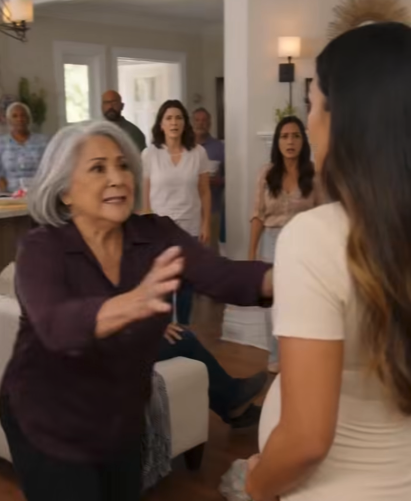
Instead, she lunged.
Daniel shouted.
I stumbled backward, one hand flying to my belly. Pain shot through my lower back. Chairs scraped. Someone screamed. Patricia’s fingers caught my sleeve, pulling hard enough to tear the fabric.
“Give him to me!” she cried. “You don’t deserve him!”
Daniel grabbed her arm.
Arthur stood but did not move fast enough.
I lost my balance.
The room tilted.
My vision blurred.
Then the front door burst open.
Cold air swept through the house.
A woman stepped inside carrying a leather folder and a stack of official documents.
She wore a gray coat, dark hair pulled back, eyes steady behind rimless glasses.
“Patricia Whitmore,” she said, “take your hands off my sister.”
My heart stopped.
“Mara,” I breathed.
Patricia released me as if burned.
All the color drained from her face.
Not because Mara was my sister.
Because Patricia recognized her.
And that was the first crack in the entire lie.
Daniel held me against him, trembling.
Mara walked into the living room like a storm wearing heels.
“I apologize for interrupting,” she said, though nothing in her voice sounded sorry. “But given the circumstances, I think everyone here should see what Mrs. Whitmore has been arranging.”
Patricia whispered, “You.”
Arthur’s head snapped toward his wife. “You know her?”
Mara opened the folder.
“Yes,” Mara said. “She knows me. We spoke six weeks ago.”
I stared at Patricia.
Six weeks ago?
Mara looked at me, and for the first time, pain crossed her face.
“I didn’t know it was you at first, Claire. She contacted my office through an intermediary. No names. Just a wealthy grandmother seeking advice on obtaining custody of an unborn child.”
My knees nearly buckled.
Daniel tightened his arm around me.
Mara continued, “When details began matching your situation, I investigated further.”
Patricia found her voice. “This is confidential.”
“No,” Mara said. “Fraud is not confidential.”
She placed the first document on the coffee table.
A petition draft.
My name was on it.
Claire Whitmore.
Under allegations, I saw words that made my stomach turn.
Emotionally unstable.
Neglect risk.
No family support.
Possible prenatal depression.
Daniel grabbed the paper, eyes scanning wildly.
“This is insane,” he said.
Mara placed another document down.
A private investigator’s report.
Photos of me leaving doctor appointments.
Photos of me crying in my car.
Photos of me carrying groceries, one hand pressed to my back.
“She had you followed,” Mara said quietly.
Patricia’s relatives erupted.
Arthur’s face darkened. “Patricia.”
But Mara wasn’t done.
She placed the final document down.
A hospital authorization form.
My signature was at the bottom.
Except I had never signed it.
My blood went cold.
“What is that?” I whispered.
Mara’s voice softened. “A forged medical release naming Patricia as authorized to receive the baby if you were deemed incapacitated after delivery.”
Daniel looked like he might be sick.
Patricia shook her head. “I was protecting him.”
“You forged my wife’s signature,” Daniel said.
“I was protecting Samuel!”
“Noah!” I screamed.
The name tore out of me with months of swallowed fear behind it.
The room fell silent.
I pressed both hands to my belly, tears burning my eyes.
“His name is Noah. He is my son. He is alive. He is not a replacement. He is not a second chance for your grief. He is not yours.”
Patricia stared at me, breathing hard.
Then she said the words that sealed everything.
“You took him from me before he was even born.”
No one moved.
Even Arthur looked afraid of her.
Mara turned to Reverend Mills. “You heard that?”
He nodded slowly.
Mara looked at the family. “All of you heard it?”
One by one, people nodded.
Patricia seemed to realize too late that the witnesses she had gathered to trap me had become witnesses against her.
Then my water broke.
At first, I thought I had imagined it.
A warm rush.
A sharp cramp.
Daniel looked down, then back at my face.
“Claire?”
I grabbed his shirt.
“The baby.”
Chaos exploded again, but this time it moved around me like a protective wall.
Daniel lifted me carefully. Mara called 911. An aunt grabbed towels. Reverend Mills prayed under his breath. Patricia stood frozen in the center of the room, staring at my stomach like heaven had just closed a door in her face.
When paramedics arrived, Patricia tried to follow.
Mara stepped in front of her.
“You are not going anywhere near my sister or that baby.”
Patricia looked past her at Daniel.
“Danny,” she pleaded.
Daniel’s eyes were red.
For the first time in his life, he did not soften.
“No,” he said. “You don’t come with us.”
At the hospital, labor swallowed the world.
Pain came in waves so violent they broke time into pieces. Daniel stayed beside me, one hand in mine, the other brushing sweat-damp hair from my forehead. He kept whispering, “I’m here. I’m here. I’m here.”
At some point, I screamed at him that this was his fault.
He cried and said, “I know.”
Mara stood near the door, calm and fierce, speaking to nurses, handing over copies of legal documents, making sure Patricia’s forged authorization was flagged and removed.
Hours passed.
Then, just before dawn, Noah came into the world screaming.
The sound shattered me.
They placed him on my chest, warm and furious and real. His tiny fist pressed against my skin. His face was red, wrinkled, perfect.
Daniel bent over us, sobbing openly.
“He’s here,” he whispered.
I touched Noah’s cheek.
“Hi, baby,” I said. “I kept you.”
For the first time in months, my body relaxed.
Noah opened his eyes.
And Daniel laughed through tears.
“He looks like you.”
I looked down at my son, expecting to feel triumph.
Instead, I felt something quieter.
Peace.
But the twist had not finished unfolding.
Two days later, Arthur Whitmore came to the hospital alone.
Daniel stood immediately when he entered.
“If you’re here to defend her—”
“I’m not,” Arthur said.
He looked older than I had ever seen him. His expensive suit hung on him like borrowed clothing. In his hands was a small wooden box.
“I owe you both the truth.”
Mara, who had been sitting by the window reviewing paperwork, closed her laptop.
Arthur placed the box on the table.
“Patricia did lose a baby named Samuel,” he said. “But not the way Daniel was told.”
Daniel went still.
Arthur opened the box.
Inside were hospital bracelets, old letters, and a photograph of a newborn wrapped in a blue blanket.
My throat tightened.
Arthur’s voice cracked.
“Samuel didn’t die after three days.”
Daniel whispered, “What?”
“He was born healthy. Patricia was nineteen. We weren’t married yet. My parents hated her. They said she was unsuitable, unstable, beneath our family. They forced an adoption.”
The room seemed to shrink.
Daniel sat down slowly.
Arthur continued, “I told Patricia he died because my father told me it was kinder. I was twenty-one and a coward. By the time I realized what we had done, it was too late.”
I stared at him, horrified.
“So all these years,” Mara said, “she believed her baby died?”
Arthur nodded.
“And you let her?”
His face crumpled.
“Yes.”
Daniel stood, shaking.
“You lied to her. You lied to me. You let her build her whole life around a grave that didn’t exist.”
“I know.”
“Is Samuel alive?” Daniel asked.
Arthur looked at me.
Then at Mara.
Then he said, “Yes.”
My breath caught.
Mara’s eyes narrowed. “How do you know?”
Arthur reached into his coat and removed another envelope.
“Because Patricia found him four months ago.”
Silence.
Arthur’s hand trembled as he held out a photograph.
Mara took it first.
Her face changed.
She looked at me, then at Daniel.
“What?” I asked.
She handed me the photo.
It showed a man in his early forties standing outside a courthouse, dark-haired, serious-eyed, familiar in a way I couldn’t place at first.
Then I realized.
He had Mara’s eyes.
I looked up slowly.
“Mara?”
She was pale.
Arthur whispered, “His adoptive name is Marcus Hale.”
Mara gripped the back of the chair.
“That’s my father.”
The room vanished beneath me.
Mara’s father.
My father too.
The man who had raised us. The man we had buried three years ago. The quiet man who made pancakes on Sundays, who taught me to ride a bike, who cried at my wedding when Patricia watched from the front pew with unreadable eyes.
My father had been Patricia’s Samuel.
Daniel’s half-brother.
Which meant Patricia had found out that the woman carrying her grandson was also the daughter of the baby she had lost.
No.
Not lost.
Stolen.
Arthur covered his face.
“When Patricia discovered it, something broke. She said God had returned Samuel’s blood to her through Claire’s child. She became convinced Noah was meant to heal everything.”
I looked at my sleeping baby.
Suddenly all the strange comments made terrible sense.
You’ll have others.
My baby back.
Samuel returned.
Mara sank into a chair, tears in her eyes.
“She knew Claire was Samuel’s daughter?”
“Yes,” Arthur said.
Daniel looked shattered. “Why didn’t she tell us?”
“Because then she would have to admit Samuel had lived a full life without her. That he had daughters. That he had loved another family. That she was not the center of his story.”
Mara wiped her face and stood.
“My father was a good man,” she said. “And if Patricia had come to us with the truth, we might have grieved with her.”
Her voice hardened.
“But she tried to steal his grandson.”
Arthur nodded.
“I will cooperate with whatever legal action you take.”
And he did.
The following weeks were a blur of newborn cries, legal filings, sleepless nights, and revelations.
Mara filed restraining orders against Patricia. The forged hospital form triggered a criminal investigation. The family meeting recording, witness statements, private investigator report, and custody petition draft formed a wall of evidence Patricia could not charm her way through.
But the happy ending did not come from watching Patricia fall.
It came from what rose afterward.
Daniel left his father’s company.
He began therapy.
So did I.
Mara stayed with us for three weeks, claiming it was “for legal reasons,” though I caught her asleep in the rocking chair more than once with Noah curled against her chest.
One morning, as sunlight filled the nursery, Daniel found me looking at an old photograph of my father.
Marcus Hale.
Samuel Whitmore.
Dad.
“He would have loved Noah,” I said.
Daniel sat beside me.
“He would have protected you from all of this.”
“He did,” I said softly.
Daniel looked at me.
I touched the edge of the frame.
“He raised Mara. Mara saved us. That was him.”
Daniel bowed his head.
Months later, Patricia accepted a plea deal and entered long-term psychiatric treatment as part of her sentence. I did not visit her. Maybe one day Noah would know the whole story. Maybe one day he would decide for himself what forgiveness meant.
But not as a baby.
Not as a replacement.
Not as anyone’s second chance.
On Noah’s first birthday, we gathered in our backyard beneath strings of warm lights. Mara brought a ridiculous cake shaped like a whale. Daniel burned the barbecue and blamed the grill. Arthur came quietly, carrying a small gift and a lifetime of regret in his eyes.
He had begun searching for records from my father’s adoption, not to erase the harm, but to restore the truth.
Before we cut the cake, Mara handed me a wrapped frame.
Inside was a photograph I had never seen.
My father at twenty-two, holding baby Mara.
On the back, in his handwriting, were the words:
Family is not who claims you.
Family is who keeps you safe.
I started crying before I could stop myself.
Daniel wrapped an arm around me.
Noah clapped frosting-covered hands, delighted by everyone’s tears.
And for the first time, the past did not feel like a shadow reaching for him.
It felt like a bridge.
Built from truth.
Guarded by love.
And leading my son safely home.
