PART 2 — THE RECORDING THAT FROZE THE ROOM
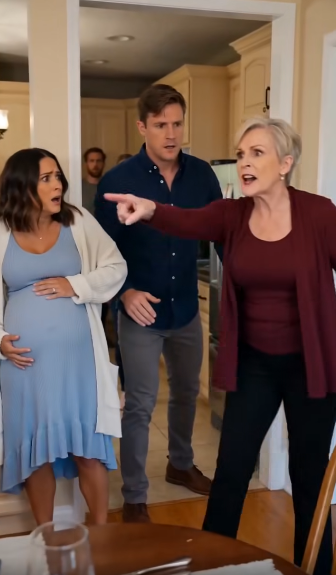
The sound of my mother-in-law’s voice filled the dining room like poison poured into clean water.
“That baby is the reason this family is falling apart.”
No one moved.
Not my husband, Daniel, standing halfway between me and his mother.
Not my father-in-law, Arthur, whose face had gone pale with shame.
Not Daniel’s sister, Elise, who had been gripping her fork so tightly her knuckles were white.
And not Vivian—my mother-in-law—who suddenly looked less like a woman who had spoken “the truth” and more like someone watching a locked door swing open.
The recording continued.
Her voice was sharp, bitter, unmistakable.
“You think carrying my grandchild makes you important? You are not family. You are a mistake Daniel made because he was lonely.”
My hand trembled around the phone.
Daniel whispered, “Mara…”
I looked at him. My husband. The man who had promised to protect me. The man who had watched me hit a cabinet while pregnant and still told me to apologize first.
“Don’t,” I said.
My voice was quiet, but it cut through the room.
The recording played on.
Vivian’s voice again: “One day he’ll wake up and realize he belongs with his real family. Not with you. Not with that baby.”
A chair scraped the floor.
Arthur stood slowly, his face hardening into something I had never seen before.
“Vivian,” he said, “what have you done?”
She lifted her chin, but her eyes flickered.
“I said what everyone has been thinking.”
“No,” Elise said suddenly. “You said what only you have been thinking.”
Vivian spun toward her daughter. “Stay out of this.”
Elise laughed once, but there was no humor in it. “I stayed out of it for years. That’s the problem.”
Daniel finally reached for my arm. “Mara, let me help you sit down.”
I pulled away.
That tiny movement broke something between us.
His hand hovered in the air, useless.
“Help me?” I repeated. “You told me to apologize.”
His face crumpled. “I panicked.”
“No,” I said, swallowing against the ache in my throat. “You chose.”
The room went silent again.
My stomach tightened—not dangerously, just enough to remind me that I wasn’t alone inside my own body. Our daughter moved faintly, a flutter beneath my palm.
Arthur stepped toward me. “Mara, do you need a doctor?”
“I need to leave,” I said.
Daniel immediately grabbed his keys. “I’ll take you.”
I looked at him for a long second.
Then I said, “No. You won’t.”
His face turned as white as the tablecloth.
Elise was already moving. “I’ll drive her.”
Vivian scoffed. “Oh, perfect. Now everyone is dramatic.”
Arthur slammed his hand on the table so hard every glass jumped.
“Enough!”
Vivian actually flinched.
Arthur’s voice dropped low. “You shoved a pregnant woman. You insulted your grandchild. You humiliated your son and terrified this family. And you still think you are the victim?”
Vivian’s mouth opened, then closed.
For the first time that night, she had no words.
Elise helped me toward the hallway. My knees felt weak, and every step away from that dining room felt like stepping out of a burning house.
At the door, Daniel called my name.
I stopped, but I didn’t turn around.
“I love you,” he said, his voice cracking.
I closed my eyes.
The worst part was that I believed him.
But love without courage had nearly left me broken on the floor.
So I opened the door and walked out.
PART 3 — THE NIGHT I STOPPED MAKING EXCUSES
Elise drove in silence for the first five minutes.
The city lights blurred beyond the windshield, gold and white streaks against the dark glass. I sat in the passenger seat with both hands resting protectively over my belly.
Finally, Elise said, “She’s been like this forever.”
I stared ahead. “Then why didn’t anyone warn me?”
Her face twisted with guilt.
“Because Daniel always believed she would change.”
A bitter laugh escaped me. “He believed it enough to let her hurt me.”
Elise tightened her grip on the steering wheel. “When we were kids, she didn’t yell at him. Not like she yelled at everyone else. She worshipped him. Made him feel responsible for her happiness. If Dad disagreed with her, she cried to Daniel. If I fought with her, she told Daniel I was cruel. He grew up thinking peace meant giving her whatever she wanted.”
“That explains him,” I said softly. “It doesn’t excuse him.”
“No,” Elise said. “It doesn’t.”
We went to the hospital, though I kept insisting I was fine. Elise insisted harder.
The nurse checked me. A doctor examined me. The baby’s heartbeat filled the small room, steady and strong.
That sound nearly brought me to my knees.
Not from fear this time.
From relief.
My daughter was still safe.
I cried quietly while the monitor pulsed beside me.
Elise sat near the bed. “Does Daniel know you’re here?”
“No.”
“Do you want him to?”
I looked down at my wedding ring.
There had been a time when Daniel was the first person I wanted in every crisis. When my father died two years earlier, Daniel had held me all night on the kitchen floor. When I found out I was pregnant, he cried before I did. When we heard the heartbeat for the first time, he whispered, “That’s our whole world.”
But tonight, when his whole world had been shoved backward, he had looked at me and asked me to make peace with the person who hurt me.
“No,” I said. “Not yet.”
My phone buzzed again and again.
Daniel.
Then Arthur.
Then Daniel again.
Then a message.
Please tell me where you are. I’m sorry. I’m so sorry.
I stared at the words until they blurred.
Elise gently took my hand. “You don’t have to decide anything tonight.”
But I had already decided one thing.
I would not raise my daughter in a family where cruelty was called honesty and silence was called peace.
At midnight, Elise drove me to a small hotel near the hospital. She offered to stay, but I needed to breathe without anyone’s guilt filling the room.
The moment I was alone, I locked the door, sat on the bed, and listened to the recording again.
Not because I wanted to suffer.
Because I needed proof.
Proof that I was not dramatic. Proof that I was not too sensitive. Proof that it had happened exactly the way my shaking body remembered.
Then the recording reached a part I hadn’t noticed before.
Right before Vivian shoved me, when everyone had been arguing, her voice dropped low.
But the phone still caught it.
“After everything I did to keep this family together, you think I’ll let her take him too?”
I froze.
Too?
My pulse slowed.
Then Elise’s words came back.
“She’s been like this forever.”
I replayed that sentence ten times.
You think I’ll let her take him too?
Who had taken someone before me?
PART 4 — THE SECRET IN ARTHUR’S VOICE
The next morning, Arthur came to the hotel.
He did not come with Vivian. He did not come with excuses. He came holding a paper bag of breakfast and wearing the exhausted face of a man who had finally stopped pretending his house was not collapsing.
“Mara,” he said when I opened the door, “I’m sorry.”
I stepped aside silently.
He placed the bag on the small table and stood with his hands folded in front of him.
“I failed you last night,” he said. “Not because I didn’t shout. Not because I didn’t demand an apology. I failed you long before that. I knew Vivian was cruel to you.”
I swallowed hard.
“And you let it continue.”
His eyes lowered. “Yes.”
That honesty hurt more than a lie.
I sat on the edge of the bed. “There’s something on the recording. She said, ‘I won’t let her take him too.’ What did she mean?”
Arthur closed his eyes.
For several seconds, he looked older than I had ever seen him.
Then he sat down across from me.
“Before Daniel was born,” he said quietly, “Vivian had a younger sister. Clara.”
I had heard that name once. Only once. At a Christmas dinner, when Vivian snapped at Elise for mentioning an old ornament that had belonged to “Aunt Clara.”
“What happened to her?” I asked.
“She left.”
“Left where?”
Arthur rubbed his face. “She fell in love with someone Vivian hated. A kind man. A teacher. Vivian believed Clara was abandoning the family. Their mother was ill then, and Vivian felt Clara owed everything to them.”
His voice became rough.
“Vivian said terrible things. She turned relatives against Clara. She made her feel selfish for wanting a life of her own.”
I felt cold.
Arthur looked at me, and his eyes were wet.
“Clara left anyway. She wrote letters for a while. Vivian hid them.”
My breath caught. “From who?”
“From their mother.”
The room felt suddenly too small.
Arthur continued, “Their mother died believing Clara had forgotten her. Vivian told herself she had protected her mother from disappointment. But after the funeral, Clara came back and found out.”
“What happened?”
“They fought. Clara told Vivian she destroyed the last chance they had to say goodbye.”
Arthur’s voice broke.
“Clara walked out, and we never saw her again.”
The silence afterward felt enormous.
I looked down at my belly.
“So when Daniel married me…”
“She saw Clara,” Arthur said. “She saw someone taking a person she loved into a life she couldn’t control.”
“That is not love.”
“No,” Arthur whispered. “It is fear wearing love’s clothing.”
I pressed my hands together to stop them from shaking.
“Does Daniel know?”
“Not all of it.”
“Why?”
“Because Vivian begged me not to tell him. She said it would destroy him.”
I laughed softly, painfully. “Funny how secrets always protect the person who caused the damage.”
Arthur flinched, but he nodded.
Then he reached into his coat pocket and pulled out an old envelope.
“I found this last night after you left. I couldn’t sleep. I went into the attic.”
He placed it on the table.
The envelope was yellowed with age.
On the front was a name written in faded blue ink.
Daniel.
My chest tightened.
Arthur said, “It’s from Clara.”
PART 5 — THE LETTER MEANT FOR MY HUSBAND
Daniel arrived thirty minutes later.
I had agreed to see him only because Arthur stayed. Not as a guard, exactly, but as a witness.
Daniel looked destroyed.
His hair was messy. His eyes were red. His shirt was the same one from dinner, wrinkled like he had spent the night sitting in regret.
“Mara,” he whispered.
I didn’t go to him.
His eyes dropped to my stomach. “Is she okay?”
“She’s okay.”
He exhaled shakily, and for one second I saw the man I married.
Then I remembered the cabinet against my back.
I remembered his whisper.
Maybe you should say sorry first.
Daniel stepped forward, but stopped when I didn’t move.
“I don’t know how to fix what I did,” he said.
“You start by saying what you did.”
He nodded, tears filling his eyes.
“My mother hurt you. I saw it. And instead of protecting you, I tried to make you smaller so the room would calm down.”
The words landed between us.
True words.
Painful words.
Necessary words.
“I was wrong,” he said. “I was a coward.”
Arthur looked away.
I said, “Your father brought something.”
Daniel glanced at Arthur.
Arthur held out the envelope. “This was written to you years ago.”
Daniel stared at his name on it. “What is this?”
“A letter from Clara.”
Daniel’s eyes widened. “Aunt Clara?”
Arthur nodded. “Your mother kept it.”
Daniel opened it with trembling hands.
The paper inside was thin and creased. He unfolded it carefully, as though touching something alive.
He read silently.
At first, his expression was confused. Then stunned. Then devastated.
His hand covered his mouth.
“What does it say?” I asked softly.
He tried to speak, but couldn’t.
Arthur took the letter when Daniel lowered it and read aloud, his voice unsteady.
“Dear Daniel, you were only five when I last saw you. You gave me a drawing of a blue bird and told me birds know how to go home. I kept it. I wanted you to know I never left because I stopped loving this family. I left because love should not feel like a cage.”
Daniel squeezed his eyes shut.
Arthur continued.
“I hope you grow into a man who knows the difference between loyalty and fear. I hope no one teaches you that keeping peace means letting someone else disappear.”
The room blurred around me.
Daniel whispered, “She knew.”
Arthur nodded. “She knew what your mother was doing to all of us.”
Daniel read the last lines himself, voice breaking.
“Someday, if you love someone, protect the home you build with them. Do not let anyone convince you that love must ask permission.”
He lowered the letter.
For a long moment, no one spoke.
Then Daniel said, “I became exactly what she warned me about.”
I wanted to comfort him.
That instinct rose in me automatically, trained by years of loving him.
But I stayed still.
Because his guilt was not mine to carry.
Daniel looked at me. “I’m going to talk to my mother.”
I said, “No.”
He blinked.
“You’re going to talk to yourself first. Then a therapist. Then me. Your mother is not the center of this marriage anymore.”
His lips parted.
Then he nodded.
“You’re right.”
I removed my wedding ring.
Daniel looked like I had struck him.
I placed it on the table, not with anger, but with grief.
“I’m not ending our marriage today,” I said. “But I am ending the version where I beg you to choose me.”
A tear slipped down his cheek.
“You will not come home with me,” I continued. “You will not ask me to forgive her. You will not tell me she had a hard life. You will not bring our daughter near her unless I decide it is safe.”
“I understand.”
I held his gaze.
“No, Daniel. You don’t. But you’re going to learn.”
PART 6 — WHEN THE TRUTH ENTERED VIVIAN’S HOUSE
Three weeks passed.
Daniel did everything I asked.
Not perfectly. Not dramatically. Not with grand speeches posted online or flowers sent to my hotel.
He did it quietly.
He started therapy. He stayed with Arthur after Vivian refused to leave their house. He sent me updates after every doctor appointment reminder, but never pressured me to answer. He read books about boundaries. He wrote letters he did not ask me to forgive.
And every evening, he left one voicemail.
Not begging.
Not explaining.
Just telling the truth.
“I should have stood between you and her.”
“I confused obedience with love.”
“I miss you, but missing you is not the same as earning you back.”
“I heard our daughter’s heartbeat in my dream last night. I woke up crying.”
I listened to every message.
I answered none of them.
Then, on a rainy Thursday, Elise called me.
“She found out about the letter,” she said.
I sat up in bed. “Vivian?”
“Yes. Dad told her he was done hiding it.”
“What did she do?”
Elise exhaled. “She denied it. Then she cried. Then she blamed Clara. Then she blamed you.”
Of course.
“But Daniel was there,” Elise added.
My heart thudded.
“And?”
“And he didn’t fold.”
That afternoon, I received a video from Elise.
I hesitated before playing it.
The screen showed Arthur’s living room. Vivian stood near the fireplace, furious and trembling. Daniel stood across from her, holding Clara’s letter.
Vivian said, “That woman has poisoned you against your own mother.”
Daniel’s voice was calm, but his face was pale.
“No. You did that.”
Vivian recoiled.
“I loved you,” she whispered.
Daniel nodded. “I know. But your love came with a leash.”
Her eyes filled. “How can you speak to me like this?”
“Because my wife was shaking on the floor while carrying my child, and I asked her to apologize to you.”
Vivian looked away.
Daniel stepped closer.
“I will regret that for the rest of my life. But I will not repeat it.”
Vivian’s voice hardened. “So you’re choosing her.”
Daniel’s answer came without hesitation.
“I’m choosing the family I made. And I’m choosing the man I should have been.”
I paused the video.
Then I cried.
Not because everything was fixed.
Because for the first time, Daniel had not asked someone else to shrink so his mother could feel taller.
Later that night, he knocked on my hotel door.
When I opened it, he did not step inside.
He stood in the hallway, soaked from the rain, holding nothing.
No flowers.
No gifts.
Just himself.
“I told her she won’t be part of the baby’s life unless you decide otherwise,” he said.
My throat tightened.
“And?”
“She said I was dead to her.”
His voice cracked, but he did not take it back.
“I’m sorry,” I said, because I was.
He nodded. “Me too.”
For a moment, we were only two tired people standing on opposite sides of a doorway, surrounded by the wreckage of old fear.
Then Daniel reached into his pocket.
My wedding ring rested in his palm.
“I’m not asking you to wear it,” he said. “I’m asking permission to keep trying.”
I looked at the ring.
Then at him.
“You can keep trying,” I said.
His eyes filled.
“But I’m not coming home yet.”
“I know.”
“And Vivian doesn’t get an apology.”
A faint, broken smile touched his mouth.
“No,” he said. “She gets consequences.”
PART 7 — THE BABY SHOWER NO ONE EXPECTED
Two months later, Elise threw me a baby shower.
I almost said no.
The thought of sitting in a room full of Daniel’s relatives smiling over cake while pretending nothing happened made my skin crawl.
But Elise promised me it would be different.
And somehow, it was.
The shower was held in Arthur’s garden, beneath strings of warm lights and soft yellow lanterns. There were white roses, tiny sandwiches, lemon cake, and a table covered in little cards where guests could write wishes for the baby.
Vivian was not invited.
That alone made the air feel breathable.
Daniel arrived early and set up chairs. He didn’t hover near me. He didn’t perform husbandly devotion for applause. He simply worked, quietly and steadily, asking Elise where to put things and checking that I had enough shade.
When my aunt hugged him and said, “Take care of my niece,” he answered, “I failed before. I won’t again.”
No excuses.
No defensiveness.
Just truth.
Near sunset, Arthur stood to make a toast.
He held a glass of sparkling cider and looked at me with tears in his eyes.
“To Mara,” he said. “Who deserved protection, honesty, and respect from the beginning.”
My eyes burned.
“And to my granddaughter,” Arthur continued, voice shaking, “who will be born into a family that is finally learning love cannot survive without courage.”
Everyone raised their glasses.
Then Daniel stood.
My heart began to pound.
He looked at me, not the crowd.
“I wrote something,” he said. “Not a speech. A promise.”
The garden went quiet.
Daniel unfolded a piece of paper.
“Mara, I used to think being a good son meant never letting my mother feel abandoned. But I became a bad husband by abandoning you in front of everyone.”
I pressed my hand to my belly.
He continued, “Our daughter will never learn that love means tolerating cruelty. She will never be asked to hug someone who hurts her just because they are family. She will never watch me make you smaller to keep someone else comfortable.”
His voice trembled.
“And if you never trust me the same way again, I will understand. But I will spend my life becoming someone safe for you both.”
By the time he finished, there were tears on nearly every face.
Including mine.
Then something strange happened.
A woman appeared at the garden gate.
She was older, with silver hair pinned neatly behind her ears and a blue scarf around her neck.
Arthur saw her first.
His glass slipped from his hand and landed softly in the grass.
“Clara?” he whispered.
The entire garden turned.
The woman’s eyes filled with tears.
“Yes,” she said. “It’s me.”
Daniel went still.
Elise covered her mouth.
Arthur moved like a man walking through a dream. He reached the gate, opened it, and stood before Clara for one trembling second before pulling her into his arms.
“I’m sorry,” he kept saying. “I’m so sorry.”
Clara held him and cried.
I looked at Daniel.
He looked as stunned as I felt.
Later, we learned Elise had found Clara through an old return address on one of the hidden letters. She had written to her weeks ago, not knowing if Clara would answer.
Clara had answered.
And she had come.
When Clara finally stood before Daniel, she touched his cheek gently.
“You look like the little boy with the blue bird drawing,” she said.
Daniel broke.
He cried in a way I had never seen before—not neatly, not quietly, but like a child whose grief had waited decades to be named.
Clara hugged him.
And while everyone watched that impossible reunion, I felt something inside me shift.
Not forgiveness for Vivian.
Not forgetfulness.
But the sense that maybe broken families did not have to stay broken forever.
Sometimes one hidden letter could become a doorway.
Sometimes one recording could become a rescue.
And sometimes the truth arrived late, wearing a blue scarf.
PART 8 — THE END: THE WOMAN WHO KNOCKED ON MY DOOR
My daughter was born on a bright morning after a night of rain.
We named her Clara Rose.
When Daniel held her for the first time, his hands shook.
“She’s so small,” he whispered.
“She’s loud,” I said, exhausted and smiling as our daughter announced herself to the world with furious little cries.
Daniel laughed through tears.
“She gets that from you.”
I raised an eyebrow.
He quickly added, “In the best way.”
For the first time in months, I laughed without pain behind it.
We did not magically become perfect after Clara Rose was born.
Healing was not a door we walked through once.
It was a road.
Some days were easy. Some days were not. Daniel kept going to therapy. I moved back home after Clara Rose was six weeks old, but only after we changed the locks, made clear boundaries, and agreed that peace in our house would never again come at the cost of my dignity.
Vivian did not meet the baby.
For a while, she sent messages.
Some were angry.
Some were tearful.
Some sounded almost like apologies until they turned into accusations.
Daniel answered only once.
“Mom, accountability is the only path back. Not guilt. Not blame. Not pressure. Accountability.”
She did not respond for three months.
Then, one cold evening in November, there was a knock at our door.
I was feeding Clara Rose in the nursery while Daniel cooked soup in the kitchen. The knock came again, softer this time.
Daniel checked the camera and went still.
“It’s my mother,” he said.
My body tensed.
He looked at me. “She doesn’t come in unless you say so.”
I appreciated that he did not ask what I wanted him to want.
He waited.
I handed him the baby and stood.
“I’ll speak to her outside.”
“Mara—”
“I’ll be okay.”
He nodded, though worry filled his face.
Vivian stood on the porch in a gray coat, thinner than before, her once-perfect hair tucked under a rain-damp hood. She looked older. Not harmless. Just older.
When she saw me, her mouth trembled.
“Mara.”
I crossed my arms. “Why are you here?”
She looked down.
For once, silence seemed difficult for her.
“I went to see Clara,” she said.
That surprised me.
“My sister,” Vivian added unnecessarily. “She agreed to meet me.”
I said nothing.
Vivian swallowed. “I thought she would scream. She didn’t. That was worse.”
Her eyes lifted to mine.
“She told me I spent my life mistaking control for devotion. She told me I didn’t lose people because they left. I lost them because I kept building cages and calling them homes.”
The wind moved softly through the porch trees.
Vivian’s voice cracked.
“I am not here to ask to see the baby.”
I waited.
“I am not here to ask you to forgive me.”
That was the first thing she had said that made me truly listen.
“I came to say I remember pushing you,” she whispered. “I remember your face. I remember Daniel’s face. I remember everyone watching me become exactly who I always insisted I wasn’t.”
Tears slipped down her cheeks.
“I hurt you. I endangered your peace. I said cruel things about your child. There is no excuse.”
My throat tightened, but I kept my voice steady.
“No, there isn’t.”
She nodded.
“I started counseling,” she said. “Arthur moved out for a while. Elise barely speaks to me. Daniel won’t let me skip the truth anymore.”
Good, I thought.
Painful, but good.
Vivian took a folded envelope from her pocket.
“This is for you. Not Daniel. Not the baby. You.”
I didn’t take it immediately.
“What is it?”
“A written apology. No request attached.”
I accepted it carefully.
Vivian stepped back.
“I hope Clara Rose grows up surrounded by people who make her feel free,” she said.
Then she turned to leave.
I don’t know why I spoke.
Maybe because motherhood had softened some parts of me while sharpening others.
Maybe because I wanted to prove to myself that boundaries did not have to be cruel to be strong.
“Vivian.”
She stopped.
I said, “I don’t trust you.”
She nodded, crying silently.
“I know.”
“I don’t know when or whether you’ll meet her.”
“I know.”
“But this…” I lifted the letter. “This is the first right thing you’ve done.”
Her face crumpled.
“Thank you,” she whispered.
Then she walked down the porch steps and disappeared into the evening.
Inside, Daniel stood near the hallway holding our daughter. He had not listened at the door. He had stayed back. Another small proof. Another brick in the new foundation.
I opened the letter later, after Clara Rose fell asleep between soft blankets and moonlight.
Vivian’s handwriting was elegant but uneven.
She wrote about shame. About fear. About Clara. About me. About the moment she realized Daniel’s silence had not been loyalty, but damage she had taught him.
At the end, one line stayed with me.
“I spent years demanding a place in the center of every room, and now I understand love was never supposed to be a throne.”
I folded the letter and placed it in a box beside Clara’s old letter to Daniel.
Years passed.
Clara Rose grew into a fearless little girl with Daniel’s eyes and my stubborn chin. She loved birds, hated peas, and once told Arthur that rules only counted if they were fair.
Arthur laughed so hard he cried.
Vivian eventually met her, but not as a grandmother with rights.
As a woman earning trust.
Slowly.
Carefully.
With supervision, boundaries, and humility.
And the most shocking thing was not that Vivian changed.
It was that she did not change all at once.
She changed in tiny, difficult choices.
She apologized without being asked. She left when visits ended. She never again called cruelty honesty. When Clara Rose said, “No hug today,” Vivian placed a hand over her heart and said, “Thank you for telling me.”
The first time she did that, Daniel squeezed my hand under the table.
Years after that terrible Sunday dinner, our family gathered again.
Not in Vivian’s dining room.
In ours.
There was soup on the stove, roses on the table, and laughter coming from the living room where Clara Rose was teaching Aunt Clara how to build a paper bird.
Vivian sat beside Elise, listening more than she spoke.
Arthur washed dishes badly.
Daniel came up behind me in the kitchen and kissed my temple.
“Are you okay?” he asked.
I looked at the dining table.
At the people who had broken, left, returned, learned.
At my daughter, who would never know the version of us that swallowed pain to keep peace.
Then I looked at my husband.
The man who had failed me.
The man who had faced it.
The man who had spent years becoming safe.
“Yes,” I said. “I’m okay.”
In the living room, Clara Rose held up a blue paper bird.
“Look!” she shouted. “It knows how to go home!”
Everyone went quiet.
Aunt Clara began to cry softly.
Daniel’s hand found mine.
And somehow, impossibly, the room did not feel haunted anymore.
It felt healed.
Not perfectly.
Not easily.
But honestly.
And that was the ending no one expected.
The woman who once shoved me out of her family became the reason we rebuilt it differently.
The husband who told me to apologize became the father who taught our daughter never to apologize for needing respect.
And me?
I kept the recording.
Not because I wanted to relive the pain.
But because someday, if my daughter ever asks how our family became so careful with love, I will tell her the truth.
I will tell her that one night, her mother stopped being quiet.
I will tell her that silence can protect the wrong person.
I will tell her that love without courage is not enough.
And then I will show her the blue paper bird tucked inside an old wooden box.
The one her great-aunt Clara made with her small hands.
The one that reminded us all of the same impossible lesson:
A family is not the place that traps you.
A family is the place brave enough to let you be free.
