## PART 2
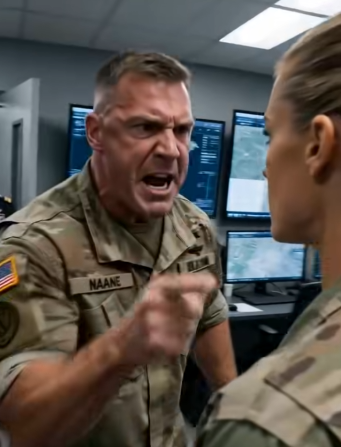
The operations center descended into chaos.
Several operators restrained Major Nathan Briggs before he could reach me again.
My cheek stung where he’d struck me, but nobody was looking at me anymore.
Every eye in the room had shifted toward the senior investigator standing in the doorway.
He held a thick classified folder in one hand.
The expression on his face made my stomach tighten.
This wasn’t routine.
This was worse.
Far worse.
The commander stepped forward.
“Report.”
The investigator nodded.
“We recovered additional helmet-camera footage from a damaged recording unit found near the southern perimeter.”
Nathan’s face lost what little color remained.
The investigator continued.
“The footage confirms Major Briggs abandoned his assigned position.”
Nobody reacted.
We already knew that.
Then the investigator opened the folder.
“But that’s not the most serious finding.”
The room became completely silent.
I could hear the hum of projectors.
The distant sound of air conditioning.
Nothing else.
The investigator looked directly at Nathan.
“The recovered footage shows that after leaving his position, Major Briggs deliberately disabled a communications relay being used by Bravo Team.”
A collective gasp swept through the room.
Several operators stared in disbelief.
One officer actually whispered:
“No…”
The investigator wasn’t finished.
“The communications blackout prevented Bravo Team from receiving updated threat locations.”
The implications hit everyone instantly.
Several lives had been placed at risk.
Not by the enemy.
By one of our own.
Nathan looked ready to collapse.
“That’s a lie.”
His voice sounded weak.
Desperate.
The investigator activated the screen.
Video appeared.
Helmet-camera footage.
Timestamped.
Verified.
Undeniable.
The room watched Nathan approach the communications relay.
Watched him disconnect critical equipment.
Watched him walk away.
No explanation.
No emergency.
No justification.
Just deliberate action.
The silence afterward felt heavier than any explosion.
Then the commander spoke.
His voice was ice.
“Take him into custody.”
## PART 3
Military police escorted Nathan from the room.
He didn’t resist.
He didn’t argue.
He simply looked broken.
But the investigation was only beginning.
Over the next week, investigators tore apart every aspect of the operation.
Financial records.
Communications.
Personal contacts.
Travel histories.
Everything.
I spent long hours assisting the inquiry.
At first, everyone believed Nathan had simply panicked.
Fear could make people do terrible things.
But the evidence pointed elsewhere.
One evening I was reviewing operational data when my secure phone rang.
The investigator’s voice came through.
“Autumn, we found something.”
My pulse quickened.
“What?”
A pause.
Then:
“Money.”
I sat upright.
“What kind of money?”
“Large transfers.”
My heart sank.
“How large?”
“Several hundred thousand dollars.”
The room around me suddenly felt smaller.
Nathan’s annual salary wasn’t remotely close to that.
“Source?”
Another pause.
“We’re still tracing it.”
I already knew what that meant.
Foreign involvement.
Possible corruption.
Possible espionage.
The situation had just become much bigger than anyone imagined.
The next morning, a special investigative team arrived from Washington.
The case was upgraded immediately.
What began as cowardice was now being treated as something far more dangerous.
And deep down, I feared we still hadn’t uncovered the worst of it.
## PART 4
Three weeks later, the truth exploded into the open.
The classified briefing room was packed.
Senior commanders.
Federal investigators.
Intelligence officials.
People far above my pay grade.
The lead investigator stood before a giant display screen.
His face was grim.
“We have completed our analysis.”
Nobody moved.
Nobody spoke.
He activated the presentation.
Financial transfers appeared.
Encrypted messages.
Satellite phone records.
Foreign contacts.
The evidence painted a horrifying picture.
Nathan hadn’t abandoned his position because he was afraid.
He had abandoned it because he had been paid to.
Shock rolled through the room.
Even seasoned intelligence officers looked stunned.
The investigator continued.
“For approximately eighteen months, Major Briggs maintained contact with a criminal organization operating overseas.”
Images appeared on the screen.
Known traffickers.
Arms dealers.
Mercenaries.
People responsible for countless deaths.
My stomach twisted.
Nathan had been feeding them information.
Mission schedules.
Personnel movements.
Operational plans.
Not every detail.
Just enough.
Enough to make money.
Enough to help them avoid capture.
Enough to get good people killed.
Then came the worst revelation.
The raid we had conducted wasn’t merely dangerous.
The enemy had known we were coming.
Someone had warned them.
Someone had prepared them.
Someone had set a trap.
Nathan.
The room sat frozen.
Years of trust.
Years of service.
Years of leadership.
All shattered.
Because one man had chosen greed.
And others had paid the price.
## PART 5
The arrest made international headlines.
News networks covered it nonstop.
Analysts debated the damage.
Former operators expressed outrage.
Families of injured personnel demanded answers.
Through it all, I tried focusing on my work.
But life became complicated.
My role in exposing the evidence attracted attention.
Far more attention than I wanted.
Reporters called constantly.
Requests for interviews piled up.
I declined every one.
The story wasn’t about me.
It was about the people who had nearly died.
One afternoon, I visited Sergeant Daniel Mercer.
He had been the operator injured during the raid.
The one forced to cover Nathan’s abandoned position.
The one who took enemy fire.
He was recovering at a military hospital.
When I entered his room, he smiled.
“You look exhausted.”
I laughed softly.
“You should see yourself.”
He grinned.
“Fair.”
For a moment we talked about ordinary things.
Sports.
Food.
Recovery.
Then his expression became serious.
“You know something?”
“What?”
“You saved lives.”
I shook my head.
“No.”
“You did.”
His voice remained steady.
“If you hadn’t pushed for the investigation, Nathan would’ve gotten away with it.”
I looked down.
Part of me still struggled with the attention.
The praise.
The spotlight.
Daniel seemed to understand.
He pointed toward the window.
“People think courage happens during gunfights.”
I followed his gaze.
“But sometimes courage is standing in a room full of powerful people and telling the truth.”
His words stayed with me long after I left.
## PART 6
Months passed.
The trial began under intense security.
Much of the evidence remained classified.
But enough details emerged to shock the nation.
Nathan eventually confessed.
Not everything.
But enough.
The confession revealed years of deception.
Years of lies.
Years of betrayal.
When asked why he did it, his answer stunned everyone.
Not because it was dramatic.
Because it was pathetic.
“I deserved more.”
That was it.
No grand ideology.
No coercion.
No noble motive.
Just entitlement.
He believed the world owed him something.
And when reality failed to match his expectations, he sold pieces of his integrity.
Then pieces of his team.
Then pieces of his country.
Listening to the testimony felt surreal.
This was the man people once admired.
The officer young soldiers wanted to emulate.
The commander trusted with lives.
Now he sat alone at the defense table.
A cautionary tale.
A warning.
Proof that character matters more than reputation.
When the verdict arrived, nobody looked surprised.
The sentence was severe.
The courtroom remained silent.
Nathan simply stared ahead.
For the first time since the investigation began, I felt no anger.
Only sadness.
Because every terrible decision had started with a small one.
And nobody noticed until it was too late.
## PART 7
Several months after the trial, our task force gathered again.
The same operations center.
The same walls.
The same projection screens.
But the atmosphere felt completely different.
The scars remained.
So did the memories.
Yet there was something else too.
Relief.
Closure.
The commander addressed the room.
“We lost trust.”
Nobody disagreed.
“We lost confidence.”
Again, silence.
“But we did not lose who we are.”
Heads slowly nodded.
The commander turned toward me.
I immediately wished he hadn’t.
Attention still made me uncomfortable.
But he continued anyway.
“Special Operations Officer Autumn Reeves demonstrated exceptional integrity under extraordinary pressure.”
The room erupted into applause.
I felt my face warm.
Several operators smiled.
Others nodded respectfully.
Then Daniel Mercer stood.
The room quieted.
He was fully recovered now.
Back on duty.
Back where he belonged.
He looked around the room.
“You know why we’re still here?”
Nobody answered.
“Because truth matters.”
His voice echoed across the operations center.
“And because people like Autumn refused to look away.”
The applause returned.
Louder this time.
I didn’t know where to look.
But for the first time, I accepted something important.
Sometimes doing the right thing means becoming visible.
Even when you’d rather stay invisible.
## PART 8 (THE END)
Two years later, I stood outside a newly completed training facility.
The morning sun reflected off glass and steel.
Young operators moved across the grounds.
Instructors prepared training exercises.
A new generation was beginning its journey.
Near the entrance stood a memorial wall.
Names.
Photos.
Stories.
People who had served honorably.
People who had sacrificed.
People who represented the values we were sworn to protect.
I stopped before one inscription.
Integrity is what you do when nobody is watching.
For a long moment, I stared at those words.
Then a familiar voice interrupted.
“Still reading that thing?”
I turned.
Daniel Mercer.
Grinning as usual.
“Every time.”
He laughed.
“You’ve probably memorized it.”
“Probably.”
Together we watched recruits cross the training field.
They looked eager.
Determined.
Ready to prove themselves.
Just like every generation before them.
A young trainee approached nervously.
“Ma’am?”
I smiled.
“Yes?”
“I heard about the Briggs investigation.”
I sighed.
Some stories never disappeared.
The trainee hesitated.
Then asked:
“Were you scared?”
The question caught me off guard.
I thought about the debrief.
The evidence.
The slap.
The accusations.
The months of pressure.
The endless scrutiny.
Then I answered honestly.
“Terrified.”
The trainee blinked.
“Really?”
“Absolutely.”
“Then why did you do it?”
I looked toward the memorial wall.
Toward the names engraved there.
Toward the people who trusted each other with their lives.
Then I smiled.
“Because courage isn’t the absence of fear.”
The trainee listened carefully.
“It’s deciding that something else is more important.”
For several seconds, neither of us spoke.
Then the trainee nodded.
A thoughtful nod.
The kind that suggests a lesson has truly landed.
As the recruit walked away, Daniel glanced at me.
“Not bad.”
I laughed.
“You think so?”
“I know so.”
The training siren sounded across the facility.
Recruits hurried toward their assignments.
Instructors followed.
The day moved forward.
Life moved forward.
And standing there beneath the bright morning sky, I realized something.
Nathan Briggs had spent years chasing power, status, and money.
He lost everything.
The people who chose honesty had gained something far more valuable.
Trust.
Respect.
Purpose.
The things that cannot be bought.
The things that last.
I took one final look at the memorial wall before heading inside.
The future was waiting.
And this time, it was built on truth.
**THE END**
