PART 2 — THE DOCUMENT THAT SILENCED THE PLAZA
—the document proved my warning had been filed forty-six hours before Audrey Sinclair’s family admitted anything was wrong.
A wave of silence rolled across the plaza so heavy it seemed to press against the glass tower behind us.
The safety inspector, Mr. Callahan, did not raise his voice. He didn’t need to.
His words carried through every microphone.
“This initial safety alert was submitted by Kayla Morgan, age seventeen, assistant facade technician working under licensed contractor Daniel Morgan. She included twelve photographs, three elevation markings, and a written concern that the panels on levels thirty-eight through forty-two showed stress fractures inconsistent with installation wear.”
The giant screen changed.
There it was.
My report.
My pictures.
My handwriting.
My stomach twisted seeing it enlarged above the city, projected for investors, reporters, and officials to examine.
I heard a woman in the crowd whisper, “She’s just a kid.”
Mr. Callahan turned another page.
“Had this warning been ignored, the building would have failed final inspection. Worse, under pressure and temperature shifts, several panels could have detached.”
A reporter blurted, “Detached? During public use?”
Mr. Callahan’s jaw tightened.
“Yes.”
The crowd erupted.
Audrey stood motionless in front of me, one hand still curled from the slap she had given me moments earlier. Her face, once bright with polished confidence, drained until she looked like a photograph left too long in the sun.
Her father, Victor Sinclair, pushed through the people gathered near the investor section.
He was tall, silver-haired, expensive in every possible way. His suit probably cost more than my father’s truck. He moved toward the stage with the fury of a man who believed cameras existed to flatter him, not expose him.
“This is outrageous,” he snapped. “My company cooperated fully with all repairs.”
Mr. Callahan looked down at the binder.
“After Miss Morgan’s report forced an independent review.”
The words hit like thunder.
My cheek still burned from Audrey’s slap, but now I barely felt it. I could only hear my heartbeat and my father’s voice from somewhere behind me.
“Kayla.”
I turned.
Dad was standing at the edge of the stage in his work boots and blue uniform shirt, his weathered face full of fear, pride, and something deeper—something almost like grief. He had spent his whole life hanging from ropes against towers like this, invisible to people who walked beneath him. He had taught me how to read glass like weather, how to spot weakness, how to respect height, wind, and silence.
He had also taught me never to embarrass powerful people unless the truth left no other choice.
And now the truth was standing thirty stories tall behind us.
Audrey suddenly found her voice.
“She’s lying,” she said.
The microphone near her caught every word.
Everyone heard.
She pointed at me as if pointing could erase documents.
“She wanted attention. Her father needed money. They probably exaggerated everything to make themselves look important.”
Something inside me cracked—not loudly, not violently, but cleanly.
My father stepped forward. “Don’t you talk about my daughter.”
Victor Sinclair cut him off with a cold smile.
“Mr. Morgan, isn’t it true your small cleaning company had recently lost two contracts?”
The crowd shifted.
Dad’s face hardened.
“That has nothing to do with this.”
Victor turned toward the audience like he had found a rope and intended to hang us with it.
“It has everything to do with motive.”
My throat went dry.
Audrey looked relieved. She stepped closer to her father.
“Yes,” she said quickly. “That’s what I mean. They needed publicity.”
For one terrible second, the plaza began to tilt back toward doubt.
I saw it happen in people’s eyes. Not because the evidence disappeared, but because powerful people knew how to make truth look dirty.
Then Mr. Callahan spoke again.
“There is more.”
Victor’s smile froze.
The inspector turned toward the screen. “Please display Appendix D.”
The giant screen changed once more.
Emails appeared.
Company emails.
Sinclair Glassworks internal communications.
A date.
A subject line.
“CONCERN: PANEL BATCH SG-77 — MICROFRACTURE RISK.”
Victor Sinclair’s face went gray.
Mr. Callahan continued.
“These emails were provided to my office late last night by an anonymous source within Sinclair Glassworks. They show that concerns about the glass batch used in this tower were raised internally six weeks before Miss Morgan filed her report.”
The air left the plaza.
Six weeks.
Not three.
Not after my warning.
Before.
My eyes darted to Audrey. She was staring at the screen like it had opened a trapdoor beneath her life.
Her father whispered, “Turn that off.”
But the screen did not turn off.
Another email appeared.
This one had Victor Sinclair’s name on it.
“Delay disclosure until installation phase is complete. Replacement costs will be catastrophic if this becomes public before transfer of liability.”
A reporter shouted, “Mr. Sinclair, did you knowingly supply defective glass?”
Another yelled, “Were lives put at risk?”
Audrey shook her head, backing away.
“No. No, that’s not—Dad?”
Victor did not answer her.
He was staring at the screen, breathing fast through his nose, the way cornered animals breathe.
And for the first time since I had known her, Audrey Sinclair looked less like my enemy and more like a girl watching her family name catch fire in public.
PART 3 — THE GIRL WHO SLAPPED ME STARTED CRYING
Security moved toward Victor Sinclair, but he lifted both hands as if insulted by their presence.
“This is being misrepresented,” he said sharply. “Those were preliminary concerns. Nothing was proven.”
Mr. Callahan shut the binder.
“Until Kayla Morgan proved it.”
My name sounded strange in his mouth.
Not small.
Not background.
Not invisible.
Across the plaza, people began clapping.
At first it was scattered. Then louder. Then overwhelming.
The applause rose around me like rain hitting metal.
But I couldn’t enjoy it.
Because Audrey was crying.
She tried to hide it, turning her face away from the cameras, but the damage had already been done. Her perfect posture collapsed. Her hands trembled. The girl who had slapped me in front of an entire city suddenly looked younger than me.
Her father grabbed her wrist.
“Stand straight,” he hissed.
I heard it because I was close enough.
Audrey flinched.
Something in me shifted.
I hated her. I had every reason to. My cheek still stung. She had humiliated me, accused my father, and tried to bury the truth beneath her family’s name.
But the look on her face wasn’t pride anymore.
It was fear.
Mayor Ellis stepped to the microphone, trying to regain control.
“Given the seriousness of these findings, today’s ribbon cutting will be postponed pending further legal review.”
A roar went through the crowd.
Investors shouted.
Reporters surged forward.
Victor Sinclair turned and strode off the stage, dragging Audrey with him.
I expected her to follow him like she always did.
Instead, halfway down the steps, she pulled free.
“Don’t touch me.”
Her voice was not loud, but somehow I heard it through everything.
Victor turned slowly.
“What did you say?”
Audrey looked at the screen, at the emails, at the crowd, at me.
Then she looked back at him.
“Did you know?”
Victor’s face tightened.
“This is not the place.”
“Did you know before the opening?”
He leaned close to her. “Get in the car.”
Audrey swallowed hard.
The cameras moved in.
For one suspended moment, father and daughter stared at each other while the city watched.
Then Audrey did something no one expected.
She walked back up the steps.
Toward me.
My father immediately moved between us.
“No,” he said.
Audrey stopped. Tears streaked through her makeup.
“I’m not going to hit her.”
Dad did not move.
Audrey looked at me over his shoulder.
“I didn’t know,” she whispered.
I wanted to say I didn’t care.
I wanted to tell her that not knowing didn’t make the slap disappear.
But her voice cracked in a way that made the anger inside me stumble.
“My whole life, he told me we built safe things. Beautiful things. He said people like you only complained because you didn’t understand what excellence costs.”
My father’s shoulders stiffened.
Audrey wiped her face with the back of her hand, ruining what remained of her polished image.
“Kayla, I am sorry.”
The plaza quieted again.
Not completely, but enough.
She turned toward the microphones.
“I’m sorry,” she said louder. “I was wrong. I thought she was attacking my family, but she was protecting people. And I slapped her because I was jealous that she had done something brave while I was standing there taking credit for a lie.”
The words knocked the breath from everyone.
Victor Sinclair stormed back toward the stage.
“Audrey!”
She spun around.
“No. You don’t get to use my voice anymore.”
He stopped as if she had struck him.
For a heartbeat, I saw the real shape of their family.
Not wealth.
Not elegance.
Control.
Audrey turned back to me, trembling.
“I don’t deserve forgiveness.”
“No,” I said quietly. “Not yet.”
She nodded, accepting it like a sentence.
Then she did something even stranger.
She reached into her small white purse and pulled out a silver flash drive.
Victor’s face changed instantly.
“Audrey,” he said, very softly.
That softness frightened me more than his shouting.
Audrey held the drive up.
“I know who sent the anonymous emails.”
Every camera zoomed in.
She looked at Mr. Callahan.
“It was my brother.”
PART 4 — THE BROTHER WHO DISAPPEARED
Audrey’s brother was named Julian Sinclair.
I had heard of him only once, months earlier, when Dad came home from a maintenance job and mentioned that Sinclair Glassworks had a son who used to work in materials testing.
“Smart kid,” Dad had said then. “Too smart to last in a company like that.”
Now his name landed in the plaza like a dropped match.
Victor’s expression turned deadly calm.
“Audrey, enough.”
But Audrey had already stepped beyond his reach.
“My brother found the defect first,” she said. “He told my father the batch needed to be recalled. Then he disappeared from the company.”
A reporter called, “Disappeared how?”
Audrey looked down at the flash drive.
“He was forced to resign. My father told everyone Julian had a breakdown. He told me not to contact him because Julian was unstable.”
Her mouth trembled.
“But last night, Julian called me. He said he had been watching the tower story. He said Kayla was the only reason no one got hurt.”
My chest tightened.
Mr. Callahan walked toward her slowly.
“Miss Sinclair, does that drive contain additional evidence?”
Audrey handed it to him.
“Yes. Test results. Audio recordings. Transfer documents. Everything Julian copied before they locked him out.”
Victor lunged.
Security stopped him before he reached her.
The crowd screamed.
Audrey staggered backward, and without thinking, I caught her arm.
For a second, we both stared at my hand wrapped around her sleeve.
The girl who slapped me.
The girl I had every right to despise.
And yet there I was, keeping her from falling.
She whispered, “Why?”
I didn’t look at her.
“Because nobody deserves to be dragged by him.”
My father heard me. His face softened with painful pride.
Mayor Ellis ordered the plaza cleared. Police escorted Victor Sinclair away for questioning, though he continued insisting he was the victim of corporate sabotage.
The grand opening dissolved into chaos.
No ribbon was cut.
No champagne was poured.
No triumphant speech was given.
Instead, the newest observation tower in Dallas became a crime scene wrapped in glass.
By evening, my face was everywhere.
So was Audrey’s.
Clips of the slap played endlessly online. People called her cruel, spoiled, monstrous. People called me brave, heroic, inspiring.
But hero felt too clean for what I felt.
At home that night, Dad pressed an ice pack gently to my cheek.
“You okay, peanut?”
I leaned against the kitchen counter.
“I don’t know.”
Our apartment was small, with cracked tiles near the sink and a refrigerator that hummed like it was losing an argument. Dad had raised me there after Mom died when I was ten. There were no chandeliers, no marble stairs, no private drivers.
But there was warmth.
There was truth.
There was Dad cutting apples badly because he thought slices tasted better crooked.
He sat across from me.
“You did good today.”
“I didn’t do anything today. Mr. Callahan did.”
Dad shook his head.
“You did the hard part three weeks ago, when nobody believed you.”
I looked at the table.
“Do you think Audrey really didn’t know?”
Dad was quiet for a long time.
“I think kids can inherit castles and still be prisoners in them.”
That stayed with me.
Later that night, my phone buzzed.
Unknown number.
I almost ignored it.
Then I saw the message.
This is Julian Sinclair. Please don’t trust anyone from my family yet. Not even Audrey. There is something worse than the glass.
My blood went cold.
A second message arrived.
The tower was never the real project.
PART 5 — THE SECRET UNDER THE OBSERVATION DECK
I called Dad immediately.
He read Julian’s messages three times without speaking.
Then he locked the front door.
“Kayla, did you reply?”
“No.”
“Good.”
“But what does he mean? The tower wasn’t the real project?”
Dad rubbed both hands over his face.
“I don’t know.”
My phone buzzed again.
Meet me tomorrow at 6 a.m. Old Trinity Rail Yard. Come with your father. No police. The police have someone feeding information to Sinclair.
Dad said, “Absolutely not.”
I said, “Dad—”
“No.”
“He helped expose Victor.”
“Or he’s using you.”
I hated that he was right to be afraid.
But sleep never came.
At 5:17 a.m., Dad knocked on my bedroom door.
He was already dressed.
I sat up.
“You said no.”
“I said absolutely not.” He sighed. “Then I remembered you inherited your mother’s stubbornness and my bad judgment.”
The Old Trinity Rail Yard sat beneath a bruised dawn, all rusted tracks, weeds, and abandoned freight cars. Dad kept one hand near his phone and the other on my shoulder.
Julian Sinclair stepped out from behind a concrete pillar.
He looked nothing like Audrey.
Thin, exhausted, unshaven, with dark circles under eyes that kept checking every shadow. He wore a faded hoodie and carried a backpack clutched tight to his chest.
“You came,” he said.
Dad stood in front of me.
“Start talking.”
Julian nodded quickly.
“The glass defect is only one piece. My father wasn’t just cutting costs. He was hiding a materials substitution.”
I frowned.
“What kind?”
Julian pulled out a folder.
“The tower includes a private lower-level data vault. Investors were told it was for building operations, security systems, climate control. But Sinclair Glassworks partnered with another company to create a hardened storage facility beneath the plaza.”
Dad looked confused.
“Why would a glass company do that?”
“They weren’t acting as a glass company.” Julian swallowed. “They were acting as a shield.”
He opened the folder.
Inside were diagrams.
The observation tower above.
The foundation below.
And under the foundation, a sealed chamber labeled only:
ARCHIVE LEVEL B-9.
Julian pointed to it.
“My father was storing corporate records there for several companies under investigation. Financial records. Bribery ledgers. Offshore account backups. The tower gave them a public landmark to hide a private vault.”
My mouth went dry.
“That sounds insane.”
“Yes,” Julian said. “That’s why it worked.”
Dad took the diagrams.
“What does defective glass have to do with a vault?”
“The public opening mattered,” Julian said. “Once the tower passed inspection and opened, ownership transferred to a public-private trust. After that, accessing lower restricted levels would require court orders, city approvals, and months of delays. My father needed the opening to happen fast.”
I remembered Victor’s email.
Delay disclosure until installation phase is complete. Replacement costs will be catastrophic if this becomes public before transfer of liability.
It wasn’t just about money.
It was about time.
Julian’s voice dropped.
“Kayla’s report delayed the opening. That gave federal investigators a window. But someone tipped my father off last night after Audrey gave the drive to Callahan.”
Dad stiffened.
“Where is the evidence now?”
Julian’s answer came barely above a whisper.
“Still under the tower.”
A train horn wailed somewhere far away.
I felt the city waking around us, unaware that beneath its newest monument might be enough secrets to destroy half the people who built it.
Julian looked at me.
“My father will try to empty the vault before sunrise tomorrow.”
“Then tell the FBI,” I said.
“I tried. My contact went silent.”
Dad grabbed my arm.
“We are done.”
But Julian stepped closer, desperate.
“Kayla, you know the facade access systems. Your father knows maintenance routes. There is a service shaft no executive knows how to use because only cleaning crews take it seriously. I don’t need you to steal anything. I need you to help me prove the vault is being opened tonight.”
Dad’s face hardened.
“She is seventeen.”
Julian lowered his head.
“I know.”
“Then don’t ask her to save adults who should have saved themselves.”
For a moment, nobody spoke.
Then Julian said the one thing that changed everything.
“My father is planning to blame Daniel Morgan.”
Dad froze.
I felt the world drop beneath me.
Julian’s eyes filled with shame.
“There are draft statements. Fabricated maintenance logs. If the vault operation is exposed without the full evidence, they’ll claim your father used his cleaning access to plant false documents and sabotage the opening for a payout.”
Dad went pale.
I remembered Victor onstage asking about lost contracts.
He had already begun building the lie.
My voice came out cold.
“Show us the route.”
PART 6 — THE NIGHT WE ENTERED THE TOWER
At 11:43 p.m., the tower looked nothing like a place meant for celebration.
Police tape fluttered near the entrance, but the main security presence had shifted to the front plaza. Julian led us through a service alley behind the neighboring parking structure, where maintenance trucks passed without attention.
Audrey was waiting there.
Dad stopped.
“No.”
Audrey stepped forward, wearing jeans, sneakers, and a dark jacket instead of designer armor.
“I know you don’t trust me,” she said. “You shouldn’t. But I know my father’s private access codes.”
I looked at Julian.
“You brought her?”
“She brought herself,” he said.
Audrey met my eyes.
“I heard him on the phone. He said your father’s name.”
That was enough.
Not forgiveness.
Not friendship.
Enough.
We entered through a lower service door Audrey opened with a code that made her flinch as she typed it. The tower’s interior was dark except for emergency lights glowing red along polished floors.
Every footstep sounded too loud.
Dad moved like he belonged there. To him, buildings were not glamorous. They were ladders, panels, anchors, ducts, bolts, locks, and risks. He led us through a maintenance corridor into a narrow stairwell that smelled of metal and dust.
Julian kept checking his phone.
“They’re supposed to arrive at midnight.”
“We have seventeen minutes,” Audrey whispered.
We descended instead of climbing.
Down past electrical rooms.
Down past storage cages.
Down past signs warning AUTHORIZED PERSONNEL ONLY.
At the lowest landing, we found a steel door with no handle.
Audrey typed another code.
Denied.
She tried again.
Denied.
Her face crumpled.
“He changed it.”
Julian cursed under his breath.
Dad knelt near the wall panel and removed a small flashlight from his belt.
“What are you doing?” Audrey asked.
“My job.”
He opened the utility cover beside the door.
Behind it was a manual override box.
Julian stared.
“That’s not on the plans.”
Dad gave him a look.
“Plans are what rich people think buildings are. This is what buildings actually are.”
He worked quickly, fingers steady.
A heavy click echoed.
The steel door opened.
Behind it was an elevator barely large enough for four people.
The button panel had only one option.
B-9.
Audrey whispered, “Oh my God.”
The elevator descended so quietly it felt like sinking underwater.
When the doors opened, we stepped into a corridor that should not have existed.
Smooth concrete walls.
Black cameras.
Cold white lights.
At the end stood a circular vault door.
And in front of it were three men loading metal cases onto a cart.
Victor Sinclair was with them.
He turned slowly.
For one second, he looked surprised.
Then amused.
“Well,” he said. “The window cleaner brought his daughter to commit a felony.”
Dad pushed me behind him.
Victor smiled.
“You make this too easy.”
Audrey stepped out.
“Stop.”
Victor’s face darkened.
“You stupid girl.”
She flinched, but did not step back.
Julian lifted his phone.
“It’s over. I’m recording.”
Victor laughed.
“No, Julian. It is beginning.”
One of the men raised a tablet.
Suddenly, every light in the corridor switched red.
A security alarm began to pulse.
Victor looked directly at Dad.
“Daniel Morgan, you are trespassing in a restricted facility. You brought minors. You forced entry. And soon, investigators will find your fingerprints all over stolen corporate files.”
He had planned this.
All of it.
I felt panic claw up my throat.
Then Audrey did something reckless.
She ran at the cart and shoved it.
Metal cases crashed open across the floor.
Documents spilled everywhere.
Hard drives skidded against concrete.
Victor shouted.
One of the men grabbed Audrey.
I moved without thinking.
I swung my flashlight at his wrist. He yelled and let her go.
Dad pulled us both back.
Julian dropped to his knees, gathering scattered files, aiming his phone camera at everything.
“Names,” he shouted. “Kayla, get the names!”
I saw binders labeled with companies, council members, land deals, offshore transfers.
Then I saw one folder that made no sense.
MORGAN, ELENA — INCIDENT SETTLEMENT.
My mother’s name.
Everything stopped.
My mother, Elena Morgan, had died seven years earlier in what we were told was an industrial accident at a downtown construction site where she worked as a safety coordinator.
Dad saw the folder too.
His face went white.
Victor noticed.
And smiled.
“Oh,” he said softly. “You found the family section.”
PART 7 — THE TRUTH ABOUT MY MOTHER
Dad lunged at Victor.
I had never seen my father lose control before.
He was the calmest man I knew, the kind of man who could hang forty floors above traffic and still joke about lunch. But my mother’s name in Victor Sinclair’s vault broke something open in him.
Two security men restrained him.
I grabbed the folder with shaking hands.
Inside were photographs.
Reports.
A settlement draft never signed.
And a memo with Sinclair Glassworks letterhead dated seven years ago.
My vision blurred as I read.
Subject: Fatal Site Incident — Exposure Risk Related to Safety Complaint Filed by Elena Morgan.
Safety complaint.
My mother had filed a complaint.
Just like me.
Dad’s voice cracked.
“What did you do?”
Victor adjusted his cuffs, as if this were a meeting and not the ruin of our lives.
“Your wife was persistent.”
“You killed her?”
“I did not touch her.”
“That’s not what I asked.”
Victor’s silence answered.
Audrey covered her mouth.
Julian looked sick.
I read another line.
Morgan identified substandard anchor fittings supplied through Sinclair subsidiary. Recommend containment strategy prior to municipal hearing.
My knees weakened.
Mom hadn’t died because of a random accident.
She had died after discovering unsafe materials.
After trying to warn people.
Just like I had.
Victor looked at me.
“Your mother had the same flaw you do. She believed truth protects people. It doesn’t. Power protects people.”
Dad fought harder against the men holding him.
“You buried this?”
Victor shrugged.
“We resolved a liability matter.”
A sound escaped me. Not a sob. Not a scream. Something worse.
Audrey stepped toward her father.
“You knew her mother died because of us?”
Victor snapped, “Because of her own choices.”
Audrey recoiled as if he had slapped her.
And in that moment, I saw her finally understand.
Her family’s empire was not cracked.
It was built from cracks.
From silence.
From buried warnings.
From people like my mother.
The alarm continued flashing red.
Victor’s men began gathering the scattered evidence again, faster now.
Julian whispered, “We need to get out.”
But Dad was staring at the folder.
At Mom’s name.
At the proof he had needed for seven years without knowing it existed.
Victor took one step closer.
“Here is what happens now. Daniel goes to prison. Julian returns to psychiatric care. Audrey comes home. Kayla becomes a troubled girl overwhelmed by attention. And this folder disappears.”
He reached for it.
I stepped back.
“No.”
His eyes narrowed.
“You are a child.”
I held the folder against my chest.
“Then why are you so afraid of me?”
For the first time, Victor Sinclair had no answer.
Then the elevator doors opened behind us.
Everyone turned.
Mr. Callahan stepped out.
With him came two federal agents, three police officers, Mayor Ellis, and half a dozen cameras from a news crew.
Victor’s face collapsed.
Julian exhaled like he had been holding his breath for years.
Audrey stared at him.
“You said your FBI contact went silent.”
Julian gave a weak smile.
“He did. So I called the one person my father underestimated more than Kayla.”
Mr. Callahan lifted his phone.
“I have been listening since you entered the service corridor.”
Victor backed away.
“No.”
One of the agents held up a warrant.
“Victor Sinclair, you are under arrest.”
He shouted then. Not words. Just rage dressed as sound.
As they cuffed him, he looked at Audrey.
“This is your fault.”
Audrey’s face was wet with tears, but her voice was steady.
“No. It was yours.”
The agents secured the vault.
Reporters filmed the documents.
Mr. Callahan took the folder from my trembling hands with surprising gentleness.
“We’ll make copies,” he said. “The originals will go into evidence.”
Dad wrapped his arms around me.
I buried my face in his shirt and finally cried.
Not because I was scared.
Because for seven years, my mother had been a wound without a story.
Now she had a voice.
And somehow, impossibly, it had spoken through me.
PART 8 — THE END — THE TOWER THAT FINALLY OPENED
Six months later, the observation tower opened again.
But not as the Sinclair Tower.
The city renamed it the Elena Morgan Safety Center and Observation Deck.
Dad cried when the sign went up.
He tried to hide it by pretending something was in his eye, but I knew better. His hands shook as he traced Mom’s name carved into brushed steel beneath the entrance.
The investigation became bigger than anyone imagined.
Victor Sinclair’s arrest exposed bribery, fraud, falsified safety certifications, and years of buried complaints. Executives resigned. Officials were indicted. Families of past victims were contacted. Old cases reopened.
Julian testified first.
Audrey testified after him.
People expected her to disappear into shame, but she didn’t. She stood before a federal panel and admitted what she had done to me, what she had ignored, what she had been taught not to see.
When reporters asked why she helped expose her own father, she said, “Because a family name is not worth more than a human life.”
I watched that interview in our kitchen.
Dad nodded once.
“That girl might make it.”
I didn’t answer.
Forgiveness, I learned, was not a door that swung open all at once.
Sometimes it was a window cracked slightly after a long winter.
Audrey wrote me letters.
I ignored the first three.
The fourth included a photograph of my mother from an old Sinclair event. Mom was standing in the background, holding a clipboard, her hair tied back, eyes sharp and alive. Audrey had found it in archived company files before investigators seized them.
On the back, Audrey had written:
She saw the danger before anyone else. I am sorry my family punished her for being right.
I cried for an hour.
Then I called her.
We met at a quiet coffee shop nowhere near downtown. She looked nervous when she arrived, carrying no designer purse, wearing no perfect mask.
For a while, neither of us knew how to speak.
Finally she said, “I don’t expect us to be friends.”
“Good,” I said.
She nodded.
Then I added, “Not yet.”
Her eyes lifted.
A small, fragile smile appeared.
That was how healing began.
Not with forgetting.
Not with pretending the slap had never happened.
But with truth sitting between us, ugly and undeniable, and neither of us running from it.
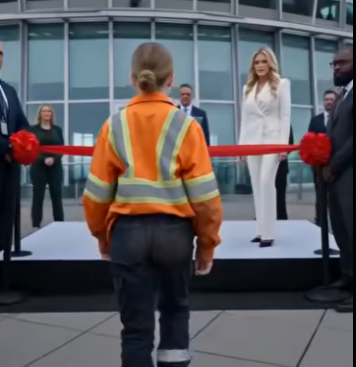
On opening day, Mayor Ellis invited me to cut the ribbon.
I said no.
Everyone was shocked.
Then I handed the ceremonial scissors to Dad.
He shook his head fiercely.
“No, Kayla. This is yours.”
“It was Mom’s first,” I said.
The crowd quieted.
Dad looked at the ribbon, then at the tower, then at me.
His lips trembled.
Together, we held the scissors.
On my other side stood Julian, pale but smiling.
Beside him stood Audrey.
When the cameras flashed, she did not step forward.
She did not try to claim the center.
She simply stood there, hands folded, letting the moment belong where it should have belonged years ago.
Dad whispered, “For Elena.”
I whispered, “For everyone who warned them.”
We cut the ribbon.
The plaza exploded with applause.
This time, I did not feel out of place in my orange safety jacket.
I wore it on purpose.
Patched pants and all.
Inside, the tower had changed. The lower vault had been converted into a public safety archive, where whistleblower reports, engineering ethics exhibits, and memorials to workers lined the walls. Mom’s story was displayed near the entrance.
So was mine.
But my favorite part was the highest level.
The observation deck.
Glass wrapped around the city in every direction, repaired, reinforced, honest. Sunlight poured through the panels, turning the floor gold beneath our feet.
Dad and I stood together at the edge, looking out over Dallas.
For years, heights had belonged to him.
Now, somehow, they belonged to both of us.
Audrey approached quietly.
“I have something for you.”
She handed me a small envelope.
Inside was a check.
A very large check.
I frowned.
“What is this?”
“Part of the victim restitution fund,” she said. “The court assigned it to your family.”
Dad looked at the number and nearly dropped it.
I stared at Audrey.
“We can’t take this from you.”
“It isn’t from me,” she said. “It’s from what my family stole.”
Julian stepped beside her.
“And there’s something else.”
He handed Dad a folder.
Dad opened it slowly.
His mouth fell open.
It was a deed.
For Morgan Safety & Facade Consulting.
A new company.
Fully funded for five years through a court-approved foundation created from seized Sinclair assets.
Dad looked like the paper might vanish if he breathed too hard.
Julian smiled.
“The city needs independent safety inspectors who can’t be bought.”
Audrey looked at me.
“And teenagers who notice what adults ignore.”
I laughed then.
A real laugh.
The kind I had not felt since before Mom died.
Dad pulled me into a hug so tight I squeaked.
For the first time in years, our future did not look like overdue bills, lost contracts, and quiet grief.
It looked wide.
Bright.
Possible.
Then Mr. Callahan appeared behind us with his usual serious expression.
“Miss Morgan,” he said.
I straightened automatically.
“Yes, sir?”
He handed me a visitor badge.
It read:
KAYLA MORGAN — JUNIOR SAFETY FELLOW.
I blinked.
“What?”
“The city council approved a youth safety fellowship program this morning,” he said. “Named after your mother. You are the first fellow.”
I couldn’t speak.
Dad could.
“She accepts.”
“Dad!”
“You accept,” he said, crying again and not even pretending this time.
Everyone laughed.
But the most surprising moment came later, when the crowd thinned and I returned alone to the observation deck.
I pressed my hand against the glass.
For a second, I imagined Mom beside me, clipboard tucked under her arm, telling me to check the corners because danger loved hiding where people forgot to look.
Behind me, footsteps approached.
Audrey stood a few feet away.
“I never thanked you,” she said.
“For what?”
“For stopping the opening. For saving everyone. For saving me from becoming him.”
I looked out at the city.
The sun was setting, painting the buildings in fire and honey.
“You helped save yourself.”
She nodded slowly.
Then she said, “Do you think your mom would be proud?”
My throat tightened.
I looked at the glass, at our reflections standing side by side—two girls from opposite worlds, both changed by the same truth.
“Yes,” I said. “But she’d also tell us to stop standing around and inspect the west panels before the temperature drops.”
Audrey laughed through tears.
And somehow, that laugh felt like an ending and a beginning at once.
The tower did not fall.
The truth did not disappear.
My father did not go to prison.
My mother’s name was not buried anymore.
And the girl who had slapped me in front of the whole city became the girl who helped me build a foundation no lie could crack.
Years later, people would ask me when my life changed.
They expected me to say it was the day I found the defect.
Or the day the inspector revealed my report.
Or the night we opened the vault beneath the tower.
But the truth was simpler.
My life changed the moment I realized being invisible is not the same as being powerless.
Sometimes the person everyone overlooks is the only one close enough to see the danger.
Sometimes a faded orange safety jacket can shine brighter than a ballroom full of expensive suits.
And sometimes, the report powerful people try hardest to destroy becomes the one that saves an entire city—and finally brings a family home.
