PART 2 — THE RECORDING ABOVE THE CITY
Victoria Kensington ran like the entire city had caught fire behind her.
Her heels struck the rooftop tiles with sharp, frantic clicks. The empty glass slipped from her hand and shattered near a planter, sending tiny crystals across the floor like broken stars. Her friends stopped laughing instantly.
The sound technician stood inside the control booth with one hand on the audio board and the other gripping the headset.
“Don’t play that!” Victoria shouted.
Her voice cracked.
That crack changed everything.
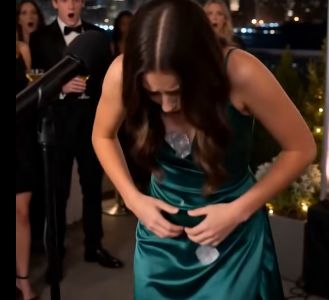
A few seconds earlier, she had been smiling as if pouring ice down my dress in front of hundreds of people was harmless entertainment. Now she looked terrified.
The host stepped forward. “Victoria, stop right there.”
She didn’t.
Two staff members moved toward the booth, but Victoria shoved past a waiter carrying sparkling cider. Glasses tipped. Guests gasped. Her father, Senator Kensington, rose from the VIP table with a face so pale it seemed carved from moonlight.
“Victoria!” he barked.
She froze.
For one breath, the rooftop held still.
Then the technician pressed a button.
Static hissed through the speakers.
Victoria’s recorded voice filled the night.
“Wait until she starts talking,” she said, laughing. “Then drop the ice down her dress. She’ll jump like some little charity-case squirrel.”
A horrible silence fell over the rooftop.
My fingers tightened around the microphone stand.
The recording continued.
Another girl giggled. “Are you sure? There are donors everywhere.”
Victoria scoffed. “Exactly. She needs to remember who this night is really for. Everyone keeps acting like she’s some miracle student because she got a scholarship and wrote one decent essay.”
A third voice whispered, “But the award committee chose her.”
Victoria laughed again. “Only because my mother told them it would look good to celebrate someone ‘underprivileged.’ They needed a sob story. That’s all she is.”
The words moved through me slowly, like ice colder than the cubes still melting against my skin.
A sob story.
That was what she thought I was.
Not the girl who studied under a flickering kitchen light while my mother worked double shifts.
Not the girl who tutored freshmen for free.
Not the girl who had won the citywide youth leadership prize after building a weekend food program for students who came to school hungry.
Just a sob story.
The recording clicked, then Victoria’s voice became lower.
“Besides, once she embarrasses herself tonight, nobody will ask why my recommendation letter disappeared.”
The host turned sharply toward the sound booth.
The headmistress, Dr. Evelyn Moore, stood so fast her chair scraped against the rooftop floor.
My heart began to pound.
Recommendation letter?
Victoria screamed, “Turn it off!”
But the technician didn’t. His jaw was tight, his eyes fixed on the board.
Another recorded voice asked, “You really deleted it?”
Victoria replied, “Obviously. My mom said the international fellowship committee had already shortlisted her. Can you imagine? Maya Bennett representing Westbridge instead of me?”
There it was.
My name.
Maya Bennett.
Spoken like an insult.
The crowd had become so quiet I could hear traffic far below.
Victoria’s recorded voice continued, careless and smug.
“I used Tara’s login from the student office. Deleted Maya’s teacher recommendation before final submission. Then I uploaded an older draft with missing pages. By the time anyone notices, deadlines are over.”
A low wave of shock traveled through the guests.
Somebody whispered, “That’s sabotage.”
My knees weakened.
The international fellowship had been my dream for two years. I had cried in the guidance office when I received the rejection email, blaming myself for not being good enough. I had told my mother I must have failed somewhere.
But I hadn’t failed.
Someone had reached into my future and tried to steal it.
The recording ended with laughter.
Then the rooftop speakers went dead.
No one clapped. No one moved.
Victoria stood near the booth, breathing hard, her eyes wild. Her friends shrank away from her like she had become contagious.
Dr. Moore stepped forward. Her voice was quiet, but every person heard it.
“Victoria Kensington, come with me immediately.”
Victoria shook her head. “That was private. Nobody had permission to record me.”
The technician finally spoke. “The backstage lounge mic was connected for the host’s toast rehearsal. The light was on. Everyone backstage was told twice.”
The host looked at me, then at the crowd.
I realized I was still standing at the microphone with water dripping from my dress, humiliated, shaking, and somehow more visible than I had ever been.
I wanted to run.
Then I saw my mother.
She stood at the back near the catering table, still wearing the black uniform from the hotel where she worked. She had come straight from her shift and barely made it in time. Her hands were clasped in front of her mouth. Tears shone in her eyes.
Not pity.
Pride.
That was when I lifted my chin.
The host approached carefully. “Maya, would you like to step away for a moment?”
I looked at Victoria.
She looked back at me with hatred, fear, and something else.
Desperation.
I turned toward the guests.
“No,” I said.
My voice shook, but I stayed.
“I’d like to finish my speech.”
PART 3 — THE GIRL WHO DIDN’T RUN
The first sound was a single clap.
Then another.
Then another.
Within seconds, the entire rooftop erupted.
People stood. Chairs slid backward. Donors, students, teachers, even waiters holding trays began applauding. The applause rose above the city traffic and wrapped around me like warmth after freezing rain.
Victoria covered her ears.
I did not smile.
Not yet.
I waited until the applause faded.
Then I leaned toward the microphone.
“I wrote this speech three nights ago,” I began. “I practiced it in my bedroom while my little brother told me I sounded too serious.”
A few soft laughs broke the tension.
“My original speech was about gratitude. About opportunity. About how Westbridge Academy changed my life.”
I paused.
The skyline glittered behind the guests, but I no longer felt like a tiny girl standing beneath enormous buildings. I felt taller than all of them.
“I’m still grateful,” I said. “But tonight, I learned something important. Opportunity means nothing if people with power can quietly take it away from people without power.”
Dr. Moore lowered her gaze.
Several board members exchanged uncomfortable looks.
I continued.
“I used to think success meant being perfect enough that no one could question whether I belonged. I thought if I worked harder, smiled politely, and never complained, people would eventually stop seeing my scholarship before they saw me.”
My mother wiped her cheek.
“But some people will always call hard work luck when it belongs to someone else. Some people will call dignity a performance. Some people will call a student a sob story because it makes them feel less guilty for trying to erase her.”
Victoria whispered, “Stop.”
I heard her.
Everyone heard her.
I did not stop.
“I don’t want tonight to become only about what was done to me. I want it to become about what we do next. Because I’m not the only student who has been made to feel grateful for scraps while others are handed whole tables.”
A hush settled again, but this time it was alive.
Listening.
Waiting.
“So yes,” I said, voice strengthening, “I am a scholarship student. My mother works harder than anyone I know. My brother and I share a room. My dress tonight was borrowed from my cousin. And I am not ashamed of any of that.”
My throat tightened.
“I am proud.”
The applause exploded again.
This time, I smiled.
Not because I had won.
Because I had survived the moment meant to break me.
When I stepped away from the microphone, my mother rushed forward. She didn’t care about donors or photographers or school officials. She wrapped me in her arms right there beside the stage.
“My brave girl,” she whispered.
That broke me.
I cried into her shoulder while the whole rooftop watched. For once, I didn’t care who saw.
Dr. Moore approached us after a minute. Her face looked older than it had at the start of the night.
“Maya,” she said, “I owe you an apology.”
I pulled back from my mother.
Dr. Moore continued, “We will open an immediate investigation into the fellowship submission. If your application was sabotaged, we will contact the committee directly.”
Senator Kensington appeared behind her, jaw clenched. “Evelyn, surely this can be handled privately.”
Dr. Moore turned to him. “No, Senator. It became public when your daughter humiliated a student on a stage.”
His wife, Celeste Kensington, gripped Victoria’s arm so tightly Victoria winced.
“This is being exaggerated,” Celeste said sharply. “Teenagers say foolish things.”
My mother faced her.
She was shorter than Celeste. Less wealthy. Less polished. Her hotel uniform still had a name tag pinned to it.
But in that moment, my mother looked like a queen.
“Teenagers spill drinks,” Mom said. “They don’t delete recommendation letters.”
Celeste’s mouth tightened.
Victoria suddenly snapped, “I only did what everyone does! Everyone protects their own future!”
I stared at her.
“That wasn’t protecting your future,” I said. “That was stealing mine.”
For the first time all night, she had no answer.
Security escorted Victoria and her parents away from the rooftop. Her friends followed, heads down, trying to look invisible.
But one of them lingered.
Tara.
The girl whose office login Victoria claimed to have used.
Her face was gray.
“Maya,” she whispered.
I turned.
“I didn’t know she used my login for that,” Tara said. “But I knew she had my password. She made me give it to her.”
“Why?”
Tara’s eyes filled with tears. “Because she had something on me.”
Before I could ask what, Dr. Moore stepped closer.
“What do you mean, Tara?”
Tara looked toward the exit where Victoria had disappeared.
Then she said the words that changed everything again.
“Victoria has a folder. On her laptop. She calls it insurance.”
PART 4 — THE INSURANCE FOLDER
The rooftop celebration ended early.
No one admitted that it had collapsed, but everyone knew.
Guests left in clusters, whispering into phones. Sponsors demanded meetings. Parents pulled their children close. Students who had spent years laughing at Victoria’s jokes suddenly looked afraid to have ever stood near her.
By midnight, I was sitting in Dr. Moore’s office with my mother, Tara, the host, the sound technician, and two board members.
My borrowed dress was wrapped in a school blazer. My hair was still damp. My skin smelled faintly of melted ice and rooftop flowers.
Tara sat across from me, shaking.
Dr. Moore spoke gently. “Tara, tell us what you know.”
Tara twisted a tissue in her hands. “Victoria collects things. Screenshots, recordings, photos. Anything embarrassing or useful. If someone refuses to help her, she reminds them what she has.”
A board member frowned. “Are you accusing her of blackmail?”
Tara nodded.
The word seemed to poison the room.
My mother took my hand under the table.
Tara continued. “Last semester, I reported cheating in advanced chemistry. Victoria found out. She had screenshots of private messages I sent when my dad lost his job. I said things about leaving school because we couldn’t afford fees. She threatened to post them and make everyone think I was begging for pity.”
Her voice cracked.
“So I gave her my student office password. I told myself she just wanted to check event lists or seating charts.”
Dr. Moore looked devastated.
The sound technician, whose name was Daniel Cho, placed a small drive on the desk. “I saved the audio from tonight. Full file. Time-stamped.”
Dr. Moore nodded. “Thank you, Daniel.”
He looked at me. “I’m sorry I didn’t catch the open mic sooner.”
I shook my head. “You caught it when it mattered.”
His eyes softened.
Then the door opened.
A school security officer stepped inside. “Dr. Moore, Victoria Kensington is downstairs with her parents and their attorney. They’re demanding that all recordings be deleted.”
Dr. Moore stood. “They can demand whatever they like.”
For the first time, I saw something fierce beneath her polished calm.
The next morning, Westbridge Academy changed.
Not visibly at first.
The banners still hung outside the front entrance. Students still arrived in polished shoes and expensive jackets. The marble floors still shone.
But beneath the surface, something had cracked.
By lunch, everyone knew about the recording.
By afternoon, three more students had gone to Dr. Moore.
By the next day, there were nine.
Victoria had threatened one boy with a video of his panic attack during debate practice. She had pressured another girl into withdrawing from a leadership election. She had spread rumors about a transfer student after he refused to let her copy his economics project.
The “insurance folder” became more than gossip.
It became evidence.
Victoria did not return to school that week.
Her empty seat in history class felt louder than her presence ever had.
On Friday, Dr. Moore called me into her office.
The fellowship committee had responded.
My stomach twisted as she handed me a printed email.
“Maya,” she said softly, “your original recommendation was never received. The file submitted under your name was incomplete.”
I stared at the paper.
Even knowing the truth, seeing it confirmed hurt in a new way.
Dr. Moore continued, “We sent them the audio, the teacher’s original letter, and documentation of the tampering. They have agreed to reopen your application.”
Mom cried when I told her.
My little brother, Leo, asked if that meant I was famous now.
“No,” I said, ruffling his hair. “It means my paperwork got rescued.”
But privately, I was terrified.
Because hope is dangerous after disappointment.
A week later, Victoria returned.
Not to class.
To a disciplinary hearing.
I was asked to attend.
So was Tara.
So were the others.
The hearing room was lined with portraits of former headmasters and donors. Victoria sat at one side of a long table in a navy dress, hands folded neatly, hair perfect, face unreadable.
She looked like a painting of innocence.
Until she saw me.
Then her expression flickered.
Her attorney spoke first. He said the recording was misunderstood. He said Victoria had been under academic pressure. He said no permanent harm had been done.
No permanent harm.
My mother nearly stood, but I squeezed her hand.
Then Tara testified.
Then Daniel.
Then three more students.
Every story removed another brick from Victoria’s polished wall.
Finally, Dr. Moore asked Victoria one question.
“Did you delete Maya Bennett’s recommendation letter?”
Victoria looked at her parents.
Her father stared straight ahead.
Her mother gave the smallest shake of her head.
Do not admit it.
Victoria swallowed.
Then, to everyone’s shock, she said, “Yes.”
The room stopped breathing.
Celeste Kensington whispered, “Victoria.”
Victoria’s eyes filled, but her voice stayed flat.
“I deleted it.”
Dr. Moore asked, “Why?”
Victoria looked at me.
And for one second, she looked sixteen.
Not powerful.
Not untouchable.
Just terribly young and terribly lost.
“Because everyone kept saying she deserved it,” Victoria whispered. “And I needed them to say that about me.”
PART 5 — THE PRICE OF BEING PERFECT
Victoria’s confession did not save her.
It only made the truth official.
She was suspended pending expulsion. Her leadership titles were revoked. Her family’s name was removed from the scholarship gala program. The Kensington Foundation, which had donated heavily to Westbridge, paused all funding and released a cold statement about “private family matters.”
But the school did something unexpected too.
Dr. Moore announced an independent audit of student awards, fellowships, leadership roles, and disciplinary complaints from the past three years.
That was when more secrets surfaced.
Not all involving Victoria.
Teachers had favored donors’ children. Applications from scholarship students had been “lost.” Complaints about bullying had been softened to protect reputations. Quiet students had been ignored because loud families were easier to please.
The rooftop recording had not created the rot.
It had only made the smell impossible to deny.
One afternoon, I found Dr. Moore standing alone in the auditorium, staring at rows of empty seats.
“I thought I was running a fair school,” she said without turning.
I stood beside her.
“Maybe you wanted to.”
She closed her eyes.
“That is a kinder answer than I deserve.”
I didn’t know what to say.
Adults always seemed enormous until you saw them ashamed.
Two weeks after the hearing, a letter arrived at our apartment.
The envelope was thick.
Cream-colored.
Official.
My hands shook so badly I almost tore it opening.
Mom stood in the kitchen still wearing her work shoes. Leo bounced beside the table chanting, “Open it, open it, open it!”
I read the first line.
Then I read it again.
Then everything blurred.
“Mom,” I whispered.
Her face changed. “What?”
“I got it.”
She covered her mouth.
“I got the fellowship.”
Leo screamed like we had won the lottery.
Mom hugged me so hard the letter crumpled between us.
The fellowship included a summer leadership program in Geneva, mentorship, travel funding, and a full college application grant.
The future that Victoria had tried to bury had climbed out of the ground, breathing.
The next day, the school held an assembly.
I hated assemblies.
Especially ones where everyone stared at me.
But this one was different. Dr. Moore stood onstage and announced new protections for student submissions, anonymous reporting systems, independent review panels, and scholarship student advocates.
Then she called my name.
My heart pounded as I walked up.
She handed me a certificate for the fellowship, but before I could step back, she turned to the audience.
“Maya Bennett should never have had to become evidence in order to be believed.”
The auditorium went silent.
Dr. Moore continued, “This school failed her. It failed others. We will not repair that failure with applause alone.”
That mattered more than the certificate.
After the assembly, Tara found me near the lockers.
“I’m transferring,” she said.
I blinked. “What?”
“My aunt lives in Portland. There’s a school there with a theater program. I think I need a place where I’m not scared of every whisper.”
I nodded, though it made me sad.
Tara hugged me.
“I’m sorry,” she said.
“I know.”
She pulled back. “Do you hate Victoria?”
Everyone kept asking me that.
I looked down the hallway where Victoria’s old locker sat closed and undecorated.
“I hate what she did,” I said. “But hating her feels like letting her live in my head for free.”
Tara smiled faintly. “That sounds like something you’d say in a speech.”
I laughed.
Then came the day I saw Victoria again.
It was raining.
I was leaving the public library with three books under my jacket when a black car pulled up beside the curb. The window rolled down.
Victoria sat inside.
No friends. No perfect smile. No glittering crown of attention.
Just Victoria.
“Maya,” she said.
I stopped.
The rain tapped against the pavement between us.
“What do you want?”
She looked down at her hands. “To give you something.”
She stepped out holding a silver laptop.
I stiffened.
“This has the folder,” she said. “The insurance folder. I gave a copy to Dr. Moore already. But there’s something else on it you need to see.”
“No.”
“It’s about your father.”
My breath vanished.
My father had died when I was seven.
At least, that was what I had always believed.
PART 6 — THE FILE NAMED BENNETT
The world narrowed to rain, pavement, and Victoria’s face.
“My father is dead,” I said.
Victoria looked miserable. “That’s what I thought too. I mean, that’s what everyone thought.”
I stepped back. “Don’t play with this.”
“I’m not.” Her voice cracked. “I swear I’m not.”
Mom had told me my father died in a construction accident when I was little. I remembered his laugh only in fragments. Warm hands. The smell of sawdust. A song he used to hum while fixing our kitchen chair.
Victoria held out the laptop.
“There’s a file named Bennett. My mother had it. I found it when everything happened.”
“Why would your mother have a file about my family?”
Victoria’s face twisted. “Because your father worked for Kensington Development.”
I couldn’t breathe.
That night, Mom and I opened the laptop together at our kitchen table. Leo was asleep. Rain streaked the windows. The apartment felt too small for whatever truth was waiting inside.
The folder contained scanned documents.
Emails.
Incident reports.
Settlement drafts.
Photographs of a construction site.
Mom’s hand flew to her mouth.
“No,” she whispered.
I clicked the first email.
It was dated nine years earlier.
Kensington Development had been warned about unsafe scaffolding at a hotel renovation site. Repairs were delayed because an inspection failure would have cost them a major contract. Three days later, a section collapsed.
My father had not died immediately.
He had survived long enough to report what happened.
Then the company buried the complaint.
There was a settlement. A tiny one. Mom had signed it while grieving, without understanding that the company had hidden evidence of negligence.
My voice shook. “Did you know?”
Mom was crying silently.
“No,” she said. “They told me it was an accident. They said your father had made a mistake.”
For years, my mother had carried that lie like a stone in her chest.
The final document was a memo from Celeste Kensington to the legal team.
“Ensure the Bennett matter remains closed. Widow unlikely to challenge. Limited resources.”
Widow unlikely to challenge.
Limited resources.
I stood so abruptly the chair fell backward.
Mom grabbed my wrist. “Maya.”
“They knew.”
“Yes.”
“They knew and let you blame yourself.”
Mom’s face crumpled.
The cruelty of it was almost too large to understand.
Victoria had tried to steal my future.
Her family had already helped steal the truth about my father.
For three days, I didn’t go to school.
Reporters started calling after Dr. Moore forwarded the file to authorities with our permission. Lawyers contacted us. Former Kensington Development workers came forward. One man said my father had saved his life by pushing him away from the collapse.
His name was Ben Carter.
He came to our apartment carrying an old lunchbox.
“I kept this,” he told Mom. “Daniel gave it to me the day before the accident because my kid liked the stickers on it. I always meant to return it.”
Daniel.
My father’s name.
Inside the lunchbox was a folded photograph.
My dad holding me on his shoulders at a park.
On the back, in handwriting I barely remembered, he had written:
Maya sees the whole sky. Don’t ever let anyone teach her to look down.
I pressed the photo to my chest and sobbed.
Not quietly.
Not politely.
I cried like a little girl who had just found her father again and lost him all over.
The investigation into Kensington Development grew fast. The senator announced he would not seek reelection. Celeste Kensington resigned from three charity boards. Their perfect family portrait cracked in public.
And Victoria disappeared.
Some said she was sent away.
Some said she was hiding.
Some said she had ruined her own family on purpose by giving me the laptop.
I didn’t know what to believe.
Then, one week before I was supposed to leave for Geneva, I received a letter.
No return address.
Inside was one page.
Maya,
I don’t expect you to forgive me. I don’t forgive myself.
I found the file months before the rooftop gala. I didn’t understand all of it at first. Then I did. I should have given it to you immediately. Instead, I kept it because knowing something about you made me feel powerful.
That is the ugliest truth about me.
After the hearing, I realized my whole life was built on people hiding damage and calling it success.
I gave you the laptop because your father deserved truth. So did you.
I am sorry for the ice. For the letter. For every time I made you feel small.
I was terrified that without being admired, there would be nothing left of me.
Victoria
At the bottom, there was one more line.
There is one more thing my mother doesn’t know I copied. It could help your family. Trust Daniel Cho.
PART 7 — THE SOUND TECHNICIAN’S SECRET
Daniel Cho was not surprised when I found him in the theater control room.
He was coiling cables under the dim blue stage lights, moving with the calm focus of someone who heard things other people missed.
“You got her letter,” he said.
I stopped in the doorway. “You knew?”
He nodded.
“What did she give you?”
Daniel looked toward the closed auditorium doors. “A recording.”
My pulse jumped.
“Of what?”
“Celeste Kensington speaking to their former legal director. It was made in their home office. Victoria copied it from a security backup.”
He opened his laptop.
My mother sat beside me when he played it.
Celeste’s voice emerged, cold and sharp.
“The Bennett widow will not reopen anything. She cannot afford counsel. Keep the original inspection memo sealed. If necessary, classify it under executive privilege.”
A man replied, “If the memo surfaces, it proves prior knowledge.”
Celeste said, “Then it will not surface.”
Mom squeezed my hand so hard it hurt.
Daniel stopped the audio.
“That’s enough to reopen the civil case,” he said. “Maybe more.”
I stared at him. “Why didn’t Victoria give it to me directly?”
“Because she was afraid her mother would trace it. And because I think she wanted one decent thing to survive her without asking credit for it.”
For the first time, I wondered what it must feel like to grow up inside a palace built from threats.
Not sympathy.
But understanding.
Those are not the same.
The recording changed everything.
Our lawyer, a woman named Naomi Reyes who took the case after seeing the evidence, filed emergency motions. The city opened a criminal inquiry into the construction cover-up. Former employees testified. The inspection memo surfaced from an archive no one had searched before.
My father’s name was cleared publicly.
The article appeared on a Sunday morning.
WORKER BLAMED IN DEADLY COLLAPSE HAD WARNED COMPANY DAYS BEFORE ACCIDENT.
Mom read it at the kitchen table.
Then she folded the newspaper, placed both hands over it, and whispered, “Daniel, they know now.”
I knew she wasn’t speaking to Daniel Cho.
She was speaking to my father.
The settlement that followed did not bring Dad back.
No amount of money could.
But it paid off our debts. It gave Mom the choice to leave the hotel job that had worn down her knees. It created a college fund for Leo. And at Mom’s insistence, part of it established the Daniel Bennett Student Justice Fund at Westbridge.
Not a charity for sob stories.
A fund for students whose voices had been ignored.
The night before I left for Geneva, Dr. Moore invited students and families to the school courtyard for a small dedication ceremony.
No rooftop.
No champagne glasses.
No glittering performance.
Just lanterns, folding chairs, and people who had learned the cost of silence.
I gave a speech again.
This time, no ice fell.
This time, my voice did not shake.
“My father used to say I saw the whole sky,” I told them. “For years, I thought opportunity meant climbing high enough to touch it. Now I think it means making sure nobody locks the door behind them.”
Mom cried. Leo pretended he had allergies.
Afterward, Daniel Cho approached with a shy smile.
“You did great,” he said.
“So did you,” I replied.
He laughed. “I mostly press buttons.”
“Sometimes pressing the right button changes a life.”
His cheeks turned pink.
Then I saw her.
Victoria stood beyond the courtyard gate.
Alone.
Half-hidden beneath the sycamore trees.
She looked thinner. Her hair was pulled back simply. No designer circle surrounded her. No queen’s court. No spotlight.
I walked toward her before I could change my mind.
She looked ready to run.
“You came,” I said.
“I wasn’t going to.” She glanced at the lanterns. “But I wanted to hear his name said out loud.”
For a while, neither of us spoke.
Then she whispered, “My mother says I destroyed our family.”
I looked at her carefully.
“Did you?”
Victoria’s eyes filled.
“No,” she said. “I think I just stopped helping her hide what already had.”
That answer surprised me.
A year earlier, I would have wanted her punished forever.
Part of me still wanted the universe to keep score.
But life is stranger than punishment.
“You hurt me,” I said.
“I know.”
“You stole something from me.”
“I know.”
“And you gave something back that mattered more than you understood.”
She began to cry.
I did not hug her.
Not then.
But I handed her a lantern.
“Light one,” I said. “For the truth.”
Her hands trembled as she took it.
PART 8 — THE END: THE SKY WE REFUSED TO LOOK DOWN FROM
Three years later, I returned to Westbridge Academy under a sky the color of polished silver.
The school looked the same from the outside. Stone steps. Iron gates. Perfect hedges. Students in pressed uniforms moving between buildings with books hugged to their chests.
But it was not the same.
Neither was I.
I had graduated, completed the Geneva fellowship, and earned admission to Columbia with a focus on public policy and education law. Mom had opened a small community café near our old apartment, where students could eat free after school if they needed to. Leo had grown taller than me and liked to remind me every chance he got.
Westbridge invited me back to speak at the annual leadership gala.
This time, the event was not on the rooftop.
It was in the courtyard.
No hidden lounges. No unchecked microphones. No VIP section towering above everyone else.
Just one stage beneath strings of lights, with students seated closest to the front.
Before the ceremony, I visited the new student advocacy office.
On the wall hung a framed photograph of my father, Daniel Bennett, smiling in his work helmet. Beneath it were the words he had written on the back of my childhood photo:
DON’T EVER LET ANYONE TEACH HER TO LOOK DOWN.
I touched the frame lightly.
“Hi, Dad,” I whispered.
A voice behind me said, “He’d be proud.”
I turned.
Victoria stood in the doorway.
For a second, the years folded in half.
She was no longer the girl with the ice-filled glass. No longer the rooftop queen. No longer the daughter hiding behind her family name.
She wore simple black pants, a cream blouse, and a visitor badge. Her expression was nervous but steady.
“I wasn’t sure you’d come,” I said.
“I almost didn’t.”
“Why did you?”
She looked past me at my father’s photograph.
“Because I work with Naomi Reyes now. As an intern. Filing documents, mostly. Making coffee. Reading case notes until my eyes burn.”
My eyebrows rose.
Victoria gave a small, embarrassed smile. “I’m studying legal ethics.”
I almost laughed from pure disbelief.
She noticed. “I know.”
“No,” I said. “It’s just… unpredictable.”
“That’s one word for it.”
We stood in silence, but it was not empty.
Finally, she reached into her bag and pulled out something wrapped in tissue paper.
“I found this while cleaning out storage,” she said. “My mother kept things. Trophies, invitations, articles. Proof of status. But this didn’t belong with her.”
She handed it to me.
Inside was the original inspection memo my father had signed before the accident.
A copy had already been used in court, but this was the real one. His handwriting marked the margins. Firm. Urgent. Alive.
My breath caught.
“How did you get this?”
“My mother hid it in a box labeled gala linens.” Victoria looked ashamed. “She’s facing charges now. My father gave permission for the remaining files to be released. I thought you should have the original.”
I held the paper like it was fragile bone.
“Thank you,” I whispered.
Victoria nodded, eyes shining.
Then came the announcement calling speakers to the courtyard.
The gala began at sunset.
Dr. Moore, now humbler and grayer, spoke first. Then Tara appeared onstage, visiting from Portland, where she had become a theater student with bright red glasses and a laugh that filled the courtyard. Daniel Cho managed the sound system and gave me a thumbs-up from the booth.
This time, when I stepped to the microphone, I checked the little green light.
The audience laughed.
So did I.
Then I began.
“Years ago, on a rooftop above this city, someone tried to humiliate me during the biggest speech of my life.”
The courtyard grew quiet.
“I thought that night was about cruelty. And it was. But it was also about exposure. A microphone left on by accident revealed what people had worked very hard to keep hidden.”
I looked at the students in the front row.
“Since then, I’ve learned that truth does not always arrive politely. Sometimes it crashes through a celebration. Sometimes it ruins the perfect lighting. Sometimes it makes powerful people uncomfortable. But truth is not destruction. Truth is the beginning of repair.”
My eyes found Mom and Leo sitting together.
Then Daniel.
Then Tara.
Then Victoria, standing near the back beneath a sycamore tree.
“Some people tried to make my life smaller. My mother made it bigger. My father’s courage made it bigger. My teachers, my friends, and even people who were brave too late made it bigger.”
Victoria lowered her head.
“But being brave too late is still better than never being brave at all.”
When the speech ended, the applause rose gently at first, then stronger, filling the courtyard like bells.
Afterward, a first-year scholarship student approached me. She was tiny, with a backpack almost larger than her body.
“Miss Bennett?” she asked.
“Maya,” I said.
She swallowed. “I’m scared I don’t belong here.”
The words struck my heart so sharply I had to breathe before answering.
I knelt in front of her.
“People who belong don’t always feel like they do at first,” I said. “Sometimes belonging begins when you stop asking permission.”
She nodded solemnly, as if I had handed her a map.
Across the courtyard, Victoria watched.
Later, she found me near the lantern table.
“I’m leaving tomorrow,” she said. “For Boston. Internship program.”
“That’s good.”
“I’m still sorry.”
“I know.”
She hesitated. “Do you forgive me?”
The question hung between us for a long time.
I looked up at the sky. The city lights blurred some of the stars, but not all of them.
“I don’t forgive the girl who poured ice down my dress,” I said. “Not completely.”
Victoria’s face tightened, but she nodded.
“But I’m starting to believe you’re not only that girl anymore.”
Tears slipped down her cheeks.
That was the closest thing to forgiveness I could give.
And it was honest.
Before she left, Victoria handed me a small envelope. Inside was a donation receipt made to the Daniel Bennett Student Justice Fund. The amount was not huge. Not performative. It looked like savings.
At the bottom, she had written:
For the students I once would have tried to silence.
I folded it carefully and placed it in my pocket.
The night ended with lanterns rising from the courtyard, drifting upward in soft gold waves. Students cheered. Parents cried. Teachers watched silently. My mother put her arm around my shoulders.
“Your father was right,” she said.
“About what?”
She smiled up at the lanterns.
“You really do see the whole sky.”
I leaned my head against hers.
Above us, the lanterns climbed higher and higher, past the rooftops, past the windows, past the old places where secrets had once hidden.
And somewhere in that glowing darkness, I understood the ending no one could have predicted.
Victoria did not win.
I did not simply defeat her.
The truth did something stranger, harder, and better.
It gave my father his name back.
It gave my mother peace.
It gave frightened students a door.
It gave even the girl who hurt me a chance to become someone who would never again mistake cruelty for power.
The rooftop microphone Victoria forgot was on did not just expose her plan to humiliate me.
It uncovered a buried crime, restored a stolen future, and turned one frozen moment of cruelty into a fire that lit the way for everyone after us.
And from that night forward, none of us looked down again.
