PART 2 — THE DOCTOR’S WARNING
The doctor’s words cut through the hospital room like a blade.
“Call the police immediately.”
For a second, I could not move.
My wife lay unconscious beneath harsh white lights, an IV line taped to her arm, her hair damp against her forehead. Only hours earlier, I had imagined coming home to kiss her, to hold our newborn son, to place warm pastries on the kitchen counter and apologize for being gone.
Now Sarah looked like someone who had been abandoned in her own home.
And my son, Oliver, was in another room being treated for dehydration and hunger.
The doctor, a tall man with tired eyes and a clipped badge reading Dr. Marcus Hale, turned fully toward me.
“Mr. Parker,” he said, quieter now, but no less firm, “these bruises are consistent with restraint.”
The word made the floor tilt beneath me.
“Restraint?”
He lifted Sarah’s other wrist gently. The same dark, ugly marks circled it.
“They are not from normal postpartum care. They are not from IV attempts. They are not random bumps.”
I stared at the purple rings around her skin.
My mother’s voice echoed in my memory.
New mothers are dramatic.
My hands curled into fists.
“No,” I whispered. “No, this can’t be…”
A nurse nearby was already speaking into a phone. Hospital security appeared in the doorway. Another nurse came in and told me Oliver was stable, but under observation.
Stable.
That word should have comforted me.
It did not.
Because stable meant he had not been stable when he arrived.
A police officer entered twenty minutes later, followed by a woman in plain clothes who introduced herself as Detective Marla Jensen.
She had kind eyes, but her expression was serious in a way that made my chest tighten.
“Mr. Parker,” she said, “we need to ask you some questions.”
I told them everything.
The emergency trip.
My calls.
My mother answering every time.
Sarah’s weak voice saying, “Please come home.”
The call ending.
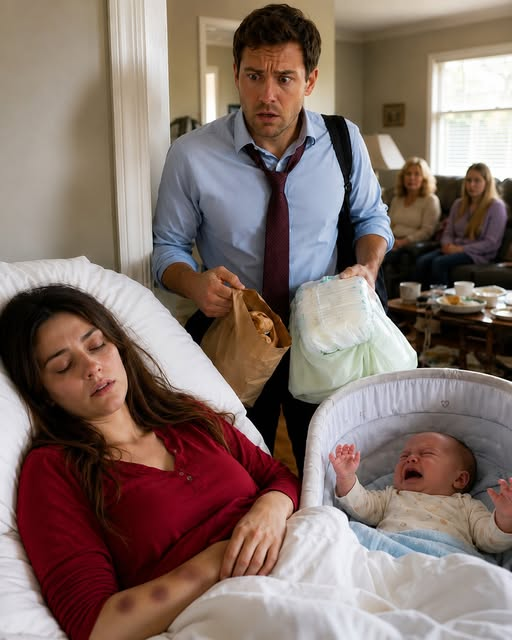
The front door open.
My mother and Ashley asleep while my wife lay unconscious and my newborn screamed.
Detective Jensen wrote without interrupting.
Then she asked the question I feared most.
“Who had access to your wife and baby while you were gone?”
I swallowed.
“My mother. Linda Parker. And my sister, Ashley.”
The officer beside her exchanged a glance with the detective.
“Were there previous problems between them and your wife?”
I almost said no.
Not because it was true, but because denial still had its claws in me.
Then I thought of Sarah standing near the nursery before I left.
The look in her eyes.
Fear.
A silent plea.
“Yes,” I said. “There were problems.”
Detective Jensen closed her notebook halfway.
“What kind?”
I told her about the house. About my mother wanting my savings. About Sarah refusing. About the insults. About Ashley mocking her. About every moment I had dismissed as family tension because facing the truth would have meant admitting my mother was not the person I wanted her to be.
When I finished, Detective Jensen’s face was unreadable.
“Mr. Parker,” she said, “we will need to speak with your mother and sister.”
Before I could answer, shouting erupted from the hallway.
“I am his mother! You cannot keep me out!”
My blood turned cold.
Linda Parker swept into view wearing the same cardigan she had been wrapped in when I found her on the couch. Ashley followed behind, arms crossed, face twisted with annoyance.
My mother saw the police.
For the first time in my life, her confidence faltered.
Then she looked at me.
“Ethan,” she said sharply, “what have you done?”
Something inside me broke.
“What have I done?”
She stepped closer, lowering her voice.
“You are embarrassing this family.”
Behind her, Ashley scoffed.
“Sarah probably scratched herself for attention.”
The room went silent.
Detective Jensen turned slowly.
“Excuse me?”
Ashley’s face changed as if she realized too late that she was no longer speaking inside our family’s private bubble, where cruelty had always gone unchallenged.
My mother grabbed Ashley’s arm.
“She didn’t mean that.”
But I heard it.
Everyone heard it.
And from the hospital bed, Sarah stirred.
Her eyes opened just enough to find me.
Tears slipped down her temples.
“Ethan,” she whispered.
I rushed to her side.
She tried to lift her hand, but winced.
Her voice came out broken.
“Don’t let them take Oliver.”
I looked back at my mother.
And Linda Parker’s face went pale.
PART 3 — WHAT SARAH REMEMBERED
The police cleared the room.
My mother protested. Ashley cried about being “treated like a criminal.” But Detective Jensen was not moved by tears that appeared only when consequences arrived.
I stayed beside Sarah.
She drifted in and out of consciousness for another hour. Doctors said she was severely dehydrated, sleep-deprived, physically exhausted, and showing signs of postpartum complications worsened by neglect.
Neglect.
Such a small word for what I had seen.
When she was finally strong enough to speak, Detective Jensen returned with a recorder. She asked Sarah if she felt able to give a statement.
Sarah looked at me.
I had never seen her so fragile.
But beneath the exhaustion, there was something else.
A woman who had survived long enough to tell the truth.
She nodded.
Detective Jensen spoke gently. “Tell us what happened after Ethan left.”
Sarah closed her eyes.
“At first, Linda acted helpful,” she whispered. “She made tea. Held Oliver. Told me to sleep.”
Her fingers tightened around mine.
“Then she started saying I was feeding him wrong. Holding him wrong. Changing him wrong. She said I was making him weak.”
My throat burned.
“Ashley laughed every time Oliver cried,” Sarah continued. “She said babies could smell failure.”
I looked away, ashamed that such words had ever been spoken under my roof.
Sarah swallowed painfully.
“The second day, I wanted to call Ethan. Linda took my phone. She said he was working and I needed to stop manipulating him.”
Detective Jensen asked, “Did she physically take it from you?”
“Yes.”
“And the bruises?”
Sarah’s breathing changed.
I leaned closer.
“You don’t have to—”
“No,” she said, opening her eyes. “I do.”
Her gaze fixed on the ceiling.
“Oliver was crying. He had been crying for a long time. Linda said I was spoiling him by feeding him whenever he wanted. I told her newborns need to eat often. She said I thought I knew everything.”
Tears slid down her face.
“I tried to get up. She grabbed my wrists.”
My hand shook around hers.
“Ashley helped her,” Sarah whispered.
The words entered me like ice.
“They pushed me back onto the bed. Linda said if I was going to act hysterical, I could stay there until I learned respect.”
Detective Jensen’s expression hardened.
“Did they restrain you with an object?”
Sarah nodded faintly.
“My robe belt. They tied my wrists to the headboard.”
I stood so fast my chair hit the wall.
The nurse outside looked in.
I could barely breathe.
My mother.
My sister.
They had tied my wife to a bed after childbirth.
Detective Jensen raised a hand gently toward me.
“Mr. Parker, I need you to stay calm.”
Calm?
There are moments in a man’s life when language becomes useless. When rage is too large for words. When guilt wraps itself around your throat because the person you promised to protect was hurt by the people you trusted.
Sarah kept speaking.
“I begged them to let me feed Oliver. Linda said he had already eaten enough. But I could hear him crying. I begged. She told me good mothers don’t panic.”
Her voice cracked.
“Eventually Ashley untied me, but I was dizzy. I tried to stand and fell. After that, they mostly ignored us.”
“Did they feed the baby?” Detective Jensen asked.
Sarah’s mouth trembled.
“Not enough. Not when he needed it. They said he needed a schedule.”
Oliver was five days old.
Five days.
He did not need a schedule.
He needed milk, warmth, love, and sane adults.
Sarah turned her head toward me.
“I tried to call you when they went downstairs. I found my phone in the laundry basket. But Linda came in.”
I remembered the call.
Ethan… please come home.
Then my mother’s voice.
Then silence.
Sarah squeezed my hand weakly.
“I thought you wouldn’t believe me.”
Those words destroyed me more than anything else.
Because some part of her had reason to think that.
How many times had I said, “That’s just Mom”?
How many times had I asked Sarah to be patient?
How many times had I confused peace with silence?
I bent over her hand and cried.
“I believe you,” I said. “I believe you. I’m so sorry.”
Sarah closed her eyes.
But she did not let go.
PART 4 — THE SEARCH AT HOME
The police searched our house that evening.
I could not go with them. I stayed at the hospital, moving between Sarah’s room and the neonatal observation unit where Oliver slept beneath a tiny blanket, his little chest rising and falling like a miracle I had nearly lost.
Detective Jensen called me after midnight.
Her voice was calm, but heavy.
“Mr. Parker, we found items consistent with your wife’s statement.”
I gripped the phone.
“What items?”
“A robe belt under the bed. Fibers on the headboard. Your wife’s phone hidden in a laundry basket. We also found several baby bottles in the sink with spoiled formula and timestamps from your smart kitchen monitor showing long gaps between feedings.”
I closed my eyes.
There it was.
Proof.
Cold, undeniable proof.
“There’s more,” she said.
My stomach sank.
“What?”
“We recovered footage from the nursery camera.”
I had forgotten about that camera.
Sarah and I had installed it two weeks before Oliver was born. My mother had complained that cameras made a house feel paranoid.
Now I knew why.
Detective Jensen said, “Some files were deleted, but our technician recovered portions from cloud storage.”
I could barely speak.
“What did they show?”
A pause.
Then, “Enough.”
The next morning, Linda and Ashley were brought in for questioning.
I did not see the interviews, but Detective Jensen later summarized them.
My mother denied everything at first.
She said Sarah was unstable.
She said postpartum hormones made women irrational.
She said she had only tried to help.
Ashley claimed she had slept through most of it.
Then detectives told them about the recovered footage.
That was when their stories changed.
My mother admitted she had “briefly restrained” Sarah, but insisted it was for her own safety.
Ashley said she only helped because Sarah was “acting crazy.”
Neither of them seemed to understand that their excuses sounded more monstrous than silence.
By afternoon, both were arrested.
Charges would take time, the detective warned. The legal process would be slow. Messy. Painful.
But they were not going home.
For the first time since I had found Sarah on that bed, I felt air enter my lungs.
Then my father called.
I had not spoken to him much since my parents divorced years earlier. My mother had spent my childhood painting him as selfish, weak, and unreliable. I believed most of it because children believe the parent who keeps talking.
His voice was rough when I answered.
“Ethan,” he said. “I heard about Linda.”
I almost hung up.
Instead, I said, “Did you know she was capable of this?”
Silence.
Then he exhaled.
“I knew she was cruel.”
My hand tightened around the phone.
“And you never told me?”
“I tried. When you were younger. She made sure you thought I was attacking her.”
He sounded older than I remembered.
“Your mother doesn’t just want control, Ethan. She punishes anyone who threatens it.”
I leaned against the hospital wall.
Memories shifted inside me.
My mother crying after my father missed a visit.
My mother saying he did not care.
My mother reading his texts first.
My mother telling me, “I’m the only one who ever puts you first.”
“How much of my life was a lie?” I whispered.
My father did not answer quickly.
Then he said, “Enough that I’m sorry I didn’t fight harder.”
That night, sitting beside Sarah while she slept, I understood the truth.
My mother had not suddenly become dangerous.
She had always been dangerous.
I had simply mistaken control for love because it was the only version she had taught me.
PART 5 — THE FAMILY THAT TURNED AGAINST ME
News spread faster than I expected.
Not publicly at first, but through relatives.
My aunt called before breakfast.
“Ethan, your mother is devastated,” she said, as if Linda were the one in a hospital bed.
“My wife and son are recovering from abuse.”
“That is a serious accusation.”
“It is not an accusation anymore.”
She sighed dramatically.
“Your mother made mistakes, but pressing charges? Against family?”
I looked through the glass at Oliver sleeping in his bassinet.
“Sarah and Oliver are my family.”
My aunt went silent.
Then cold.
“Linda warned us Sarah would turn you against us.”
I ended the call.
More messages came.
Cousins said I was overreacting.
An uncle said women exaggerate after childbirth.
Someone wrote that Sarah had “finally gotten what she wanted,” as if nearly dying of dehydration was a strategy.
Each message stripped away another illusion.
By noon, I blocked twelve relatives.
Sarah apologized when I told her.
That broke my heart.
“You have nothing to apologize for,” I said.
She stared at the blanket.
“I kept thinking maybe if I had been nicer to her…”
“No.”
“If I had let her help more…”
“No.”
“If I had just stayed quiet…”
I took her face gently in my hands.
“Sarah, listen to me. This happened because my mother is cruel, my sister helped her, and I left you with people I should never have trusted. Not because of you.”
Her eyes filled.
“I was so scared for Oliver.”
“I know.”
“I could hear him crying.”
“I know.”
“I couldn’t get to him.”
Her body shook.
I climbed carefully onto the bed beside her and held her while she cried. Nurses came and went softly. Oliver slept nearby. The world outside continued as if ours had not split open.
But something had changed between Sarah and me.
Not broken.
Exposed.
There is a difference.
Broken means finished.
Exposed means the wound can finally be cleaned.
Two days later, Detective Jensen returned with the recovered nursery footage.
She did not show Sarah. She asked me first.
I said yes.
I regret it and do not regret it.
The video showed my mother standing over Oliver’s bassinet while he cried. Sarah’s voice came from the bedroom, weak and desperate, begging to feed him.
Linda looked toward the hallway and said, “Let him cry. She needs to learn.”
Ashley appeared in the frame holding a glass of wine.
“She’s pathetic,” my sister said.
Then Oliver’s cries grew sharper.
I had to stop the video.
I ran to the bathroom and vomited.
When I returned, Detective Jensen gave me a moment.
“There is also audio of your wife asking to call you,” she said. “Your mother says, ‘He doesn’t need you falling apart while he’s working.’”
I pressed my palms against my eyes.
Every excuse I had ever made for Linda turned to ash.
“She wanted Sarah helpless,” I said.
Detective Jensen nodded slightly.
“Control often escalates when a baby arrives. The abuser feels their influence slipping.”
The abuser.
Not difficult.
Not dramatic.
Not overbearing.
Abuser.
The word was ugly.
It was also true.
PART 6 — SARAH’S CHOICE
Sarah came home after five days in the hospital.
But not to our house.
I could not ask her to sleep in the room where she had been restrained. I could not ask her to walk past the couch where my mother and sister had slept while she and Oliver suffered.
So we went to a small furnished rental arranged by Sarah’s parents.
Her mother, Diane, met us at the door and burst into tears when she saw Oliver.
Sarah’s father, James, hugged me only once.
Hard.
Then he whispered in my ear, “You get one chance to make this right.”
I nodded.
“I know.”
The days that followed were quiet, but not peaceful.
Sarah jumped at sudden sounds. She flinched when Oliver cried too long, as if her body still feared someone would stop her from reaching him. At night, she woke gasping, checking her wrists in the dark.
I took every feeding I could.
I washed bottles.
I changed diapers.
I tracked her medication.
I sat awake beside them long after they slept, haunted by the knowledge that love without vigilance had not been enough.
One afternoon, Sarah asked me for the truth.
“Did you ever believe them over me?”
The question landed softly.
That made it worse.
I sat across from her at the kitchen table. Oliver slept in a wrap against my chest.
“I never thought they would do this,” I said.
“That isn’t what I asked.”
I looked down.
“Yes,” I admitted. “Not completely. But sometimes. When Mom said you were too sensitive, I wondered if maybe you were. When Ashley said you didn’t like our family, I thought maybe you could try harder.”
Sarah closed her eyes.
I hated myself.
“I’m sorry,” I said. “I was wrong.”
She nodded slowly.
“I need you to understand something, Ethan. I can heal from what they did. But I don’t know if I can heal in a marriage where I have to convince my husband I’m worth protecting.”
My eyes burned.
“You won’t have to.”
“I need more than words.”
“I know.”
Sarah looked at Oliver.
“I want a protective order.”
“Done.”
“I don’t want your mother or Ashley near him. Ever.”
“Done.”
“I want us to sell the house.”
That one hit me.
The nursery.
The blue walls I had painted.
The rocking chair we chose together.
The home I thought would hold our first memories.
But then I remembered Sarah on the bed.
Oliver screaming in the bassinet.
“Done,” I said.
Sarah studied me, almost as if she expected resistance.
I gave her none.
Because for once, I understood that choosing my wife could not be symbolic.
It had to cost me something.
That week, I gave a formal police statement. I handed over call logs, text messages, and every recording from the house. I hired an attorney to help Sarah pursue protective orders. I contacted a real estate agent.
And then I went to our house alone.
The moment I stepped inside, rage and grief rose together.
The dirty dishes were gone now. A cleaning service had come. The nursery looked untouched, falsely innocent beneath soft animal decals and folded blankets.
I stood in the bedroom doorway.
For several minutes, I could not enter.
Then I saw something under the nightstand.
Sarah’s hair tie.
A small black elastic.
Ordinary.
Devastating.
I picked it up and cried like a child.
Not because of the house.
Because I finally understood that the life I had called normal had been built around everyone surviving my mother’s moods.
And Sarah had nearly paid for my blindness with her life.
PART 7 — THE TRIAL OF LINDA PARKER
The court hearings began months later.
By then, Oliver was healthy and round-cheeked, with Sarah’s eyes and my habit of frowning in his sleep. Sarah was stronger too, though trauma still appeared in small ways. She kept her phone charged at all times. She disliked closed doors. She cried the first time Oliver slept through the night because silence still frightened her.
I went to therapy.
At first, I thought therapy would be about my guilt.
Instead, it became about my entire childhood.
My therapist asked me once, “What happened when your mother was upset?”
I laughed bitterly.
“The whole house changed temperature.”
That sentence explained more than I wanted it to.
Linda and Ashley pleaded not guilty.
My mother arrived at court in soft sweaters, clutching tissues, playing wounded grandmother. Ashley wore modest dresses and looked down whenever reporters passed.
Their defense claimed Sarah had postpartum anxiety.
They claimed they had tried to protect Oliver.
They claimed the wrist bruises came from preventing Sarah from “hurting herself.”
Then the prosecutor played the footage.
My mother’s voice filled the courtroom.
“Let him cry. She needs to learn.”
Sarah gripped my hand.
The jury watched in silence.
Ashley lowered her head.
Linda stared straight ahead, expressionless.
The prosecutor showed the robe belt. The recovered messages. The call logs. The hospital report. The feeding gaps. The dehydration diagnosis.
Then Sarah testified.
She walked to the stand wearing a navy dress, her wrists bare.
No bracelets.
No sleeves hiding the past.
Her voice shook at first.
Then steadied.
She told the truth.
She told them how she begged to feed her baby.
How she was mocked.
How she was restrained.
How she thought Oliver might die crying just feet away from her.
Linda cried during the testimony.
But not once did Sarah look at her.
When the defense attorney tried to suggest Sarah had exaggerated, she leaned toward the microphone.
“Sir,” she said, voice calm and sharp, “I was too weak to stand. My newborn was dehydrated. My wrists were bruised. There is video. What part would you like me to exaggerate?”
A few people in the gallery gasped.
The judge warned the room to remain quiet.
But I felt something powerful move through me.
Pride.
Not the loud kind.
The sacred kind.
My wife had been broken open and still found the strength to stand under oath and name what happened.
Then came the surprise.
Ashley requested a deal.
Against my mother.
Linda’s face changed when she heard.
For the first time, the woman who had controlled every room she entered looked genuinely afraid.
Ashley testified that Linda had planned to “teach Sarah a lesson” from the moment I left. She admitted Linda had taken Sarah’s phone. She admitted helping tie Sarah’s wrists.
Then Ashley said something that made the courtroom freeze.
“Mom said if Sarah looked unstable enough, Ethan would let us help raise Oliver.”
I felt Sarah’s hand go cold in mine.
The prosecutor asked, “What did that mean?”
Ashley began to cry.
“She wanted Ethan to move into her house with the baby. She said Sarah wasn’t fit. She said once people saw Sarah falling apart, everyone would understand.”
My mother whispered, “Liar.”
Ashley looked at her.
“No, Mom. I lied for you my whole life. I’m done.”
The jury found Linda guilty on multiple charges.
Ashley received a reduced sentence for testimony but was still convicted.
When Linda was led away, she turned toward me.
Not toward Sarah.
Not toward Oliver.
Me.
Her eyes were full of betrayal.
“How could you do this to your mother?” she hissed.
I looked at her for a long moment.
Then I said the words I should have said years earlier.
“Because I finally became a husband and father before being your son.”
Her face twisted.
But the officers moved her on.
And for the first time in my life, her anger did not own me.
PART 8 — THE END — THE HOME WE BUILT AFTER THE NIGHTMARE
We sold the house in spring.
I thought I would feel grief watching strangers walk through the rooms.
Instead, I felt relief.
The walls knew too much.
The bedroom carried ghosts.
The nursery belonged to a version of our life that had ended the day I opened that door.
We moved into a smaller home closer to Sarah’s parents, with wide windows, a fenced yard, and a kitchen full of morning light. The first thing Sarah did was choose the locks herself.
The second thing she did was paint Oliver’s room green.
Not blue like the old nursery.
Green.
For new beginnings.
For growing things.
For survival.
Months passed.
Oliver learned to roll over. Then sit. Then crawl with fierce determination toward anything dangerous. Sarah laughed more often. Real laughter. Not the careful kind she had used around my family.
I learned to listen differently.
Not just to words.
To pauses.
To tension.
To the quiet changes in her face when a memory passed through her.
Healing did not look like forgetting.
It looked like Sarah feeding Oliver at midnight without flinching when he cried.
It looked like me deleting my mother’s birthday reminder from my phone.
It looked like family holidays with people who brought peace instead of demands.
It looked like Sarah standing in our new kitchen one morning, holding Oliver on her hip, saying, “I feel safe here.”
I had to turn away because I did not want her to see me cry.
A year after the hospital, we held Oliver’s first birthday party in our backyard.
There were balloons tied to the fence. A crooked homemade banner. Too much cake. Sarah’s parents came. My father came too, nervous at first, carrying a wooden toy train he had made himself.
I watched him kneel beside Oliver, his eyes wet.
For so long, I thought family was something you endured because blood demanded it.
That day, I learned family was something else.
Family was who protected your peace when you were too tired to guard it yourself.
After everyone left, Sarah and I sat on the back steps while Oliver slept inside.
The yard smelled of cut grass and frosting.
Sarah leaned her head on my shoulder.
“Do you ever miss them?” she asked.
I knew who she meant.
I thought carefully.
“I miss who I thought they were,” I said. “But I don’t miss who they actually were.”
She nodded.
“That makes sense.”
“I’m sorry it took me so long to see it.”
Sarah took my hand.
“You see it now.”
The sky turned pink over the rooftops.
For a while, neither of us spoke.
Then Sarah said, “I used to think that day destroyed our family.”
My chest tightened.
“And now?”
She looked through the window toward Oliver’s room.
“Now I think it revealed which family was real.”
I kissed her hair.
Inside, our son stirred and made a small sleepy sound through the baby monitor.
Sarah stood immediately.
Then paused.
The old panic did not come.
Only love.
She smiled at me.
“Come on,” she said. “Your son is summoning us.”
Our son.
Healthy.
Safe.
Loved.
We walked inside together.
Oliver was standing in his crib, gripping the rail, cheeks flushed from sleep. When he saw Sarah, he laughed. When he saw me, he bounced so hard I thought he might launch himself into space.
Sarah lifted him first.
Always first, when she wanted to.
She kissed his soft hair and whispered, “Mama’s here.”
I placed one hand on Oliver’s back and one around Sarah’s shoulders.
For a moment, I saw that terrible bedroom again.
The heat.
The crying.
The bruises.
The woman I loved barely conscious.
Then the image faded.
Not gone.
Never gone.
But no longer stronger than what stood before me.
Sarah alive.
Oliver safe.
Me awake at last.
Years from now, I know Oliver will ask why he does not know my mother or my sister. I will tell him the truth carefully, in words a child can carry.
I will tell him that love is never control.
That family never means accepting cruelty.
That protecting someone sometimes means closing a door forever.
And I will tell him his mother was brave.
Not because she never broke.
But because after being hurt in the place she should have been safest, she still found her way back to joy.
That night, Sarah rocked Oliver while I stood in the doorway watching them.
She looked up at me and smiled.
A real smile.
Soft.
Tired.
Beautiful.
The kind of smile I had once taken for granted and now understood as a miracle.
The house was quiet.
No shouting.
No judgment.
No footsteps from someone coming to take over.
Only the gentle creak of the rocking chair, Oliver’s sleepy breathing, and the steady heartbeat of the life we had rebuilt from ashes.
I came home that day expecting to hold my newborn son.
Instead, I found the truth.
It cost me the family I was born into.
But it saved the family I chose.
And in the end, that was not a loss.
It was the first honest home I had ever known.
THE END
